9709 P41 - Jun 2012 - Q3
3560
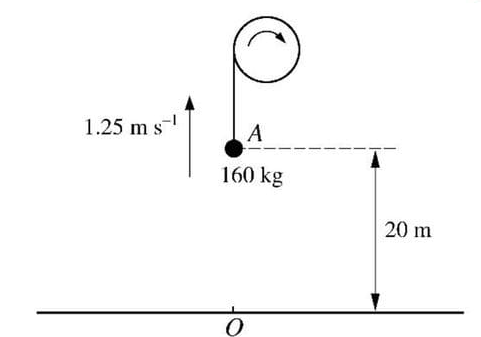
A load of mass 160 kg is pulled vertically upwards, from rest at a fixed point O on the ground, using a winding drum. The load passes through a point A, 20 m above O, with a speed of 1.25 m s-1 (see diagram). Find, for the motion from O to A,
- the gain in the potential energy of the load,
- the gain in the kinetic energy of the load.
The power output of the winding drum is constant while the load is in motion.
- Given that the work done against the resistance to motion from O to A is 20 kJ and that the time taken for the load to travel from O to A is 41.7 s, find the power output of the winding drum.
Solutions locked. Please sign in with access to view them.