Past Exam Questions
← Back9709 P12 - Nov 2015 - Q3
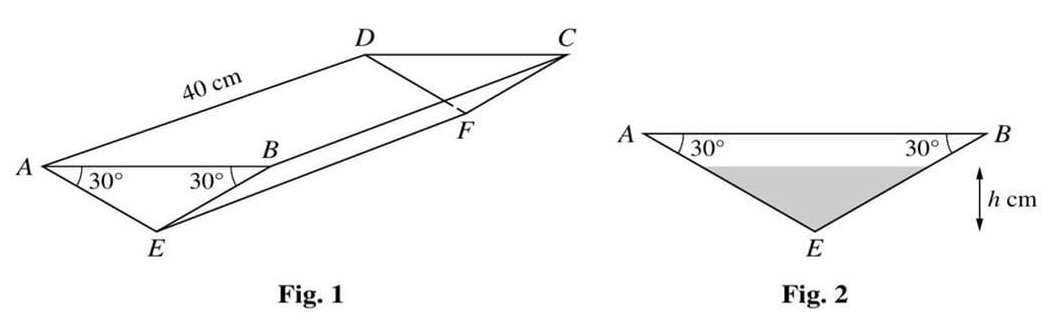
Fig. 1 shows an open tank in the shape of a triangular prism. The vertical ends ABE and DCF are identical isosceles triangles. Angle \(ABE =\) angle \(BAE = 30^\circ\). The length of \(AD\) is 40 cm. The tank is fixed in position with the open top \(ABCD\) horizontal. Water is poured into the tank at a constant rate of 200 cm\(^3\) s\(^{-1}\). The depth of water, \(t\) seconds after filling starts, is \(h\) cm (see Fig. 2).
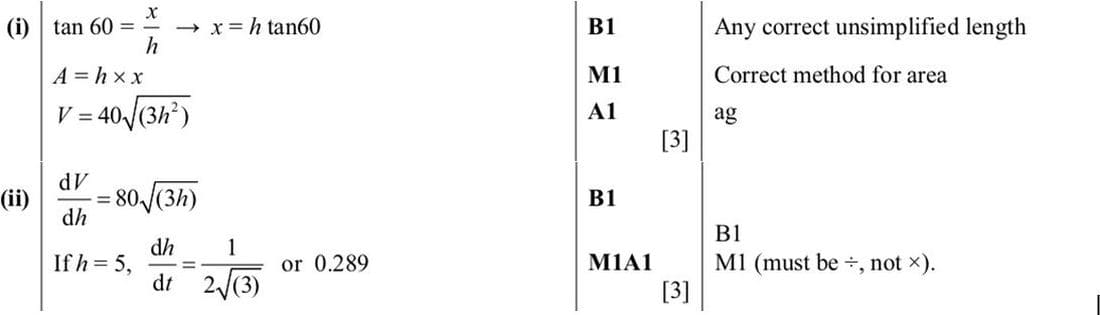
(i) Show that, when the depth of water in the tank is \(h\) cm, the volume, \(V\) cm\(^3\), of water in the tank is given by \(V = (40\sqrt{3})h^2\).
(ii) Find the rate at which \(h\) is increasing when \(h = 5\).
9709 P11 - Jun 2015 - Q2
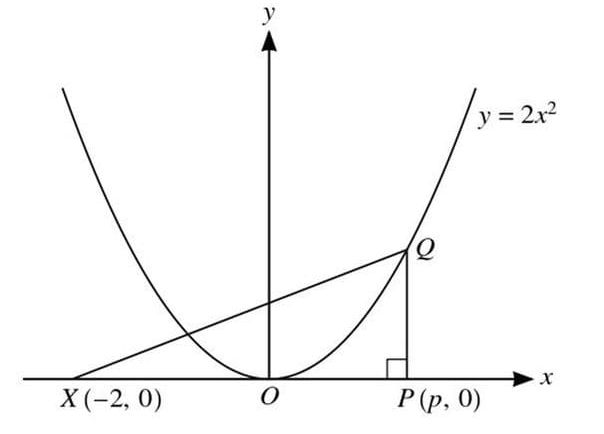
The diagram shows the curve \(y = 2x^2\) and the points \(X(-2, 0)\) and \(P(p, 0)\). The point \(Q\) lies on the curve and \(PQ\) is parallel to the \(y\)-axis.
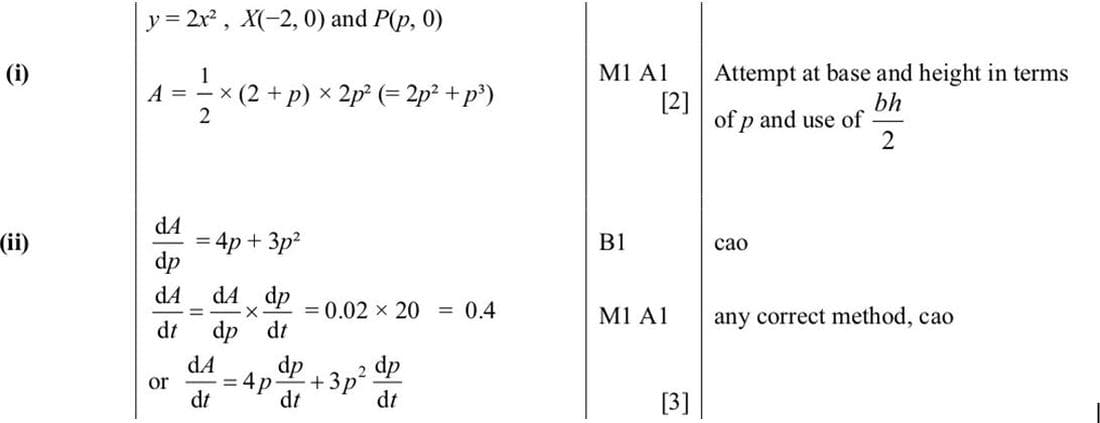
(i) Express the area, \(A\), of triangle \(XPQ\) in terms of \(p\).
(ii) The point \(P\) moves along the \(x\)-axis at a constant rate of 0.02 units per second and \(Q\) moves along the curve so that \(PQ\) remains parallel to the \(y\)-axis. Find the rate at which \(A\) is increasing when \(p = 2\).
9709 P13 - Nov 2014 - Q10
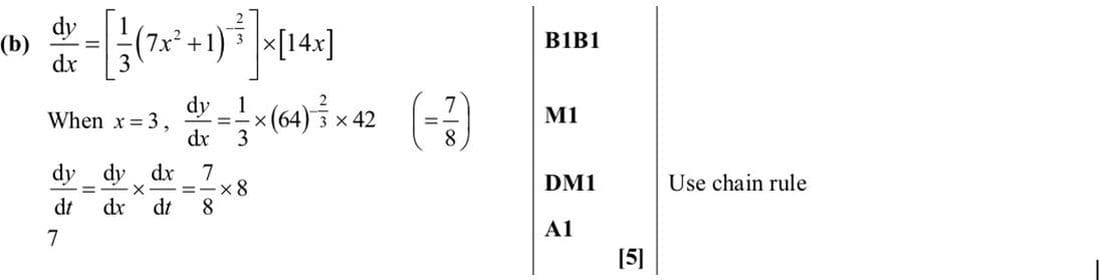
A point P travels along the curve \(y = (7x^2 + 1)^{\frac{1}{3}}\) in such a way that the x-coordinate of P at time t minutes is increasing at a constant rate of 8 units per minute. Find the rate of increase of the y-coordinate of P at the instant when P is at the point (3, 4).
9709 P12 - Nov 2014 - Q4
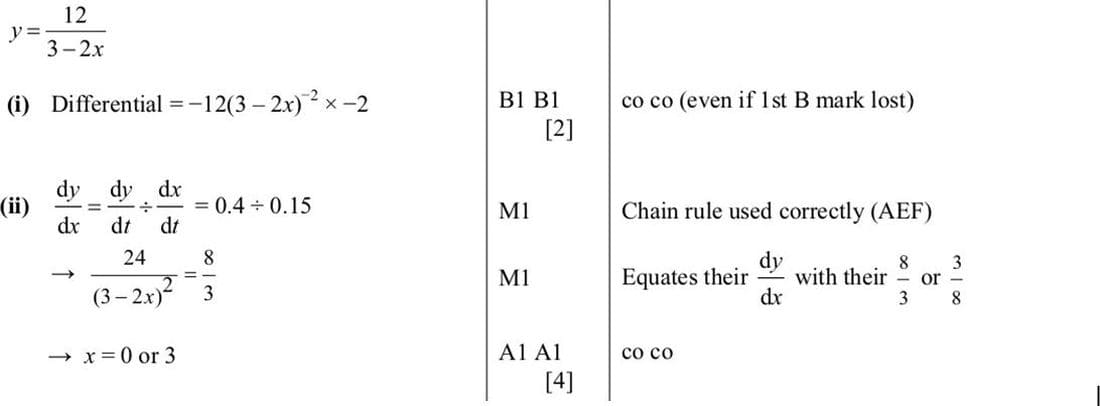
A curve has equation \(y = \frac{12}{3 - 2x}\).
(i) Find \(\frac{dy}{dx}\).
A point moves along this curve. As the point passes through \(A\), the x-coordinate is increasing at a rate of 0.15 units per second and the y-coordinate is increasing at a rate of 0.4 units per second.
(ii) Find the possible x-coordinates of \(A\).
9709 P12 - Nov 2013 - Q9
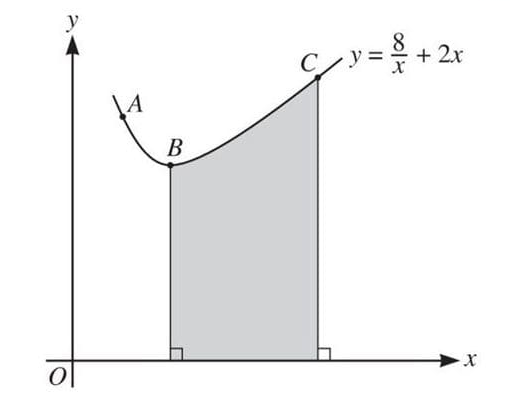
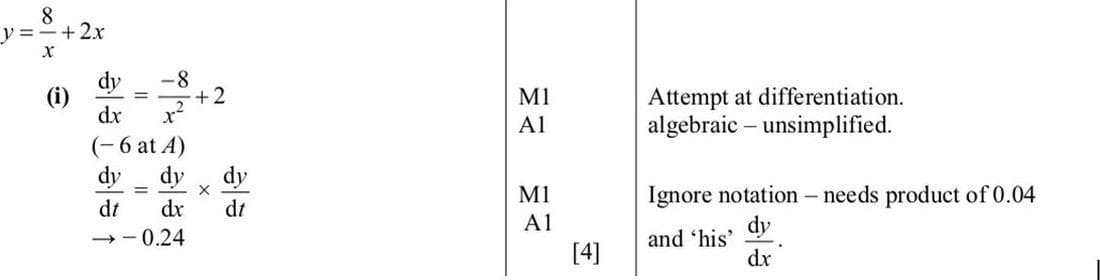
The diagram shows part of the curve \(y = \frac{8}{x} + 2x\) and three points \(A, B,\) and \(C\) on the curve with \(x\)-coordinates 1, 2, and 5 respectively.
A point \(P\) moves along the curve in such a way that its \(x\)-coordinate increases at a constant rate of 0.04 units per second. Find the rate at which the \(y\)-coordinate of \(P\) is changing as \(P\) passes through \(A\).
9709 P11 - Jun 2023 - Q9
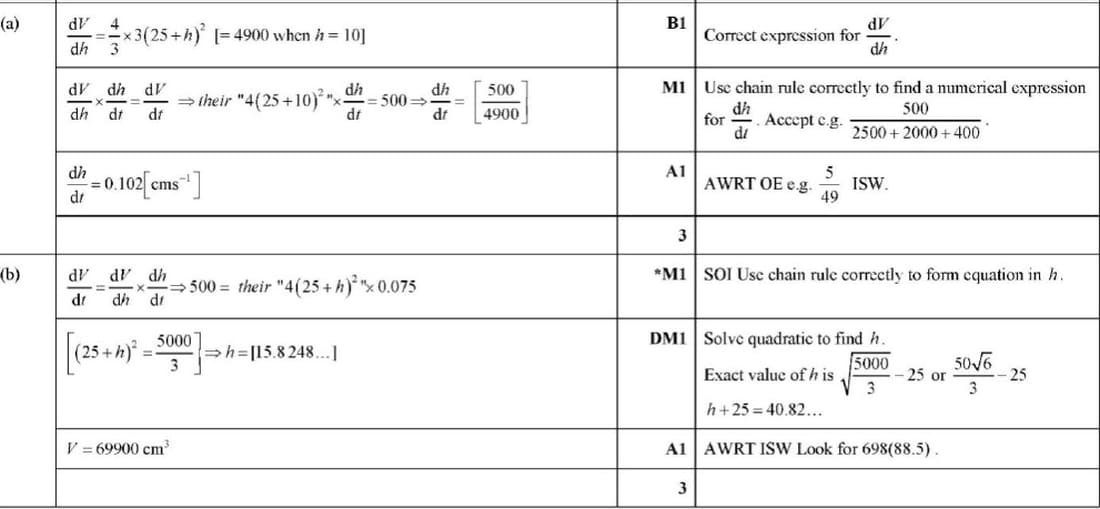
Water is poured into a tank at a constant rate of 500 cm3 per second. The depth of water in the tank, t seconds after filling starts, is h cm. When the depth of water in the tank is h cm, the volume, V cm3, of water in the tank is given by the formula \(V = \frac{4}{3}(25 + h)^3 - \frac{62500}{3}\).
\((a) Find the rate at which h is increasing at the instant when h = 10 cm.\)
(b) At another instant, the rate at which h is increasing is 0.075 cm per second. Find the value of V at this instant.
9709 P11 - Nov 2012 - Q3
An oil pipeline under the sea is leaking oil and a circular patch of oil has formed on the surface of the sea. At midday the radius of the patch of oil is 50 m and is increasing at a rate of 3 metres per hour. Find the rate at which the area of the oil is increasing at midday.

9709 P12 - Jun 2012 - Q2
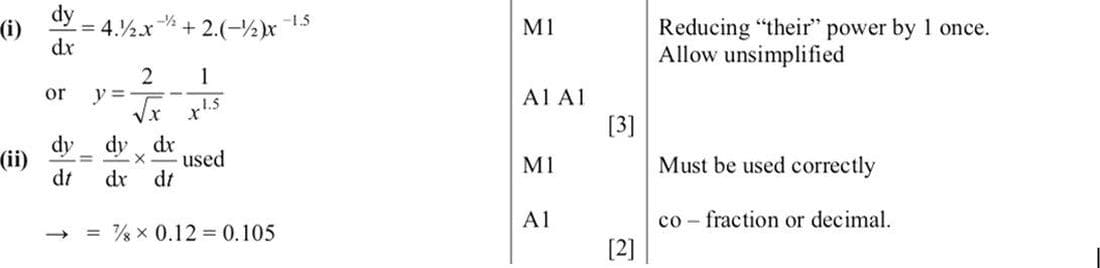
The equation of a curve is \(y = 4\sqrt{x} + \frac{2}{\sqrt{x}}\).
(i) Obtain an expression for \(\frac{dy}{dx}\).
(ii) A point is moving along the curve in such a way that the \(x\)-coordinate is increasing at a constant rate of 0.12 units per second. Find the rate of change of the \(y\)-coordinate when \(x = 4\).
9709 P11 - Jun 2012 - Q4
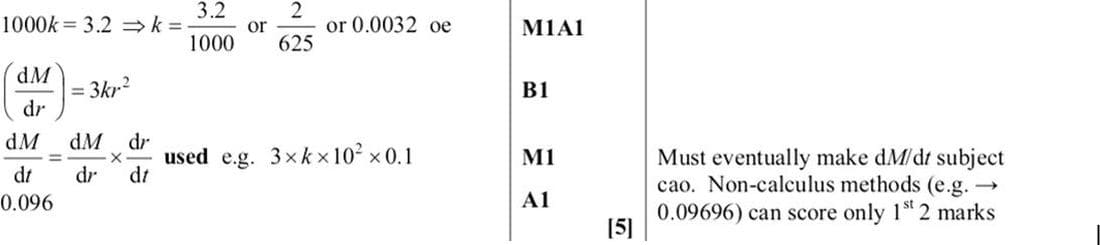
A watermelon is assumed to be spherical in shape while it is growing. Its mass, \(M\) kg, and radius, \(r\) cm, are related by the formula \(M = kr^3\), where \(k\) is a constant. It is also assumed that the radius is increasing at a constant rate of 0.1 centimetres per day. On a particular day the radius is 10 cm and the mass is 3.2 kg. Find the value of \(k\) and the rate at which the mass is increasing on this day.
9709 P11 - Jun 2011 - Q2
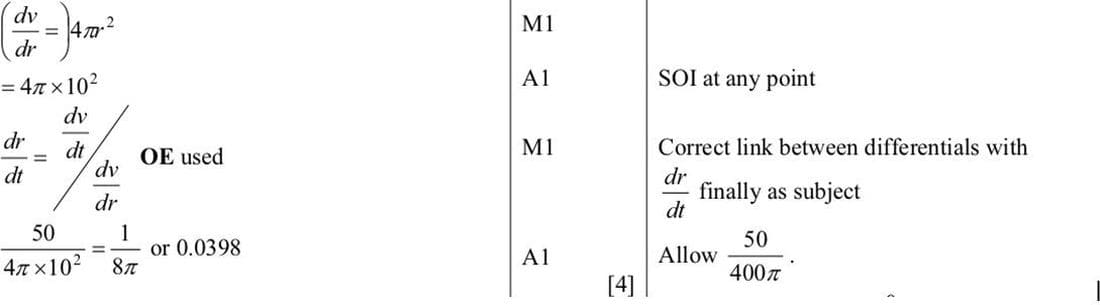
The volume of a spherical balloon is increasing at a constant rate of 50 cm3 per second. Find the rate of increase of the radius when the radius is 10 cm. [Volume of a sphere = \(\frac{4}{3}\pi r^3\).]
9709 P12 - Nov 2010 - Q3
The length, x metres, of a Green Anaconda snake which is t years old is given approximately by the formula
\(x = 0.7 \sqrt{(2t - 1)}\),
where \(1 \leq t \leq 10\). Using this formula, find
(i) \(\frac{dx}{dt}\),
(ii) the rate of growth of a Green Anaconda snake which is 5 years old.

9709 P11 - Nov 2009 - Q7
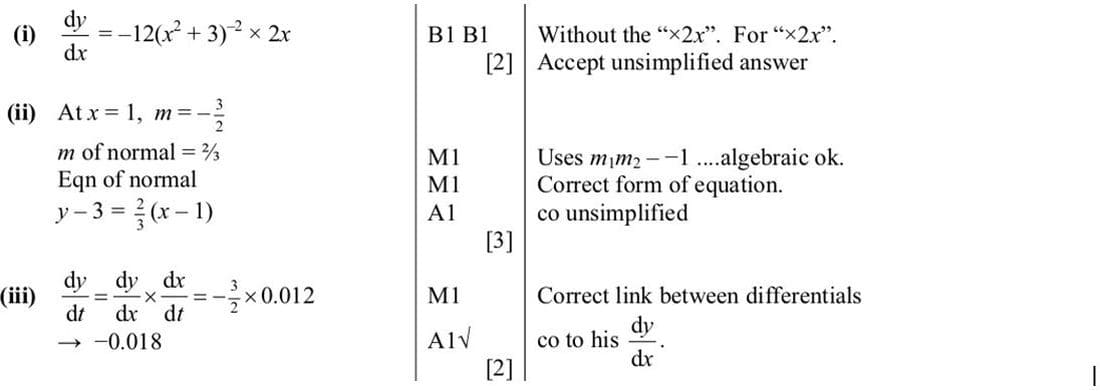
The equation of a curve is \(y = \frac{12}{x^2 + 3}\).
(i) Obtain an expression for \(\frac{dy}{dx}\).
(ii) Find the equation of the normal to the curve at the point \(P(1, 3)\).
(iii) A point is moving along the curve in such a way that the \(x\)-coordinate is increasing at a constant rate of 0.012 units per second. Find the rate of change of the \(y\)-coordinate as the point passes through \(P\).
9709 P1 - Nov 2006 - Q8
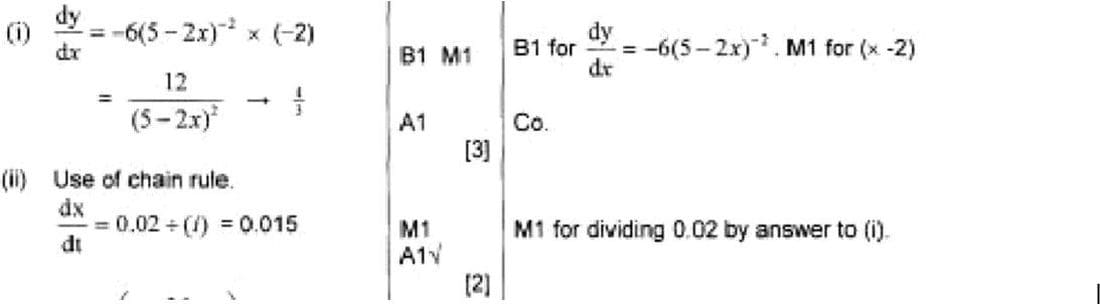
The equation of a curve is \(y = \frac{6}{5 - 2x}\).
(i) Calculate the gradient of the curve at the point where \(x = 1\).
(ii) A point with coordinates \((x, y)\) moves along the curve in such a way that the rate of increase of \(y\) has a constant value of 0.02 units per second. Find the rate of increase of \(x\) when \(x = 1\).
9709 P1 - Jun 2003 - Q10
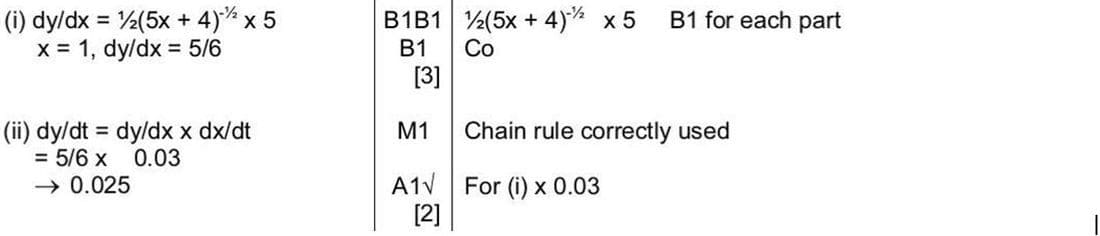
The equation of a curve is \(y = \sqrt{5x + 4}\).
(i) Calculate the gradient of the curve at the point where \(x = 1\).
(ii) A point with coordinates \((x, y)\) moves along the curve in such a way that the rate of increase of \(x\) has the constant value 0.03 units per second. Find the rate of increase of \(y\) at the instant when \(x = 1\).
9709 P12 - Mar 2023 - Q3 - 4 marks
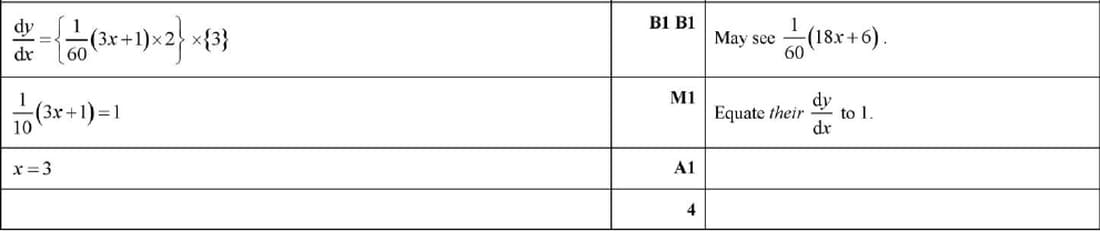
A curve has equation \(y = \frac{1}{60}(3x + 1)^2\) and a point is moving along the curve.
Find the \(x\)-coordinate of the point on the curve at which the \(x\)- and \(y\)-coordinates are increasing at the same rate.
9709 P13 - Nov 2022 - Q4
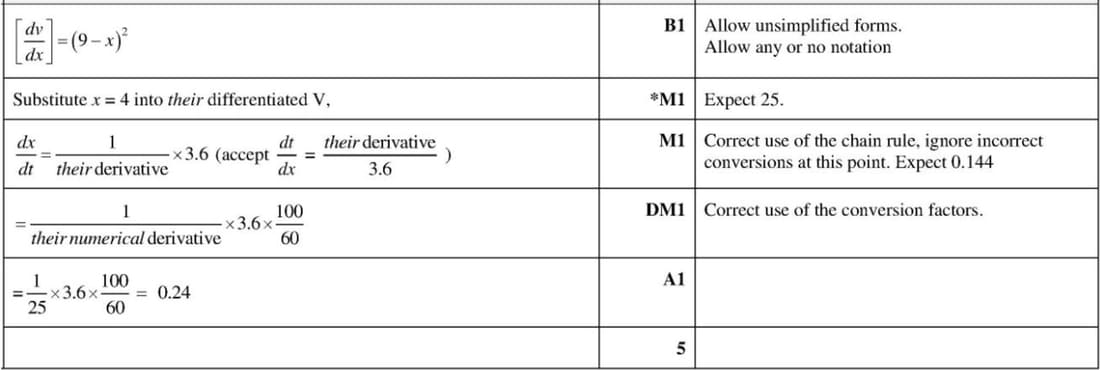
A large industrial water tank is such that, when the depth of the water in the tank is x metres, the volume V m3 of water in the tank is given by \(V = 243 - \frac{1}{3}(9-x)^3\). Water is being pumped into the tank at a constant rate of 3.6 m3 per hour.
Find the rate of increase of the depth of the water when the depth is 4 m, giving your answer in cm per minute.
9709 P12 - Nov 2022 - Q11
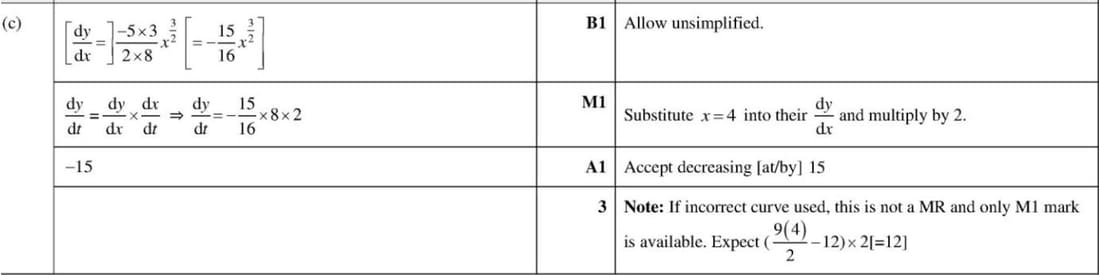
A point P is moving along the curve \(y = 18 - \frac{3}{8}x^{\frac{5}{2}}\) in such a way that the x-coordinate of P is increasing at a constant rate of 2 units per second.
Find the rate at which the y-coordinate of P is changing when \(x = 4\).
9709 P13 - Jun 2022 - Q10
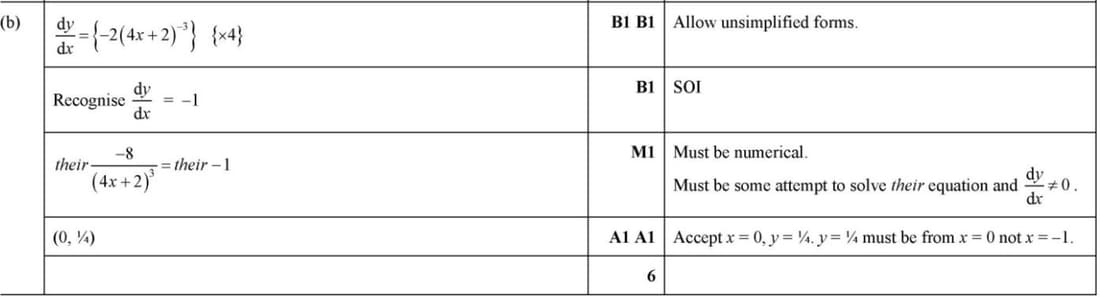
The function f is defined by \(f(x) = (4x + 2)^{-2}\) for \(x > -\frac{1}{2}\).
A point is moving along the curve \(y = f(x)\) in such a way that, as it passes through the point A, its y-coordinate is decreasing at the rate of k units per second and its x-coordinate is increasing at the rate of k units per second.
Find the coordinates of A.
9709 P12 - Nov 2021 - Q9
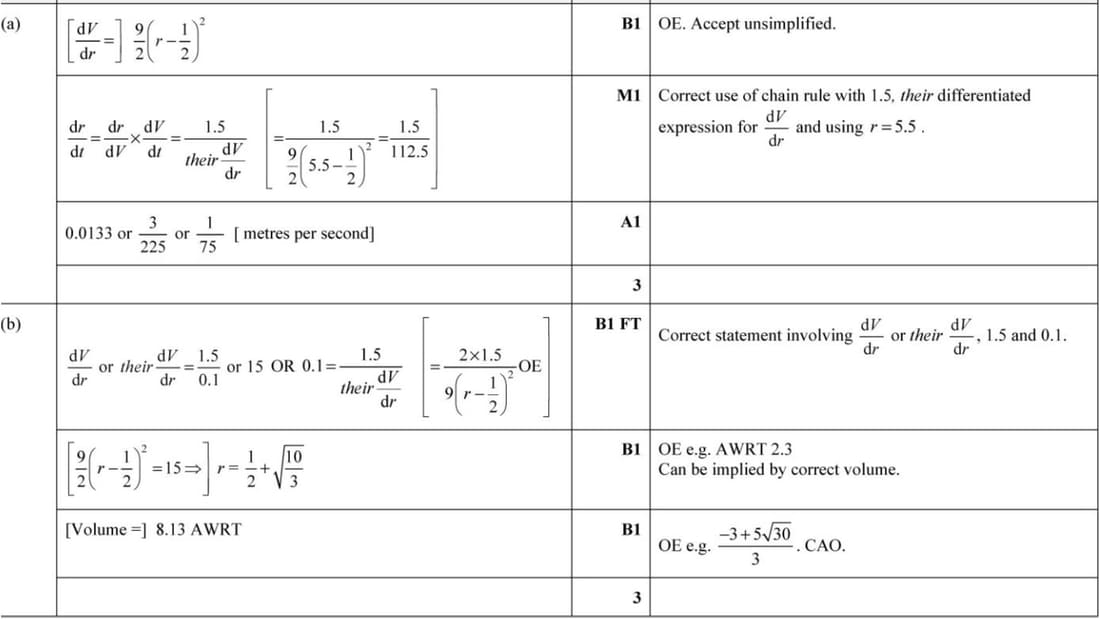
The volume \(V \text{ m}^3\) of a large circular mound of iron ore of radius \(r \text{ m}\) is modelled by the equation \(V = \frac{3}{2} \left( r - \frac{1}{2} \right)^3 - 1\) for \(r \geq 2\). Iron ore is added to the mound at a constant rate of \(1.5 \text{ m}^3\) per second.
(a) Find the rate at which the radius of the mound is increasing at the instant when the radius is \(5.5 \text{ m}\).
(b) Find the volume of the mound at the instant when the radius is increasing at \(0.1 \text{ m}\) per second.
Question #1135
A curve is such that \(\frac{dy}{dx} = \frac{6}{(3x-2)^3}\) and \(A(1, -3)\) lies on the curve. A point is moving along the curve and at \(A\) the \(y\)-coordinate of the point is increasing at 3 units per second.
Find the rate of increase at \(A\) of the \(x\)-coordinate of the point.
