Past Exam Questions
← Back9709 P12 - Nov 2019 - Q5
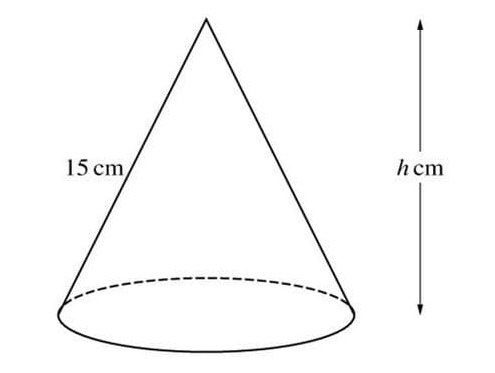
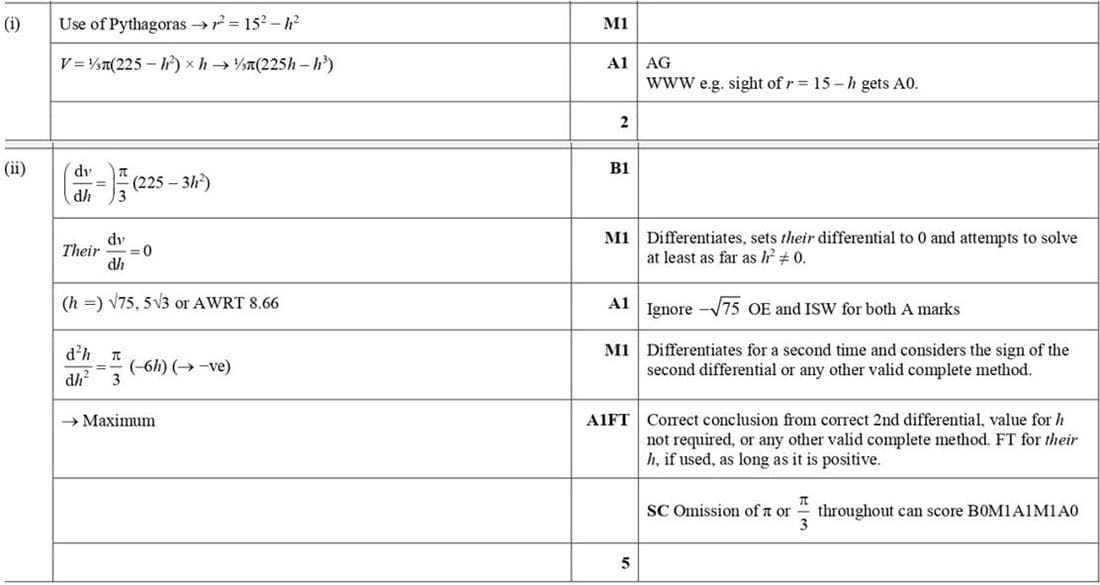
The diagram shows a solid cone which has a slant height of 15 cm and a vertical height of h cm.
(i) Show that the volume, V cm3, of the cone is given by \(V = \frac{1}{3}\pi(225h - h^3)\).
[The volume of a cone of radius r and vertical height h is \(\frac{1}{3}\pi r^2 h\).]
(ii) Given that h can vary, find the value of h for which V has a stationary value. Determine, showing all necessary working, the nature of this stationary value.
9709 P12 - Jun 2013 - Q8
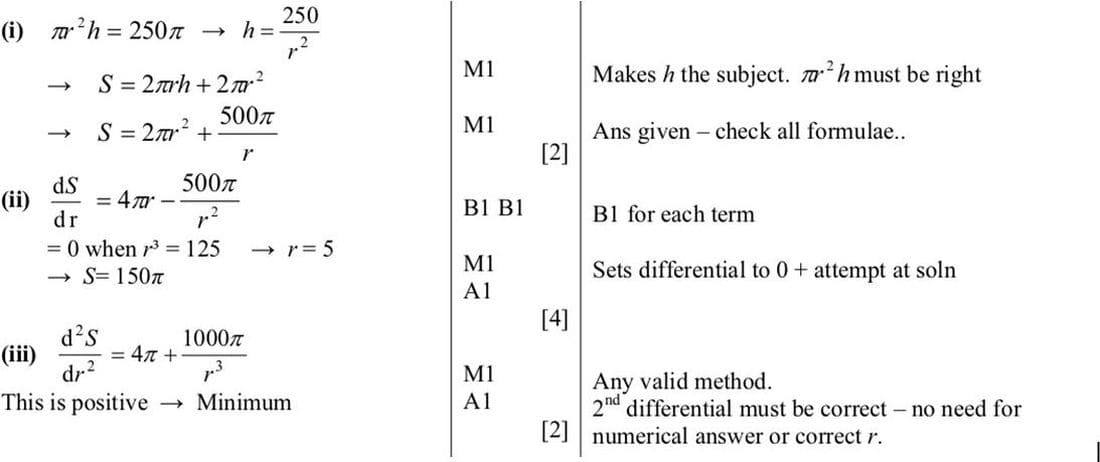
The volume of a solid circular cylinder of radius r cm is 250\(\pi\) cm3.
- Show that the total surface area, S cm2, of the cylinder is given by \(S = 2\pi r^2 + \frac{500\pi}{r}\).
- Given that r can vary, find the stationary value of S.
- Determine the nature of this stationary value.
9709 P12 - Nov 2012 - Q3
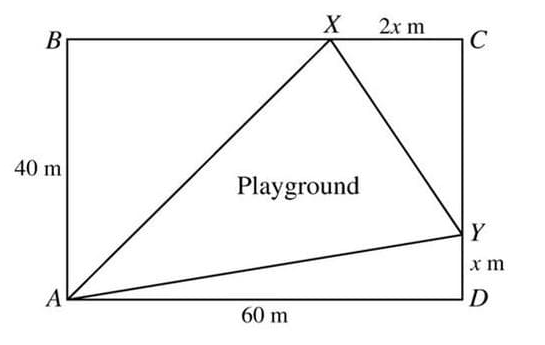
The diagram shows a plan for a rectangular park ABCD, in which AB = 40 m and AD = 60 m. Points X and Y lie on BC and CD respectively and AX, XY and YA are paths that surround a triangular playground. The length of DY is x m and the length of XC is 2x m.
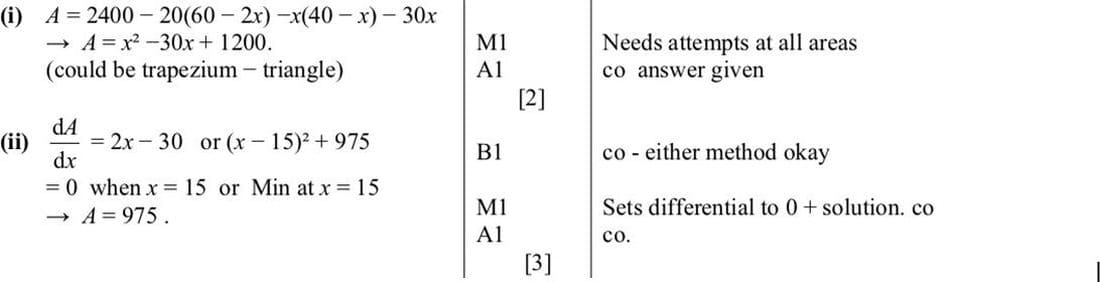
- Show that the area, A m², of the playground is given by A = x² - 30x + 1200.
- Given that x can vary, find the minimum area of the playground.
9709 P11 - Nov 2011 - Q7
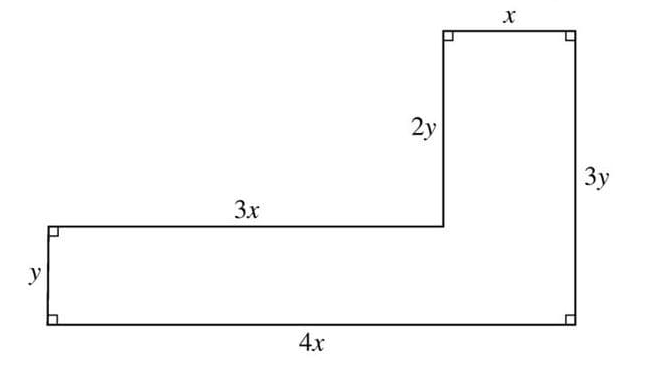
The diagram shows the dimensions in metres of an L-shaped garden. The perimeter of the garden is 48 m.
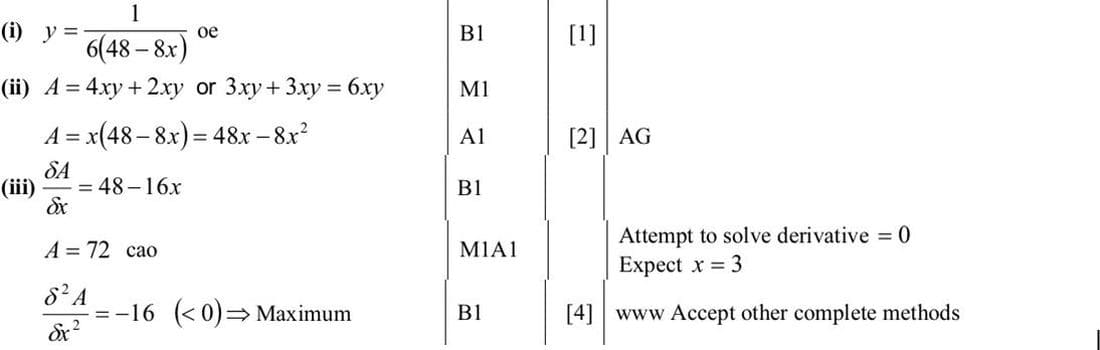
- Find an expression for y in terms of x.
- Given that the area of the garden is A m2, show that A = 48x - 8x2.
- Given that x can vary, find the maximum area of the garden, showing that this is a maximum value rather than a minimum value.
9709 P12 - Nov 2010 - Q10
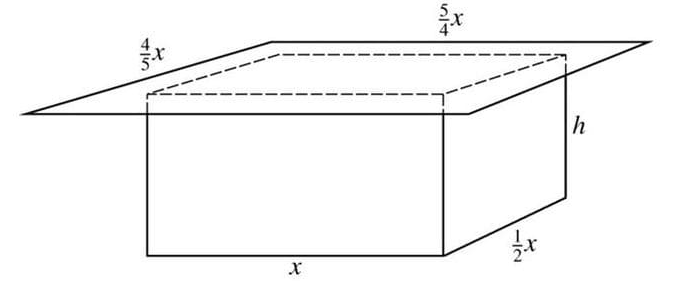
The diagram shows an open rectangular tank of height \(h\) metres covered with a lid. The base of the tank has sides of length \(x\) metres and \(\frac{1}{2}x\) metres and the lid is a rectangle with sides of length \(\frac{5}{4}x\) metres and \(\frac{4}{5}x\) metres. When full the tank holds \(4 \text{ m}^3\) of water. The material from which the tank is made is of negligible thickness. The external surface area of the tank together with the area of the top of the lid is \(A \text{ m}^2\).
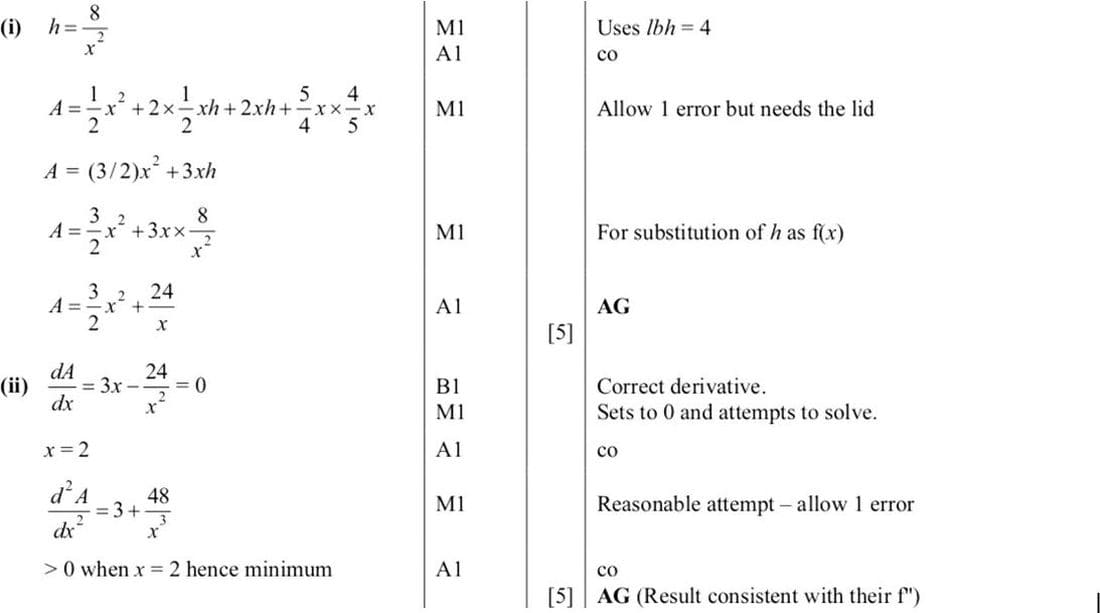
- Express \(h\) in terms of \(x\) and hence show that \(A = \frac{3}{2}x^2 + \frac{24}{x}\).
- Given that \(x\) can vary, find the value of \(x\) for which \(A\) is a minimum, showing clearly that \(A\) is a minimum and not a maximum.
9709 P11 - Nov 2010 - Q8
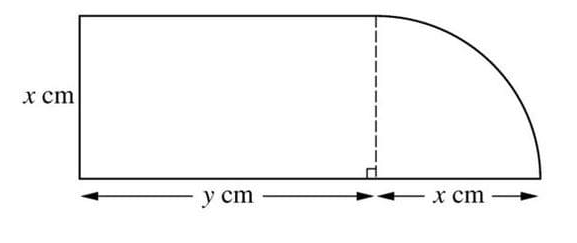
The diagram shows a metal plate consisting of a rectangle with sides x cm and y cm and a quarter-circle of radius x cm. The perimeter of the plate is 60 cm.
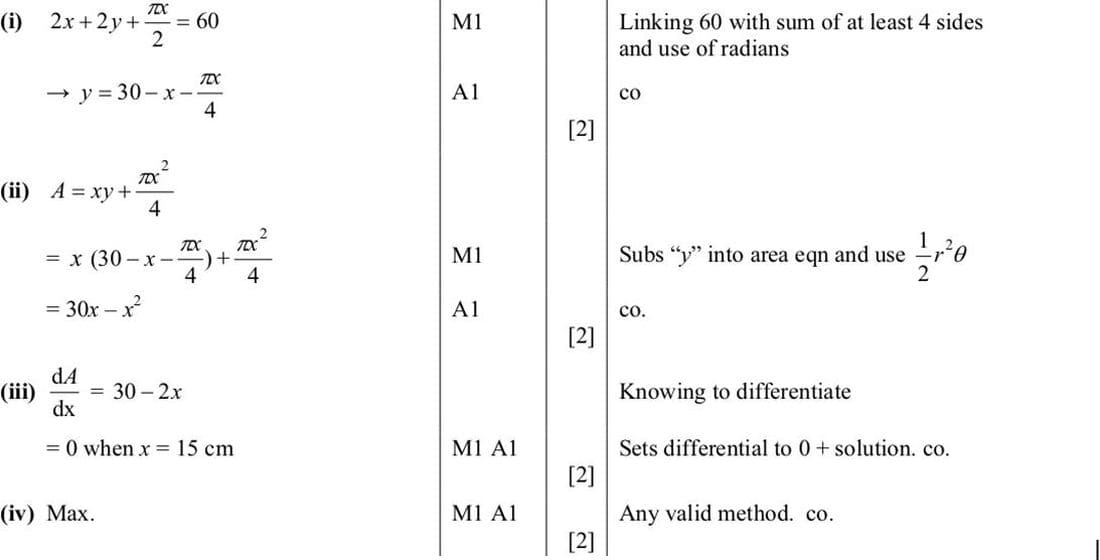
- Express y in terms of x.
- Show that the area of the plate, A cm2, is given by A = 30x - x2.
Given that x can vary,
- find the value of x at which A is stationary,
- find this stationary value of A, and determine whether it is a maximum or a minimum value.
9709 P12 - Jun 2010 - Q8
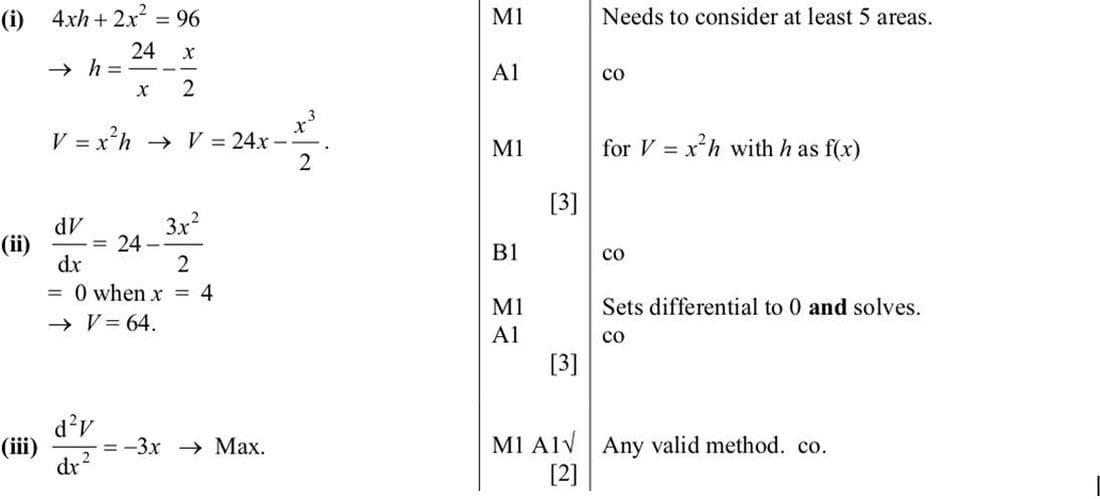
A solid rectangular block has a square base of side \(x\) cm. The height of the block is \(h\) cm and the total surface area of the block is 96 cm2.
(i) Express \(h\) in terms of \(x\) and show that the volume, \(V\) cm3, of the block is given by \(V = 24x - \frac{1}{2}x^3\).
Given that \(x\) can vary,
(ii) find the stationary value of \(V\),
(iii) determine whether this stationary value is a maximum or a minimum.
9709 P12 - Nov 2009 - Q7
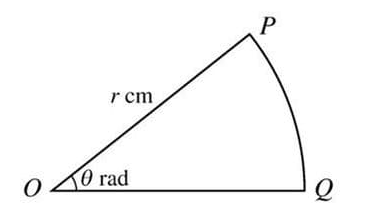
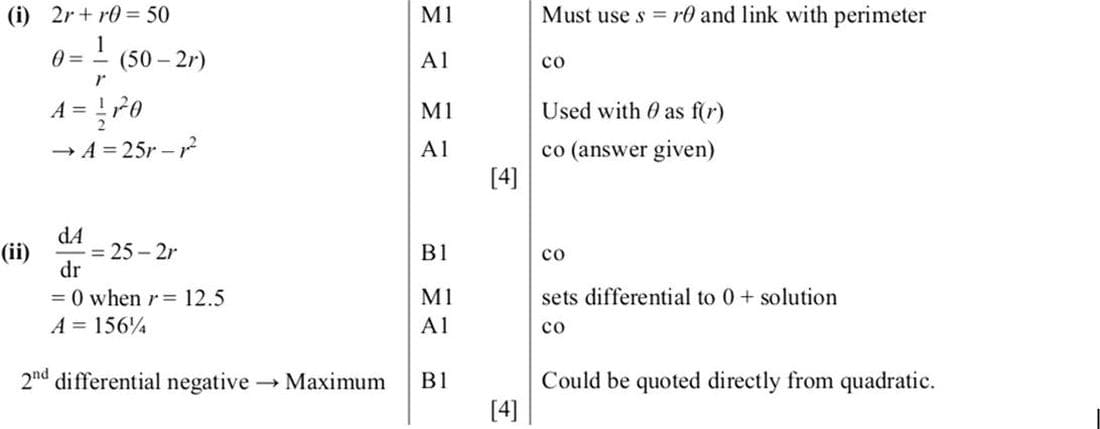
A piece of wire of length 50 cm is bent to form the perimeter of a sector POQ of a circle. The radius of the circle is r cm and the angle POQ is \(\theta\) radians (see diagram).
(i) Express \(\theta\) in terms of \(r\) and show that the area, \(A \text{ cm}^2\), of the sector is given by \(A = 25r - r^2\).
(ii) Given that \(r\) can vary, find the stationary value of \(A\) and determine its nature.
9709 P1 - Nov 2008 - Q7
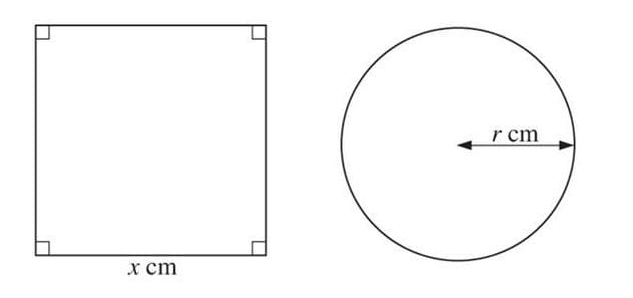
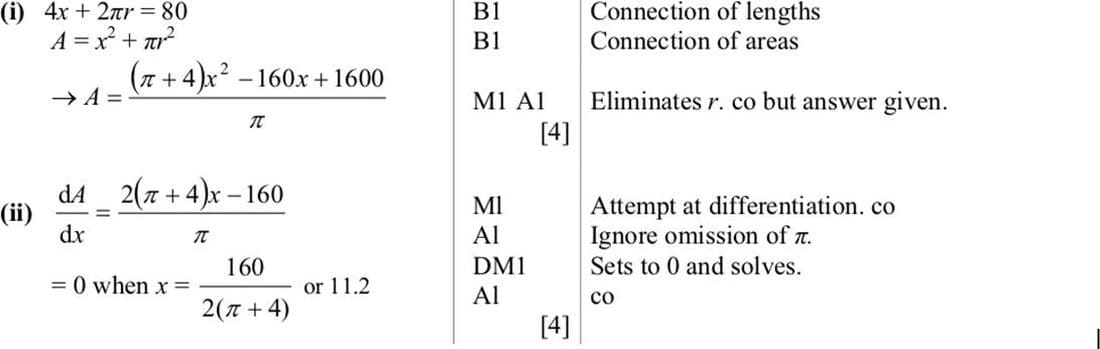
A wire, 80 cm long, is cut into two pieces. One piece is bent to form a square of side \(x\) cm and the other piece is bent to form a circle of radius \(r\) cm (see diagram). The total area of the square and the circle is \(A\) cm\(^2\).
(i) Show that \(A = \frac{(\pi + 4)x^2 - 160x + 1600}{\pi}\).
(ii) Given that \(x\) and \(r\) can vary, find the value of \(x\) for which \(A\) has a stationary value.
9709 P1 - Nov 2006 - Q9
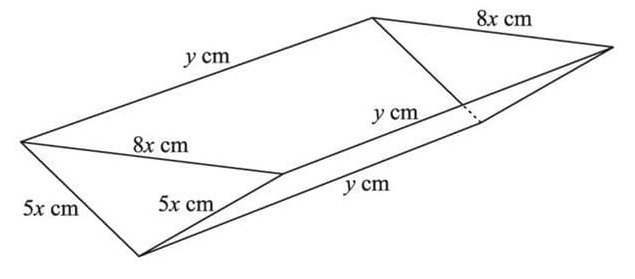
The diagram shows an open container constructed out of 200 cm2 of cardboard. The two vertical end pieces are isosceles triangles with sides 5x cm, 5x cm, and 8x cm, and the two side pieces are rectangles of length y cm and width 5x cm, as shown. The open top is a horizontal rectangle.
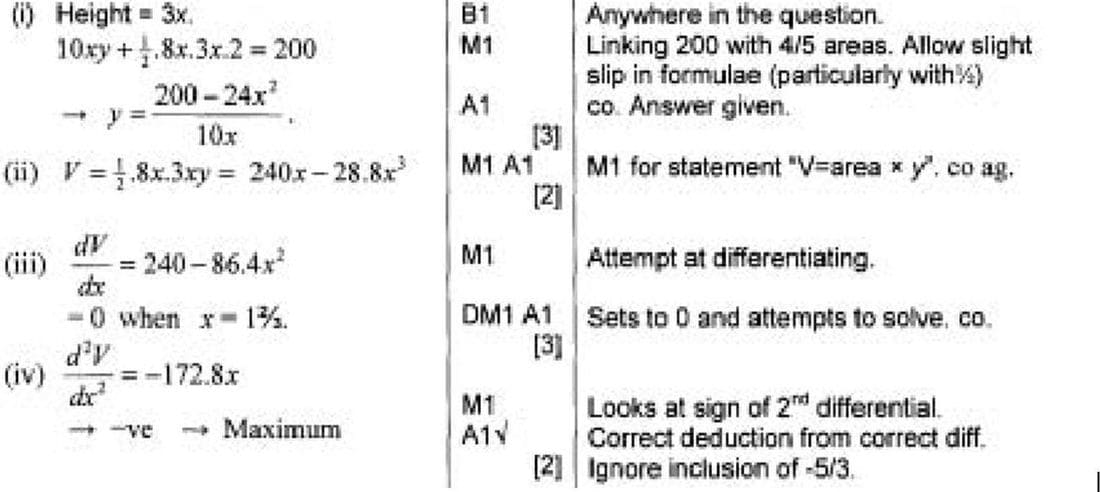
(i) Show that \(y = \frac{200 - 24x^2}{10x}\).
(ii) Show that the volume, \(V \text{ cm}^3\), of the container is given by \(V = 240x - 28.8x^3\).
Given that \(x\) can vary,
(iii) find the value of \(x\) for which \(V\) has a stationary value,
(iv) determine whether it is a maximum or a minimum stationary value.
9709 P1 - Nov 2005 - Q5
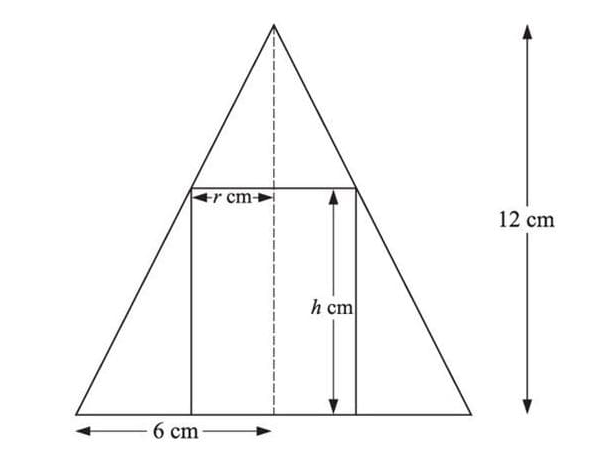
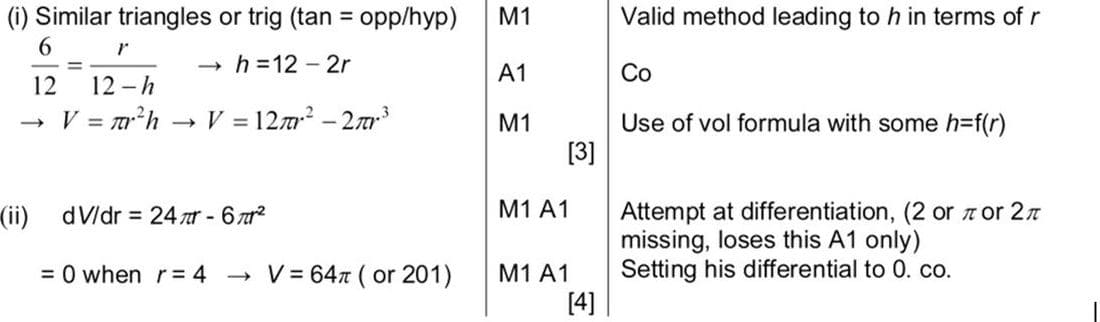
The diagram shows the cross-section of a hollow cone and a circular cylinder. The cone has radius 6 cm and height 12 cm, and the cylinder has radius \(r\) cm and height \(h\) cm. The cylinder just fits inside the cone with all of its upper edge touching the surface of the cone.
(i) Express \(h\) in terms of \(r\) and hence show that the volume, \(V \text{ cm}^3\), of the cylinder is given by \(V = 12\pi r^2 - 2\pi r^3\).
(ii) Given that \(r\) varies, find the stationary value of \(V\).
9709 P11 - Nov 2017 - Q4
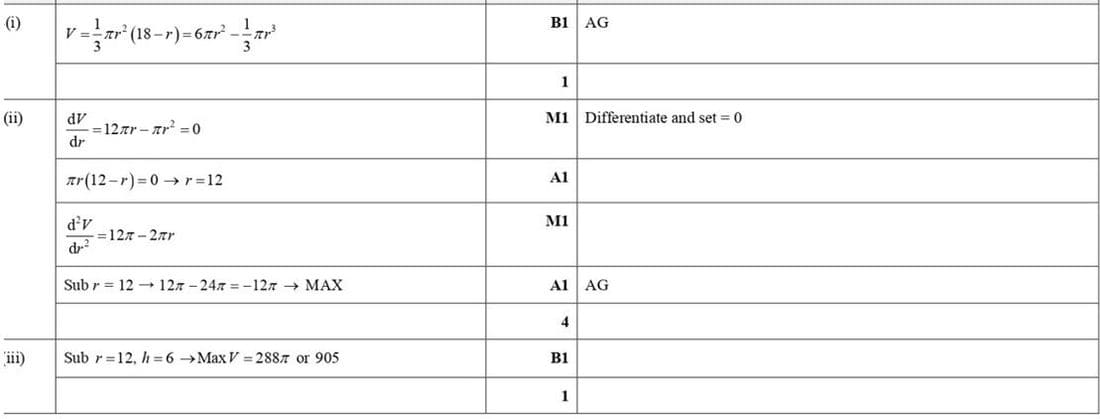
Machines in a factory make cardboard cones of base radius r cm and vertical height h cm. The volume, V cm3, of such a cone is given by \(V = \frac{1}{3} \pi r^2 h\). The machines produce cones for which \(h + r = 18\).
(i) Show that \(V = 6\pi r^2 - \frac{1}{3} \pi r^3\).
(ii) Given that r can vary, find the non-zero value of r for which V has a stationary value and show that the stationary value is a maximum.
(iii) Find the maximum volume of a cone that can be made by these machines.
9709 P1 - Jun 2004 - Q8
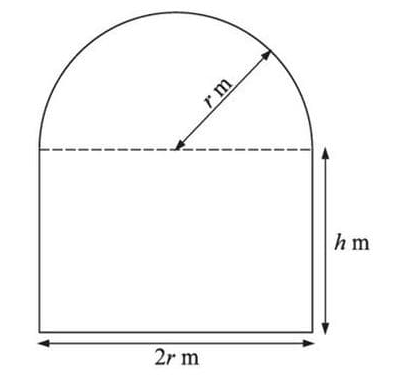
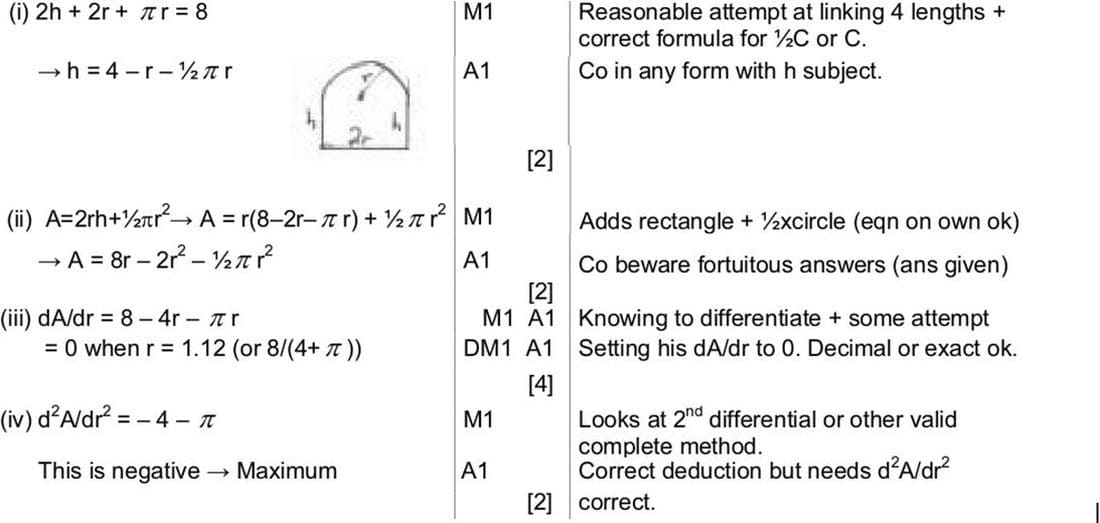
The diagram shows a glass window consisting of a rectangle of height \(h\) m and width \(2r\) m and a semicircle of radius \(r\) m. The perimeter of the window is 8 m.
(i) Express \(h\) in terms of \(r\).
(ii) Show that the area of the window, \(A\) m\(^2\), is given by \(A = 8r - 2r^2 - \frac{1}{2} \pi r^2\).
Given that \(r\) can vary,
(iii) find the value of \(r\) for which \(A\) has a stationary value,
(iv) determine whether this stationary value is a maximum or a minimum.
9709 P1 - Nov 2003 - Q8
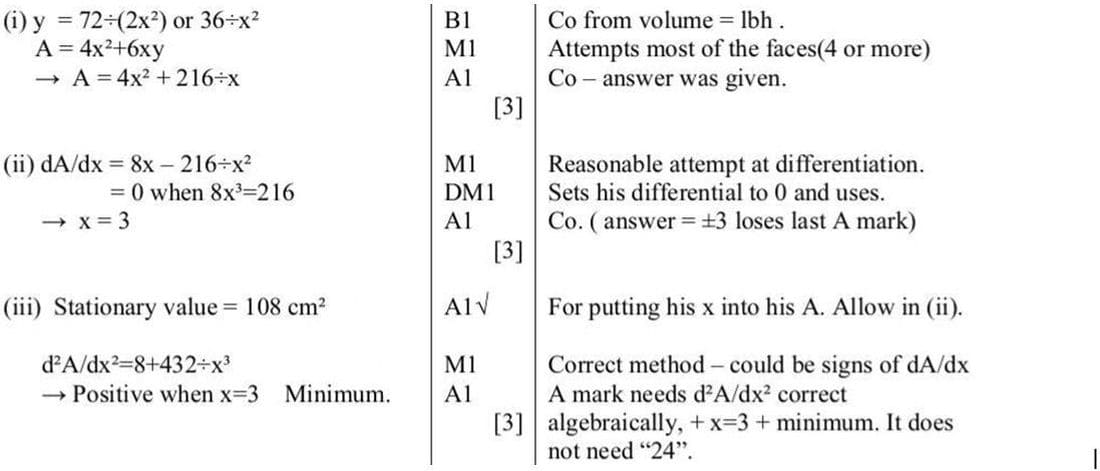
A solid rectangular block has a base which measures \(2x\) cm by \(x\) cm. The height of the block is \(y\) cm and the volume of the block is \(72\) cm3.
(i) Express \(y\) in terms of \(x\) and show that the total surface area, \(A\) cm2, of the block is given by \(A = 4x^2 + \frac{216}{x}\).
Given that \(x\) can vary,
(ii) find the value of \(x\) for which \(A\) has a stationary value,
(iii) find this stationary value and determine whether it is a maximum or a minimum.
9709 P1 - Jun 2002 - Q8
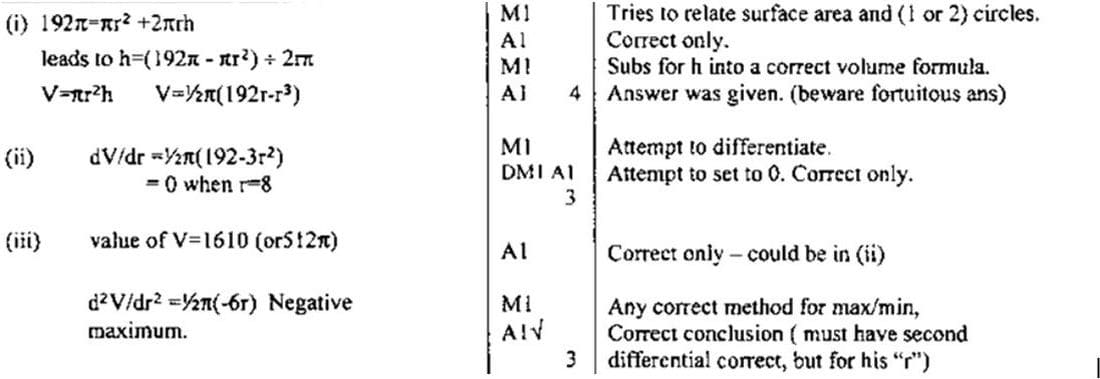
A hollow circular cylinder, open at one end, is constructed of thin sheet metal. The total external surface area of the cylinder is \(192\pi \text{ cm}^2\). The cylinder has a radius of \(r\) cm and a height of \(h\) cm.
(i) Express \(h\) in terms of \(r\) and show that the volume, \(V \text{ cm}^3\), of the cylinder is given by \(V = \frac{1}{2} \pi (192r - r^3)\).
Given that \(r\) can vary,
(ii) find the value of \(r\) for which \(V\) has a stationary value,
(iii) find this stationary value and determine whether it is a maximum or a minimum.
9709 P11 - Jun 2017 - Q6
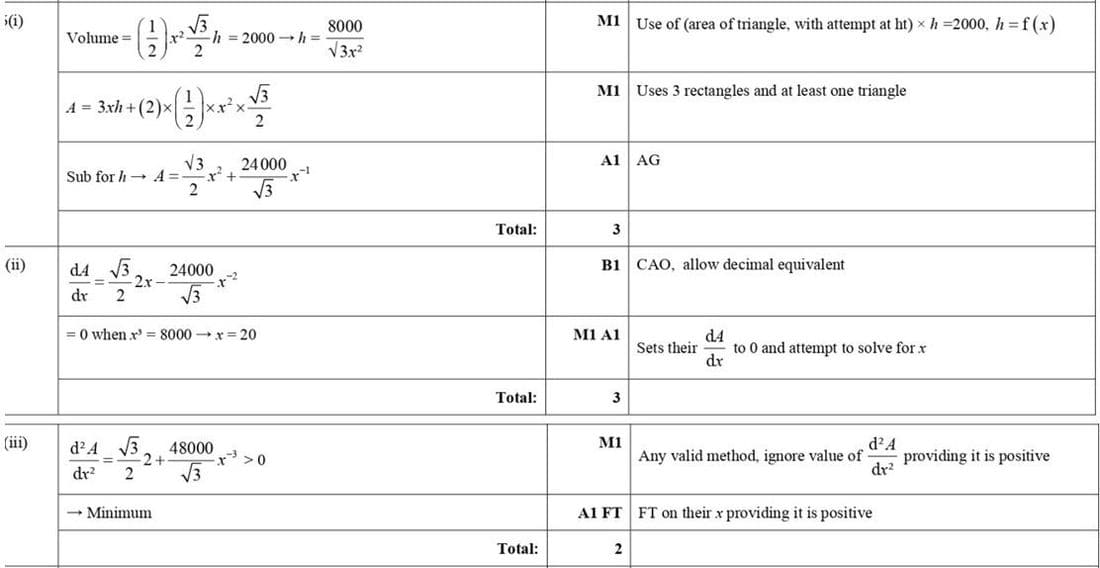
The horizontal base of a solid prism is an equilateral triangle of side \(x\) cm. The sides of the prism are vertical. The height of the prism is \(h\) cm and the volume of the prism is 2000 cm\(^3\).
(i) Express \(h\) in terms of \(x\) and show that the total surface area of the prism, \(A\) cm\(^2\), is given by
\(A = \frac{\sqrt{3}}{2}x^2 + \frac{24000}{\sqrt{3}}x^{-1}.\)
[3]
(ii) Given that \(x\) can vary, find the value of \(x\) for which \(A\) has a stationary value. [3]
(iii) Determine, showing all necessary working, the nature of this stationary value. [2]
9709 P11 - Jun 2016 - Q5
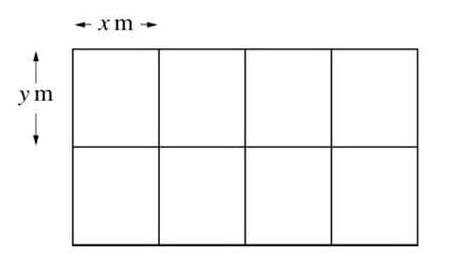
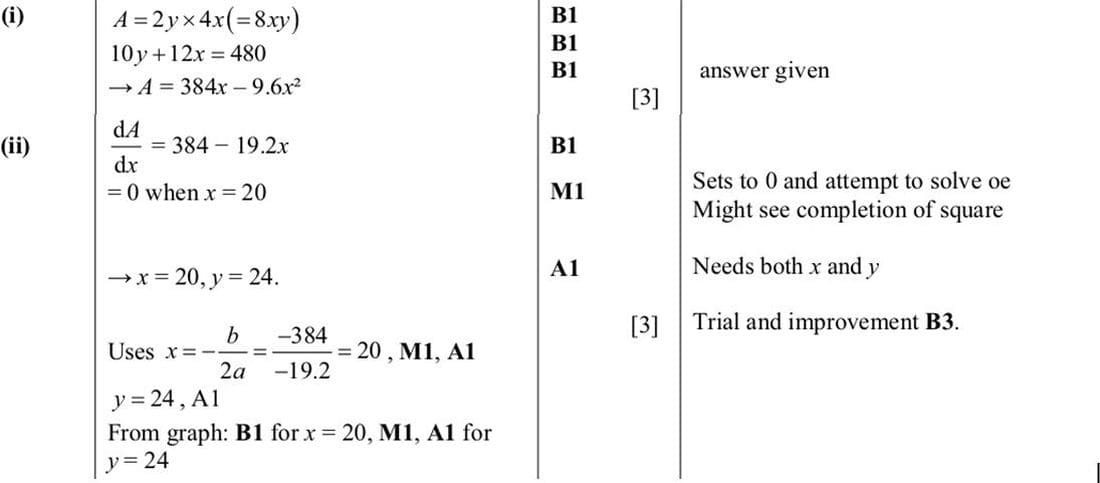
A farmer divides a rectangular piece of land into 8 equal-sized rectangular sheep pens as shown in the diagram. Each sheep pen measures \(x\) m by \(y\) m and is fully enclosed by metal fencing. The farmer uses 480 m of fencing.
(i) Show that the total area of land used for the sheep pens, \(A\) m\(^2\), is given by \(A = 384x - 9.6x^2\).
(ii) Given that \(x\) and \(y\) can vary, find the dimensions of each sheep pen for which the value of \(A\) is a maximum. (There is no need to verify that the value of \(A\) is a maximum.)
9709 P12 - Mar 2016 - Q6
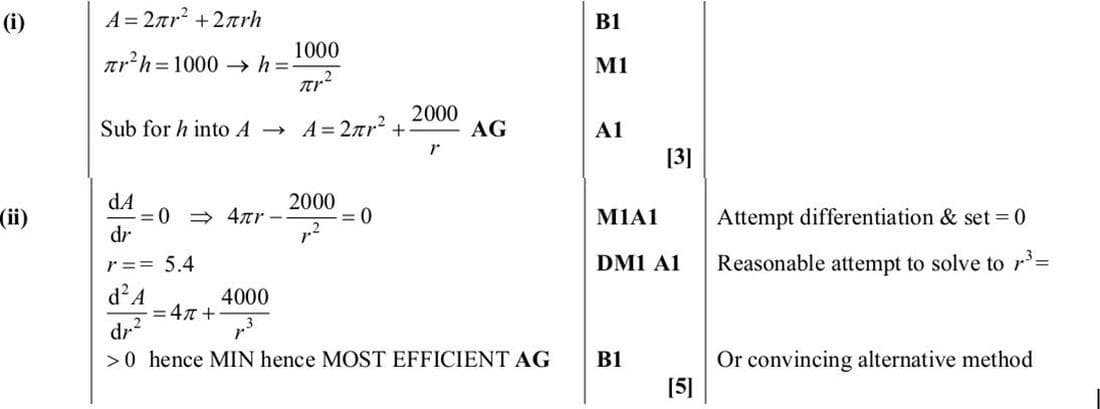
A vacuum flask (for keeping drinks hot) is modelled as a closed cylinder in which the internal radius is \(r\) cm and the internal height is \(h\) cm. The volume of the flask is 1000 cm\(^3\). A flask is most efficient when the total internal surface area, \(A\) cm\(^2\), is a minimum.
(i) Show that \(A = 2\pi r^2 + \frac{2000}{r}\).
(ii) Given that \(r\) can vary, find the value of \(r\), correct to 1 decimal place, for which \(A\) has a stationary value and verify that the flask is most efficient when \(r\) takes this value.
9709 P11 - Jun 2015 - Q5
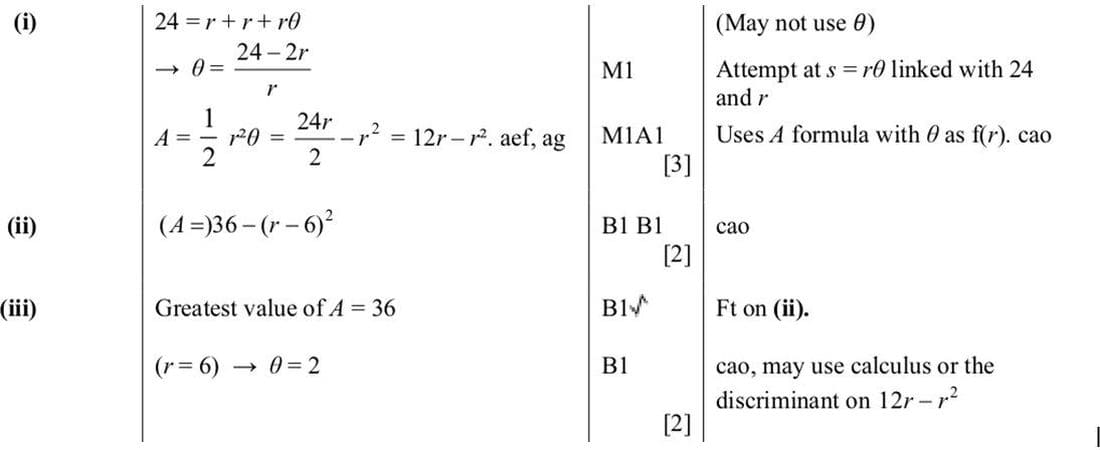
A piece of wire of length 24 cm is bent to form the perimeter of a sector of a circle of radius \(r\) cm.
(i) Show that the area of the sector, \(A\) cm\(^2\), is given by \(A = 12r - r^2\).
(ii) Express \(A\) in the form \(a - (r - b)^2\), where \(a\) and \(b\) are constants.
(iii) Given that \(r\) can vary, state the greatest value of \(A\) and find the corresponding angle of the sector.
9709 P13 - Jun 2014 - Q9
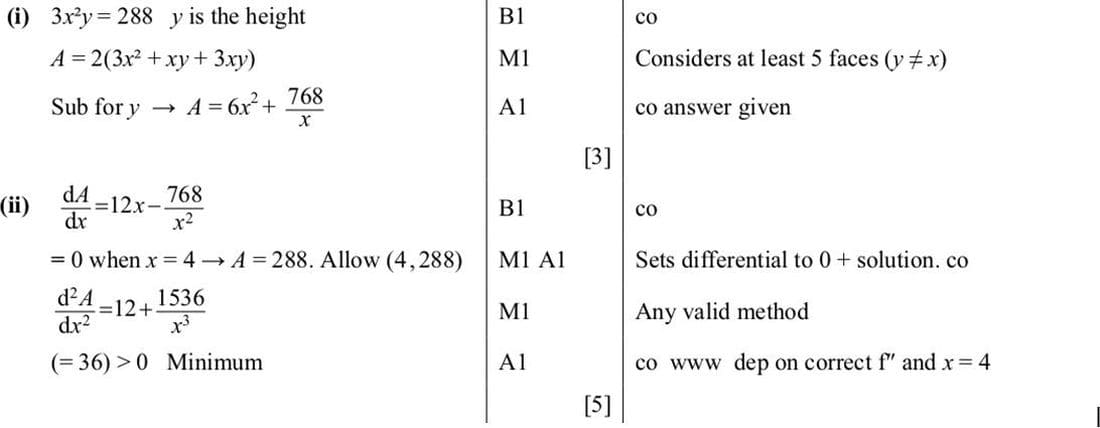
The base of a cuboid has sides of length \(x\) cm and \(3x\) cm. The volume of the cuboid is \(288 \text{ cm}^3\).
(i) Show that the total surface area of the cuboid, \(A \text{ cm}^2\), is given by
\(A = 6x^2 + \frac{768}{x}.\)
(ii) Given that \(x\) can vary, find the stationary value of \(A\) and determine its nature.