9709 P42 - Nov 2014 - Q5
3544
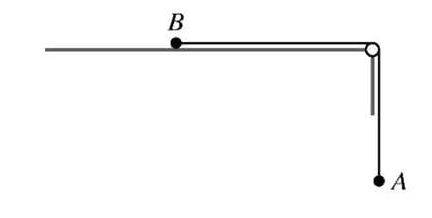
Particles A and B, each of mass 0.3 kg, are connected by a light inextensible string. The string passes over a small smooth pulley fixed at the edge of a rough horizontal surface. Particle A hangs freely and particle B is held at rest in contact with the surface (see diagram). The coefficient of friction between B and the surface is 0.7. Particle B is released and moves on the surface without reaching the pulley.
(i) Find, for the first 0.9 m of B's motion,
- the work done against the frictional force acting on B,
- the loss of potential energy of the system,
- the gain in kinetic energy of the system.
At the instant when B has moved 0.9 m the string breaks. A is at a height of 0.54 m above a horizontal floor at this instant.
(ii) Find the speed with which A reaches the floor.
Solutions locked. Please sign in with access to view them.