9709 P42 - Mar 2020 - Q3
3513
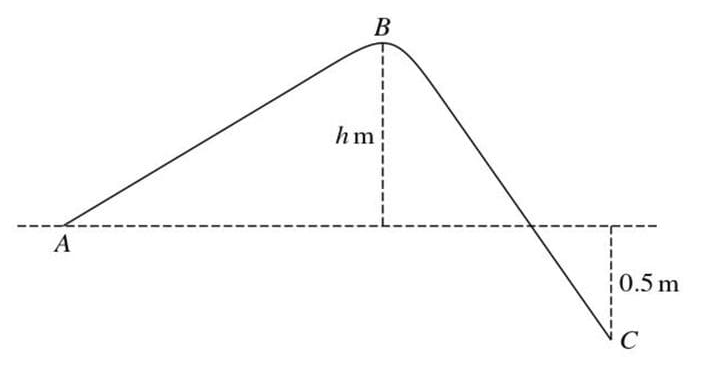
The diagram shows the vertical cross-section of a surface. A, B, and C are three points on the cross-section. The level of B is h m above the level of A. The level of C is 0.5 m below the level of A. A particle of mass 0.2 kg is projected up the slope from A with initial speed 5 m/s. The particle remains in contact with the surface as it travels from A to C.
(a) Given that the particle reaches B with a speed of 3 m/s and that there is no resistance force, find h.
(b) It is given instead that there is a resistance force and that the particle does 3.1 J of work against the resistance force as it travels from A to C. Find the speed of the particle when it reaches C.
Solutions locked. Please sign in with access to view them.