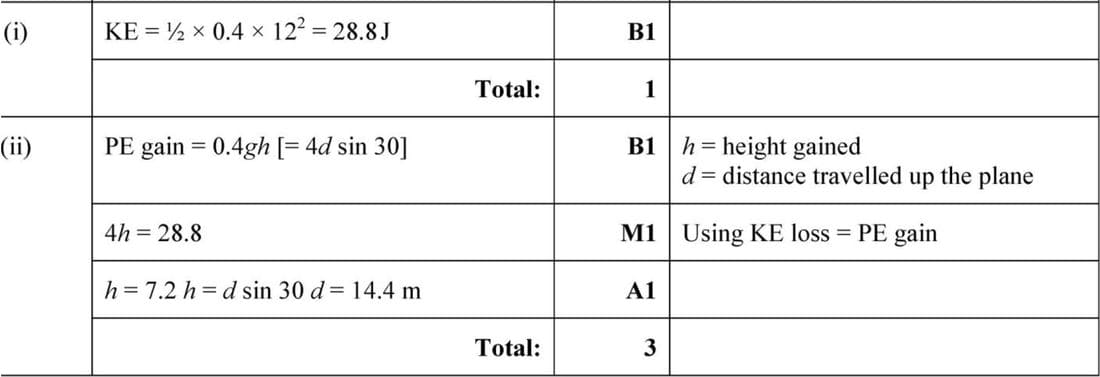
(i) The initial kinetic energy (KE) of the particle is given by the formula:
\(KE = \frac{1}{2} m v^2\)
Substituting the given values:
\(KE = \frac{1}{2} \times 0.4 \times 12^2 = 28.8 \text{ J}\)
(ii) To find the distance the particle moves up the plane, we use the conservation of energy principle. The loss in kinetic energy is equal to the gain in potential energy (PE).
The gain in potential energy is given by:
\(PE = mgh\)
where \(h\) is the height gained. Since the plane is inclined at 30°, the height \(h\) can be expressed in terms of the distance \(d\) traveled up the plane:
\(h = d \sin 30^{\circ}\)
Thus, the potential energy gain is:
\(PE = 0.4g(d \sin 30^{\circ})\)
Equating the kinetic energy loss to the potential energy gain:
\(28.8 = 0.4g(d \sin 30^{\circ})\)
\(28.8 = 0.4 \times 9.8 \times d \times 0.5\)
\(28.8 = 1.96d\)
Solving for \(d\):
\(d = \frac{28.8}{1.96} = 14.4 \text{ m}\)