9709 P43 - Nov 2017 - Q7
3525
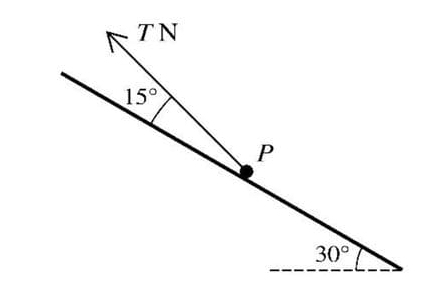
A particle P of mass 0.2 kg rests on a rough plane inclined at 30° to the horizontal. The coefficient of friction between the particle and the plane is 0.3. A force of magnitude T N acts upwards on P at 15° above a line of greatest slope of the plane (see diagram).
- Find the least value of T for which the particle remains at rest.
The force of magnitude T N is now removed. A new force of magnitude 0.25 N acts on P up the plane, parallel to a line of greatest slope of the plane. Starting from rest, P slides down the plane. After moving a distance of 3 m, P passes through the point A.
- Use an energy method to find the speed of P at A.
Solutions locked. Please sign in with access to view them.