9709 P41 - Nov 2011 - Q6
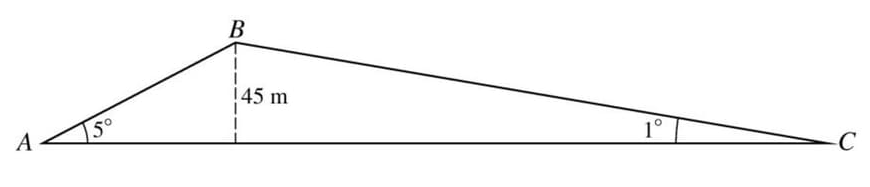
AB and BC are straight roads inclined at 5° to the horizontal and 1° to the horizontal respectively. A and C are at the same horizontal level and B is 45 m above the level of A and C (see diagram, which is not to scale). A car of mass 1200 kg travels from A to C passing through B.
(i) For the motion from A to B, the speed of the car is constant and the work done against the resistance to motion is 360 kJ. Find the work done by the car’s engine from A to B.
The resistance to motion is constant throughout the whole journey.
(ii) For the motion from B to C the work done by the driving force is 1660 kJ. Given that the speed of the car at B is 15 m s−1, show that its speed at C is 29.9 m s−1, correct to 3 significant figures.
(iii) The car’s driving force immediately after leaving B is 1.5 times the driving force immediately before reaching C. Find, correct to 2 significant figures, the ratio of the power developed by the car’s engine immediately after leaving B to the power developed immediately before reaching C.