9709 P41 - Nov 2010 - Q6
3569
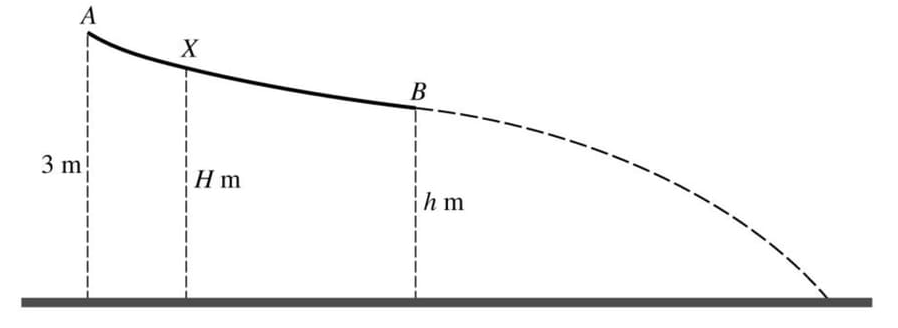
A smooth slide AB is fixed so that its highest point A is 3 m above horizontal ground. B is h m above the ground. A particle P of mass 0.2 kg is released from rest at a point on the slide. The particle moves down the slide and, after passing B, continues moving until it hits the ground (see diagram). The speed of P at B is vB and the speed at which P hits the ground is vG.
(i) In the case that P is released at A, it is given that the kinetic energy of P at B is 1.6 J. Find
- the value of h,
- the kinetic energy of the particle immediately before it reaches the ground,
- the ratio vG : vB.
(ii) In the case that P is released at the point X of the slide, which is H m above the ground (see diagram), it is given that vG : vB = 2.55. Find the value of H correct to 2 significant figures.
Solutions locked. Please sign in with access to view them.