9709 P41 - Nov 2012 - Q6
3554
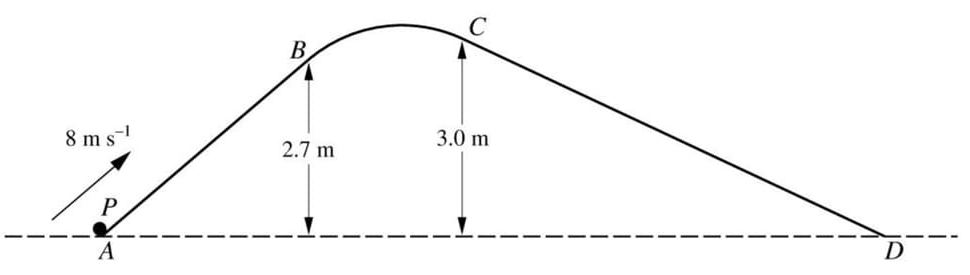
The diagram shows the vertical cross-section ABCD of a surface. BC is a circular arc, and AB and CD are tangents to BC at B and C respectively. A and D are at the same horizontal level, and B and C are at heights 2.7 m and 3.0 m respectively above the level of A and D. A particle P of mass 0.2 kg is given a velocity of 8 m s-1 at A, in the direction of AB (see diagram). The parts of the surface containing AB and BC are smooth.
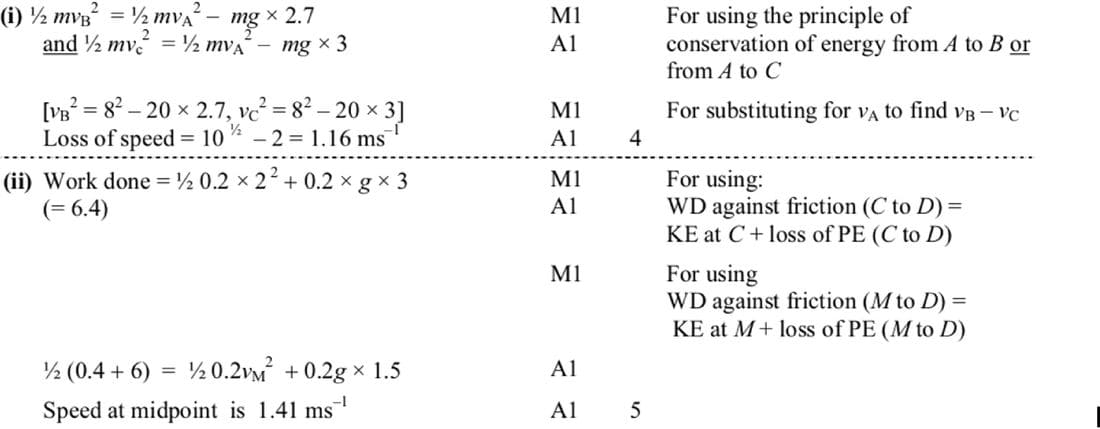
- Find the decrease in the speed of P as P moves along the surface from B to C.
- The part of the surface containing CD exerts a constant frictional force on P, as it moves from C to D, and P comes to rest as it reaches D.
- Find the speed of P when it is at the mid-point of CD.