9709 P41 - Nov 2013 - Q5
3605
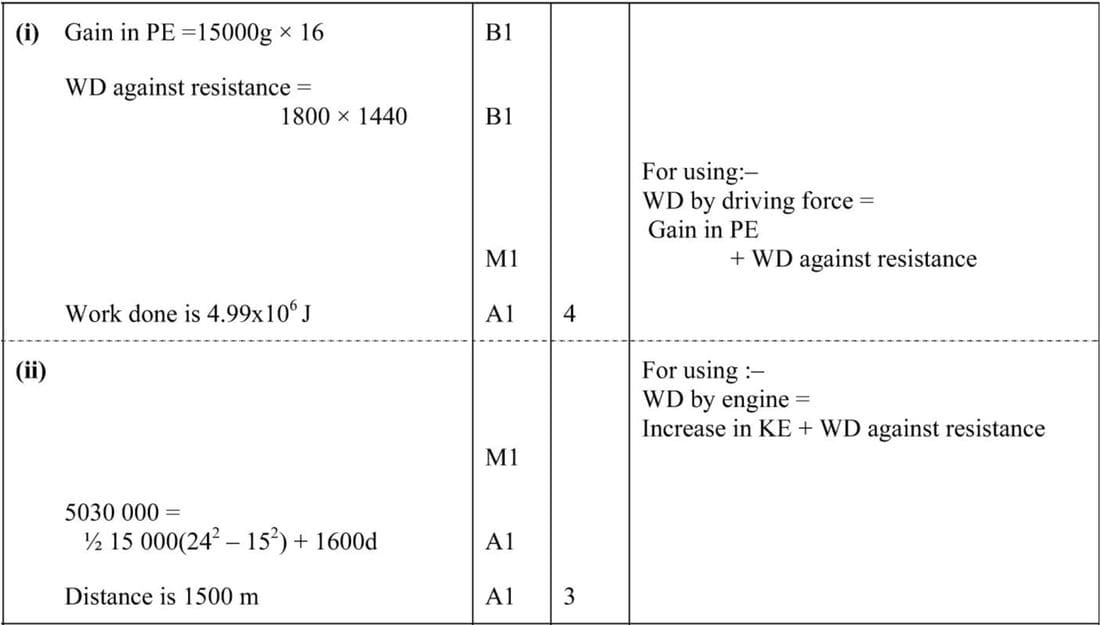
A lorry of mass 15,000 kg climbs from the bottom to the top of a straight hill, of length 1440 m, at a constant speed of 15 m s-1. The top of the hill is 16 m above the level of the bottom of the hill. The resistance to motion is constant and equal to 1800 N.
(i) Find the work done by the driving force.
On reaching the top of the hill the lorry continues on a straight horizontal road and passes through a point P with speed 24 m s-1. The resistance to motion is constant and is now equal to 1600 N. The work done by the lorry’s engine from the top of the hill to the point P is 5030 kJ.
(ii) Find the distance from the top of the hill to the point P.