9709 P4 - Nov 2005 - Q7
3585
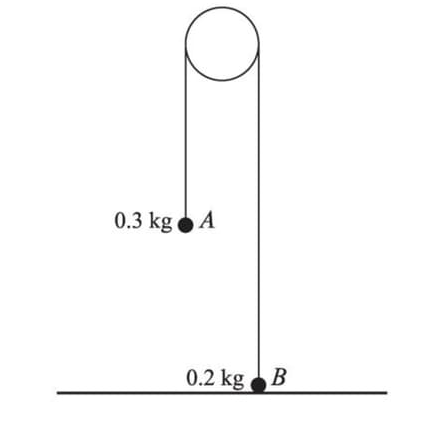
Two particles A and B, of masses 0.3 kg and 0.2 kg respectively, are attached to the ends of a light inextensible string which passes over a smooth fixed pulley. Particle B is held on the horizontal floor and particle A hangs in equilibrium. Particle B is released and each particle starts to move vertically with constant acceleration of magnitude a m s-2.
- Find the value of a.
- Show that A hits the floor with a speed of 2.4 m s-1.
- Find the gain in gravitational potential energy by B, from leaving the floor until reaching its greatest height.
Particle A hits the floor 1.2 s after it starts to move, and does not rebound upwards.
Solutions locked. Please sign in with access to view them.