9709 P41 - Nov 2009 - Q2
3574
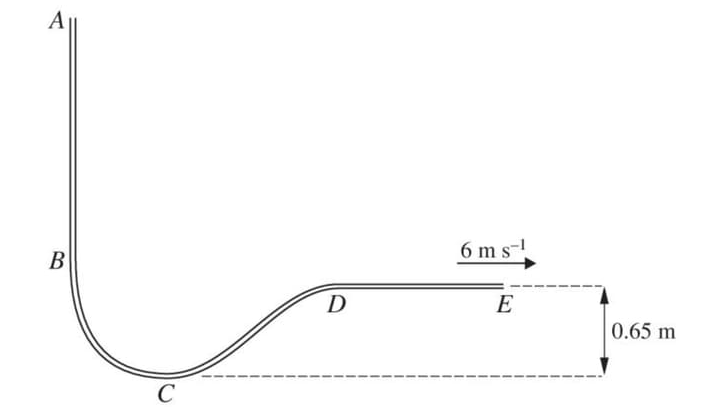
A smooth narrow tube AE has two straight parts, AB and DE, and a curved part BCD. The part AB is vertical with A above B, and DE is horizontal. C is the lowest point of the tube and is 0.65 m below the level of DE. A particle is released from rest at A and travels through the tube, leaving it at E with speed 6 m/s (see diagram). Find
- the height of A above the level of DE,
- the maximum speed of the particle.
Solutions locked. Please sign in with access to view them.