Browsing as Guest. Progress, bookmarks and attempts are disabled.
Log in to track your work.
Nov 2003 p4 q4
3590
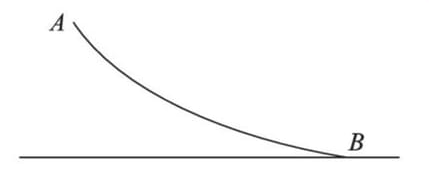
The diagram shows a vertical cross-section of a surface. A and B are two points on the cross-section. A particle of mass 0.15 kg is released from rest at A.
Assuming that the particle reaches B with a speed of 8 m s-1 and that there are no resistances to motion, find the height of A above B.
Assuming instead that the particle reaches B with a speed of 6 m s-1 and that the height of A above B is 4 m, find the work done against the resistances to motion.
Solution
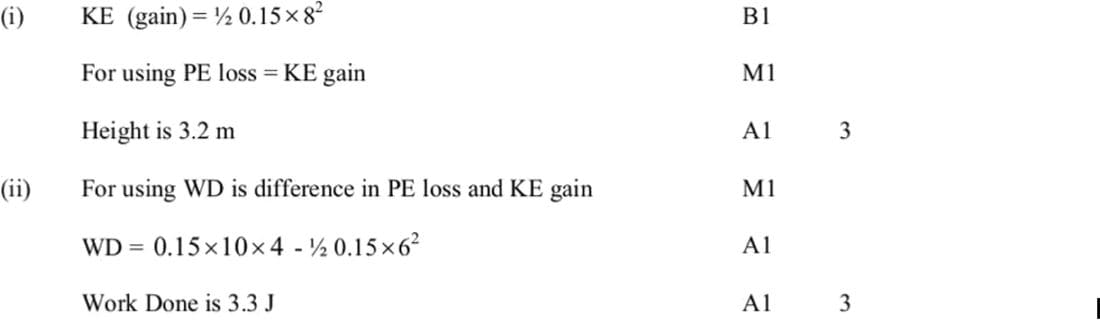
(i) The kinetic energy (KE) gained by the particle at B is given by:
\(KE = \frac{1}{2} \times 0.15 \times 8^2\)
\(KE = 4.8 \text{ J}\)
Since there are no resistances, the potential energy (PE) lost is equal to the kinetic energy gained:
\(mgh = KE\)
\(0.15 \times 9.8 \times h = 4.8\)
\(h = \frac{4.8}{0.15 \times 9.8}\)
\(h = 3.2 \text{ m}\)
(ii) The work done against resistances is the difference between the potential energy lost and the kinetic energy gained: