Past Exam Questions
← Back9231 P13 - Nov 2012 - Q1 - 4 marks
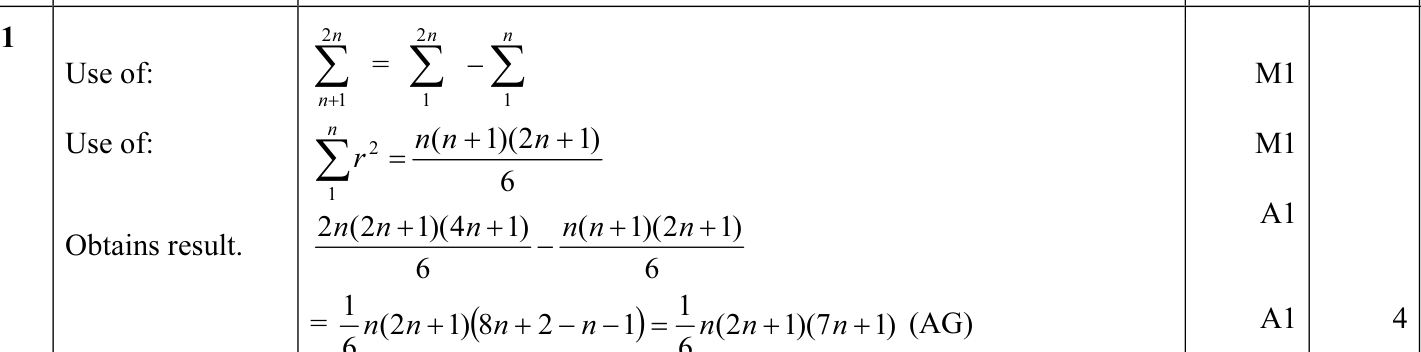
Show that \(\sum_{r=n+1}^{2 n} r^{2}=\frac{1}{6} n(2 n+1)(7 n+1)\).
9231 P11 - Jun 2010 - Q4 - 7 marks
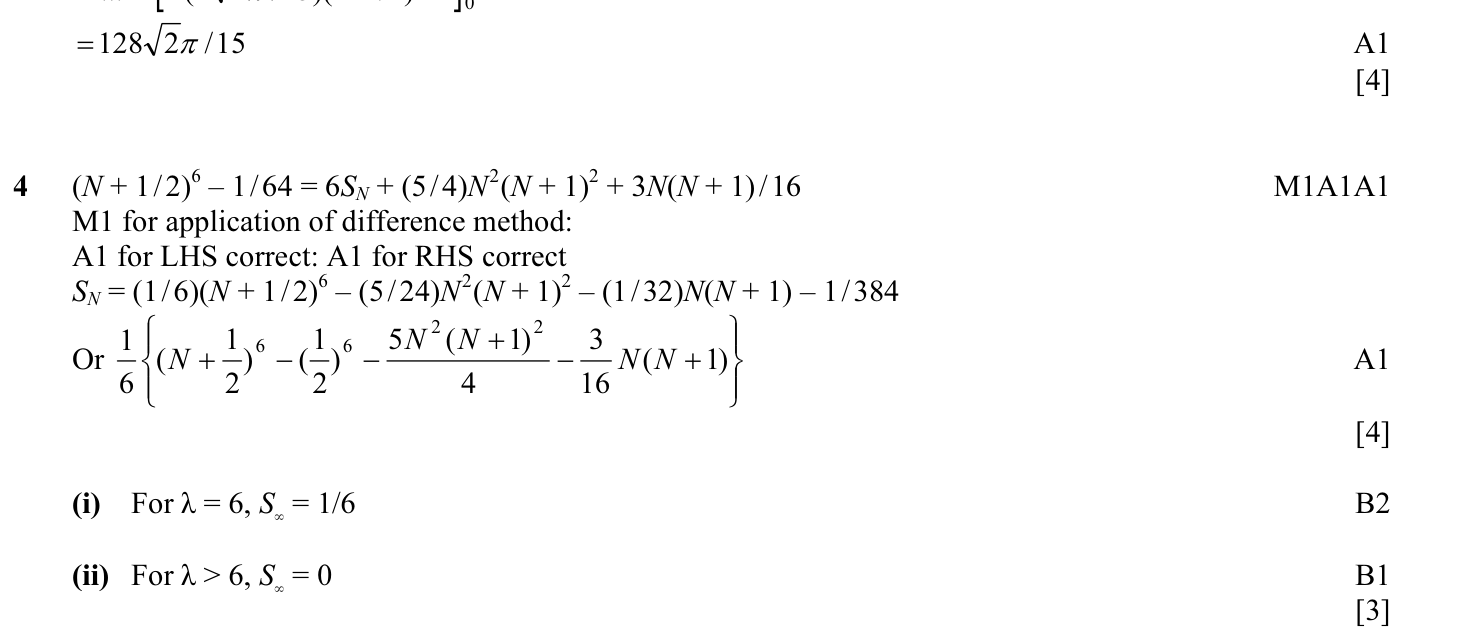
The sum \(S_{N}\) is defined by \(S_{N}=\sum_{n=1}^{N} n^{5}\). Using the identity
\(\left(n+\frac{1}{2}\right)^{6}-\left(n-\frac{1}{2}\right)^{6} \equiv 6 n^{5}+5 n^{3}+\frac{3}{8} n\)
find \(S_{N}\) in terms of \(N\). [You need not simplify your result.]
Hence find \(\lim _{N \rightarrow \infty} N^{-\lambda} S_{N}\), for each of the two cases
(i) \(\lambda=6\),
(ii) \(\lambda\gt 6\).
9231 P13 - Jun 2011 - Q1 - 5 marks
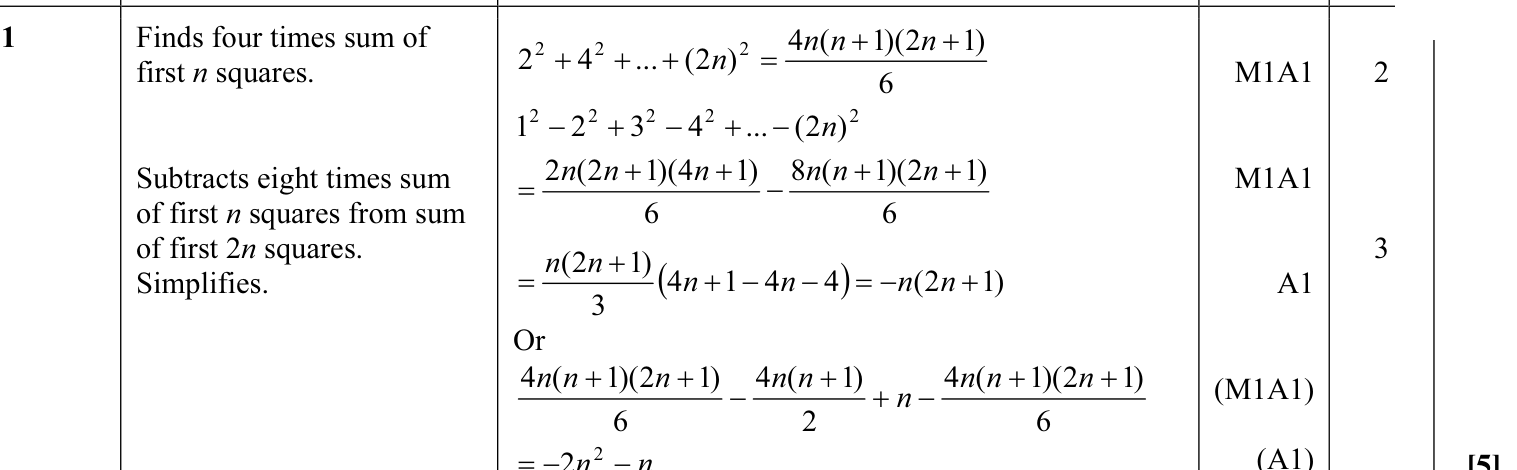
Find \(2^{2}+4^{2}+\ldots+(2 n)^{2}\).
Hence find \(1^{2}-2^{2}+3^{2}-4^{2}+\ldots-(2 n)^{2}\), simplifying your answer.
9231 P13 - Nov 2011 - Q1 - 6 marks
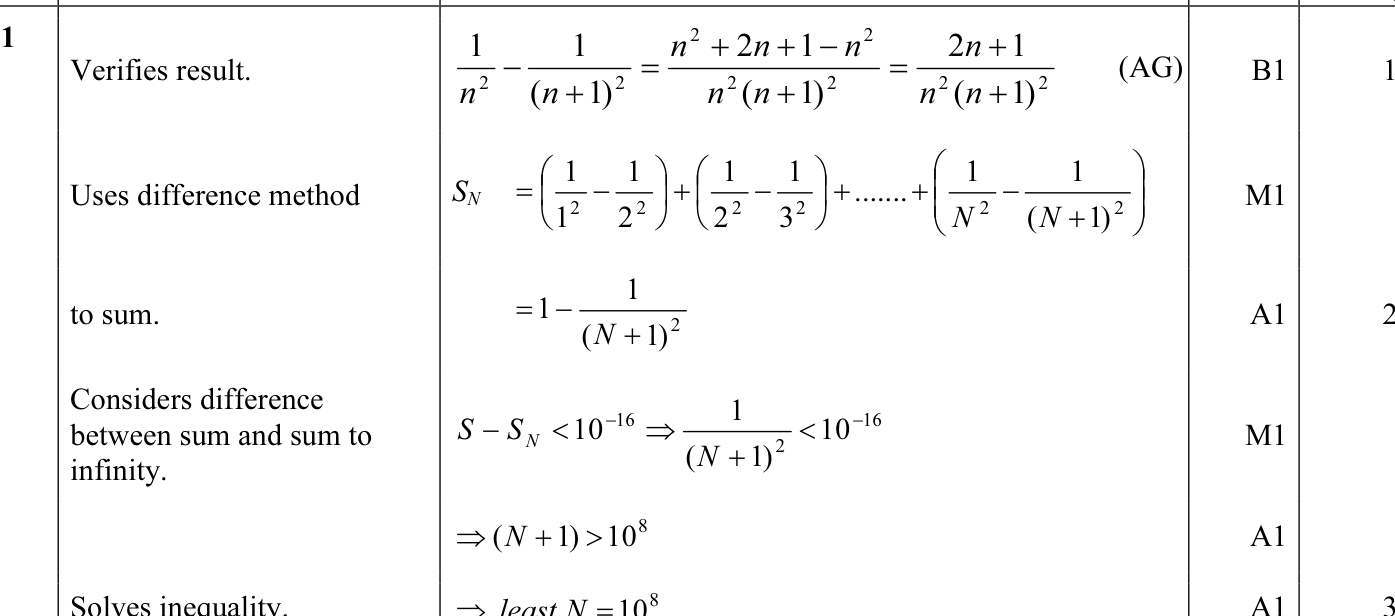
\(\mathbf{1}\) Verify that \(\frac{1}{n^{2}}-\frac{1}{(n+1)^{2}}=\frac{2 n+1}{n^{2}(n+1)^{2}}\).
Let \(S_{N}=\sum_{r=1}^{N} \frac{2 r+1}{r^{2}(r+1)^{2}}\). Express \(S_{N}\) in terms of \(N\).
Let \(S=\lim _{N \rightarrow \infty} S_{N}\). Find the least value of \(N\) such that \(S-S_{N}\lt 10^{-16}\).
9231 P13 - Jun 2025 - Q04 - 8 marks
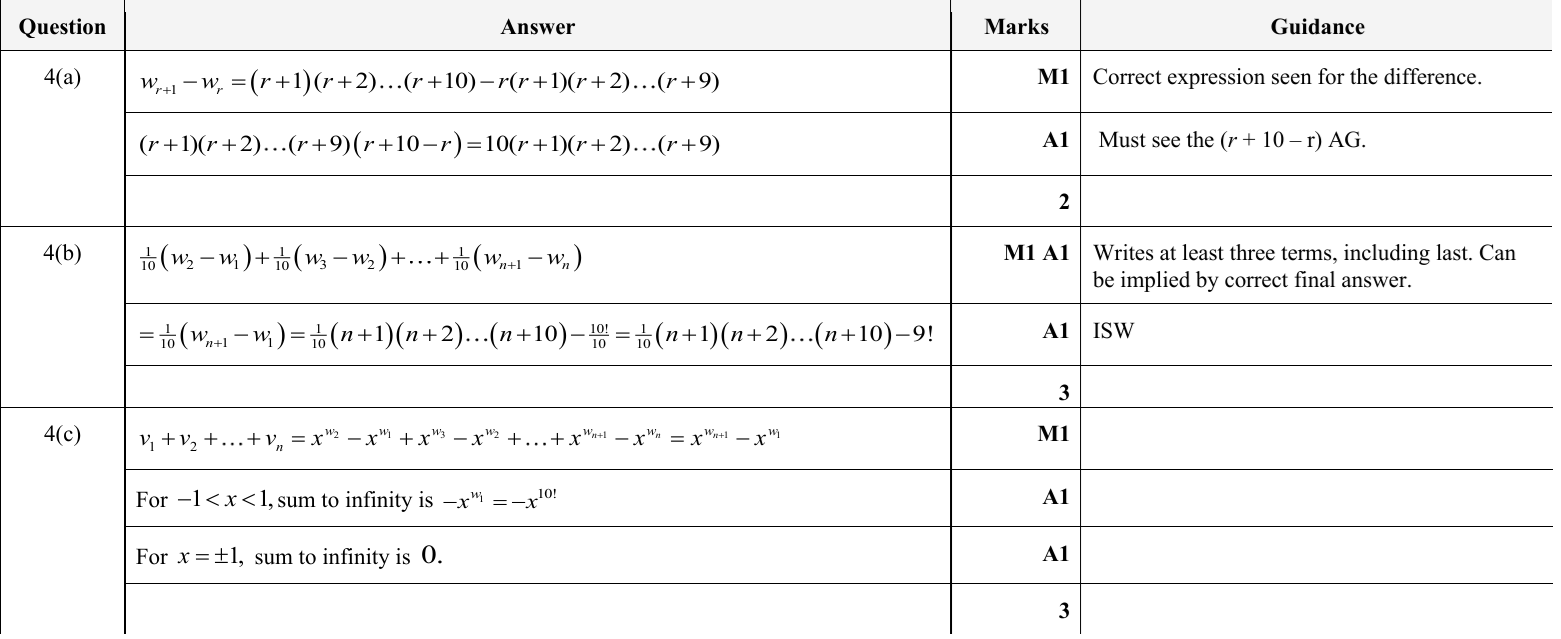
Let \(w_r = r(r+1)(r+2)\ldots(r+9)\).
(a) Show that \(w_{r+1} - w_r = 10(r+1)(r+2)\ldots(r+9)\).
(b) Given that \(u_r = (r+1)(r+2)\ldots(r+9)\), find \(\sum_{r=1}^{n} u_r\) in terms of \(n\).
(c) Given that \(v_r = x^{w_{r+1}} - x^{w_r}\), find the set of values of \(x\) for which the infinite series \(v_1 + v_2 + v_3 + \ldots\) is convergent and give the sum to infinity when this exists.
9231 P12 - Nov 2024 - Q05 - 9 marks
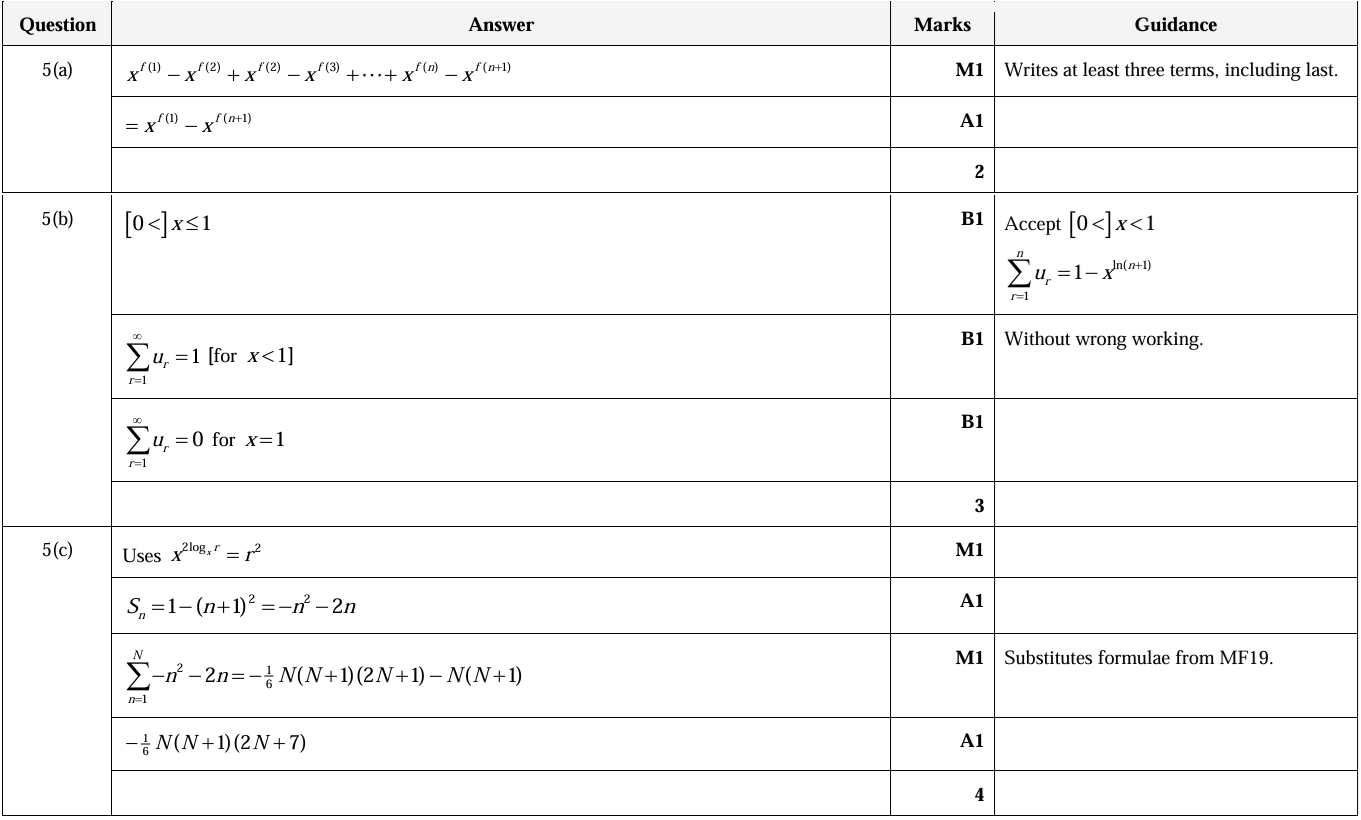
It is given that \(S_n = \sum_{r=1}^{n} u_r\), where \(u_r = x^{f(r)} - x^{f(r+1)}\) and \(x > 0\).
(a) Find \(S_n\) in terms of \(n, x\) and the function \(f\).
(b) Given that \(f(r) = \ln r\), find the set of values of \(x\) for which the infinite series \(u_1 + u_2 + u_3 + \ldots\) is convergent and give the sum to infinity when this exists.
(c) Given instead that \(f(r) = 2 \log_x r\) where \(x \neq 1\), use standard results from the List of formulae (MF19) to find \(\sum_{n=1}^{N} S_n\) in terms of \(N\). Fully factorise your answer.
9231 P13 - Jun 2022 - Q04 - 9 marks
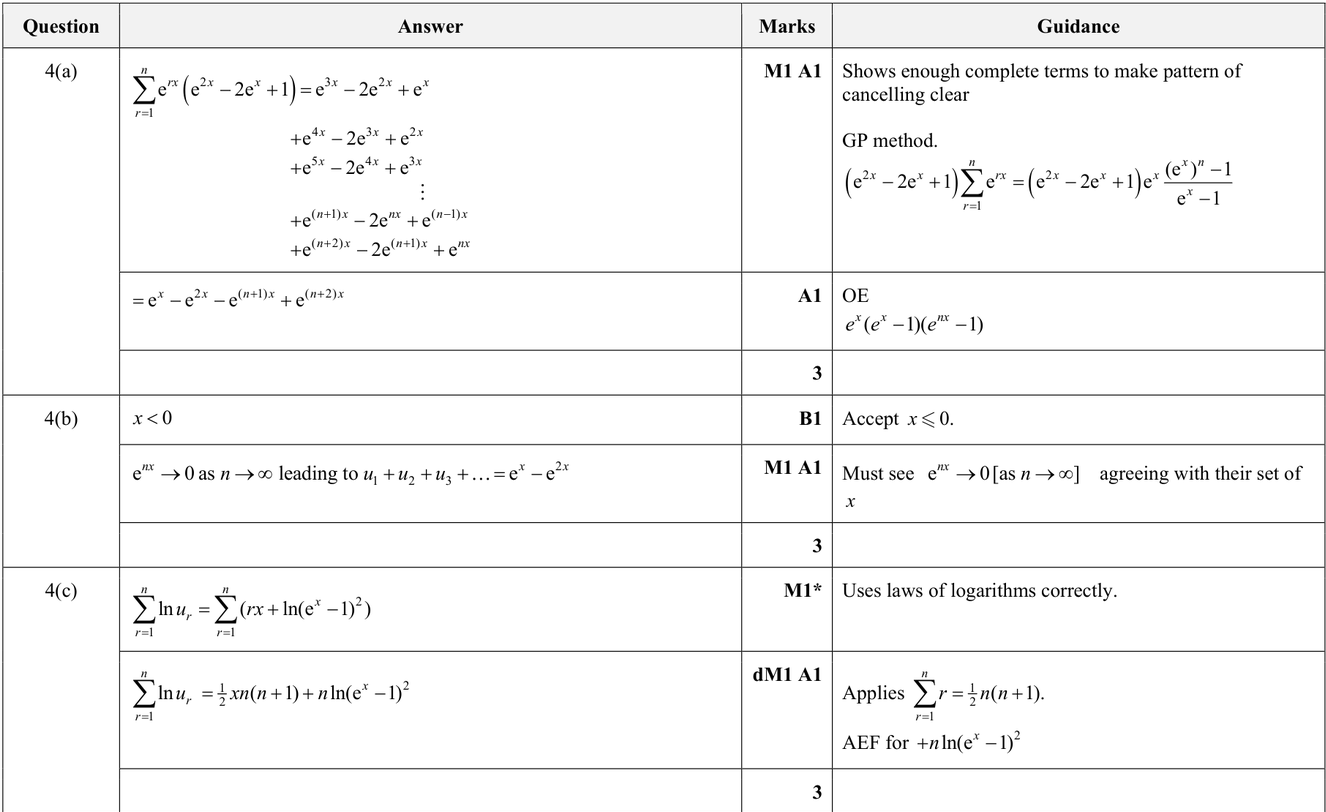
Let \(u_r = e^{rx}(e^{2x} - 2e^x + 1)\).
(a) Using the method of differences, or otherwise, find \(\sum_{r=1}^{n} u_r\) in terms of \(n\) and \(x\).
(b) Deduce the set of non-zero values of \(x\) for which the infinite series \(u_1 + u_2 + u_3 + \ldots\) is convergent and give the sum to infinity when this exists.
(c) Using a standard result from the list of formulae (MF19), find \(\sum_{r=1}^{n} \ln u_r\) in terms of \(n\) and \(x\).
9231 P13 - Jun 2021 - Q01 - 6 marks
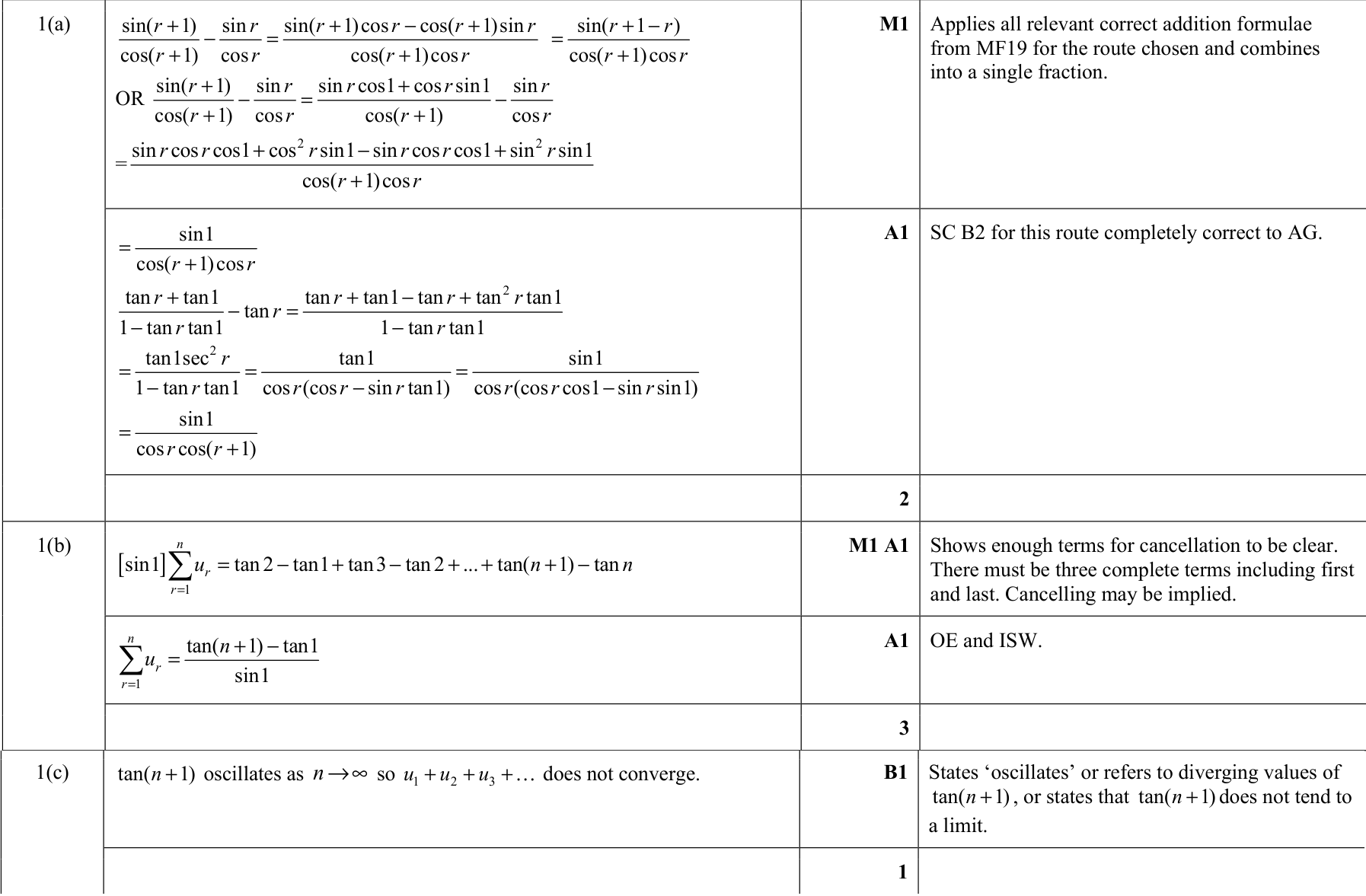
(a) Show that \(\tan(r+1) - \tan r = \frac{\sin 1}{\cos(r+1)\cos r}\).
Let \(u_r = \frac{1}{\cos(r+1)\cos r}\).
(b) Use the method of differences to find \(\sum_{r=1}^{n} u_r\).
(c) Explain why the infinite series \(u_1 + u_2 + u_3 + \ldots\) does not converge.
9231 P12 - Nov 2021 - Q03 - 7 marks
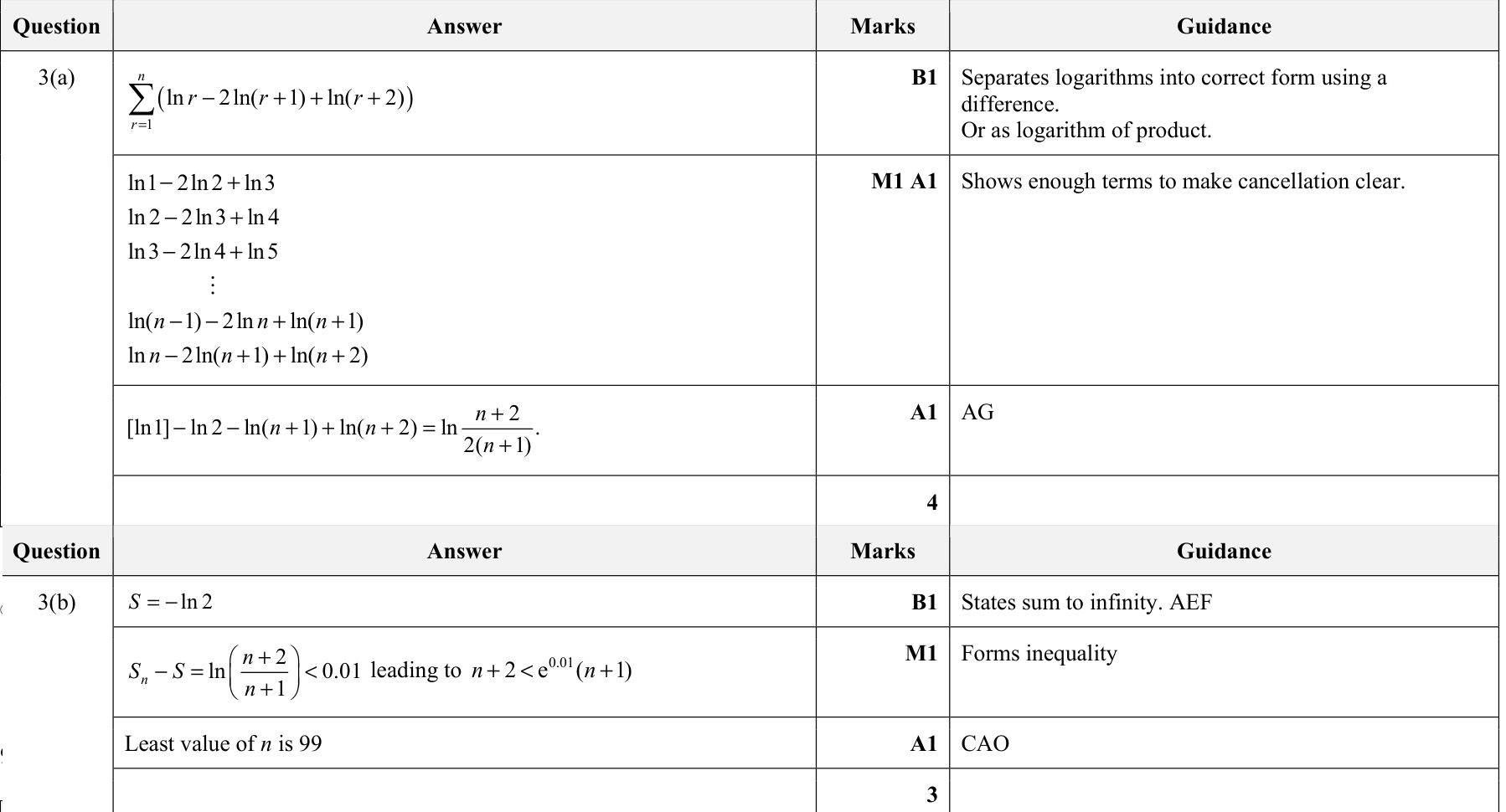
Let \(S_n = \sum_{r=1}^{n} \ln \frac{r(r+2)}{(r+1)^2}\).
(a) Using the method of differences, or otherwise, show that \(S_n = \ln \frac{n+2}{2(n+1)}\).
Let \(S = \sum_{r=1}^{\infty} \ln \frac{r(r+2)}{(r+1)^2}\).
(b) Find the least value of \(n\) such that \(S_n - S < 0.01\).
9231 P11 - Jun 2019 - Q2 - 5 marks
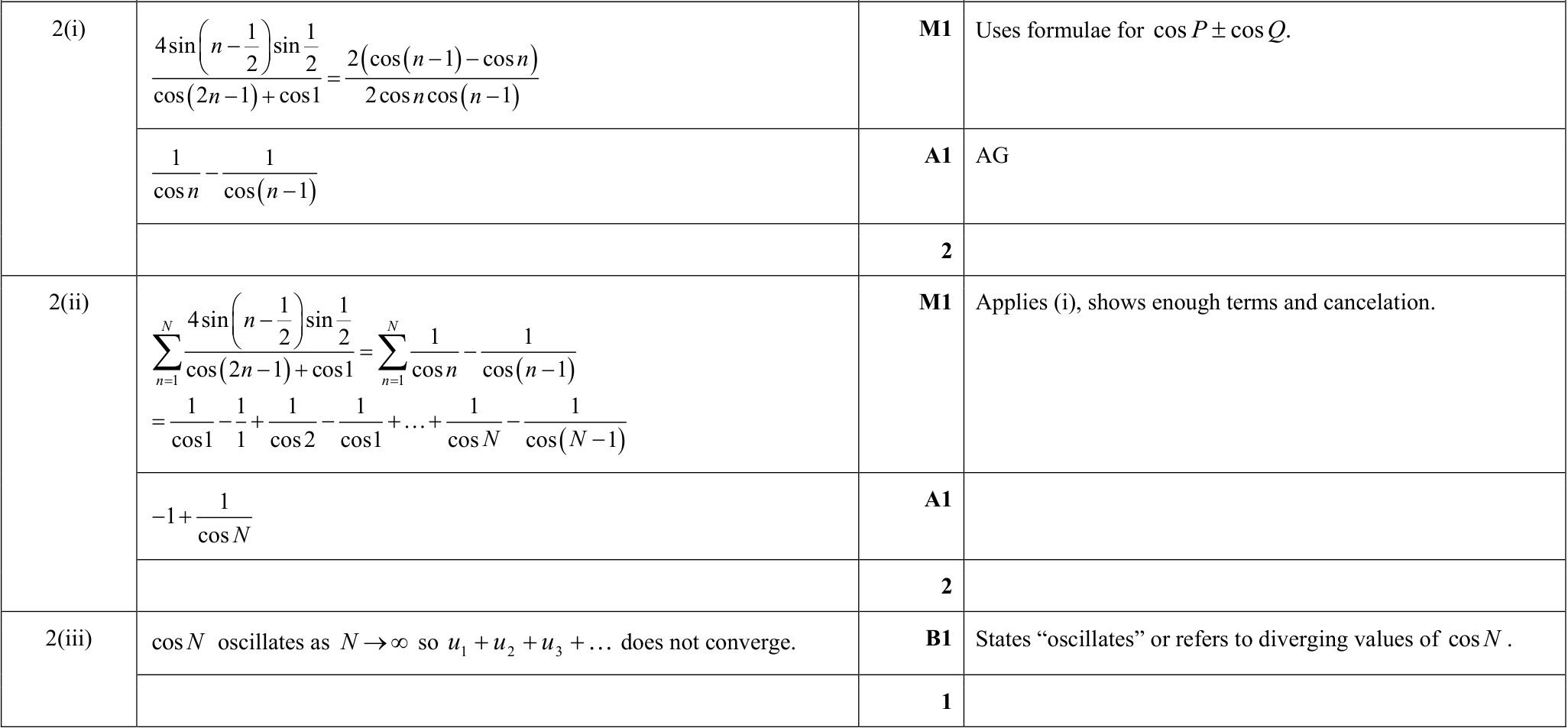
2 Let \(u_{n}=\frac{4 \sin \left(n-\frac{1}{2}\right) \sin \frac{1}{2}}{\cos (2 n-1)+\cos 1}\).
(i) Using the formulae for \(\cos P \pm \cos Q\) given in the List of Formulae MF10, show that
\(u_{n}=\frac{1}{\cos n}-\frac{1}{\cos (n-1)}\)
(ii) Use the method of differences to find \(\sum_{n=1}^{N} u_{n}\).
(iii) Explain why the infinite series \(u_{1}+u_{2}+u_{3}+\ldots\) does not converge.
9231 P11 - Nov 2025 - Q1 - 9 marks
(a) Use standard results from MF19 to find \(\sum_{r=1}^{n}(8r^3+12r^2+4r+3)\) in terms of \(n\), simplifying your answer.
(b) Show that \(\frac1{r^4}-\frac1{(r+1)^4}=\frac{4r^3+6r^2+4r+1}{r^4(r+1)^4}\), and hence find \(\sum_{r=1}^{n}\frac{4r^3+6r^2+4r+1}{r^4(r+1)^4}\).
(c) Deduce the value of \(\sum_{r=1}^{\infty}\frac{4r^3+6r^2+4r+1}{r^4(r+1)^4}\).
9231 P12 - Nov 2025 - Q1 - 9 marks
(a) Use standard results from MF19 to find \(\sum_{r=1}^{n}(r^3-r)\) in terms of \(n\), fully factorising your answer.
(b) Express \(\dfrac{r+3}{r^3-r}\) in the form \(\dfrac{A}{r-1}+\dfrac{B}{r}+\dfrac{C}{r+1}\), and hence use the method of differences to find \(\sum_{r=2}^{n}\dfrac{r+3}{r^3-r}\).
(c) Deduce the value of \(\sum_{r=2}^{\infty}\dfrac{r+3}{r^3-r}\).
9231 P13 - Jun 2014 - Q2 - 6 marks
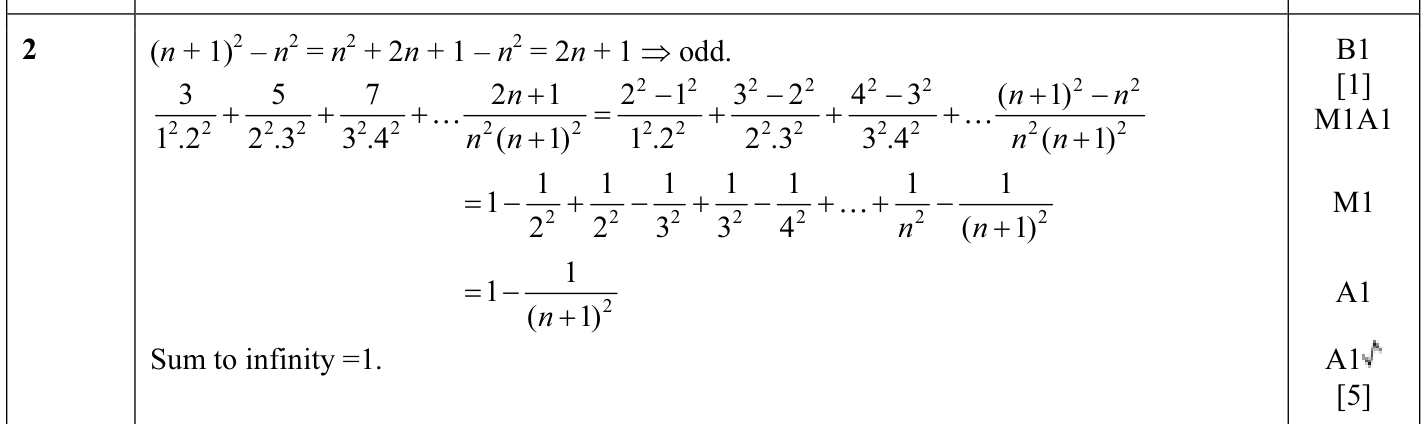
Show that the difference between the squares of consecutive integers is an odd integer.
Find the sum to \(n\) terms of the series
\(\frac{3}{1^{2} \times 2^{2}}+\frac{5}{2^{2} \times 3^{2}}+\frac{7}{3^{2} \times 4^{2}}+\ldots+\frac{2 r+1}{r^{2}(r+1)^{2}}+\ldots\)
and deduce the sum to infinity of the series.
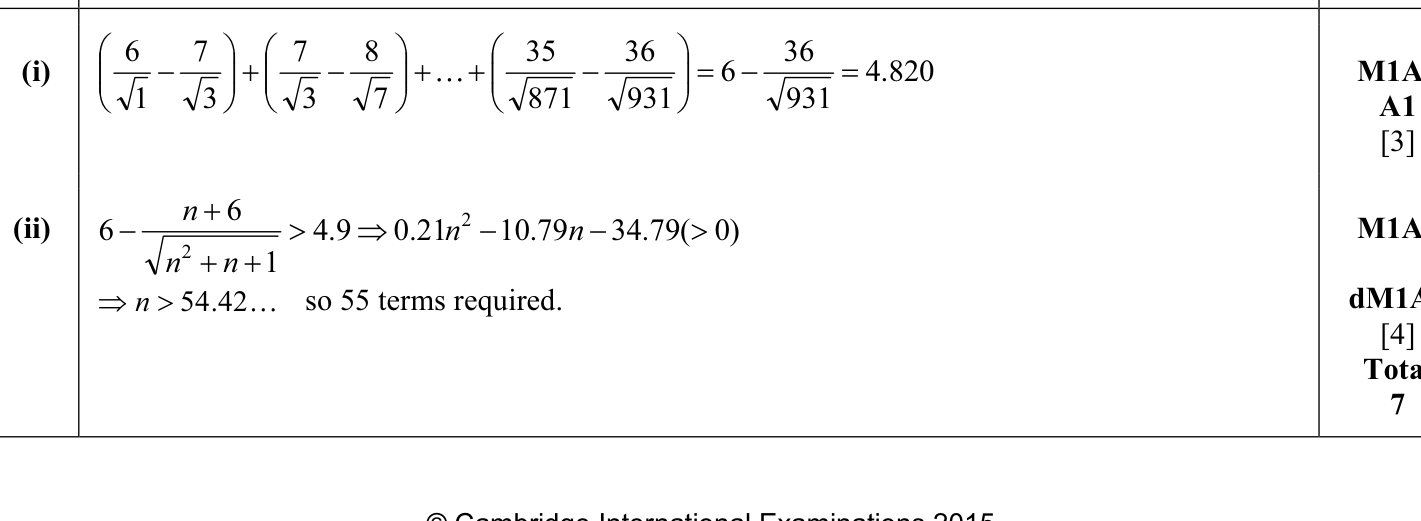
9231 P11 - Nov 2015 - Q4 - 7 marks
The sequence \(a_{1}, a_{2}, a_{3}, \ldots\) is such that, for all positive integers \(n\),
\(a_{n}=\frac{n+5}{\sqrt{ }\left(n^{2}-n+1\right)}-\frac{n+6}{\sqrt{ }\left(n^{2}+n+1\right)} .\)
The sum \(\sum_{n=1}^{N} a_{n}\) is denoted by \(S_{N}\). Find
(i) the value of \(S_{30}\) correct to 3 decimal places,
(ii) the least value of \(N\) for which \(S_{N}\gt 4.9\).
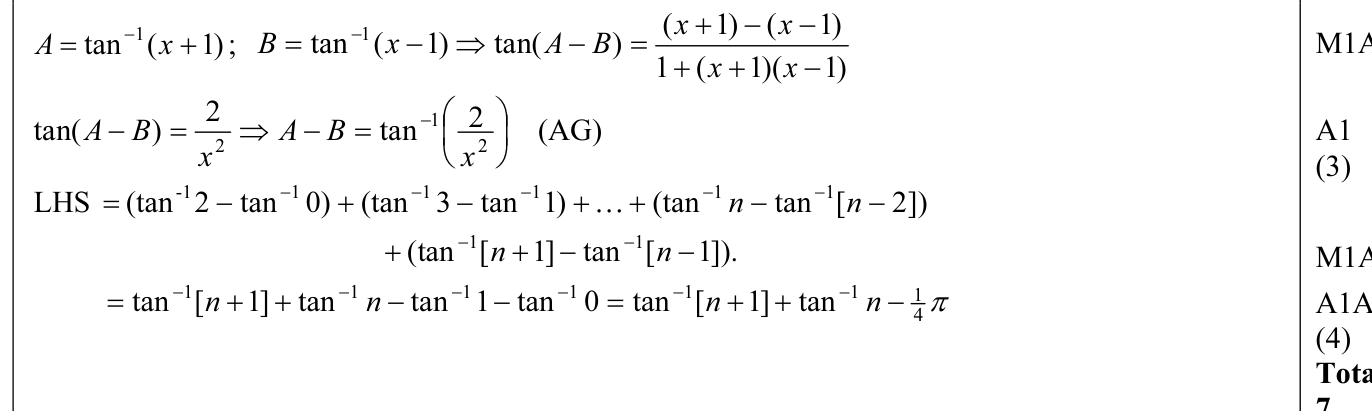
9231 P13 - Jun 2015 - Q4 - 7 marks
Use the formula for \(\tan (A-B)\) in the List of Formulae (MF10) to show that
\(\tan ^{-1}(x+1)-\tan ^{-1}(x-1)=\tan ^{-1}\left(\frac{2}{x^{2}}\right) .\)
Deduce the sum to \(n\) terms of the series
\(\tan ^{-1}\left(\frac{2}{1^{2}}\right)+\tan ^{-1}\left(\frac{2}{2^{2}}\right)+\tan ^{-1}\left(\frac{2}{3^{2}}\right)+\ldots .\)
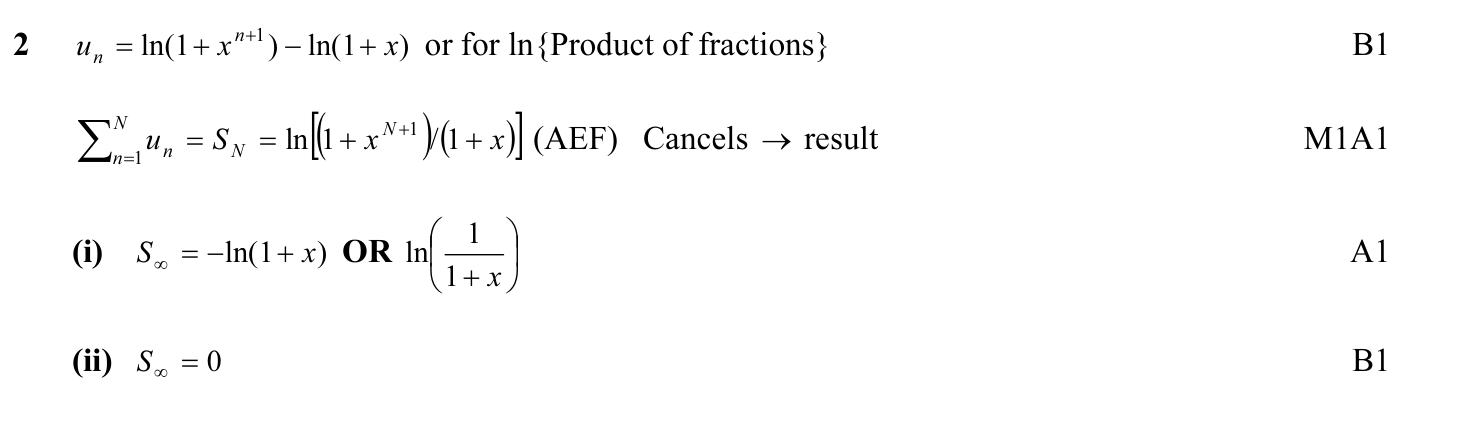
9231 P1 - Jun 2008 - Q2 - 5 marks
Given that
\(u_{n}=\ln \left(\frac{1+x^{n+1}}{1+x^{n}}\right),\)
where \(x\gt -1\), find \(\sum_{n=1}^{N} u_{n}\) in terms of \(N\) and \(x\).
Find the sum to infinity of the series
\(u_{1}+u_{2}+u_{3}+\ldots\)
when
(i) \(-1\lt x\lt 1\),
(ii) \(x=1\).
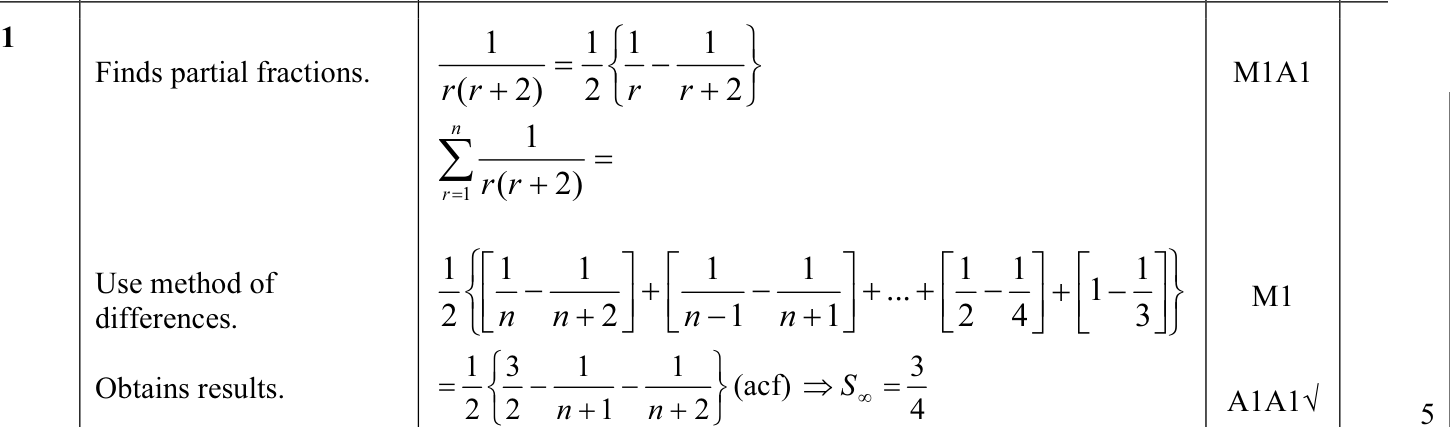
9231 P13 - Jun 2012 - Q1 - 5 marks
Find the sum of the first \(n\) terms of the series
\(\frac{1}{1 \times 3}+\frac{1}{2 \times 4}+\frac{1}{3 \times 5}+\ldots\)
and deduce the sum to infinity.
9231 P1 - Jun 2009 - Q2 - 6 marks
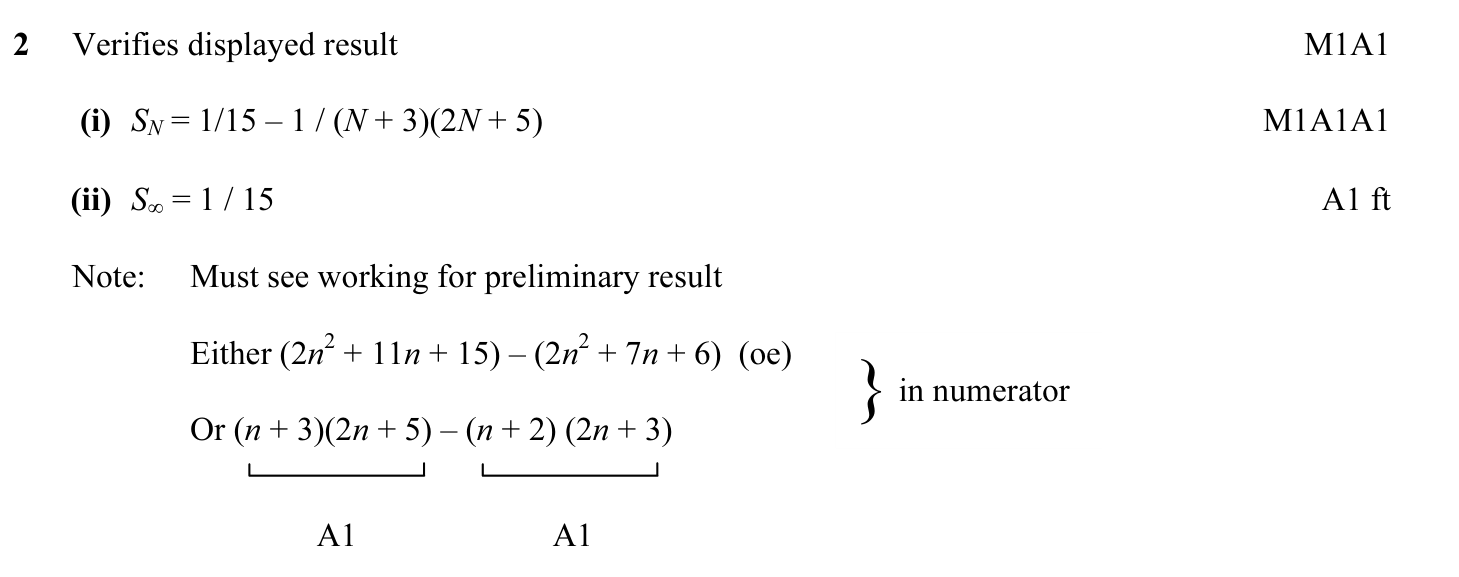
Verify that, for all positive values of \(n\),
\(\frac{1}{(n+2)(2 n+3)}-\frac{1}{(n+3)(2 n+5)}=\frac{4 n+9}{(n+2)(n+3)(2 n+3)(2 n+5)} .\)
For the series
\(\sum_{n=1}^{N} \frac{4 n+9}{(n+2)(n+3)(2 n+3)(2 n+5)},\)
find
(i) the sum to \(N\) terms,
(ii) the sum to infinity.
9231 P13 - Jun 2010 - Q2 - 5 marks
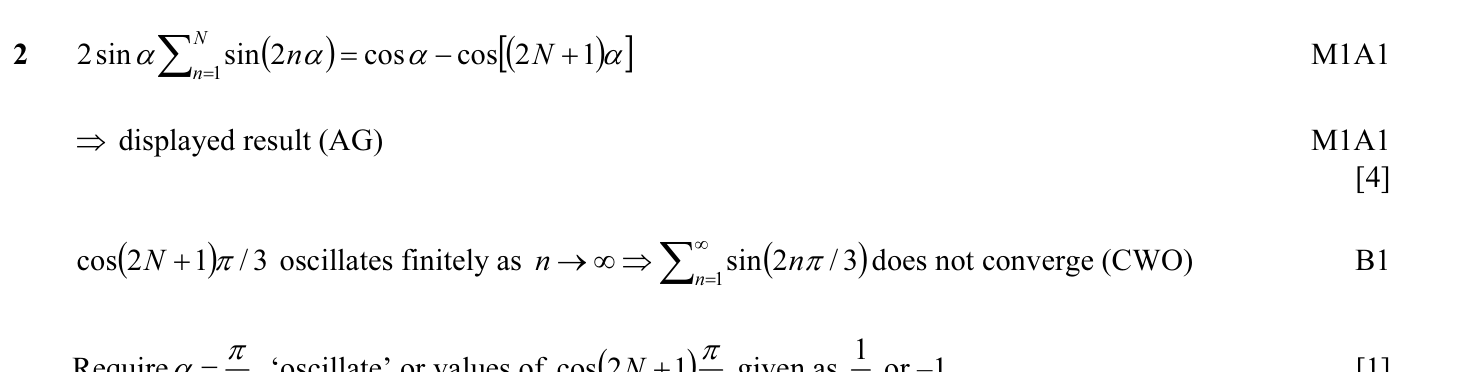
By considering the identity
\(\cos [(2 n-1) \alpha]-\cos [(2 n+1) \alpha] \equiv 2 \sin \alpha \sin 2 n \alpha,\)
show that if \(\alpha\) is not an integer multiple of \(\pi\) then
\(\sum_{n=1}^{N} \sin (2 n \alpha)=\frac{1}{2} \cot \alpha-\frac{1}{2} \operatorname{cosec} \alpha \cos [(2 N+1) \alpha]\)
Deduce that the infinite series
\(\sum_{n=1}^{\infty} \sin \left(\frac{2}{3} n \pi\right)\)
does not converge.
0606 P22 - Nov 2024 - Q6 - 5 marks
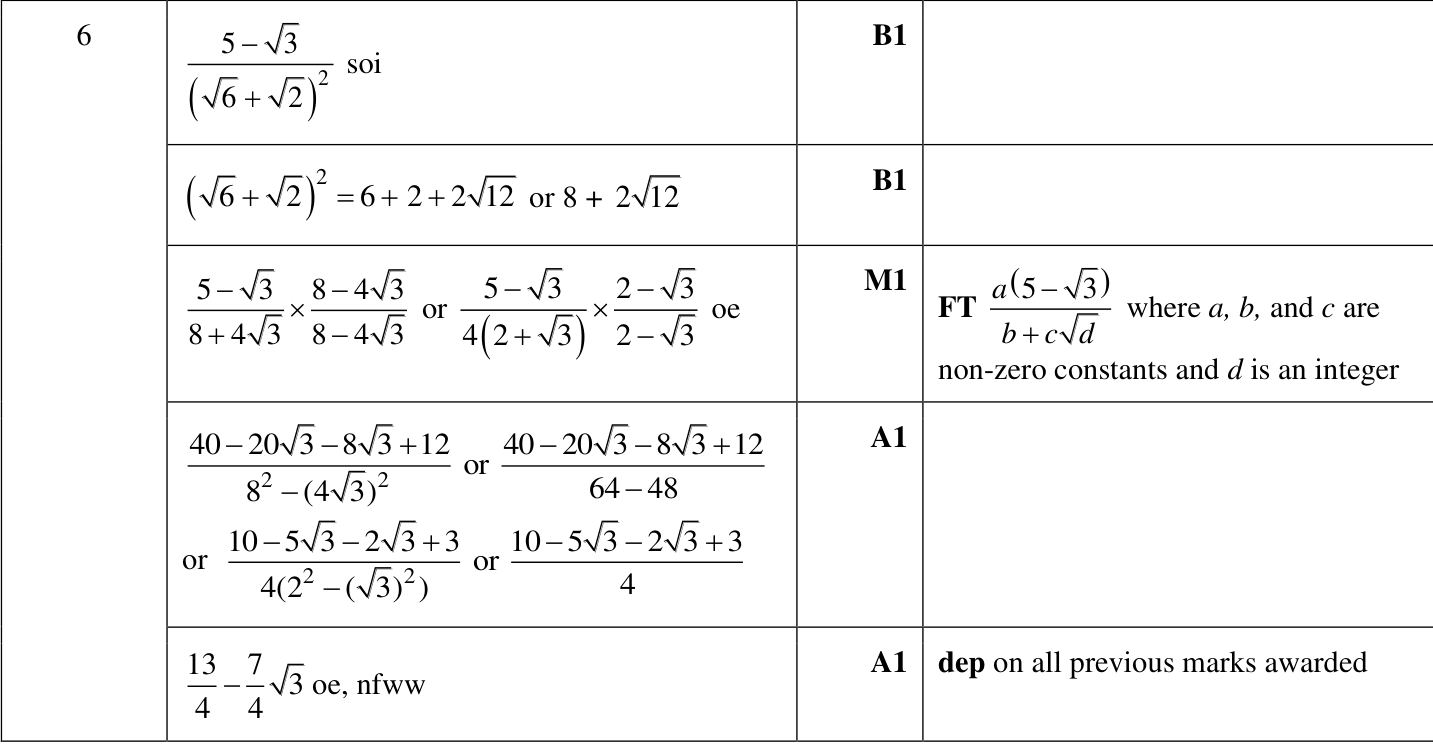
DO NOT USE A CALCULATOR IN THIS QUESTION. Write \(\quad(5-\sqrt{3})(\sqrt{6}+\sqrt{2})^{-2}\) in the form \(a+b \sqrt{3}\), where \(a\) and \(b\) are constants.