9709 P13 - Nov 2011 - Q8 - 8 marks
266
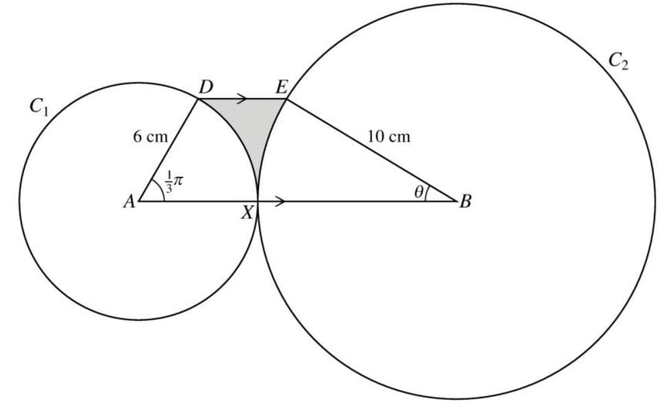
The diagram shows a circle \(C_1\) touching a circle \(C_2\) at a point \(X\). Circle \(C_1\) has centre \(A\) and radius 6 cm, and circle \(C_2\) has centre \(B\) and radius 10 cm. Points \(D\) and \(E\) lie on \(C_1\) and \(C_2\) respectively and \(DE\) is parallel to \(AB\). Angle \(DAX = \frac{1}{3}\pi\) radians and angle \(EBX = \theta\) radians.
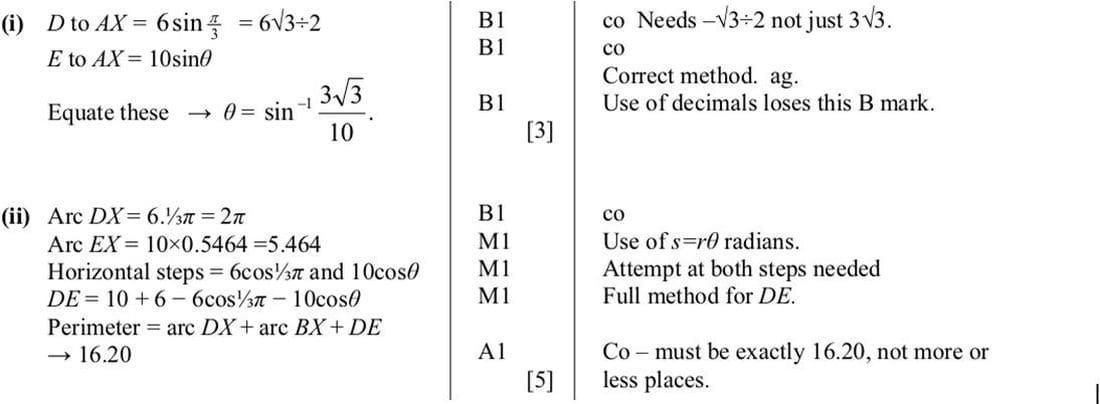
(i) By considering the perpendicular distances of \(D\) and \(E\) from \(AB\), show that the exact value of \(\theta\) is \(\sin^{-1}\left(\frac{3\sqrt{3}}{10}\right)\).
(ii) Find the perimeter of the shaded region, correct to 4 significant figures.