Past Exam Questions
← Back9231 P13 - Jun 2018 - Q2 - 6 marks
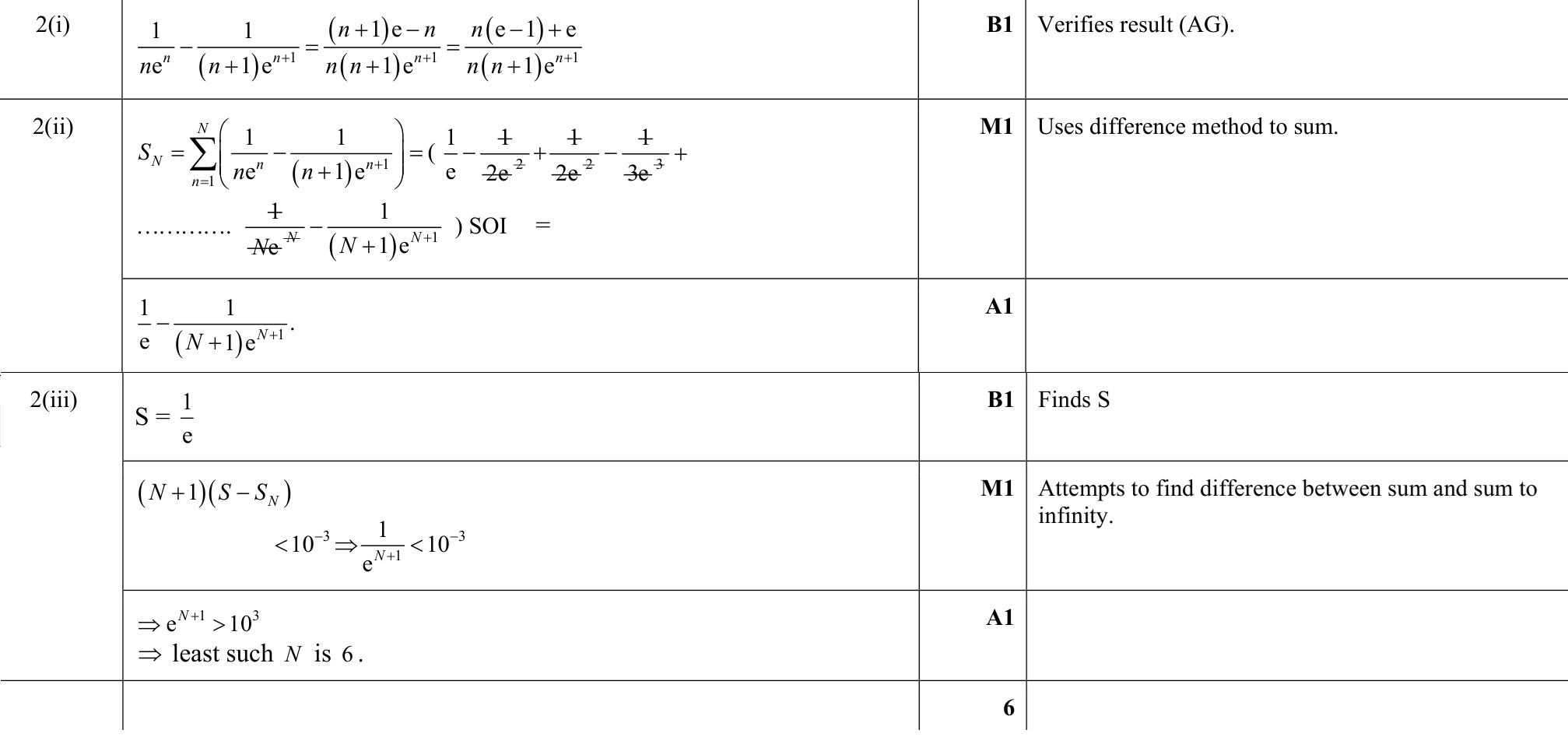
(i) Verify that
\(\frac{n(\mathrm{e}-1)+\mathrm{e}}{n(n+1) \mathrm{e}^{n+1}}=\frac{1}{n \mathrm{e}^{n}}-\frac{1}{(n+1) \mathrm{e}^{n+1}} .\)
Let \(S_{N}=\sum_{n=1}^{N} \frac{n(\mathrm{e}-1)+\mathrm{e}}{n(n+1) \mathrm{e}^{n+1}}\).
(ii) Express \(S_{N}\) in terms of \(N\) and e.
Let \(S=\lim _{N \rightarrow \infty} S_{N}\).
(iii) Find the least value of \(N\) such that \((N+1)\left(S-S_{N}\right)\lt10^{-3}\).
9231 P12 - Nov 2018 - Q7 - 10 marks
Let
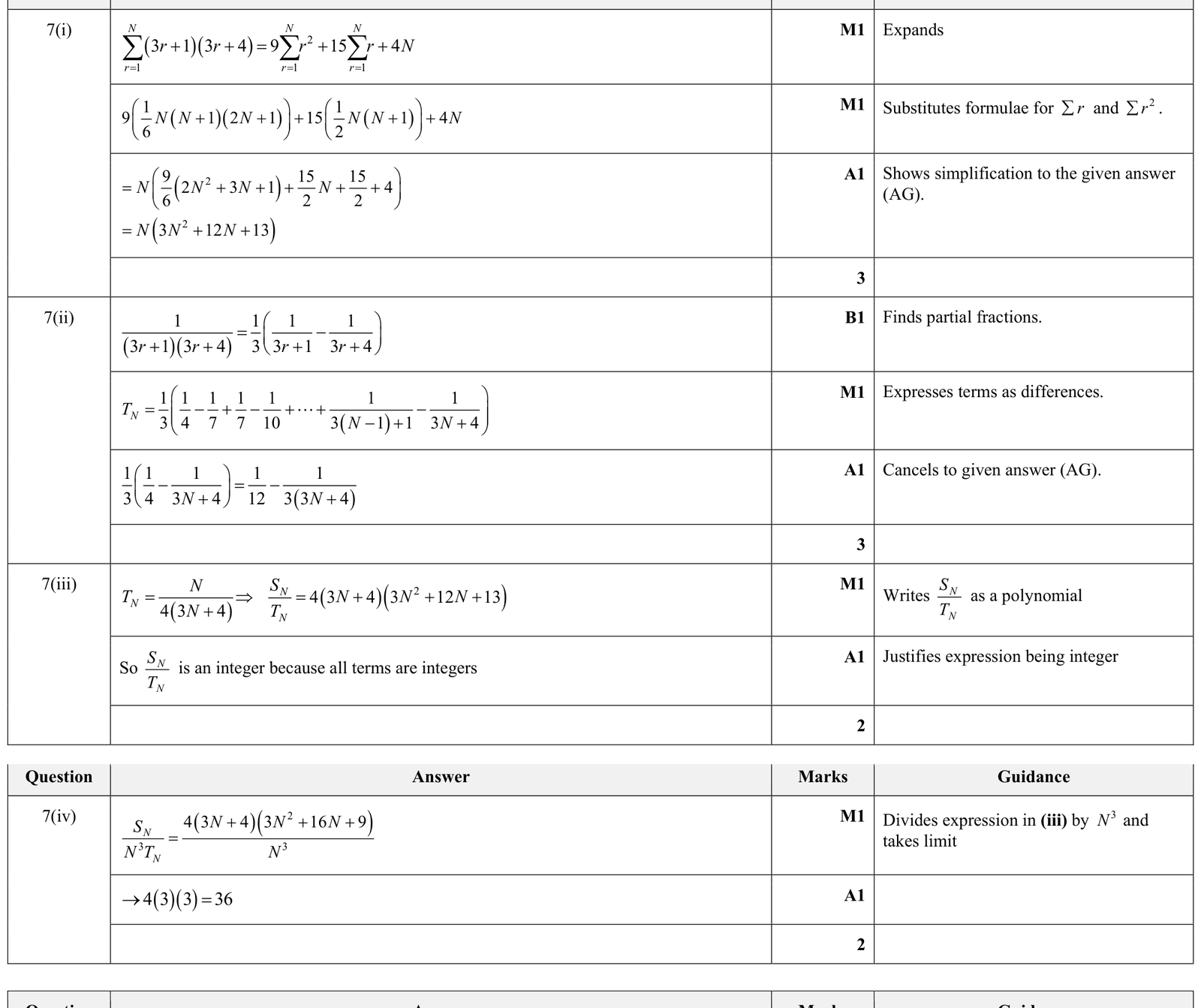
\(S_{N}=\sum_{r=1}^{N}(3 r+1)(3 r+4) \quad \text { and } \quad T_{N}=\sum_{r=1}^{N} \frac{1}{(3 r+1)(3 r+4)} .\)
(i) Use standard results from the List of Formulae (MF10) to show that
\(S_{N}=N\left(3 N^{2}+12 N+13\right)\)
(ii) Use the method of differences to show that
\(T_{N}=\frac{1}{12}-\frac{1}{3(3 N+4)}\)
(iii) Deduce that \(\frac{S_{N}}{T_{N}}\) is an integer.
(iv) Find \(\lim _{N \rightarrow \infty} \frac{S_{N}}{N^{3} T_{N}}\).
9231 P11 - Jun 2017 - Q1 - 5 marks
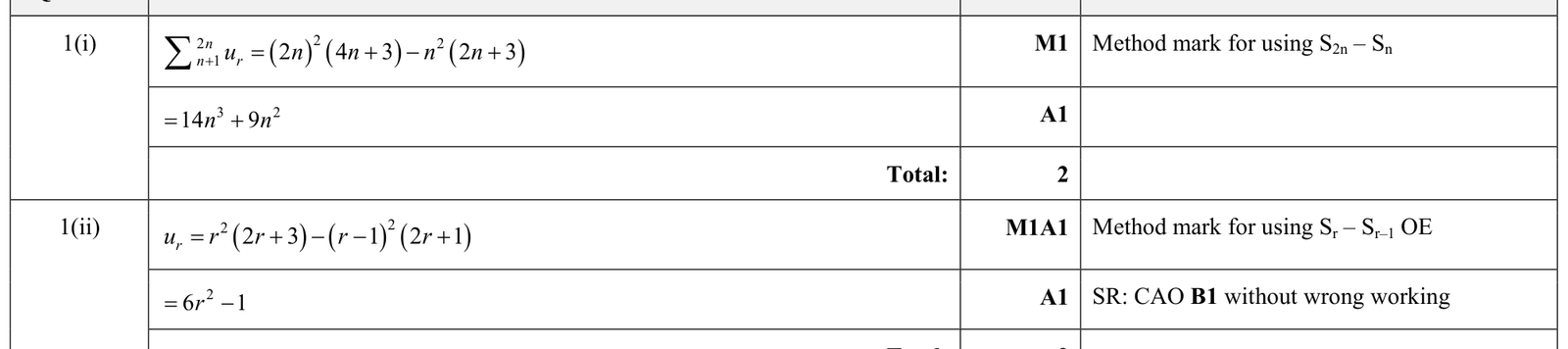
It is given that \(\sum_{r=1}^{n} u_{r}=n^{2}(2 n+3)\), where \(n\) is a positive integer.
(i) Find \(\sum_{r=n+1}^{2 n} u_{r}\).
(ii) Find \(u_{r}\).
9231 P13 - Jun 2017 - Q2 - 6 marks
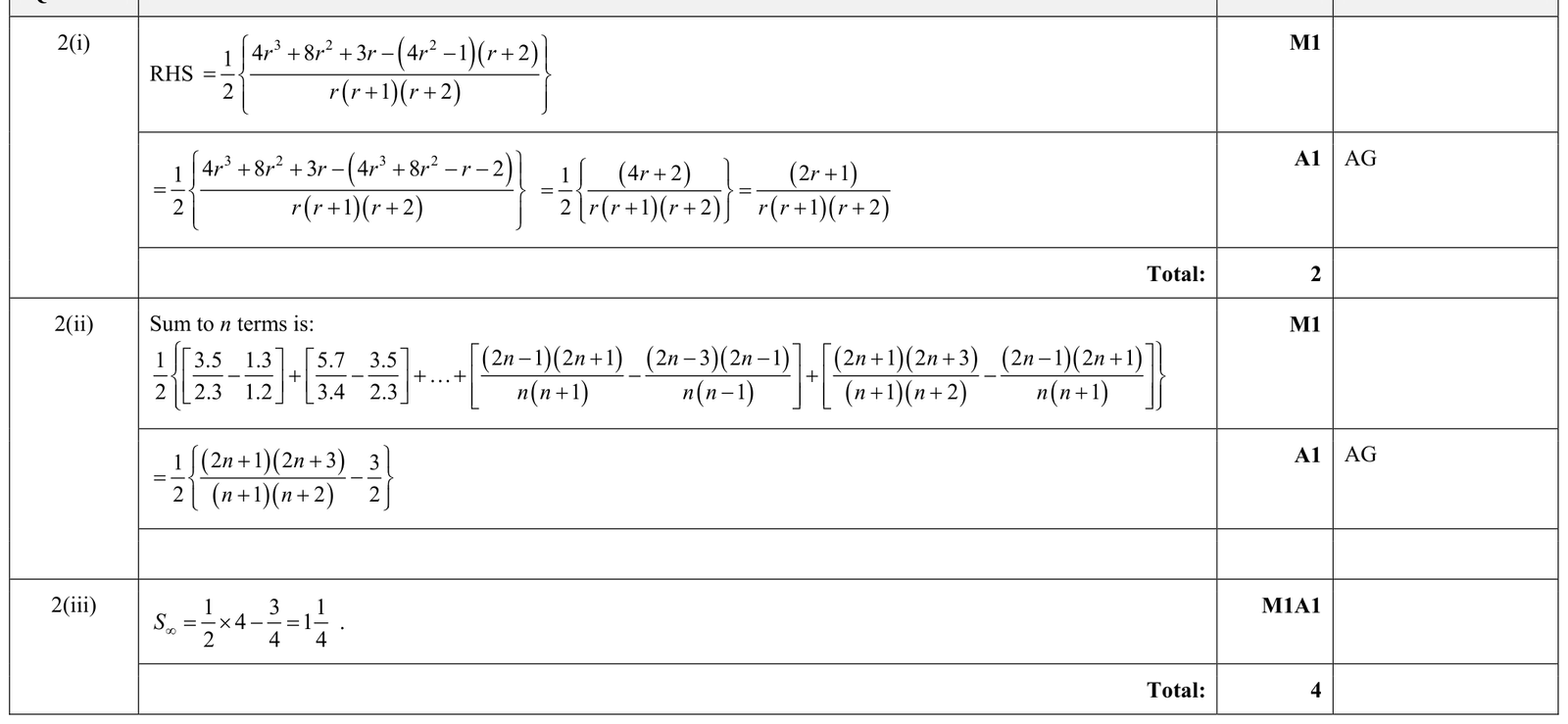
(i) Verify that \(\frac{2 r+1}{r(r+1)(r+2)}=\frac{1}{2}\left\{\frac{(2 r+1)(2 r+3)}{(r+1)(r+2)}-\frac{(2 r-1)(2 r+1)}{r(r+1)}\right\}\).
(ii) Hence show that \(\sum_{r=1}^{n} \frac{2 r+1}{r(r+1)(r+2)}=\frac{1}{2}\left\{\frac{(2 n+1)(2 n+3)}{(n+1)(n+2)}-\frac{3}{2}\right\}\).
(iii) Deduce the value of \(\sum_{r=1}^{\infty} \frac{2 r+1}{r(r+1)(r+2)}\).
9231 P11 - Jun 2014 - Q2 - 5 marks
Expand and simplify \((r+1)^{4}-r^{4}\).
Use the method of differences together with the standard results for \(\sum_{r=1}^{n} r\) and \(\sum_{r=1}^{n} r^{2}\) to show that
\(\sum_{r=1}^{n} r^{3}=\frac{1}{4} n^{2}(n+1)^{2} .\)

9231 P11 - Jun 2015 - Q1 - 4 marks
Use the List of Formulae (MF10) to show that \(\sum_{r=1}^{13}\left(3 r^{2}-5 r+1\right)\) and \(\sum_{r=0}^{9}\left(r^{3}-1\right)\) have the same numerical value.

9231 P11 - Nov 2016 - Q1 - 5 marks
Use the method of differences to find \(\sum_{r=1}^{n} \frac{1}{(2 r)^{2}-1}\).
Deduce the value of \(\sum_{r=1}^{\infty} \frac{1}{(2 r)^{2}-1}\).

9231 P13 - Jun 2016 - Q1 - 6 marks
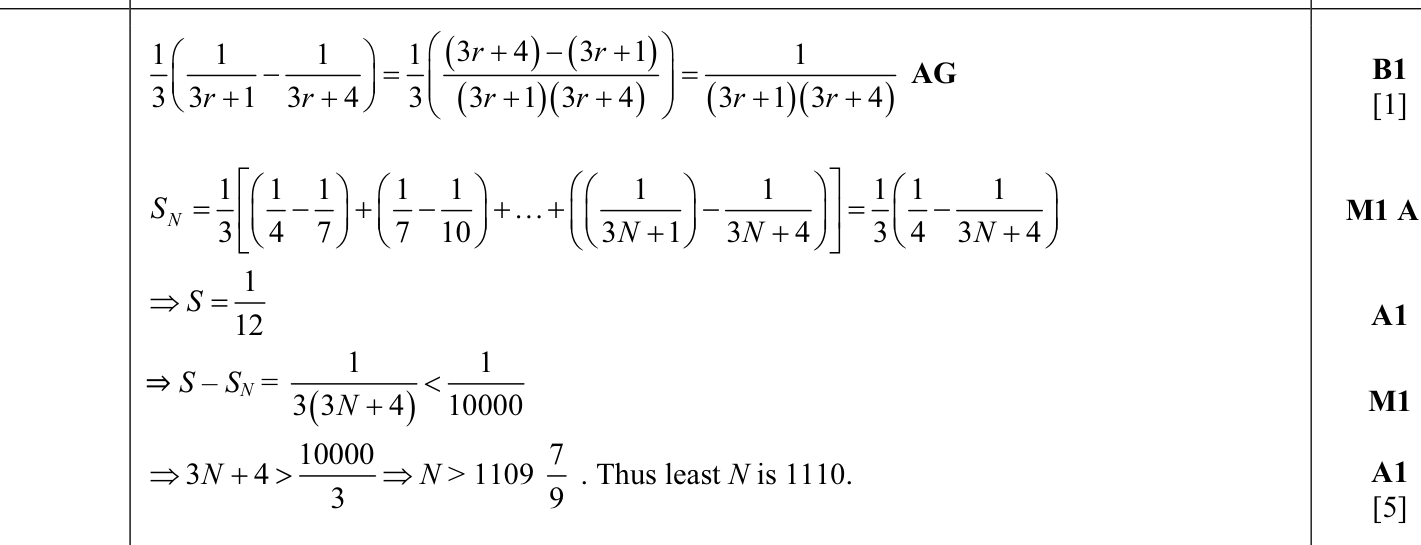
Verify that \(\dfrac{1}{(3r+1)(3r+4)}=\dfrac{1}{3}\left(\dfrac{1}{3r+1}-\dfrac{1}{3r+4}\right)\).
Let \(S_N\) denote \(\sum_{r=1}^{N}\dfrac{1}{(3r+1)(3r+4)}\) and let \(S\) denote \(\sum_{r=1}^{\infty}\dfrac{1}{(3r+1)(3r+4)}\). Find the least value of \(N\) such that \(S-S_N\lt\dfrac{1}{10000}\).
9231 P11 - Jun 2016 - Q2 - 6 marks
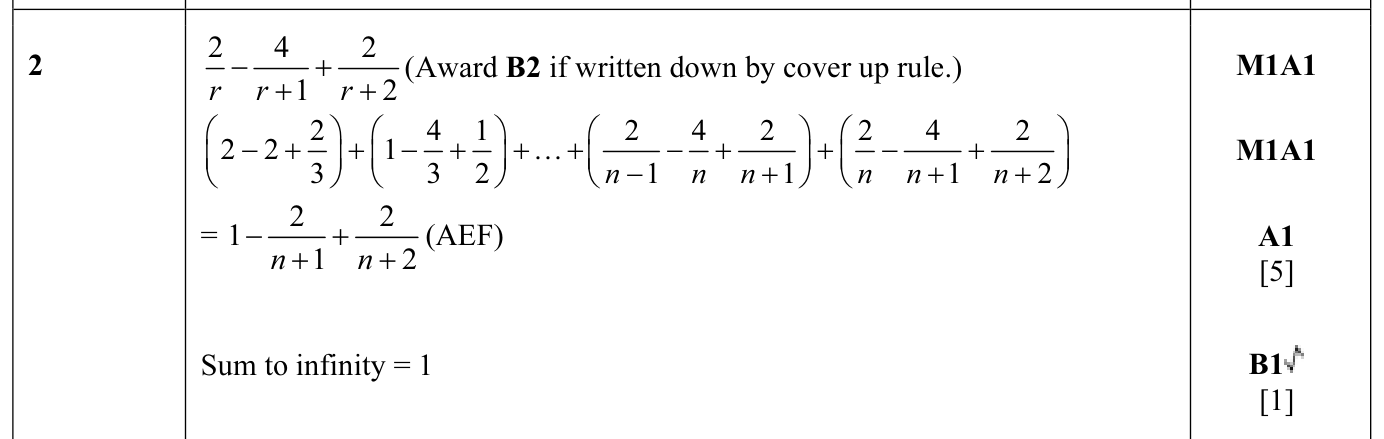
Express \(\frac{4}{r(r+1)(r+2)}\) in partial fractions and hence find \(\sum_{r=1}^{n} \frac{4}{r(r+1)(r+2)}\).
Deduce the value of \(\sum_{r=1}^{\infty} \frac{4}{r(r+1)(r+2)}\).
9231 P11 - Nov 2017 - Q1 - 4 marks
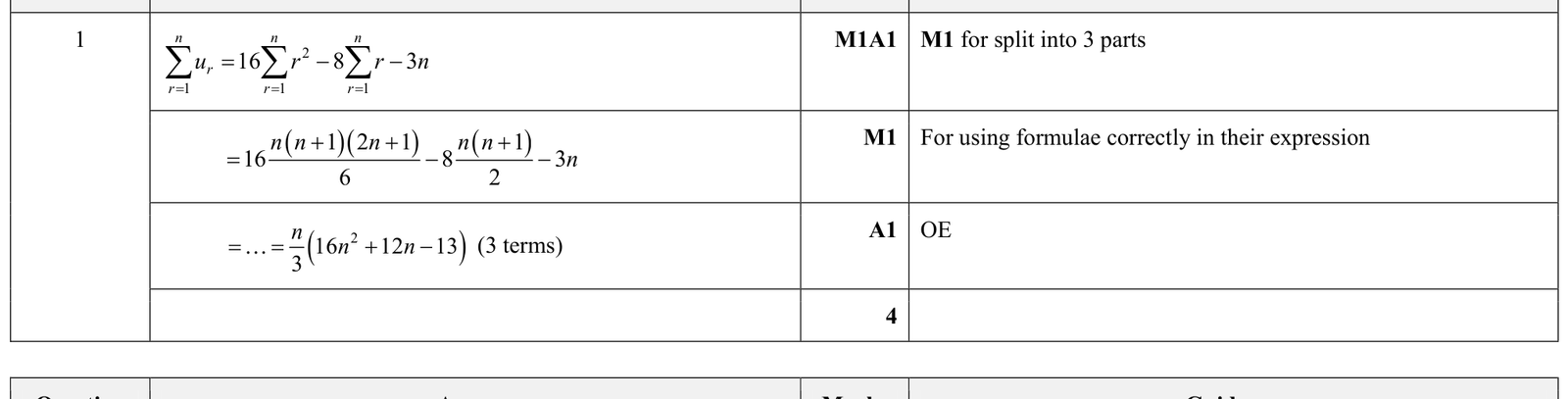
Find \(\sum_{r=1}^{n}(4 r-3)(4 r+1)\), giving your answer in its simplest form.
9231 P12 - Nov 2014 - Q1 - 5 marks
Given that
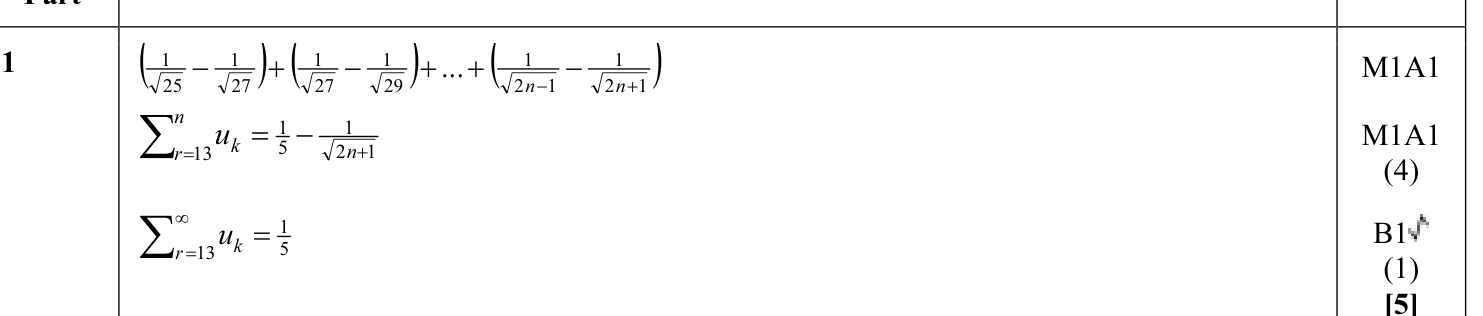
\(u_{k}=\frac{1}{\sqrt{2 k-1}}-\frac{1}{\sqrt{2 k+1}},\)
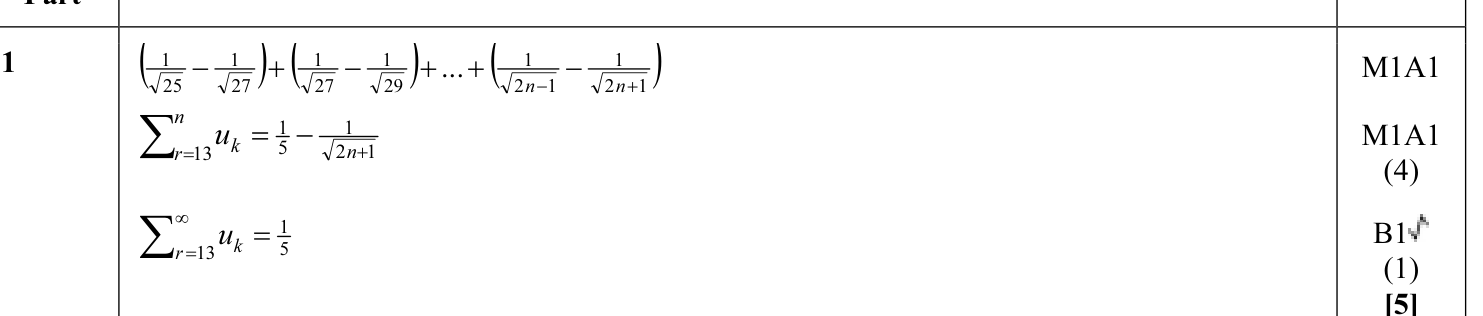
express \(\sum_{k=13}^{n} u_{k}\) in terms of \(n\).
Deduce the value of \(\sum_{k=13}^{\infty} u_{k}\).
9231 P11 - Nov 2014 - Q1 - 5 marks
Given that
\(u_{k}=\frac{1}{\sqrt{2 k-1}}-\frac{1}{\sqrt{2 k+1}},\)
express \(\sum_{k=13}^{n} u_{k}\) in terms of \(n\).
Deduce the value of \(\sum_{k=13}^{\infty} u_{k}\).
9231 P11 - Jun 2013 - Q5 - 9 marks
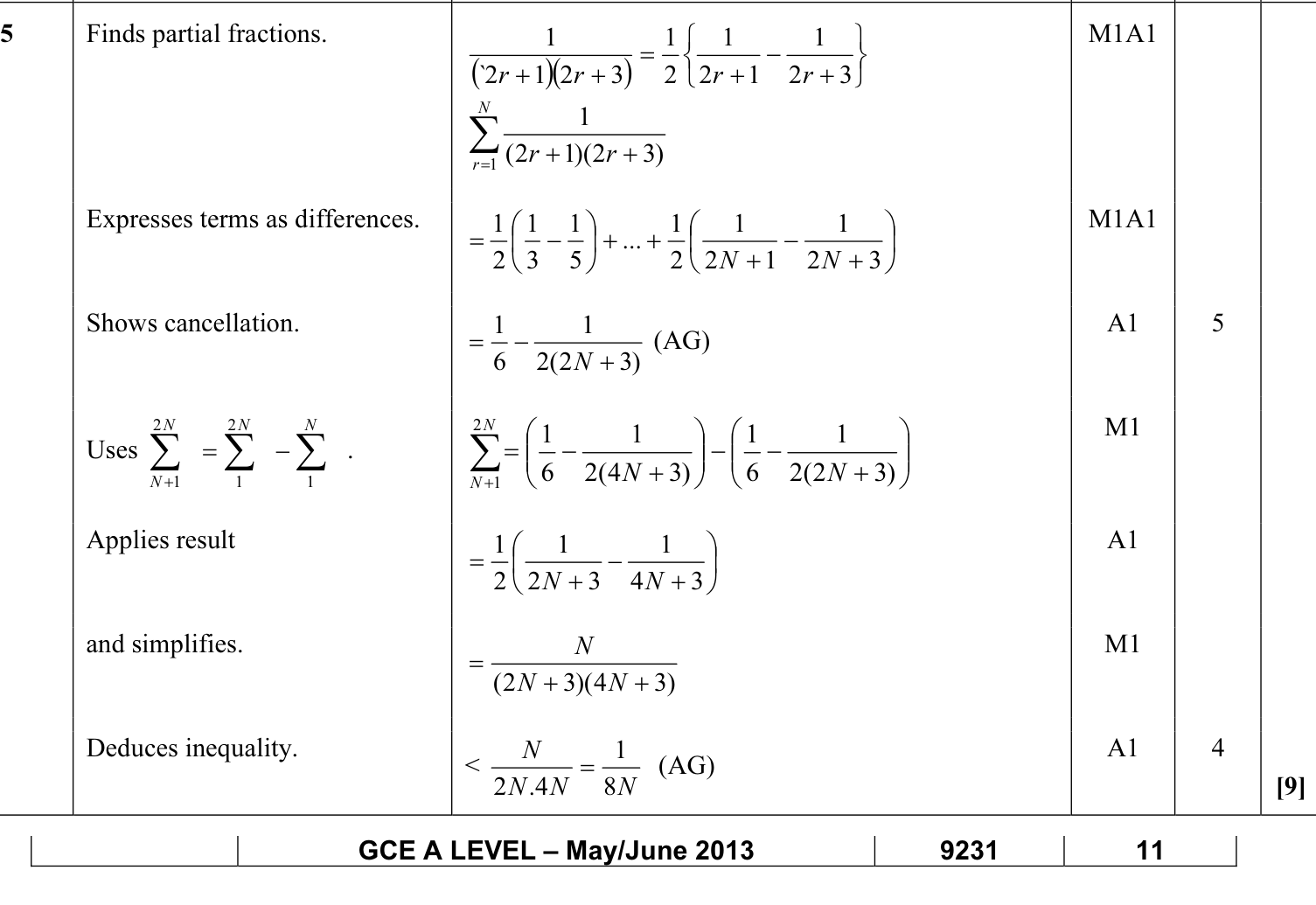
Use the method of differences to show that \(\sum_{r=1}^{N} \frac{1}{(2 r+1)(2 r+3)}=\frac{1}{6}-\frac{1}{2(2 N+3)}\).
Deduce that \(\sum_{r=N+1}^{2 N} \frac{1}{(2 r+1)(2 r+3)}\lt \frac{1}{8 N}\).
9231 P13 - Jun 2013 - Q1 - 5 marks
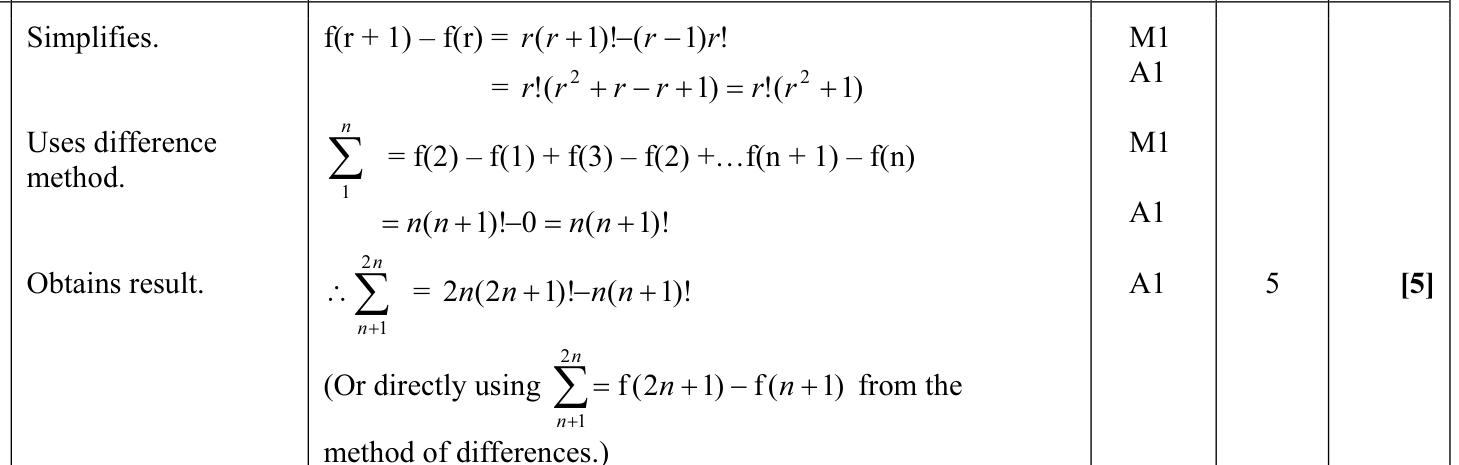
Let \(\mathrm{f}(r)=r!(r-1)\). Simplify \(\mathrm{f}(r+1)-\mathrm{f}(r)\) and hence find \(\sum_{r=n+1}^{2 n} r!\left(r^{2}+1\right)\).
9231 P11 - Nov 2013 - Q3 - 7 marks
It is given that
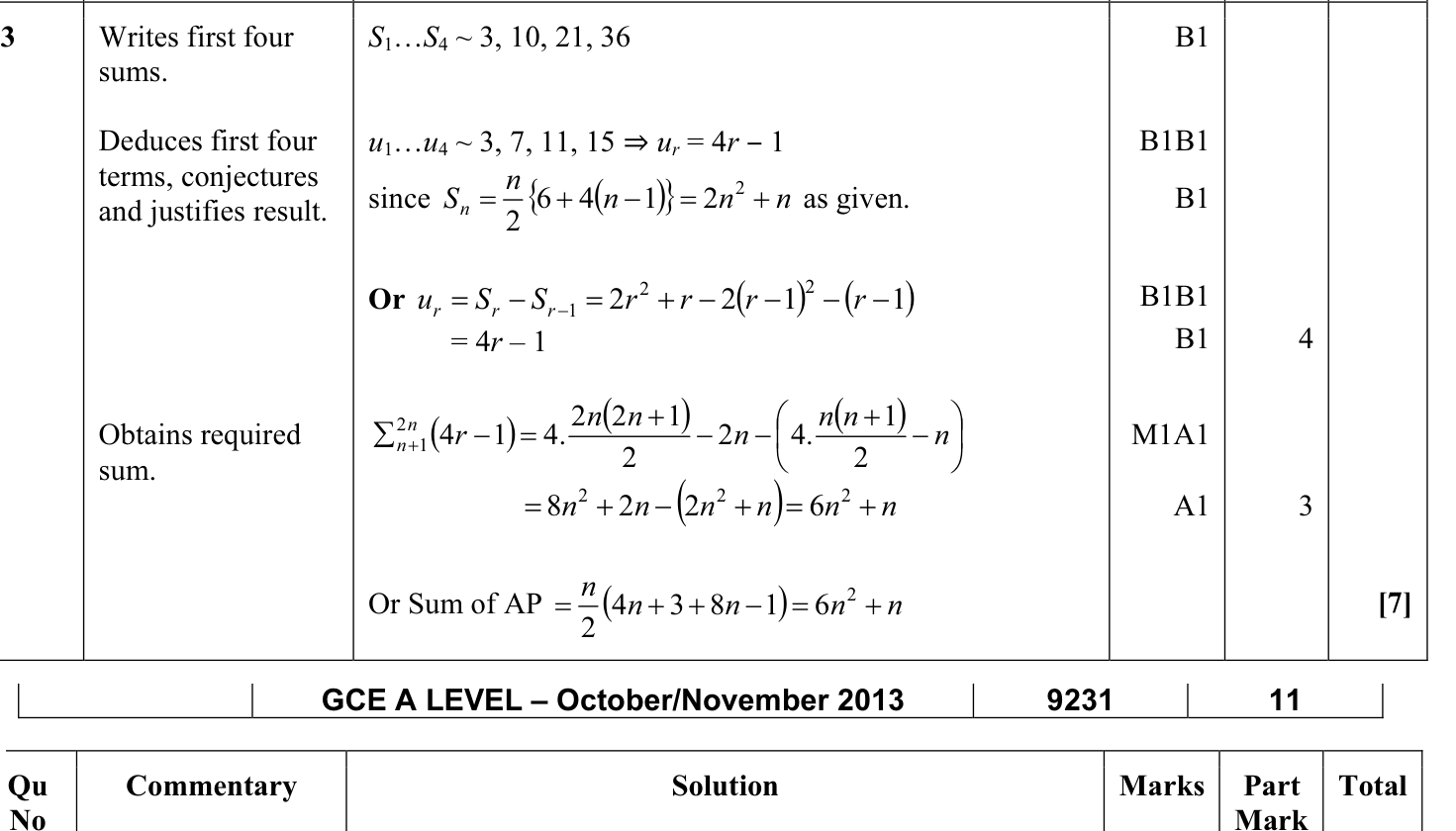
\(S_{n}=\sum_{r=1}^{n} u_{r}=2 n^{2}+n\)
Write down the values of \(S_{1}, S_{2}, S_{3}, S_{4}\). Express \(u_{r}\) in terms of \(r\), justifying your answer.
Find
\(\sum_{r=n+1}^{2 n} u_{r} .\)
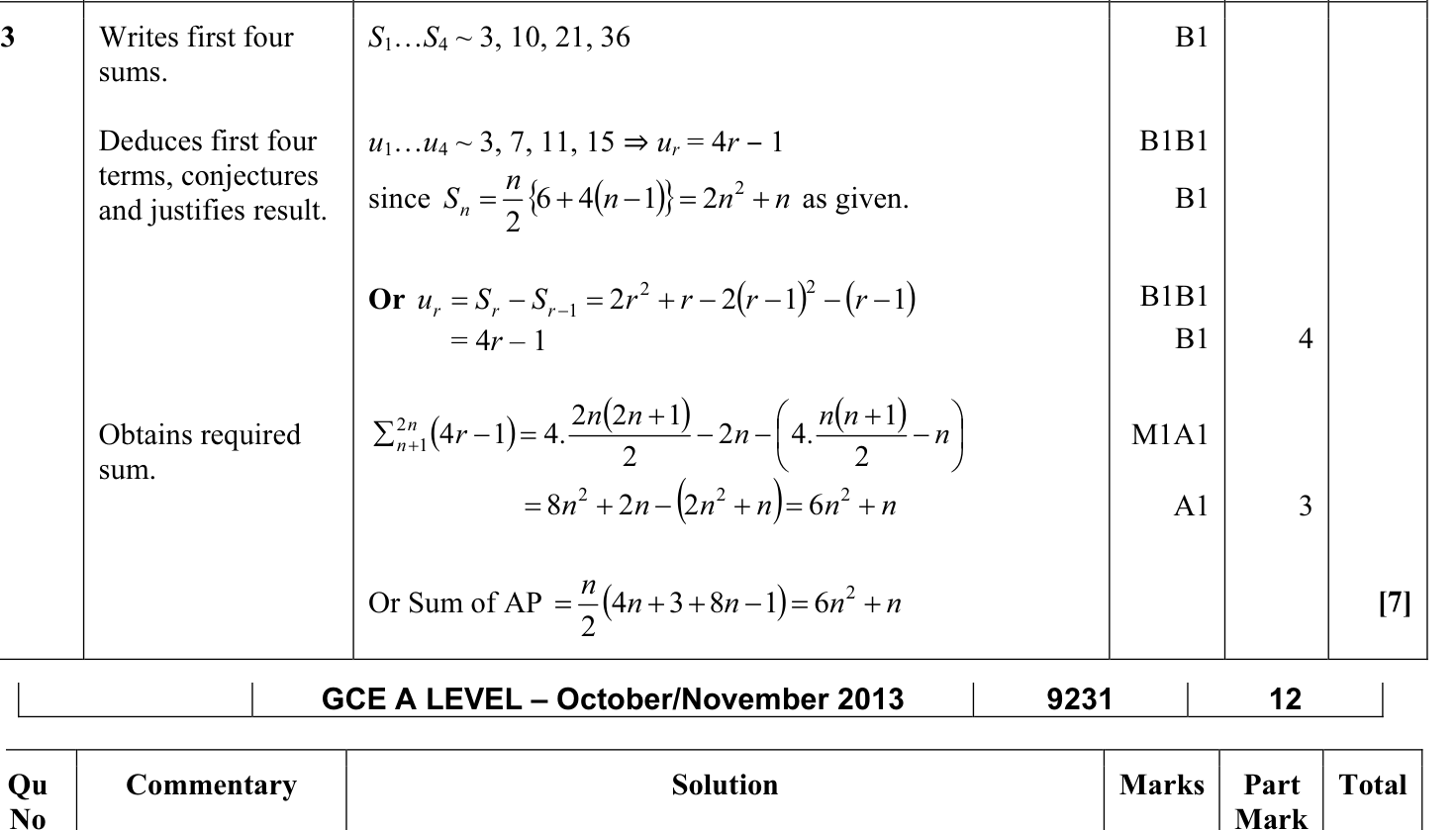
9231 P12 - Nov 2013 - Q3 - 7 marks
It is given that
\(S_{n}=\sum_{r=1}^{n} u_{r}=2 n^{2}+n\)
Write down the values of \(S_{1}, S_{2}, S_{3}, S_{4}\). Express \(u_{r}\) in terms of \(r\), justifying your answer.
Find
\(\sum_{r=n+1}^{2 n} u_{r} .\)
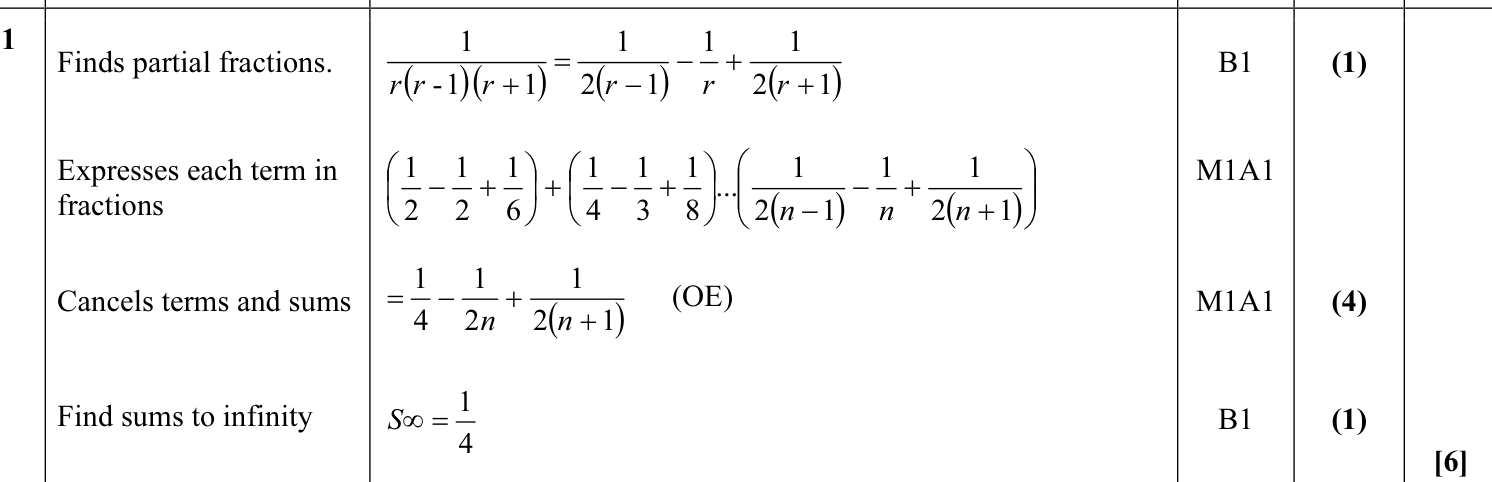
9231 P13 - Nov 2013 - Q1 - 6 marks
Express \(\frac{1}{r(r+1)(r-1)}\) in partial fractions.
Find
\(\sum_{r=2}^{n} \frac{1}{r(r+1)(r-1)}\)
State the value of
\(\sum_{r=2}^{\infty} \frac{1}{r(r+1)(r-1)} .\)
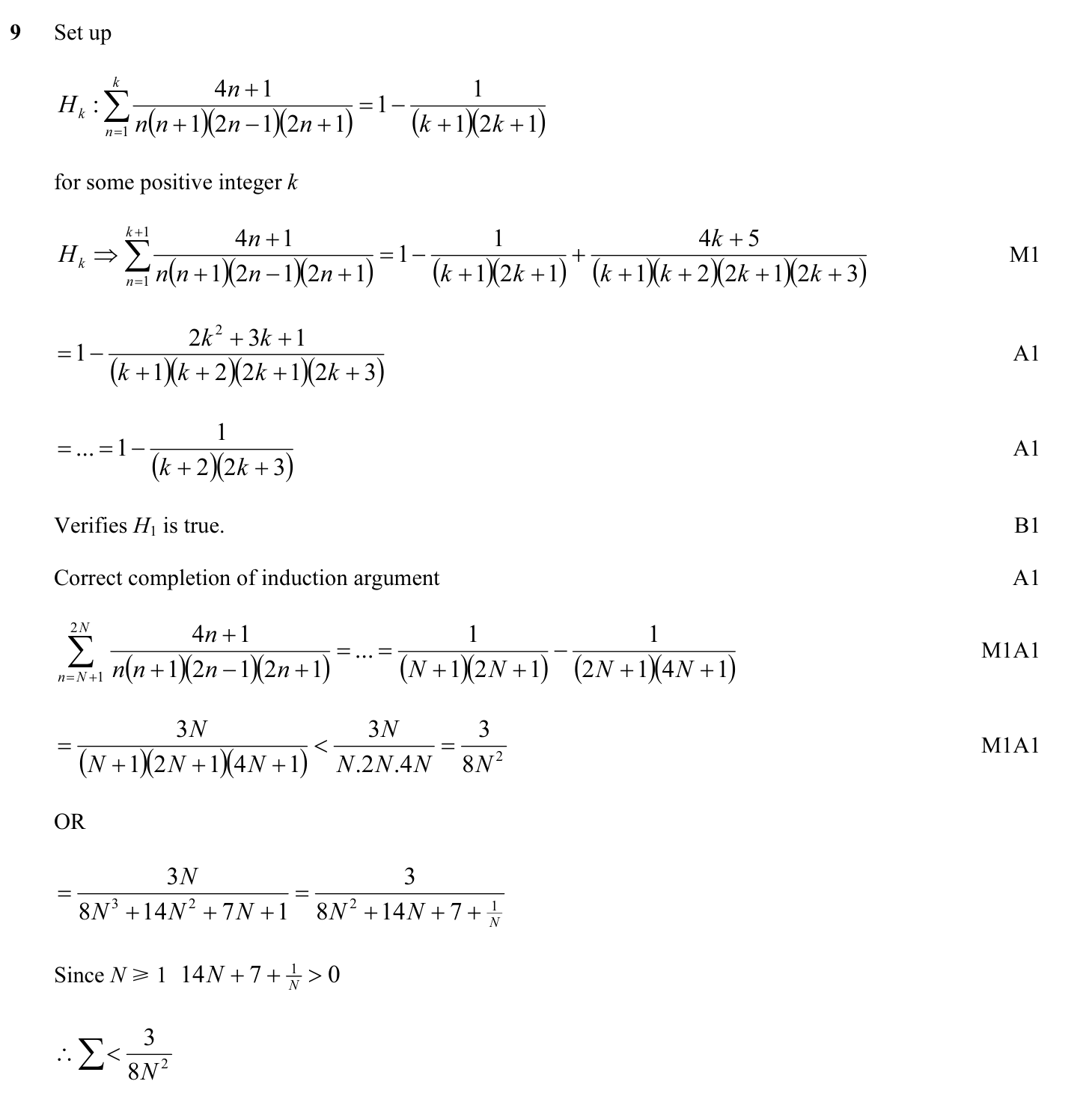
9231 P1 - Nov 2008 - Q9 - 10 marks
Use induction to prove that
\(\sum_{n=1}^{N} \frac{4 n+1}{n(n+1)(2 n-1)(2 n+1)}=1-\frac{1}{(N+1)(2 N+1)}\)
Show that
\(\sum_{n=N+1}^{2 N} \frac{4 n+1}{n(n+1)(2 n-1)(2 n+1)}\lt \frac{3}{8 N^{2}} .\)
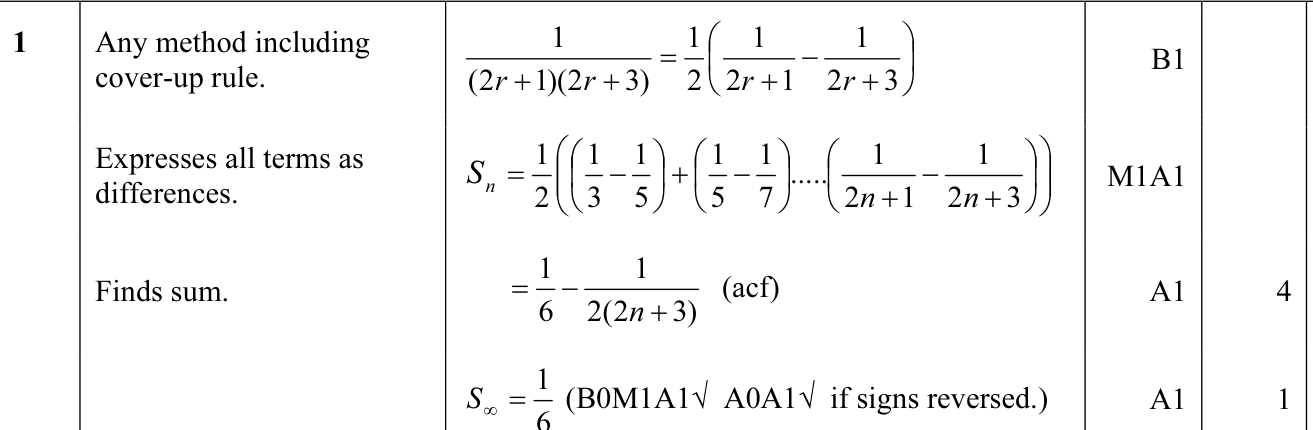
9231 P11 - Jun 2011 - Q1 - 5 marks
Express \(\frac{1}{(2 r+1)(2 r+3)}\) in partial fractions and hence use the method of differences to
\(\sum_{r=1}^{n} \frac{1}{(2 r+1)(2 r+3)}\)
Deduce the value of
\(\sum_{r=1}^{\infty} \frac{1}{(2 r+1)(2 r+3)}\)
9231 P12 - Jun 2014 - Q2 - 5 marks
Expand and simplify \((r+1)^{4}-r^{4}\).
Use the method of differences together with the standard results for \(\sum_{r=1}^{n} r\) and \(\sum_{r=1}^{n} r^{2}\) to show that
\(\sum_{r=1}^{n} r^{3}=\frac{1}{4} n^{2}(n+1)^{2} .\)
