Browsing as Guest. Progress, bookmarks and attempts are disabled.
Log in to track your work.
Problem 252
252
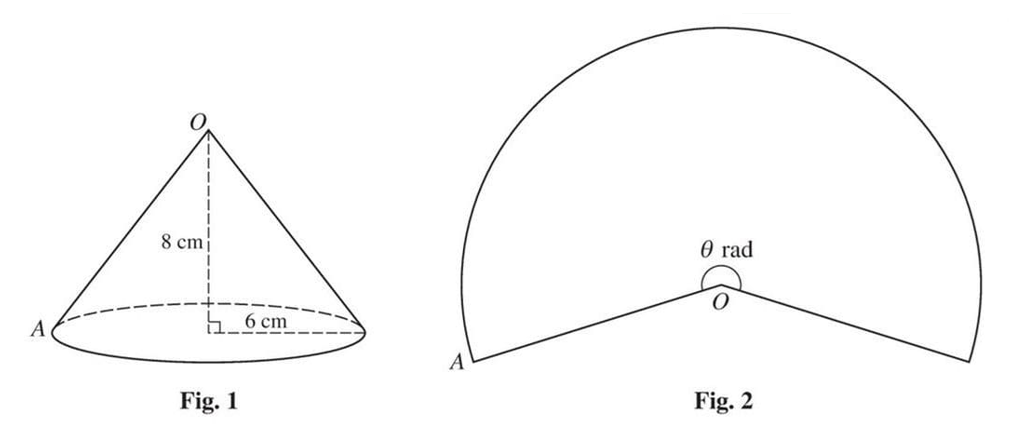
Fig. 1 shows a hollow cone with no base, made of paper. The radius of the cone is 6 cm and the height is 8 cm. The paper is cut from A to O and opened out to form the sector shown in Fig. 2. The circular bottom edge of the cone in Fig. 1 becomes the arc of the sector in Fig. 2. The angle of the sector is \(\theta\) radians. Calculate
(i) the value of \(\theta\),
(ii) the area of paper needed to make the cone.
Solution
(i) To find \(\theta\), first calculate the slant height of the cone using the Pythagorean theorem: \(l = \sqrt{6^2 + 8^2} = 10\) cm.
The circumference of the base of the cone is \(2\pi \times 6 = 12\pi\) cm.
The arc length of the sector is equal to the circumference of the base: \(10\theta = 12\pi\).
Solving for \(\theta\), we get \(\theta = \frac{12\pi}{10} = 1.2\pi\) or approximately 3.77 radians.
(ii) The area of the sector (paper) is given by \(\frac{1}{2} r^2 \theta\), where \(r = 10\) cm and \(\theta = 1.2\pi\).
Thus, the area is \(\frac{1}{2} \times 10^2 \times 1.2\pi = 60\pi\) cm\(^2\) or approximately 188.5 cm\(^2\).
