Past Exam Questions
← Back9709 P42 - Nov 2011 - Q2
A block of mass 6 kg is sliding down a line of greatest slope of a plane inclined at 8° to the horizontal. The coefficient of friction between the block and the plane is 0.2.
- Find the deceleration of the block.
- Given that the initial speed of the block is 3 m s-1, find how far the block travels.

9709 P41 - Nov 2020 - Q7
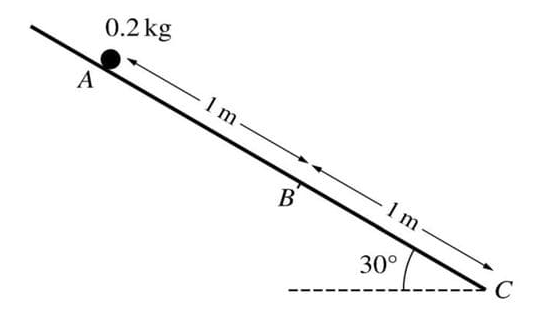
Three points A, B and C lie on a line of greatest slope of a plane inclined at an angle of 30° to the horizontal, with AB = 1 m and BC = 1 m, as shown in the diagram. A particle of mass 0.2 kg is released from rest at A and slides down the plane. The part of the plane from A to B is smooth. The part of the plane from B to C is rough, with coefficient of friction μ between the plane and the particle.
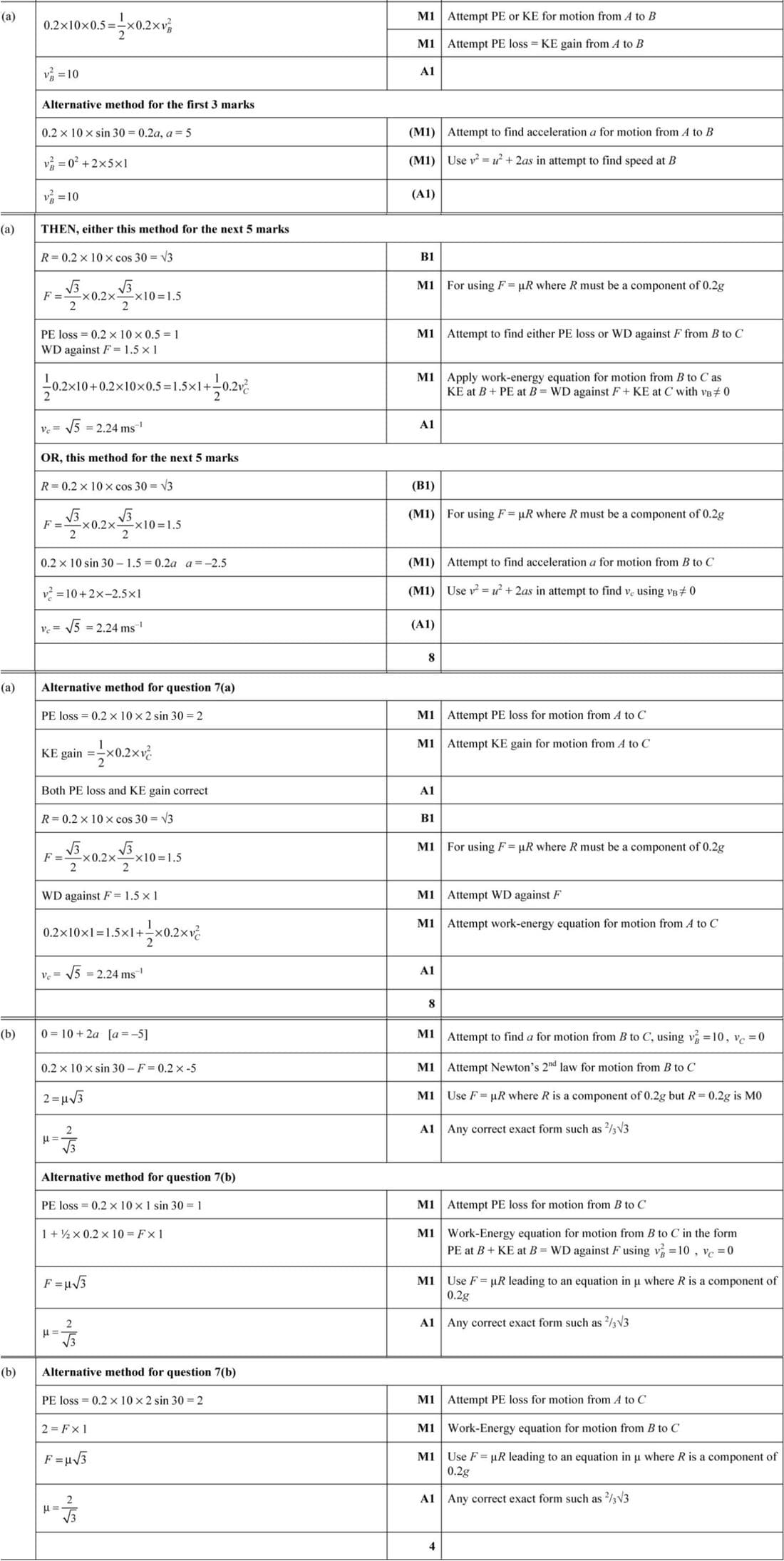
\((a) Given that μ = \frac{1}{2}\sqrt{3}, find the speed of the particle at C.\)
(b) Given instead that the particle comes to rest at C, find the exact value of μ.
9709 P41 - Nov 2018 - Q6
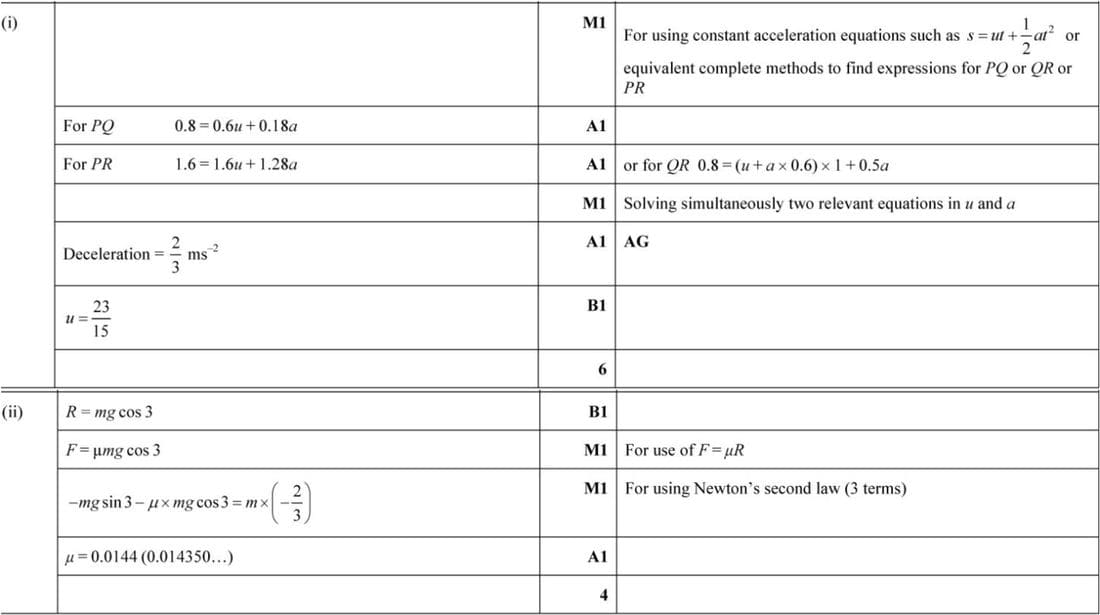
A particle is projected from a point P with initial speed u m s-1 up a line of greatest slope PQR of a rough inclined plane. The distances PQ and QR are both equal to 0.8 m. The particle takes 0.6 s to travel from P to Q and 1 s to travel from Q to R.
- Show that the deceleration of the particle is \(\frac{2}{3}\) m s-2 and hence find u, giving your answer as an exact fraction.
- Given that the plane is inclined at 3° to the horizontal, find the value of the coefficient of friction between the particle and the plane.
9709 P43 - Nov 2017 - Q3
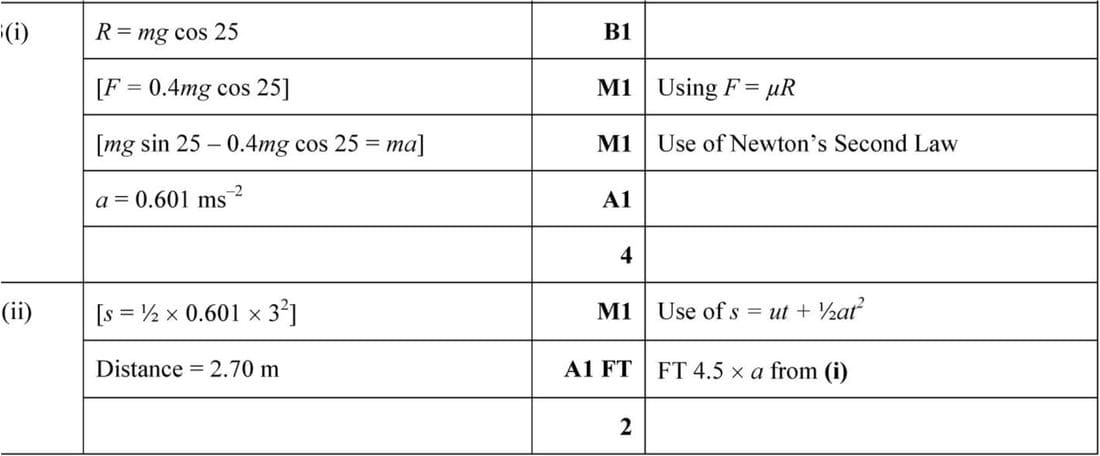
A particle is released from rest and slides down a line of greatest slope of a rough plane which is inclined at 25° to the horizontal. The coefficient of friction between the particle and the plane is 0.4.
- Find the acceleration of the particle.
- Find the distance travelled by the particle in the first 3 s after it is released.
9709 P41 - Nov 2016 - Q2
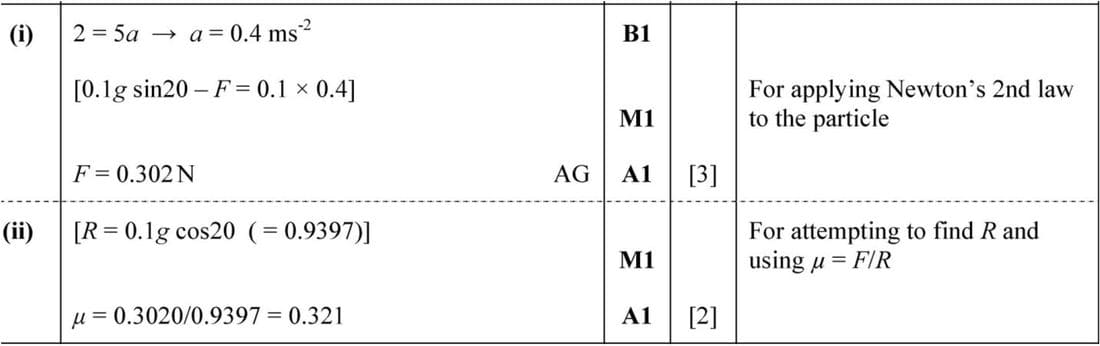
A particle of mass 0.1 kg is released from rest on a rough plane inclined at 20° to the horizontal. It is given that, 5 seconds after release, the particle has a speed of 2 m/s-1.
- Find the acceleration of the particle and hence show that the magnitude of the frictional force acting on the particle is 0.302 N, correct to 3 significant figures.
- Find the coefficient of friction between the particle and the plane.
9709 P41 - Nov 2015 - Q2
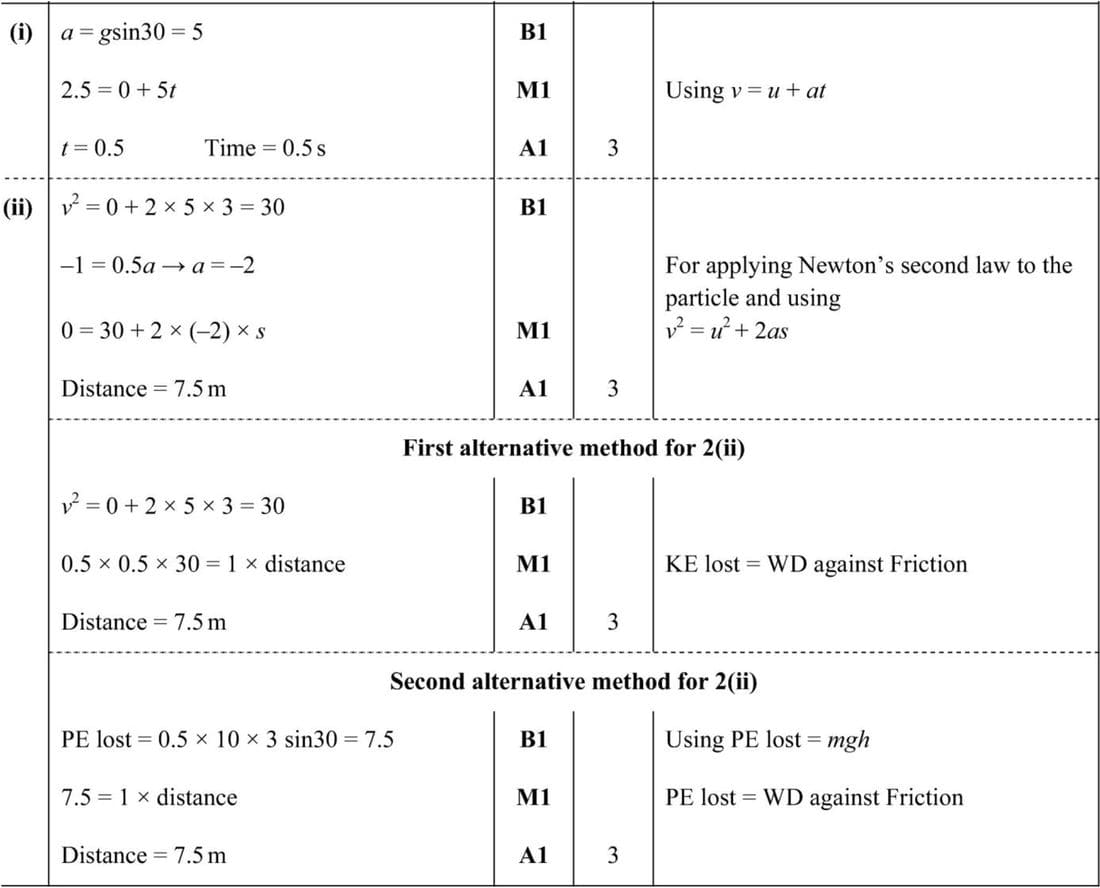
A particle of mass 0.5 kg starts from rest and slides down a line of greatest slope of a smooth plane. The plane is inclined at an angle of 30° to the horizontal.
(i) Find the time taken for the particle to reach a speed of 2.5 m s-1.
When the particle has travelled 3 m down the slope from its starting point, it reaches rough horizontal ground at the bottom of the slope. The frictional force acting on the particle is 1 N.
(ii) Find the distance that the particle travels along the ground before it comes to rest.
9709 P41 - Jun 2015 - Q3
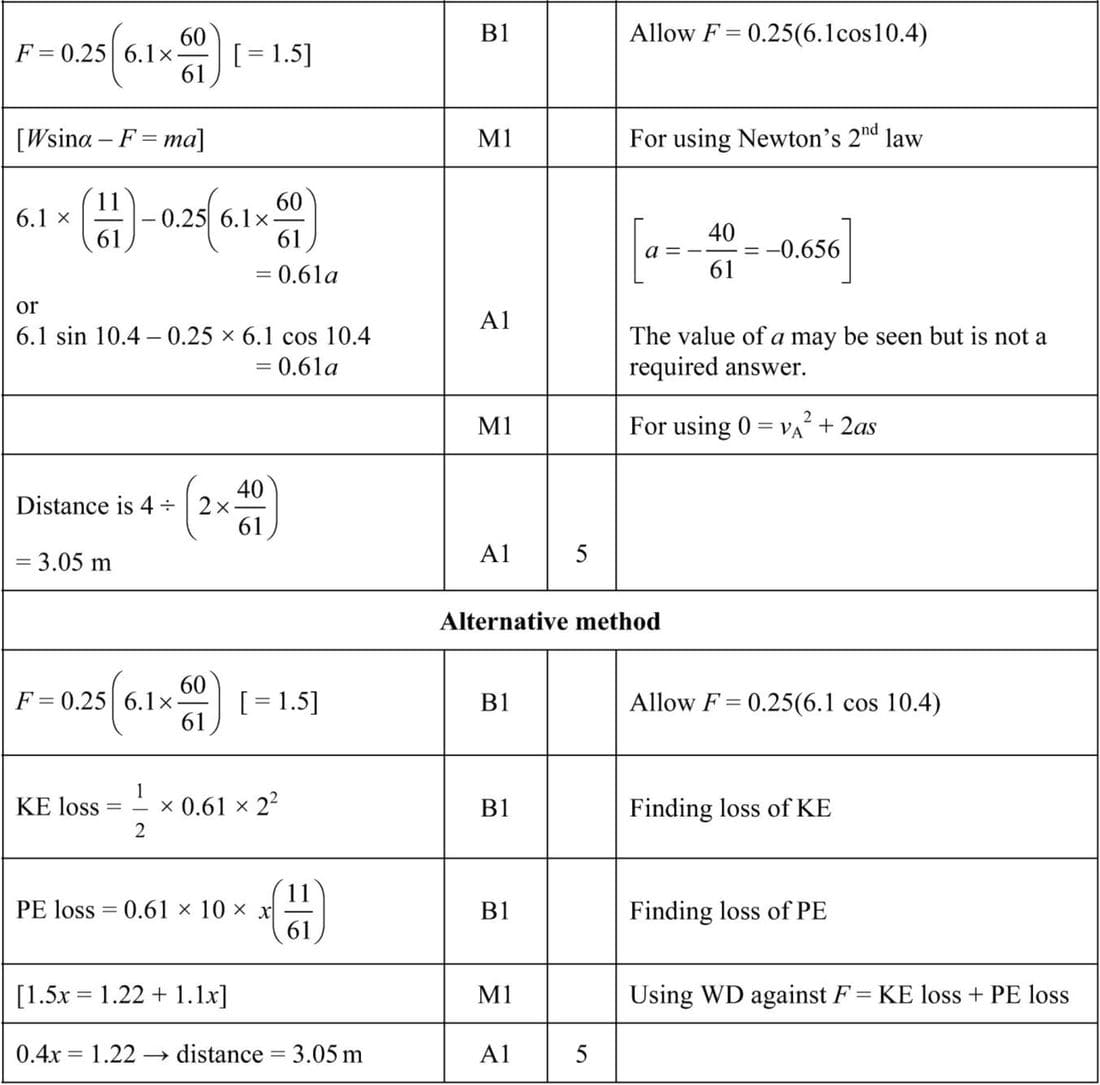
A block of weight 6.1 N slides down a slope inclined at \(\arctan\left(\frac{11}{60}\right)\) to the horizontal. The coefficient of friction between the block and the slope is \(\frac{1}{4}\). The block passes through a point A with speed 2 m s\(^{-1}\). Find how far the block moves from A before it comes to rest.
9709 P42 - Nov 2014 - Q6
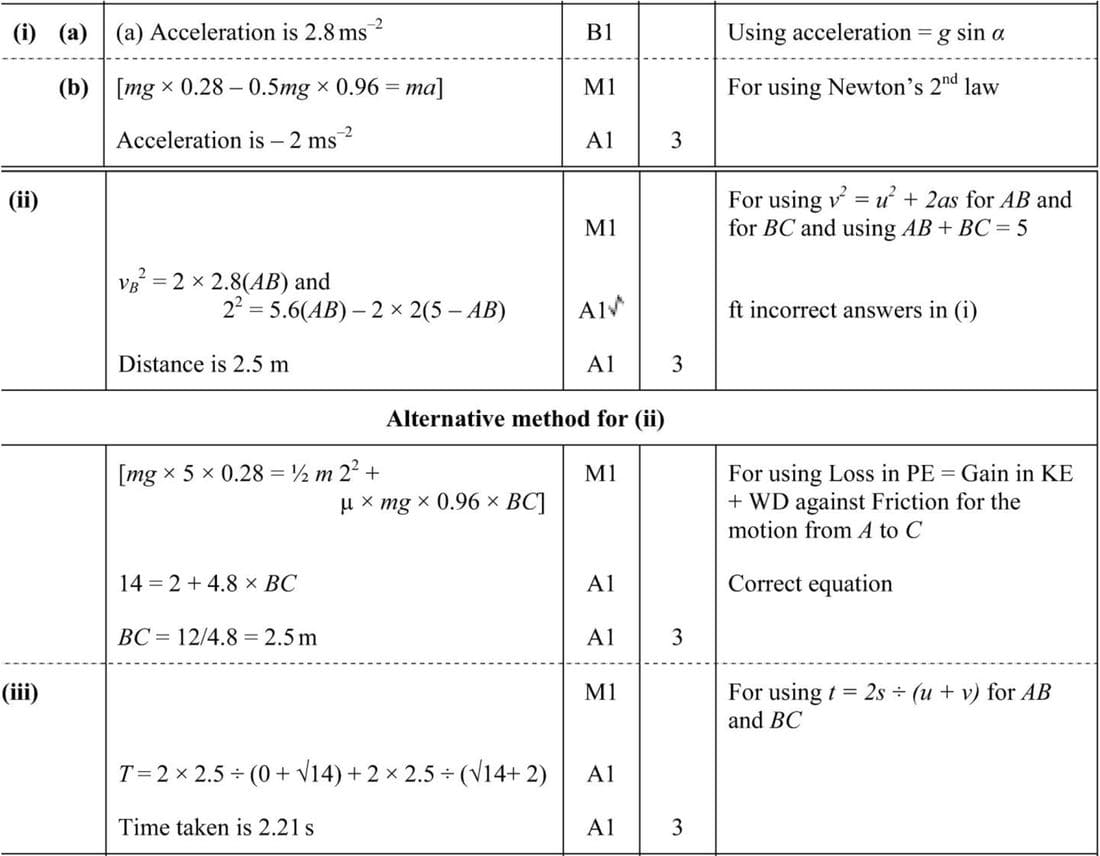
ABC is a line of greatest slope of a plane inclined at angle \(\alpha\) to the horizontal, where \(\sin \alpha = 0.28\) and \(\cos \alpha = 0.96\). The point A is at the top of the plane, the point C is at the bottom of the plane and the length of AC is 5 m. The part of the plane above the level of B is smooth and the part below the level of B is rough. A particle P is released from rest at A and reaches C with a speed of 2 m s-1. The coefficient of friction between P and the part of the plane below B is 0.5. Find
- the acceleration of P while moving
- from A to B,
- from B to C.
- the distance AB,
- the time taken for P to move from A to C.
9709 P43 - Jun 2013 - Q1
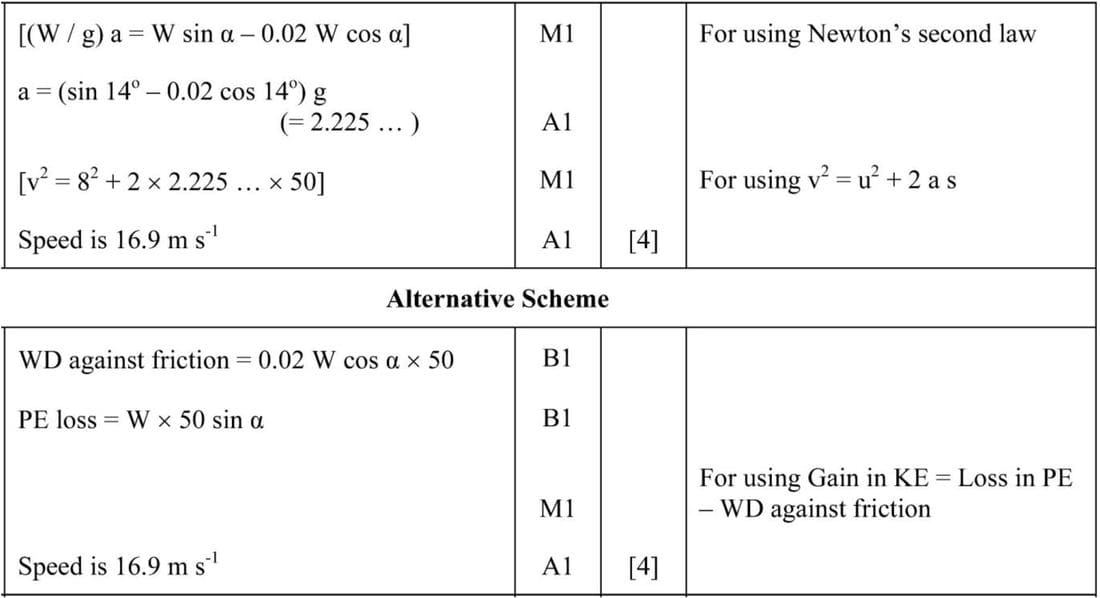
A straight ice track of length 50 m is inclined at 14° to the horizontal. A man starts at the top of the track, on a sledge, with speed 8 m s-1. He travels on the sledge to the bottom of the track. The coefficient of friction between the sledge and the track is 0.02. Find the speed of the sledge and the man when they reach the bottom of the track.
9709 P42 - Nov 2020 - Q6
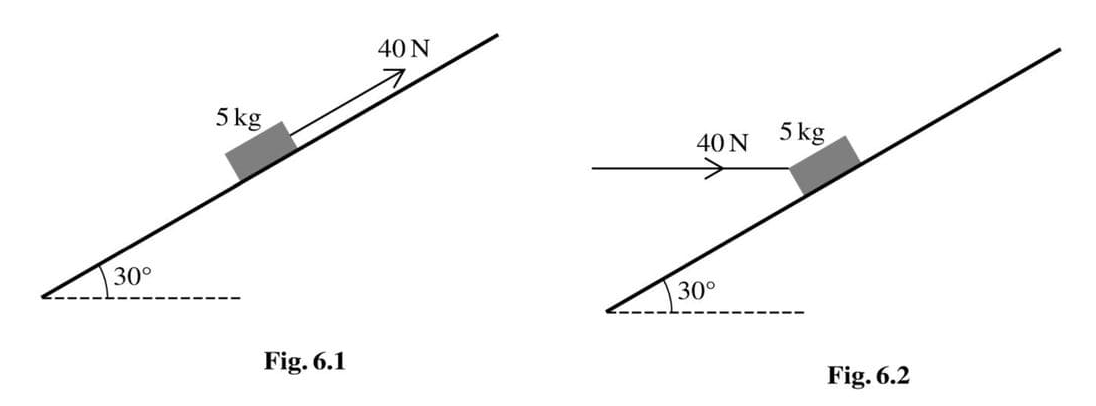
A block of mass 5 kg is placed on a plane inclined at 30° to the horizontal. The coefficient of friction between the block and the plane is \(\mu\).
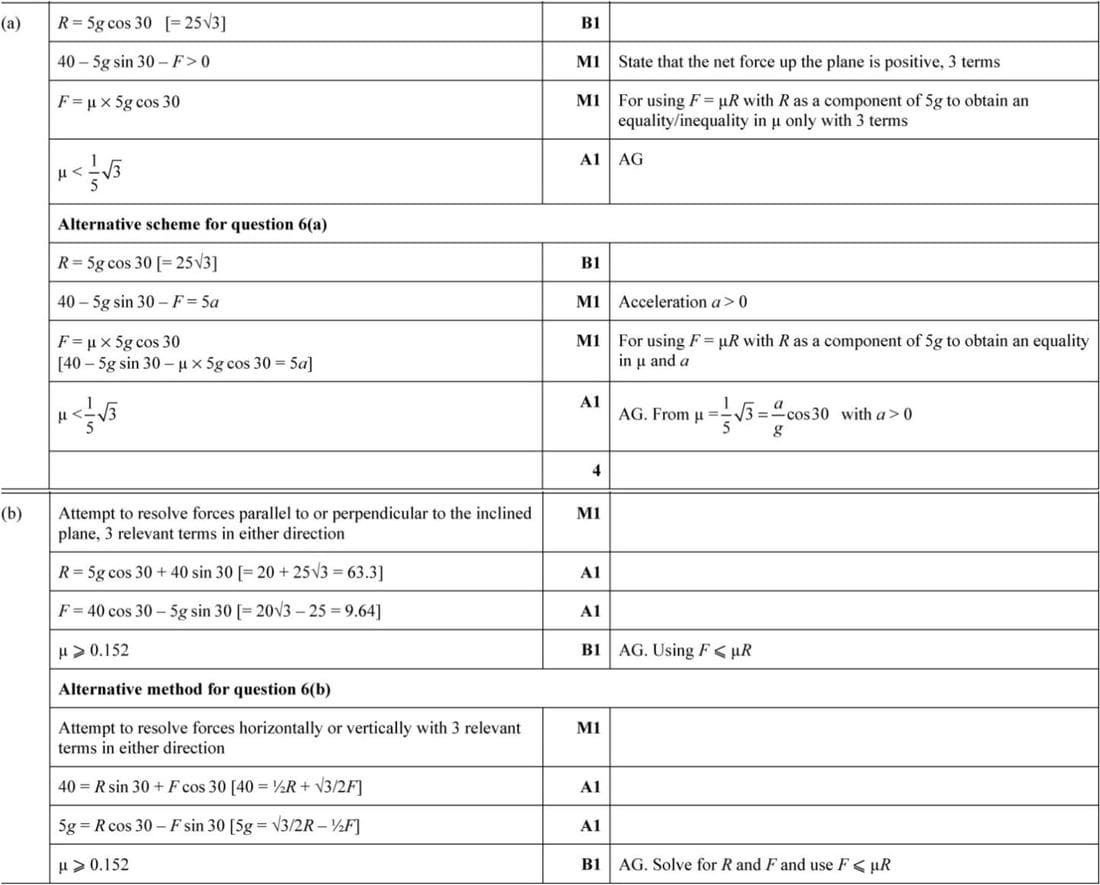
(a) When a force of magnitude 40 N is applied to the block, acting up the plane parallel to a line of greatest slope, the block begins to slide up the plane (see Fig. 6.1). Show that \(\mu < \frac{1}{5} \sqrt{3}\).
(b) When a force of magnitude 40 N is applied horizontally, in a vertical plane containing a line of greatest slope, the block does not move (see Fig. 6.2). Show that, correct to 3 decimal places, the least possible value of \(\mu\) is 0.152.
9709 P41 - Nov 2014 - Q3
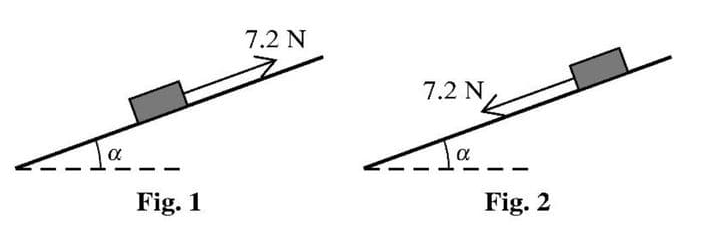
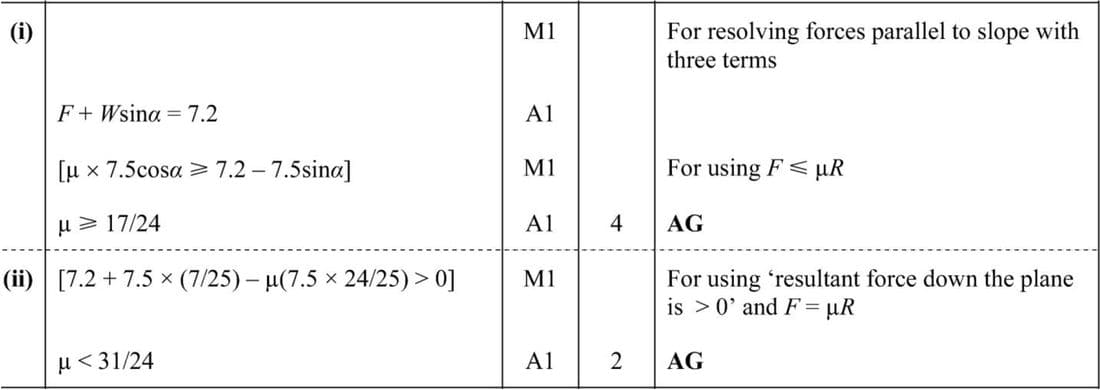
A block of weight 7.5 N is at rest on a plane which is inclined to the horizontal at angle \(\alpha\), where \(\tan \alpha = \frac{7}{24}\). The coefficient of friction between the block and the plane is \(\mu\). A force of magnitude 7.2 N acting parallel to a line of greatest slope is applied to the block. When the force acts up the plane (see Fig. 1) the block remains at rest.
- Show that \(\mu \geq \frac{17}{24}\).
When the force acts down the plane (see Fig. 2) the block slides downwards.
- Show that \(\mu < \frac{31}{24}\).
9231 P12 - Jun 2025 - Q01 - 8 marks
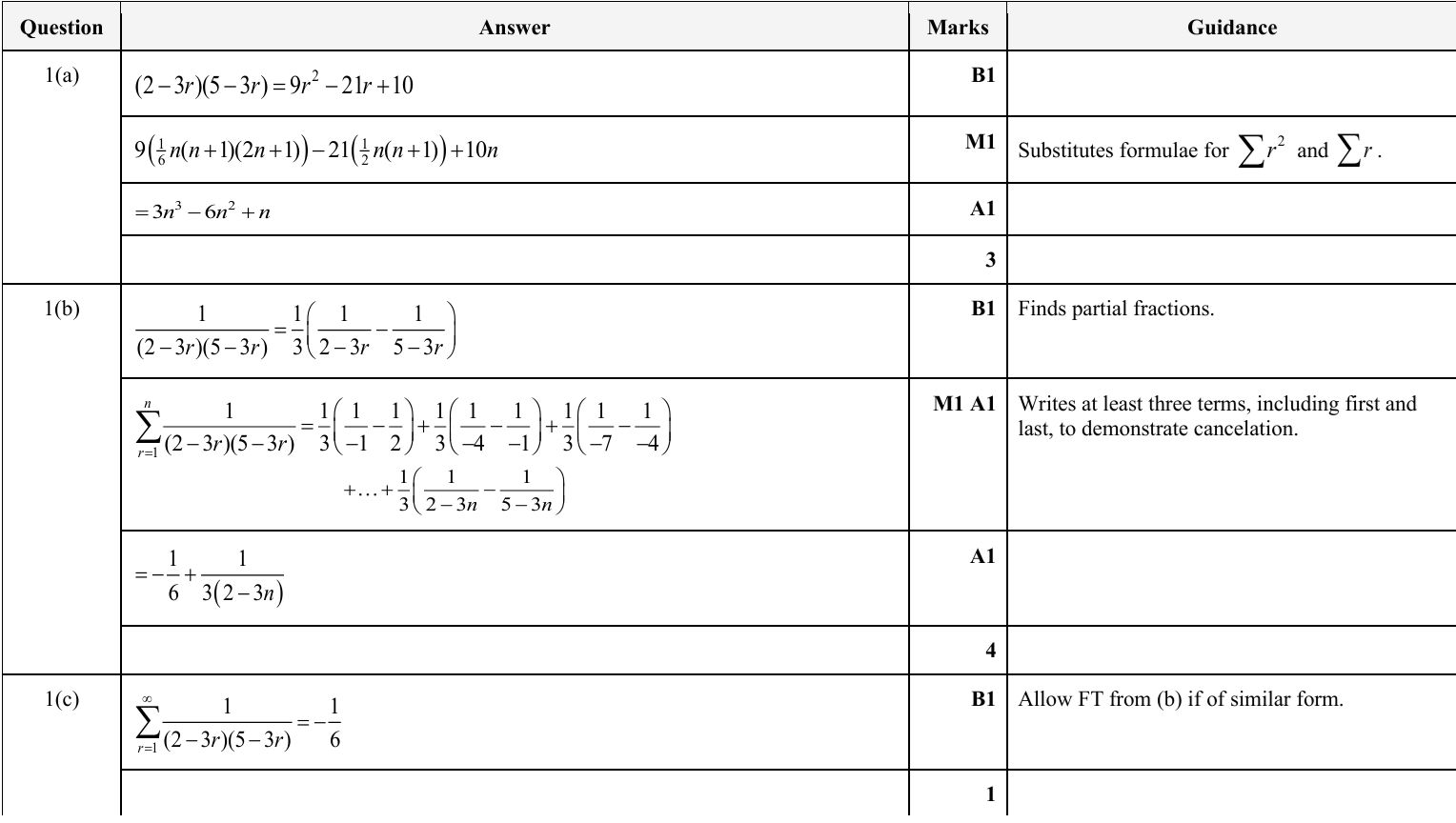
(a) Use standard results from the list of formulae (MF19) to show that
\(\sum_{r=1}^{n} (2-3r)(5-3r) = an^3 + bn^2 + cn,\)
where \(a, b\) and \(c\) are integers to be determined.
(b) Use the method of differences to find \(\sum_{r=1}^{n} \frac{1}{(2-3r)(5-3r)}\) in terms of \(n\).
(c) Deduce the value of \(\sum_{r=1}^{\infty} \frac{1}{(2-3r)(5-3r)}\).
9231 P11 - Jun 2025 - Q01 - 8 marks
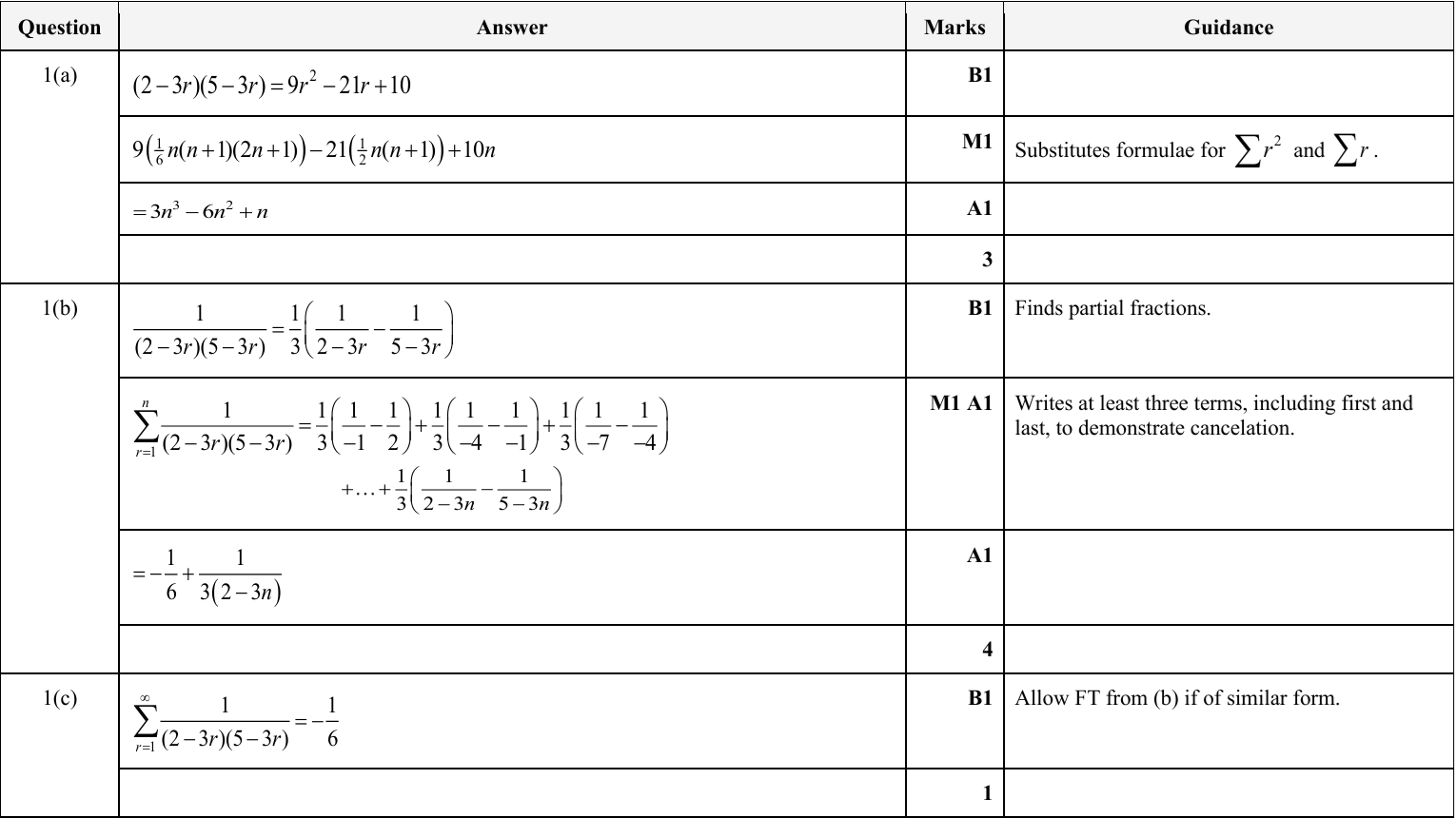
(a) Use standard results from the list of formulae (MF19) to show that
\(\sum_{r=1}^{n} (2-3r)(5-3r) = an^3 + bn^2 + cn,\)
where \(a, b\) and \(c\) are integers to be determined.
(b) Use the method of differences to find \(\sum_{r=1}^{n} \frac{1}{(2-3r)(5-3r)}\) in terms of \(n\).
(c) Deduce the value of \(\sum_{r=1}^{\infty} \frac{1}{(2-3r)(5-3r)}\).
9231 P13 - Jun 2025 - Q03 - 9 marks
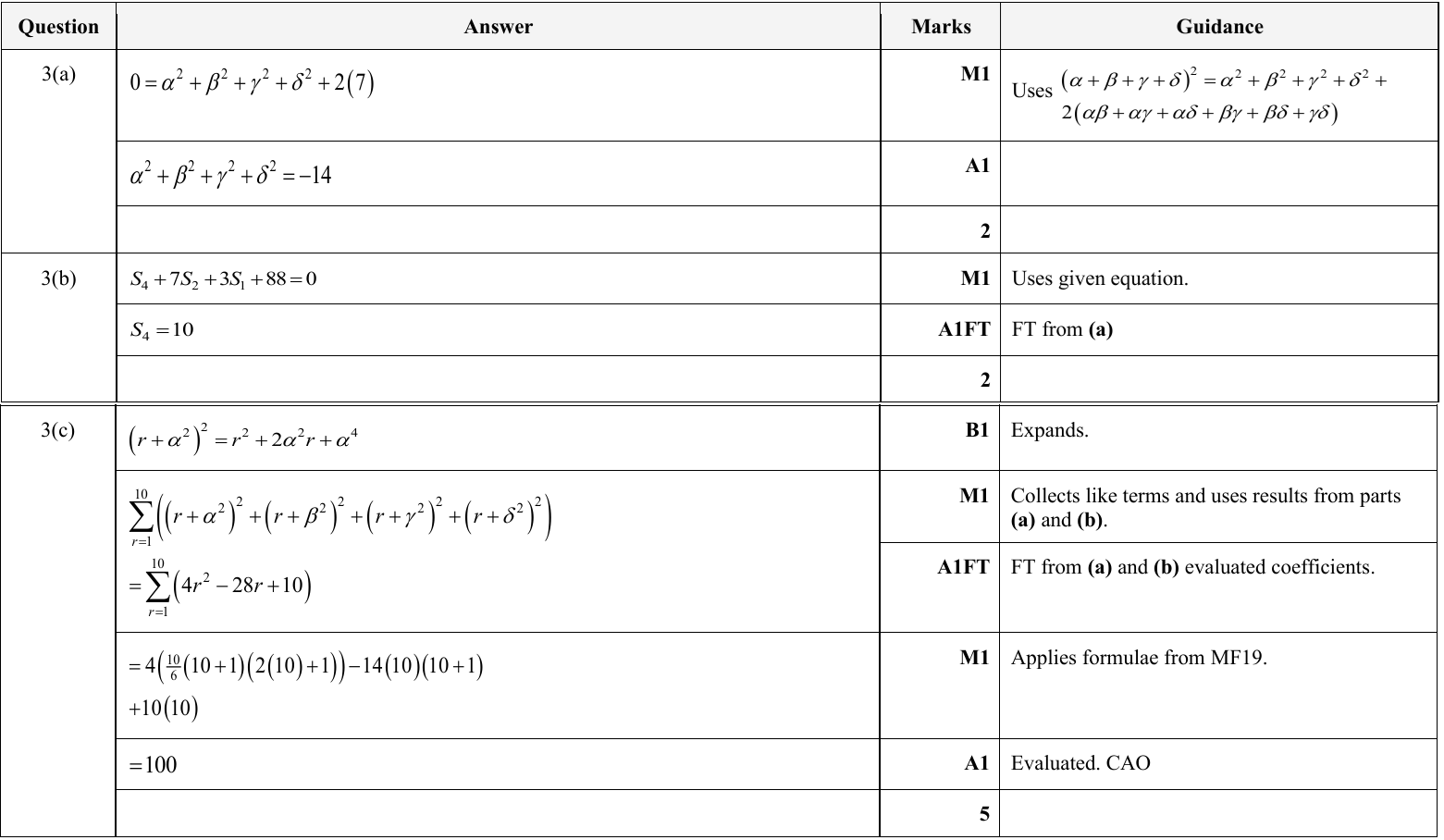
The quartic equation \(x^4 + 7x^2 + 3x + 22 = 0\) has roots \(\alpha, \beta, \gamma, \delta\).
(a) Find the value of \(\alpha^2 + \beta^2 + \gamma^2 + \delta^2\).
(b) Find the value of \(\alpha^4 + \beta^4 + \gamma^4 + \delta^4\).
(c) Use standard results from the list of formulae (MF19) to find the value of \(\sum_{r=1}^{10} ((\alpha^2 + r)^2 + (\beta^2 + r)^2 + (\gamma^2 + r)^2 + (\delta^2 + r)^2)\).
9231 P14 - Jun 2025 - Q01 - 6 marks
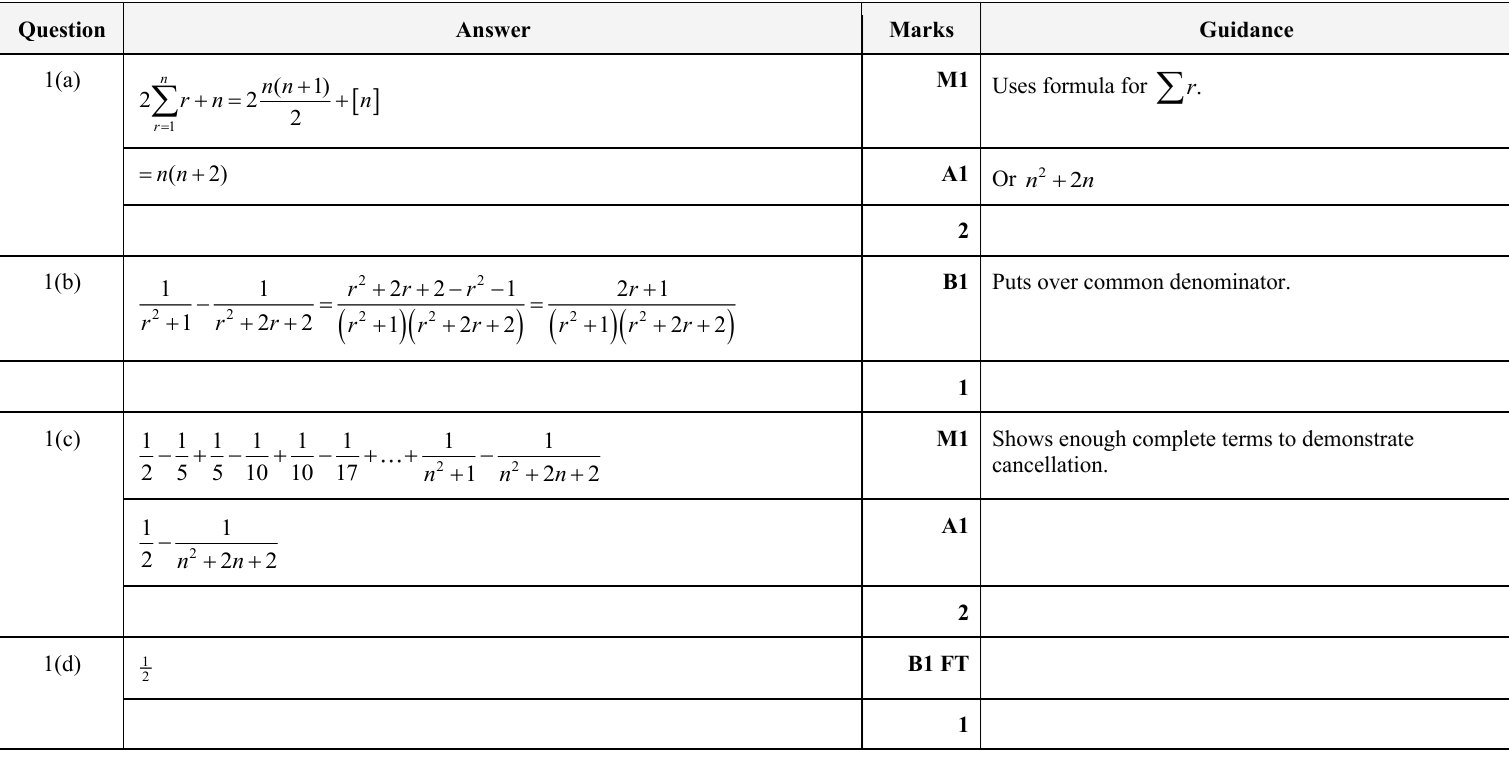
- Use the List of formulae (MF19) to find \(\sum_{r=1}^{n} (2r+1)\) in terms of \(n\), simplifying your answer.
- Show that \(\frac{2r+1}{(r^2+1)(r^2+2r+2)} = \frac{1}{r^2+1} - \frac{1}{r^2+2r+2}\).
- Use the method of differences to find \(\sum_{r=1}^{n} \frac{2r+1}{(r^2+1)(r^2+2r+2)}\).
- Deduce the value of \(\sum_{r=1}^{\infty} \frac{2r+1}{(r^2+1)(r^2+2r+2)}\).
9231 P11 - Nov 2024 - Q04 - 8 marks
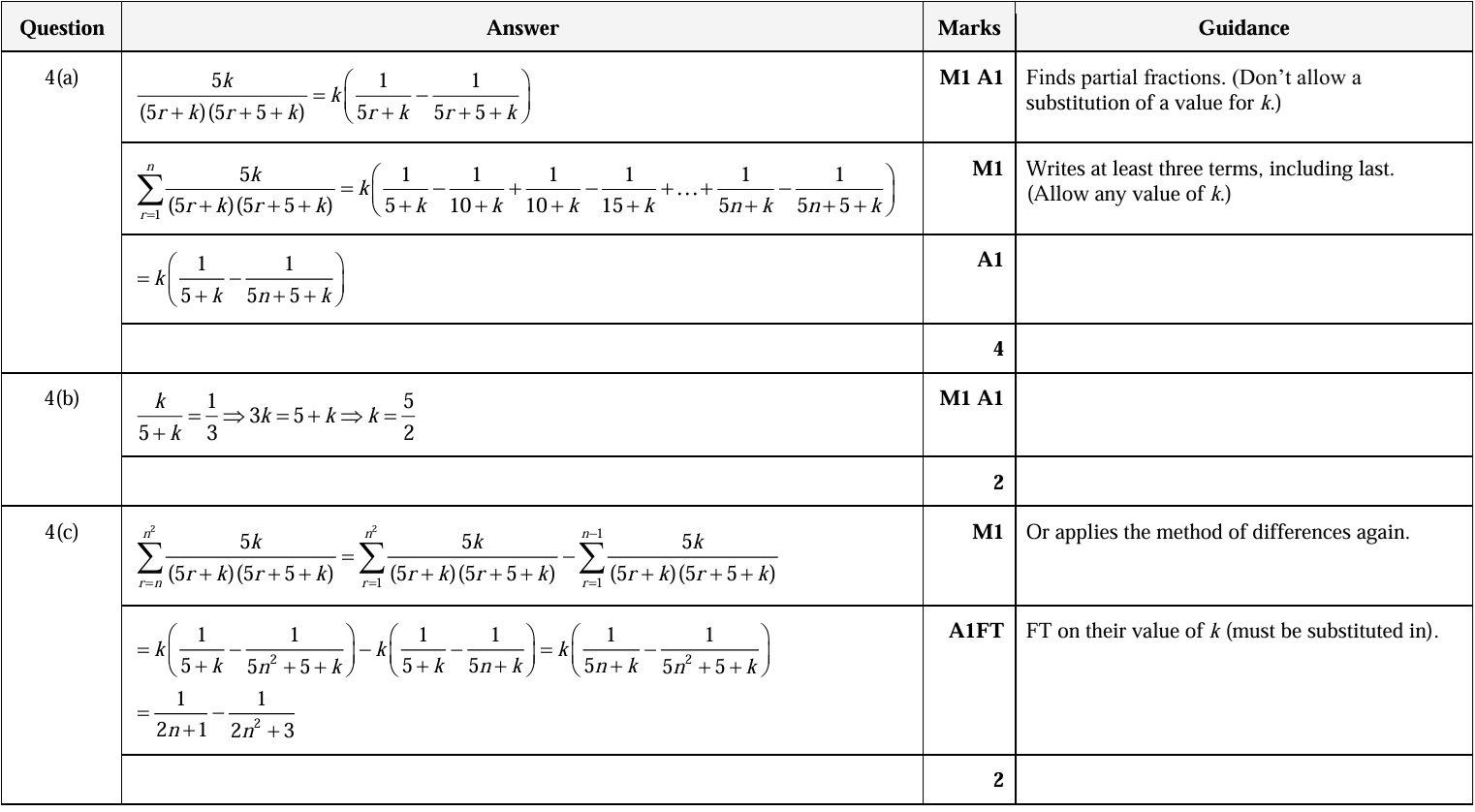
(a) Use the method of differences to find \(\sum_{r=1}^{n} \frac{5k}{(5r+k)(5r+5+k)}\) in terms of \(n\) and \(k\), where \(k\) is a positive constant.
It is given that \(\sum_{r=1}^{\infty} \frac{5k}{(5r+k)(5r+5+k)} = \frac{1}{3}\).
(b) Find the value of \(k\).
(c) Hence find \(\sum_{r=n}^{n^2} \frac{5k}{(5r+k)(5r+5+k)}\) in terms of \(n\).
9231 P13 - Nov 2024 - Q04 - 8 marks
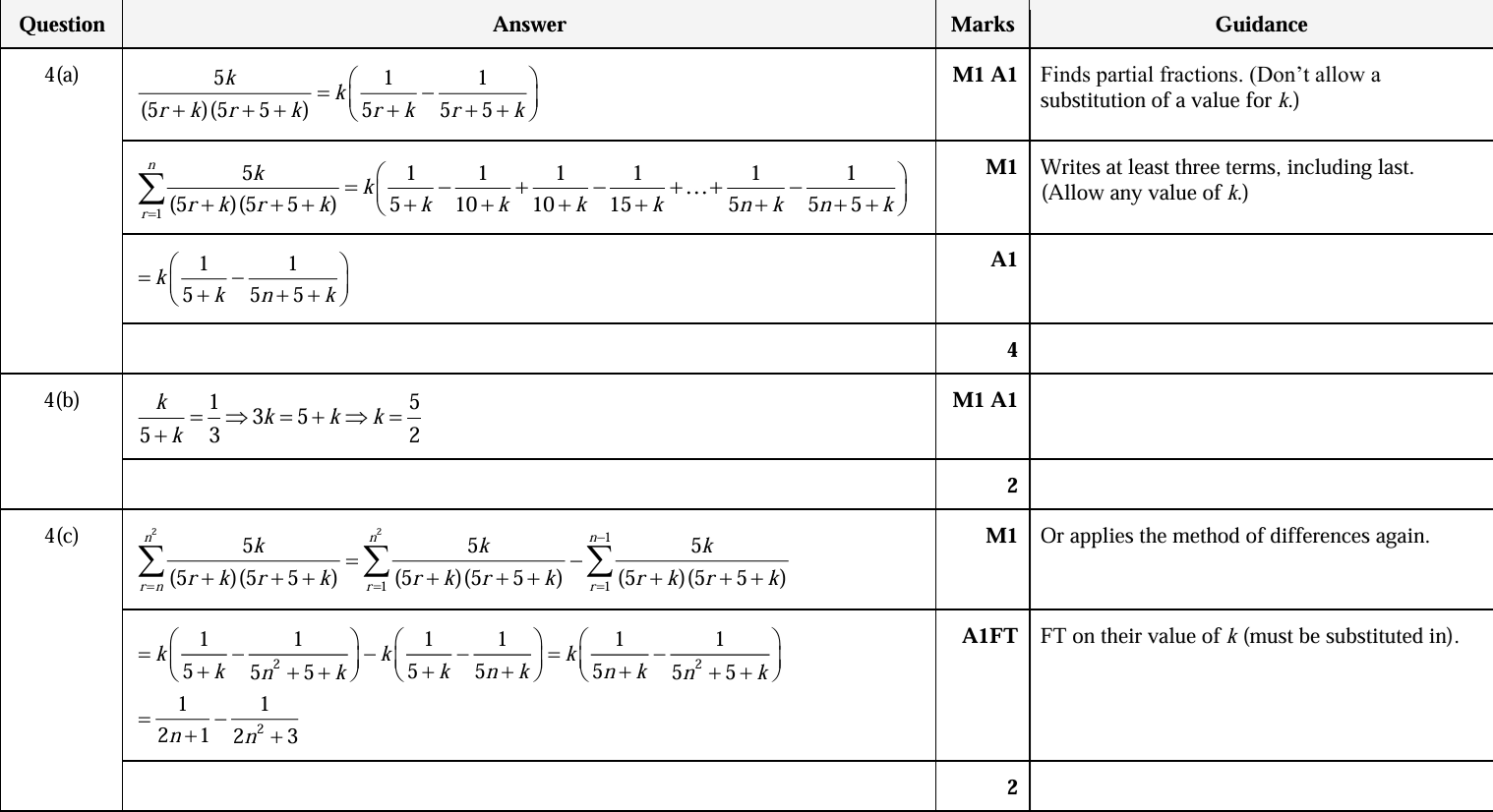
(a) Use the method of differences to find \(\sum_{r=1}^{n} \frac{5k}{(5r+k)(5r+5+k)}\) in terms of \(n\) and \(k\), where \(k\) is a positive constant.
It is given that \(\sum_{r=1}^{\infty} \frac{5k}{(5r+k)(5r+5+k)} = \frac{1}{3}\).
(b) Find the value of \(k\).
(c) Hence find \(\sum_{r=n}^{n^2} \frac{5k}{(5r+k)(5r+5+k)}\) in terms of \(n\).
9231 P11 - Jun 2024 - Q03 - 8 marks
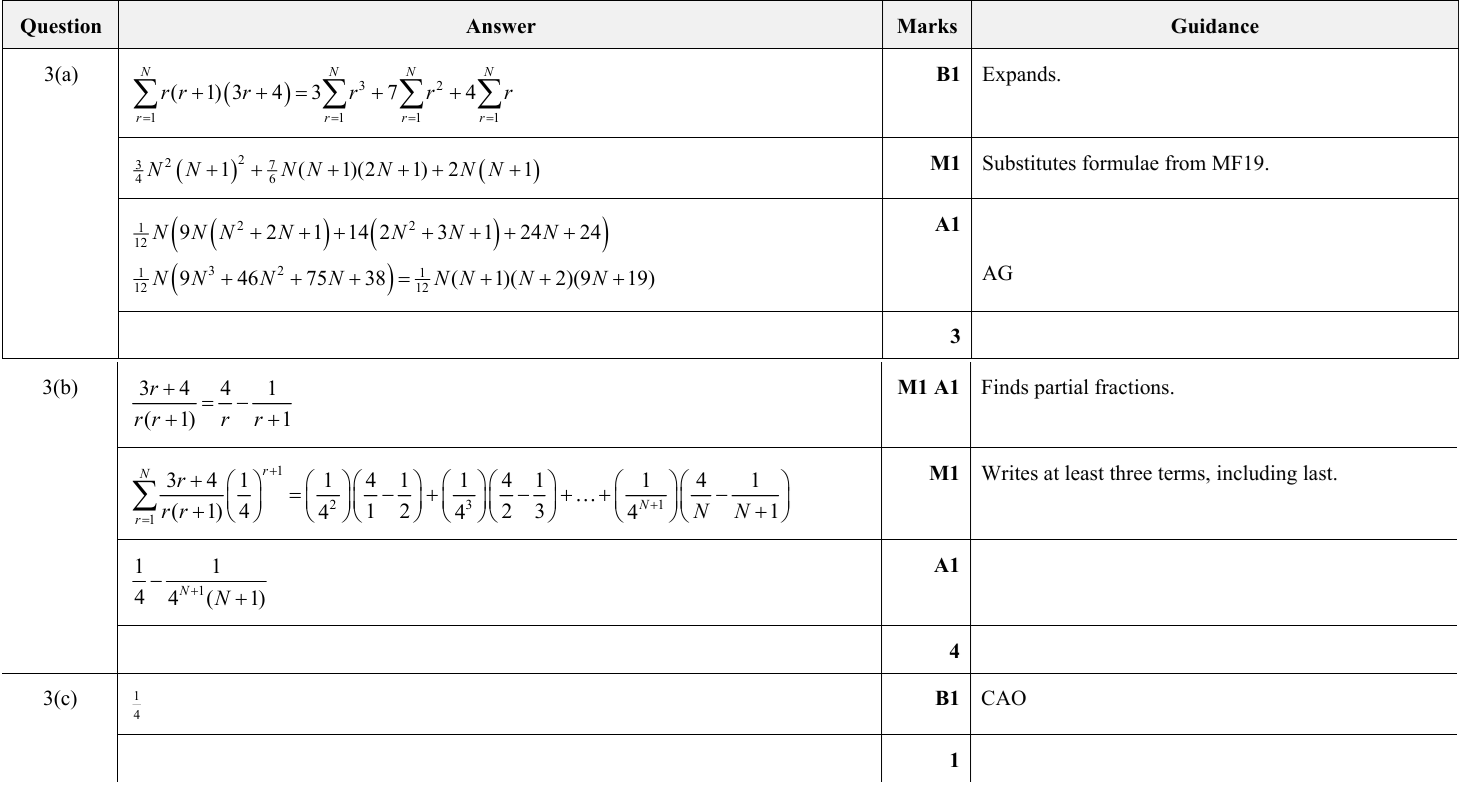
(a) Use standard results from the list of formulae (MF19) to show that
\(\sum_{r=1}^{N} r(r+1)(3r+4) = \frac{1}{12}N(N+1)(N+2)(9N+19).\)
(b) Express \(\frac{3r+4}{r(r+1)}\) in partial fractions and hence use the method of differences to find
\(\sum_{r=1}^{N} \frac{3r+4}{r(r+1)} \left( \frac{1}{4} \right)^{r+1}\)
in terms of \(N\).
(c) Deduce the value of
\(\sum_{r=1}^{\infty} \frac{3r+4}{r(r+1)} \left( \frac{1}{4} \right)^{r+1}.\)
9231 P12 - Jun 2024 - Q03 - 8 marks
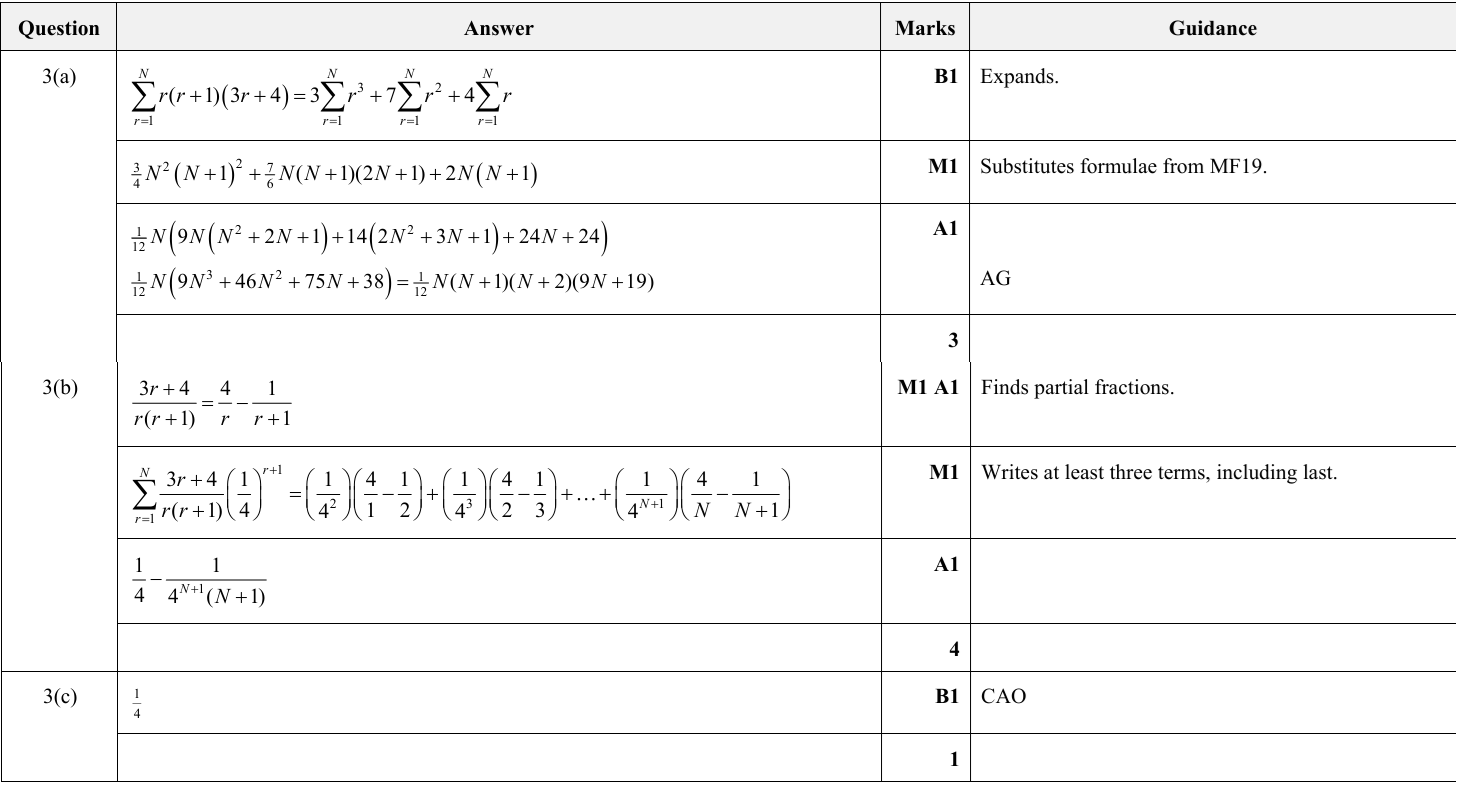
(a) Use standard results from the list of formulae (MF19) to show that
\(\sum_{r=1}^{N} r(r+1)(3r+4) = \frac{1}{12}N(N+1)(N+2)(9N+19).\)
(b) Express \(\frac{3r+4}{r(r+1)}\) in partial fractions and hence use the method of differences to find
\(\sum_{r=1}^{N} \frac{3r+4}{r(r+1)} \left( \frac{1}{4} \right)^{r+1}\)
in terms of \(N\).
(c) Deduce the value of
\(\sum_{r=1}^{\infty} \frac{3r+4}{r(r+1)} \left( \frac{1}{4} \right)^{r+1}.\)
9231 P11 - Nov 2023 - Q01 - 7 marks
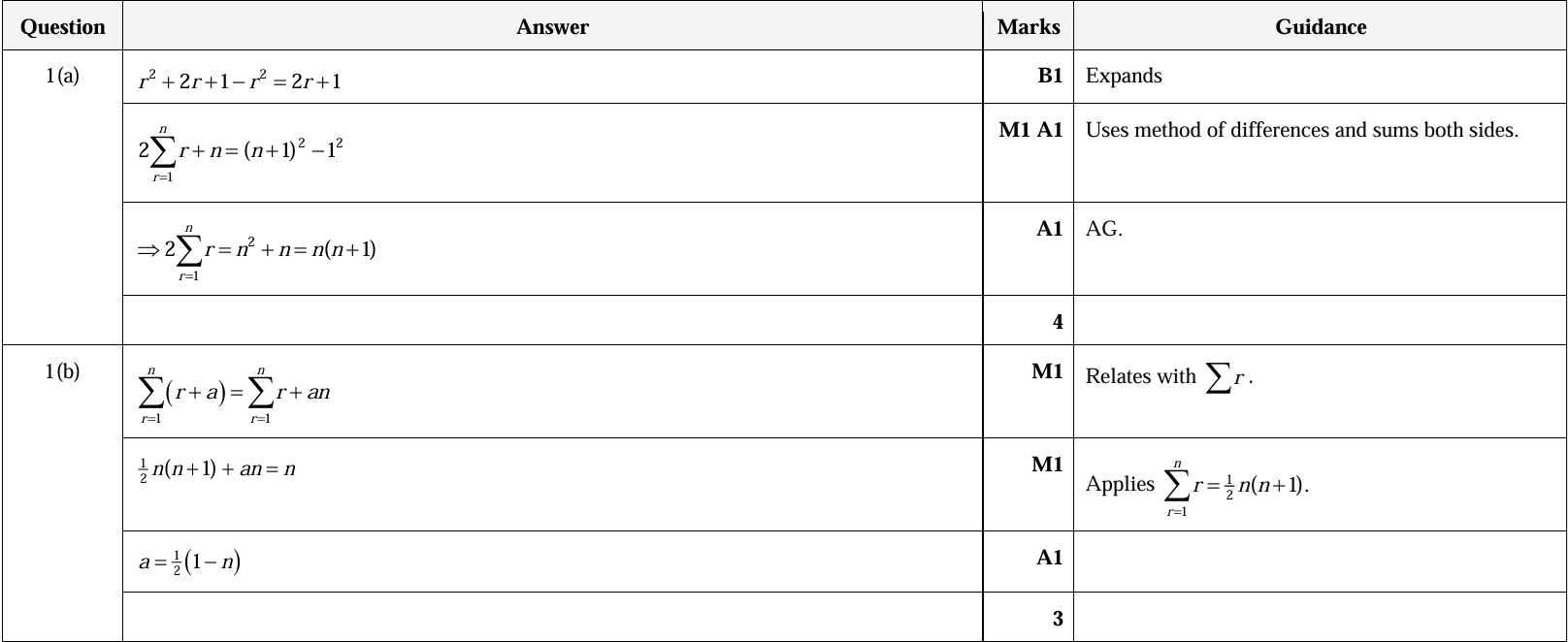
(a) By considering \((r+1)^2 - r^2\), use the method of differences to prove that
\(\sum_{r=1}^{n} r = \frac{1}{2} n(n+1).\)
(b) Given that \(\sum_{r=1}^{n} (r+a) = n\), find \(a\) in terms of \(n\).