Browsing as Guest. Progress, bookmarks and attempts are disabled.
Log in to track your work.
Problem 194
194
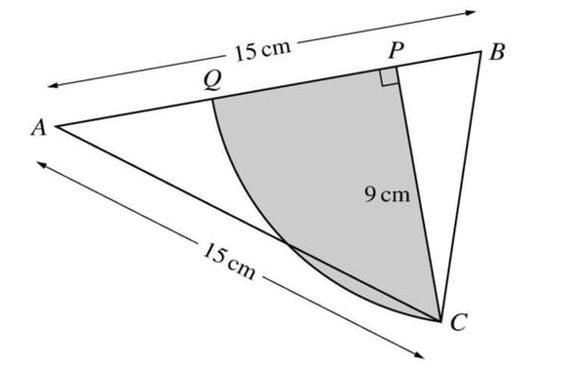
In the diagram the lengths of \(AB\) and \(AC\) are both 15 cm. The point \(P\) is the foot of the perpendicular from \(C\) to \(AB\). The length \(CP = 9\) cm. An arc of a circle with centre \(B\) passes through \(C\) and meets \(AB\) at \(Q\).
(a) Show that angle \(ABC = 1.25\) radians, correct to 3 significant figures.
(b) Calculate the area of the shaded region which is bounded by the arc \(CQ\) and the lines \(CP\) and \(PQ\).
Solution
(a) To find \(\angle ABC\), we can use trigonometry. Since \(P\) is the foot of the perpendicular from \(C\) to \(AB\), \(AP = 12\) cm and \(BP = 3\) cm. Therefore, \(\tan \angle ABC = \frac{9}{3} = 3\). Using the inverse tangent function, \(\angle ABC = \tan^{-1}(3) \approx 1.249\) radians, which rounds to \(1.25\) radians to 3 significant figures.
(b) To find the area of the shaded region, we first find \(BC\) using the sine rule: \(BC = \frac{9}{\sin 1.25} \approx 9.4869\) cm.
The area of sector \(BCQ\) is \(\frac{1}{2} \times (BC)^2 \times \angle ABC = \frac{1}{2} \times 9.4869^2 \times 1.25 \approx 56.207\) square cm.
The area of triangle \(PBC\) is \(\frac{1}{2} \times 9 \times 3 = 13.5\) square cm.
Therefore, the area of the shaded region is \(56.207 - 13.5 = 42.7\) square cm (or \(42.8\) square cm depending on rounding).