Browsing as Guest. Progress, bookmarks and attempts are disabled.
Log in to track your work.
Problem 195
195
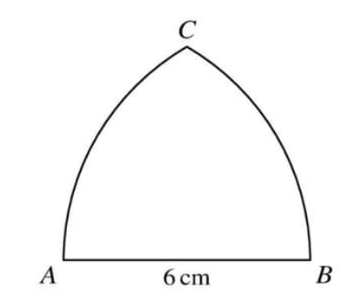
The diagram shows a metal plate ABC in which the sides are the straight line AB and the arcs AC and BC. The line AB has length 6 cm. The arc AC is part of a circle with centre B and radius 6 cm, and the arc BC is part of a circle with centre A and radius 6 cm.
(a) Find the perimeter of the plate, giving your answer in terms of \(\pi\).
(b) Find the area of the plate, giving your answer in terms of \(\pi\) and \(\sqrt{3}\).
Solution
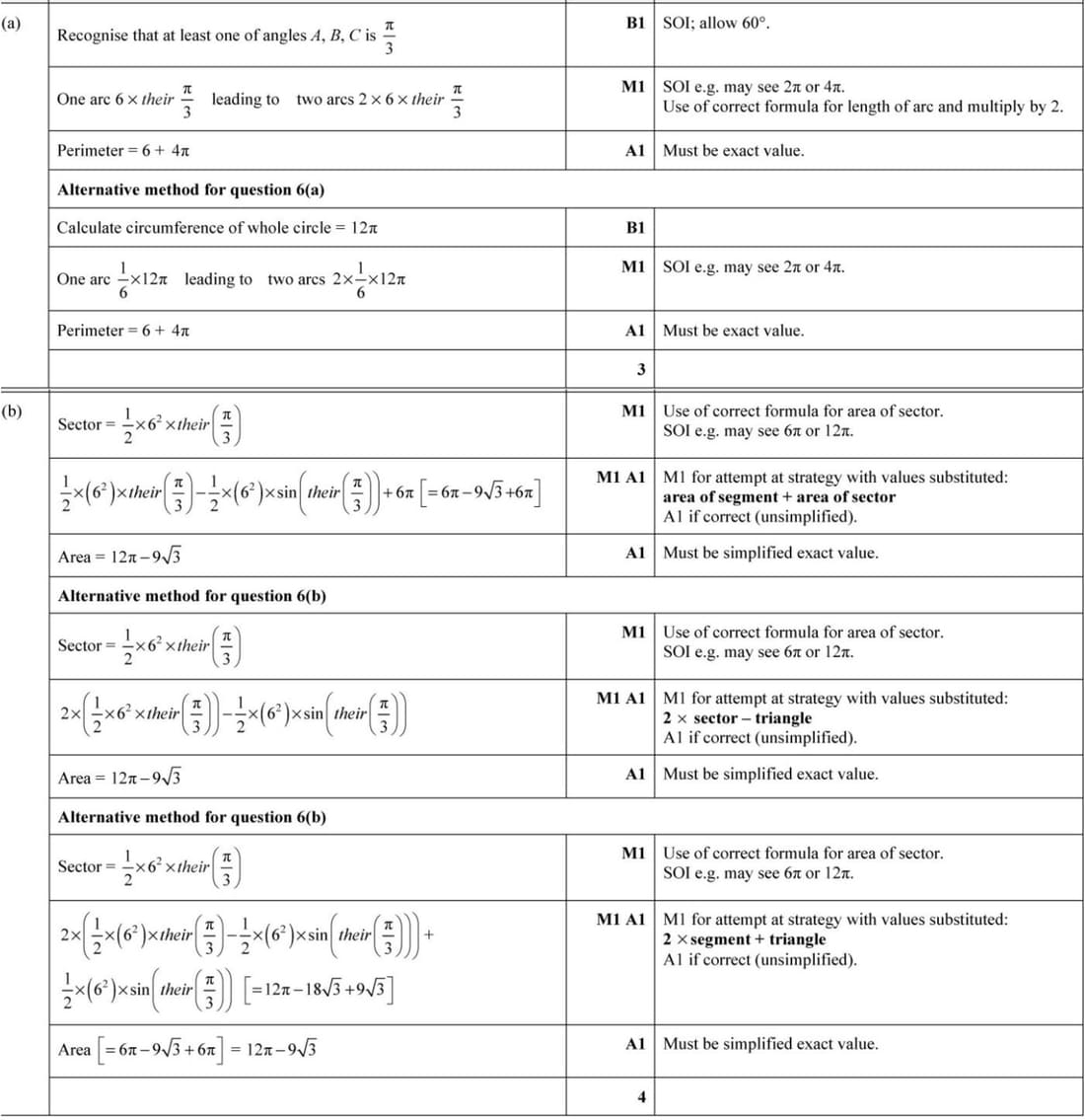
(a) Recognize that at least one of the angles \(A, B, C\) is \(\frac{\pi}{3}\) (60°). Each arc is \(\frac{1}{6}\) of a full circle. The circumference of a full circle with radius 6 cm is \(12\pi\). Therefore, the length of each arc is \(\frac{1}{6} \times 12\pi = 2\pi\). Since there are two arcs, the total arc length is \(4\pi\). The perimeter is the sum of the straight line and the arcs: \(6 + 4\pi\).
(b) The area of each sector is \(\frac{1}{2} \times 6^2 \times \frac{\pi}{3} = 6\pi\). The area of the triangle formed by the radii and the line \(AB\) is \(\frac{1}{2} \times 6 \times 6 \times \sin\left(\frac{\pi}{3}\right) = 9\sqrt{3}\). The area of the plate is the sum of the areas of the sectors minus the area of the triangle: \(2 \times 6\pi - 9\sqrt{3} = 12\pi - 9\sqrt{3}\).