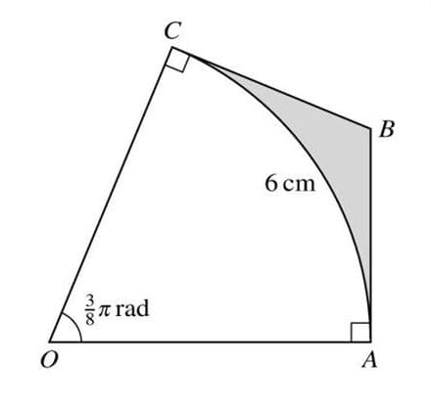
(i) The length of the arc AC is given by the formula \(r \theta = 6\), where \(r = OA\) and \(\theta = \frac{3}{8} \pi\). Solving for \(r\), we have:
\(OA \times \frac{3}{8} \pi = 6\)
\(OA = \frac{6 \times 8}{3 \pi} = \frac{16}{\pi} \approx 5.093 \text{ cm}\)
(ii) The perimeter of the shaded region is the sum of the lengths of AB, BC, and the arc AC. Since AB and BC are tangents, \(AB = BC\). Using the tangent formula:
\(AB = OA \times \tan\left(\frac{3}{16} \pi\right)\)
\(AB = 5.093 \times \tan\left(\frac{3}{16} \pi\right) \approx 3.403 \text{ cm}\)
The perimeter is:
\(2 \times 3.403 + 6 = 12.8 \text{ cm}\)
(iii) The area of the shaded region is the difference between the area of triangle OABC and the area of sector OAC. The area of triangle OABC is:
\(\text{Area of } OABC = \frac{1}{2} \times OA \times AB = \frac{1}{2} \times 5.093 \times 3.403 \approx 8.665 \text{ cm}^2\)
The area of sector OAC is:
\(\text{Area of sector } OAC = \frac{1}{2} \times (5.093)^2 \times \frac{3}{8} \pi \approx 6.615 \text{ cm}^2\)
The shaded area is:
\(8.665 - 6.615 = 2.05 \text{ cm}^2\)