Past Exam Questions
← Back9709 P41 - Nov 2014 - Q7
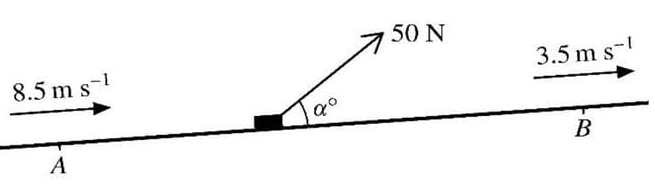
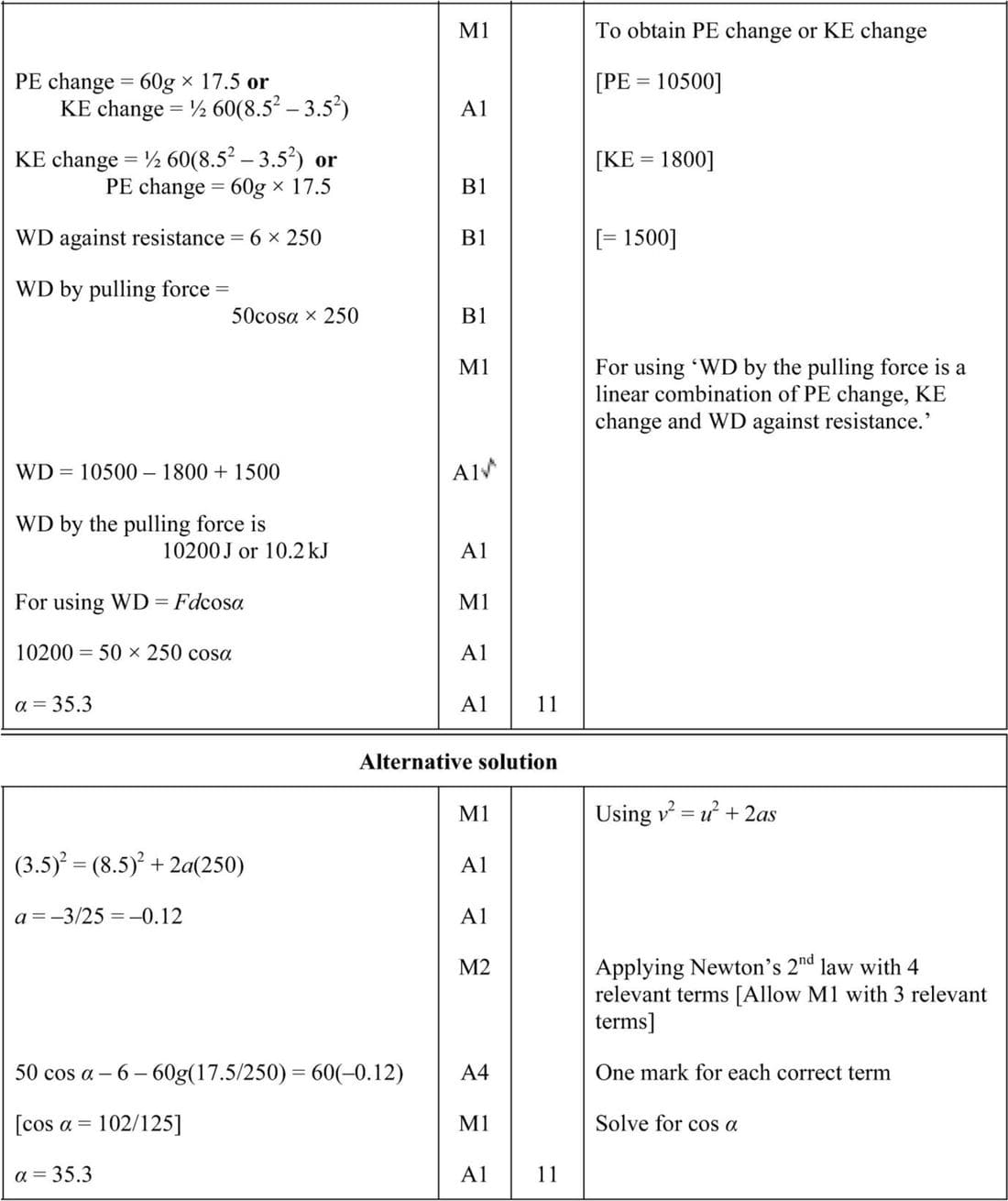
A block of mass 60 kg is pulled up a hill in the line of greatest slope by a force of magnitude 50 N acting at an angle \(\alpha^\circ\) above the hill. The block passes through points A and B with speeds 8.5 m s\(^{-1}\) and 3.5 m s\(^{-1}\) respectively (see diagram). The distance \(AB\) is 250 m and \(B\) is 17.5 m above the level of \(A\). The resistance to motion of the block is 6 N. Find the value of \(\alpha\).
9709 P43 - Nov 2013 - Q1
A particle moves up a line of greatest slope of a rough plane inclined at an angle \(\alpha\) to the horizontal, where \(\sin \alpha = 0.28\). The coefficient of friction between the particle and the plane is \(\frac{1}{3}\).
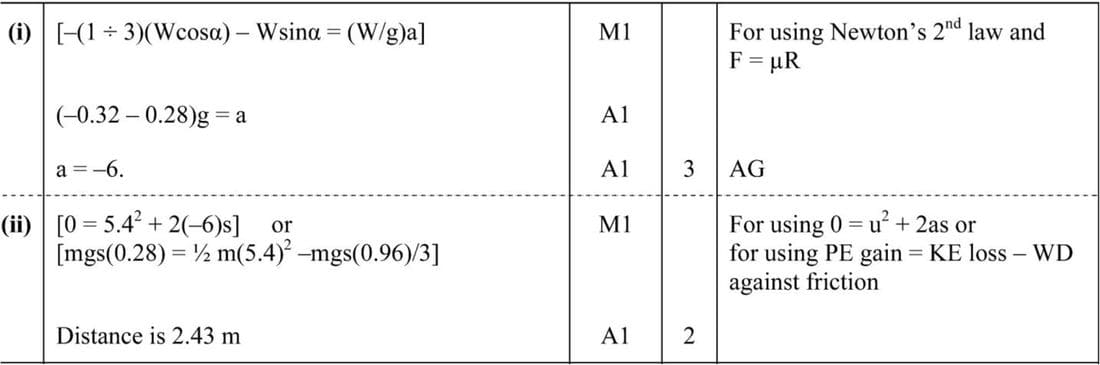
- Show that the acceleration of the particle is \(-6 \text{ m s}^{-2}\).
- Given that the particle’s initial speed is \(5.4 \text{ m s}^{-1}\), find the distance that the particle travels up the plane.
9709 P41 - Nov 2013 - Q3
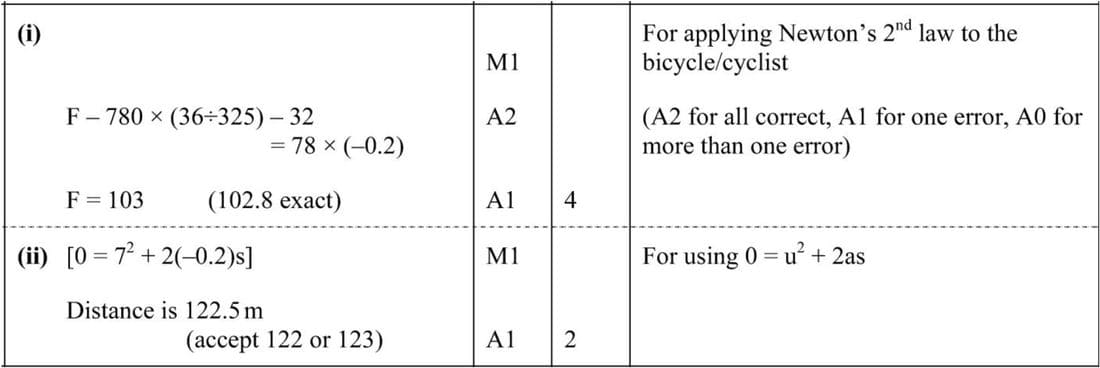
A cyclist exerts a constant driving force of magnitude \(F\) N while moving up a straight hill inclined at an angle \(\alpha\) to the horizontal, where \(\sin \alpha = \frac{36}{325}\). A constant resistance to motion of 32 N acts on the cyclist. The total weight of the cyclist and his bicycle is 780 N. The cyclist's acceleration is \(-0.2 \text{ m s}^{-2}\).
(i) Find the value of \(F\).
The cyclist’s speed is 7 m s-1 at the bottom of the hill.
(ii) Find how far up the hill the cyclist travels before coming to rest.
9709 P43 - Jun 2012 - Q6
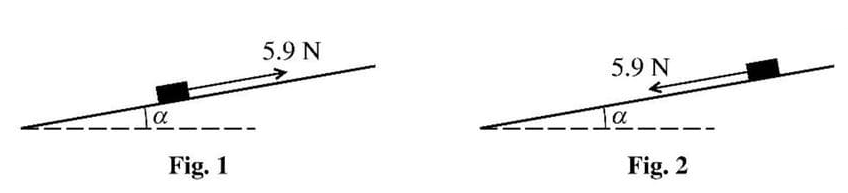
A block of weight 6.1 N is at rest on a plane inclined at angle \(\alpha\) to the horizontal, where \(\tan \alpha = \frac{11}{60}\). The coefficient of friction between the block and the plane is \(\mu\). A force of magnitude 5.9 N acting parallel to a line of greatest slope is applied to the block.
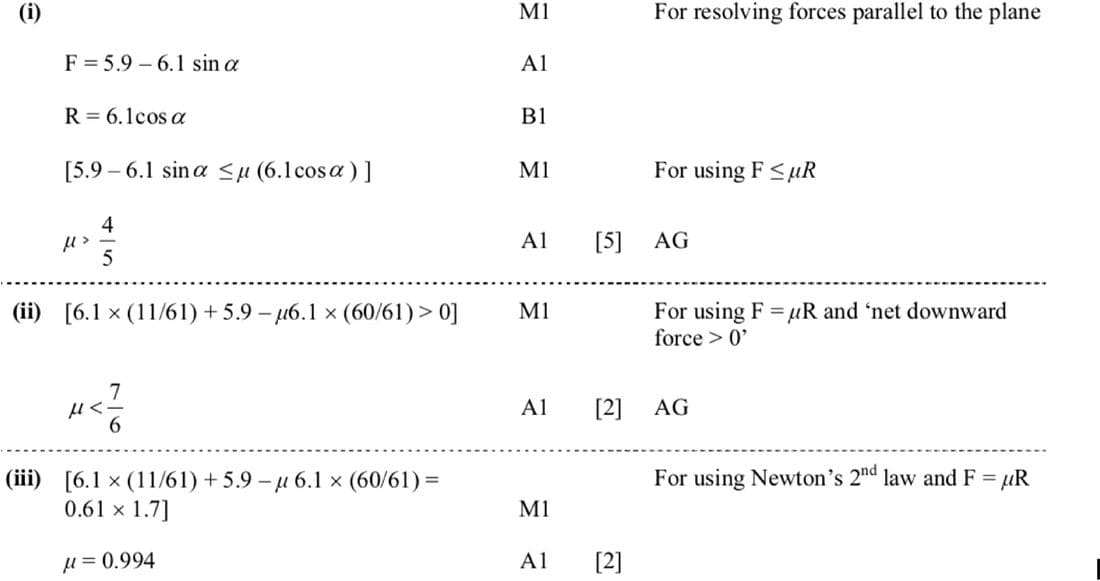
(i) When the force acts up the plane (see Fig. 1) the block remains at rest. Show that \(\mu \geq \frac{4}{5}\).
(ii) When the force acts down the plane (see Fig. 2) the block slides downwards. Show that \(\mu < \frac{7}{6}\).
(iii) Given that the acceleration of the block is 1.7 m s\(^{-2}\) when the force acts down the plane, find the value of \(\mu\).
9709 P42 - Nov 2009 - Q4
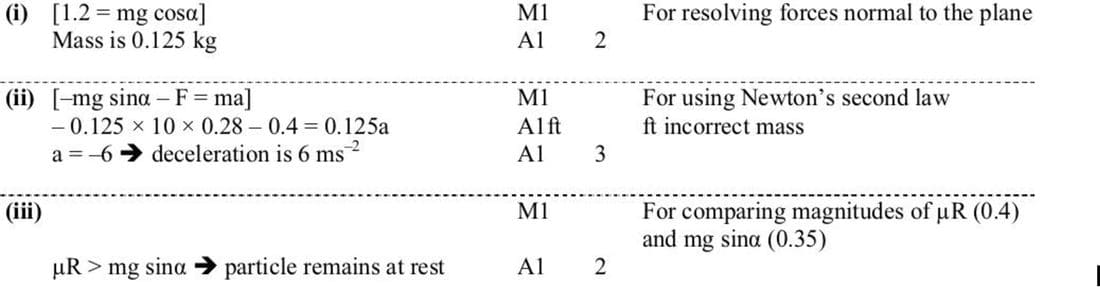
A particle moves up a line of greatest slope of a rough plane inclined at an angle \(\alpha\) to the horizontal, where \(\cos \alpha = 0.96\) and \(\sin \alpha = 0.28\).
- Given that the normal component of the contact force acting on the particle has magnitude 1.2 N, find the mass of the particle.
- Given also that the frictional component of the contact force acting on the particle has magnitude 0.4 N, find the deceleration of the particle.
The particle comes to rest on reaching the point \(X\).
- Determine whether the particle remains at \(X\) or whether it starts to move down the plane.
9709 P41 - Nov 2009 - Q5
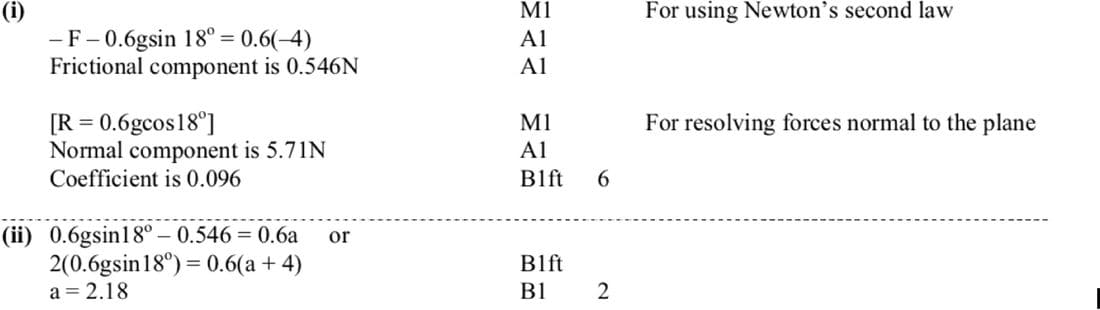
A particle P of mass 0.6 kg moves upwards along a line of greatest slope of a plane inclined at 18° to the horizontal. The deceleration of P is 4 m s-2.
(i) Find the frictional and normal components of the force exerted on P by the plane. Hence find the coefficient of friction between P and the plane, correct to 2 significant figures.
After P comes to instantaneous rest it starts to move down the plane with acceleration a m s-2.
(ii) Find the value of a.
9709 P4 - Nov 2006 - Q7
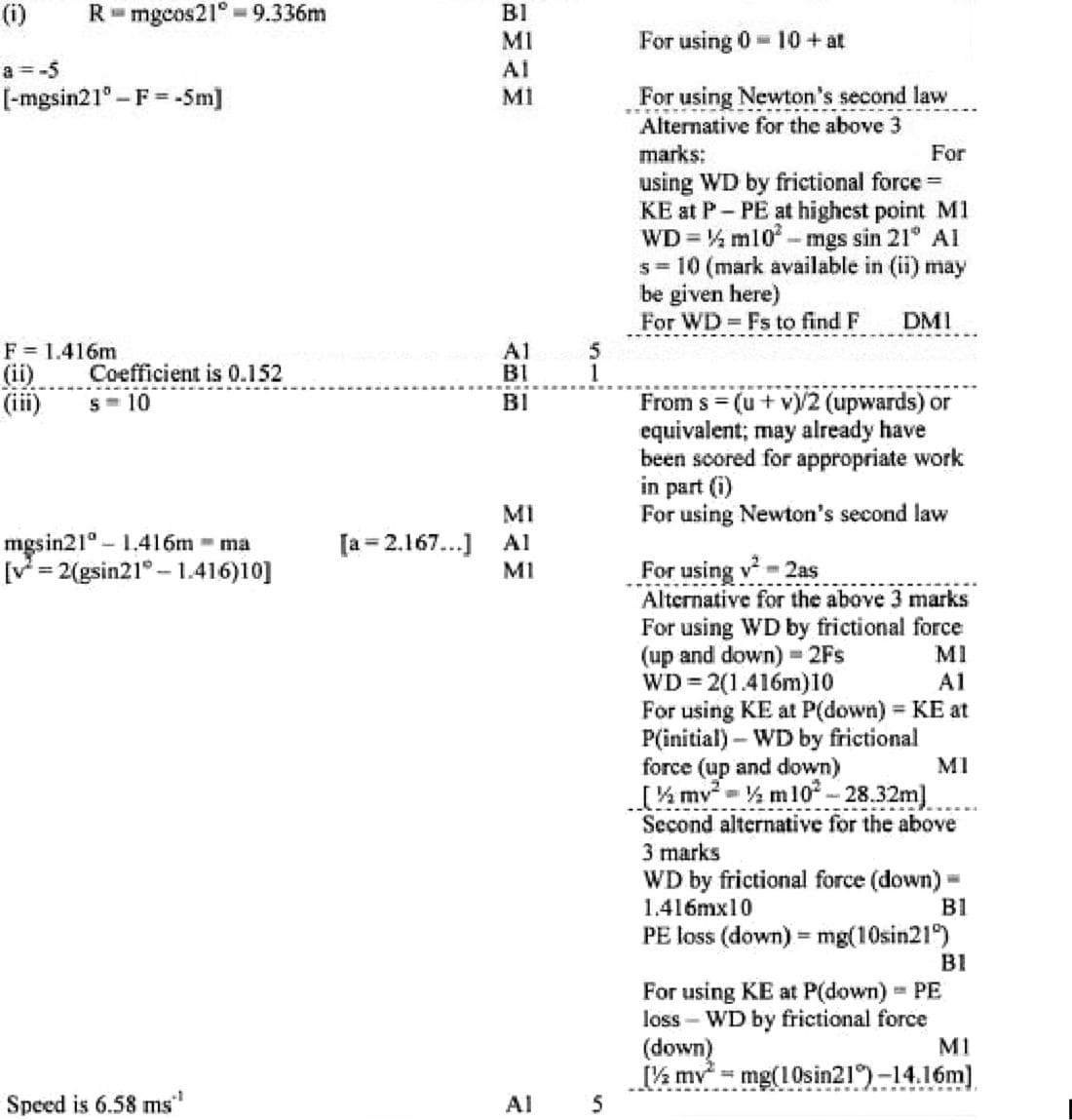
A particle of mass m kg moves up a line of greatest slope of a rough plane inclined at 21° to the horizontal. The frictional and normal components of the contact force on the particle have magnitudes F N and R N respectively. The particle passes through the point P with speed 10 m s-1, and 2 s later it reaches its highest point on the plane.
- Show that R = 9.336m and F = 1.416m, each correct to 4 significant figures.
- Find the coefficient of friction between the particle and the plane.
- After the particle reaches its highest point it starts to move down the plane. Find the speed with which the particle returns to P.
9709 P42 - Nov 2022 - Q2
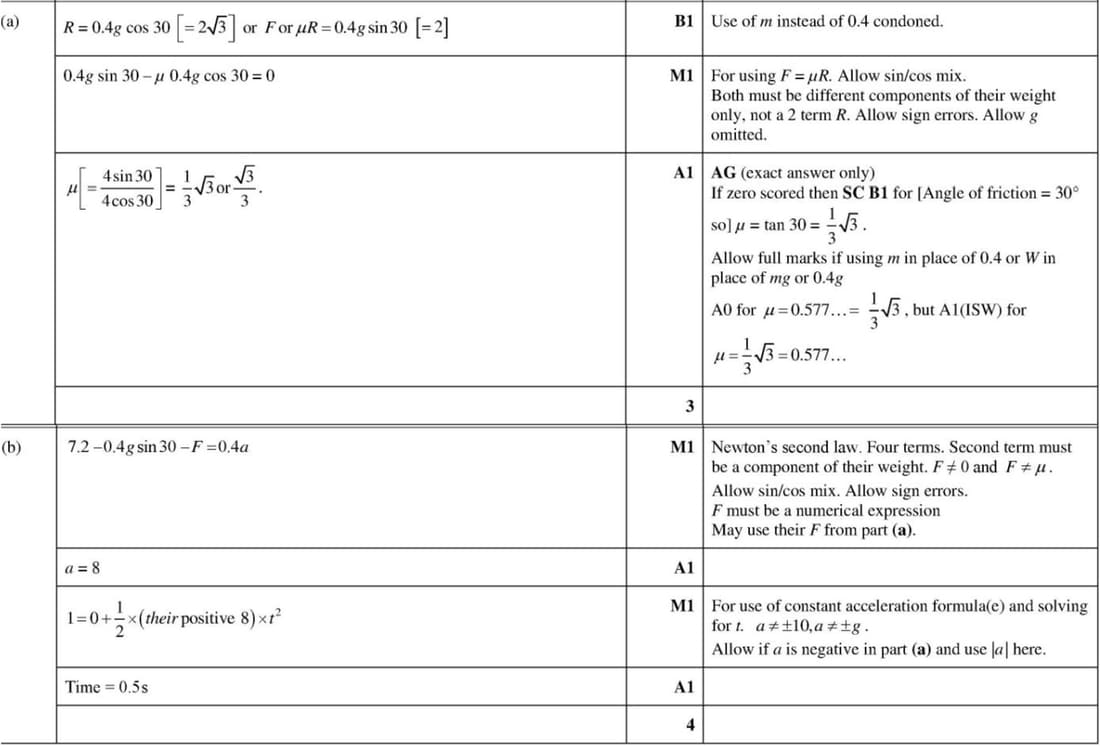
A particle P of mass 0.4 kg is in limiting equilibrium on a plane inclined at 30° to the horizontal.
(a) Show that the coefficient of friction between the particle and the plane is \(\frac{1}{3} \sqrt{3}\).
A force of magnitude 7.2 N is now applied to P directly up a line of greatest slope of the plane.
(b) Given that P starts from rest, find the time that it takes for P to move 1 m up the plane.
9709 P4 - Jun 2005 - Q3
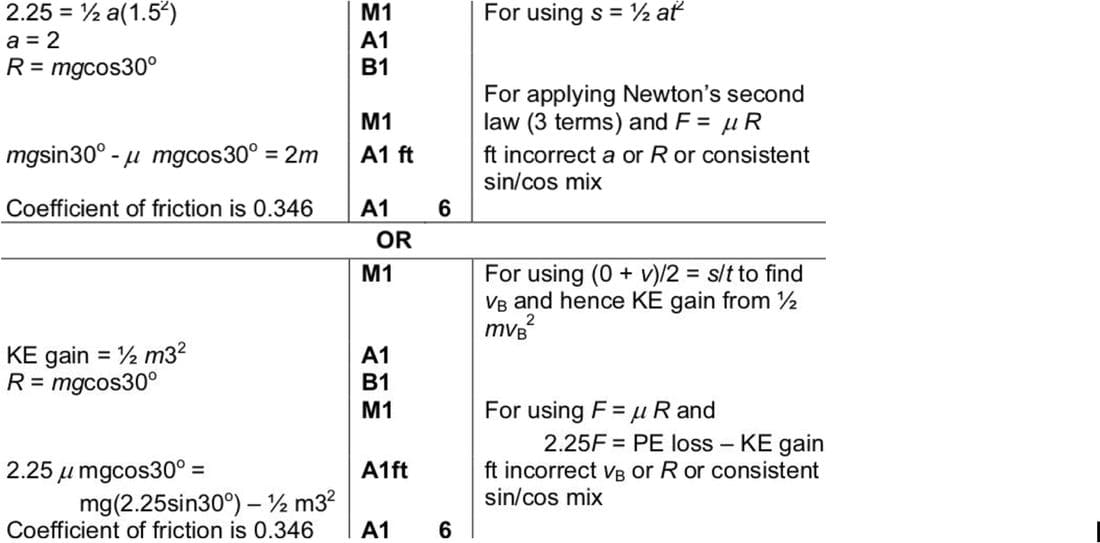
A and B are points on the same line of greatest slope of a rough plane inclined at 30° to the horizontal. A is higher up the plane than B and the distance AB is 2.25 m. A particle P, of mass m kg, is released from rest at A and reaches B 1.5 s later. Find the coefficient of friction between P and the plane.
9709 P4 - Jun 2003 - Q7
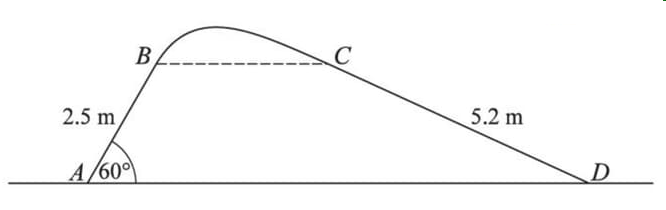
The diagram shows a vertical cross-section ABCD of a surface. The parts AB and CD are straight and have lengths 2.5 m and 5.2 m respectively. AD is horizontal, and AB is inclined at 60° to the horizontal. The points B and C are at the same height above AD. The parts of the surface containing AB and BC are smooth. A particle P is given a velocity of 8 m s-1 at A, in the direction AB, and it subsequently reaches D. The particle does not lose contact with the surface during this motion.
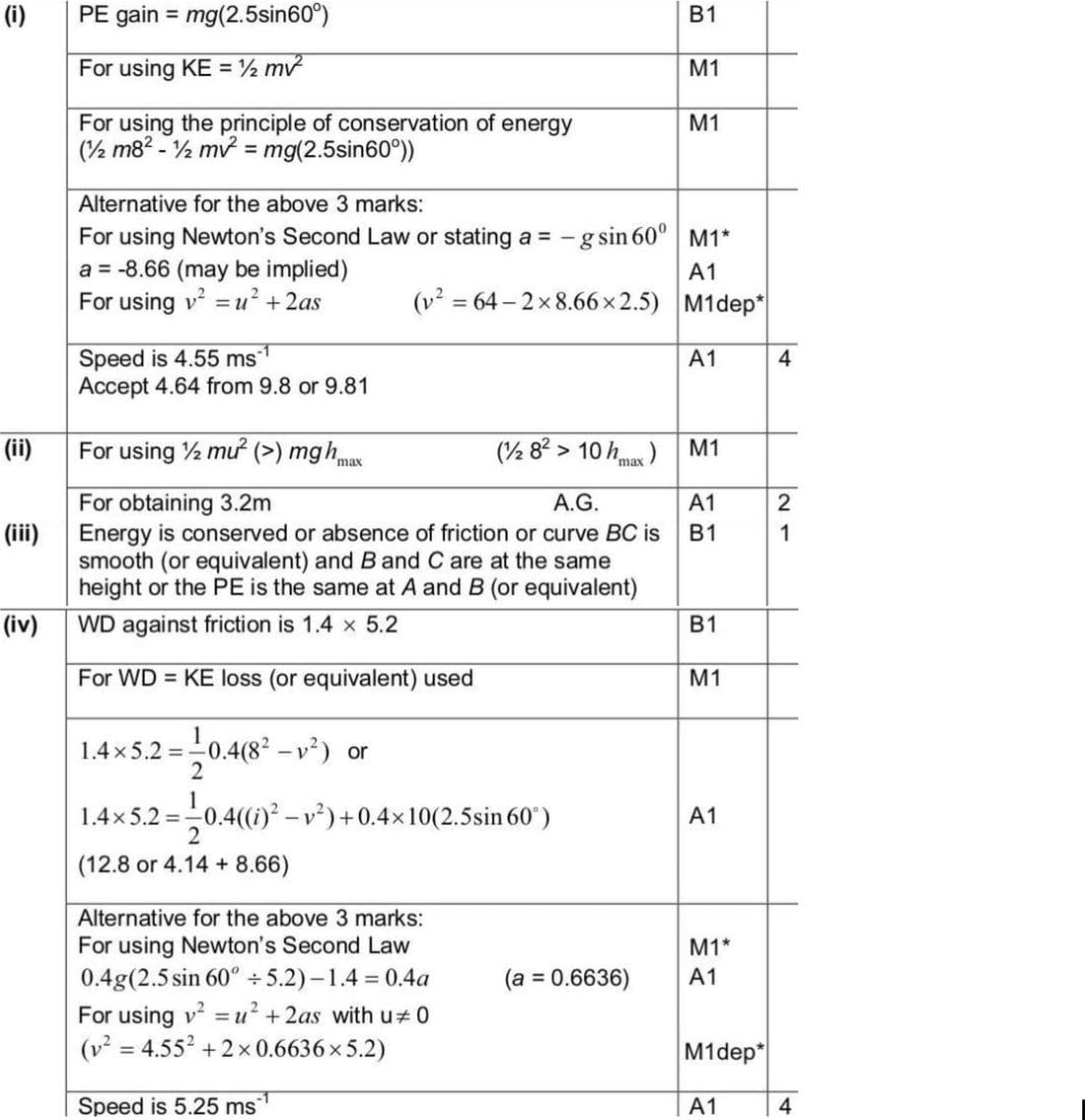
- Find the speed of P at B.
- Show that the maximum height of the cross-section, above AD, is less than 3.2 m.
- State briefly why P’s speed at C is the same as its speed at B.
- The frictional force acting on the particle as it travels from C to D is 1.4 N. Given that the mass of P is 0.4 kg, find the speed with which P reaches D.
9709 P41 - Nov 2022 - Q4
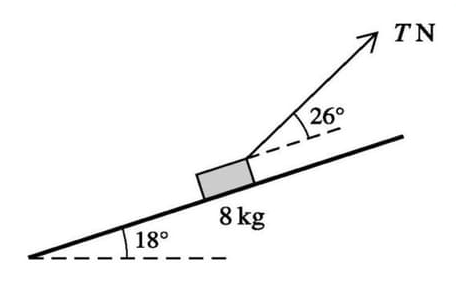
A block of mass 8 kg is placed on a rough plane which is inclined at an angle of 18° to the horizontal. The block is pulled up the plane by a light string that makes an angle of 26° above a line of greatest slope. The tension in the string is \(T\) N (see diagram). The coefficient of friction between the block and plane is 0.65.
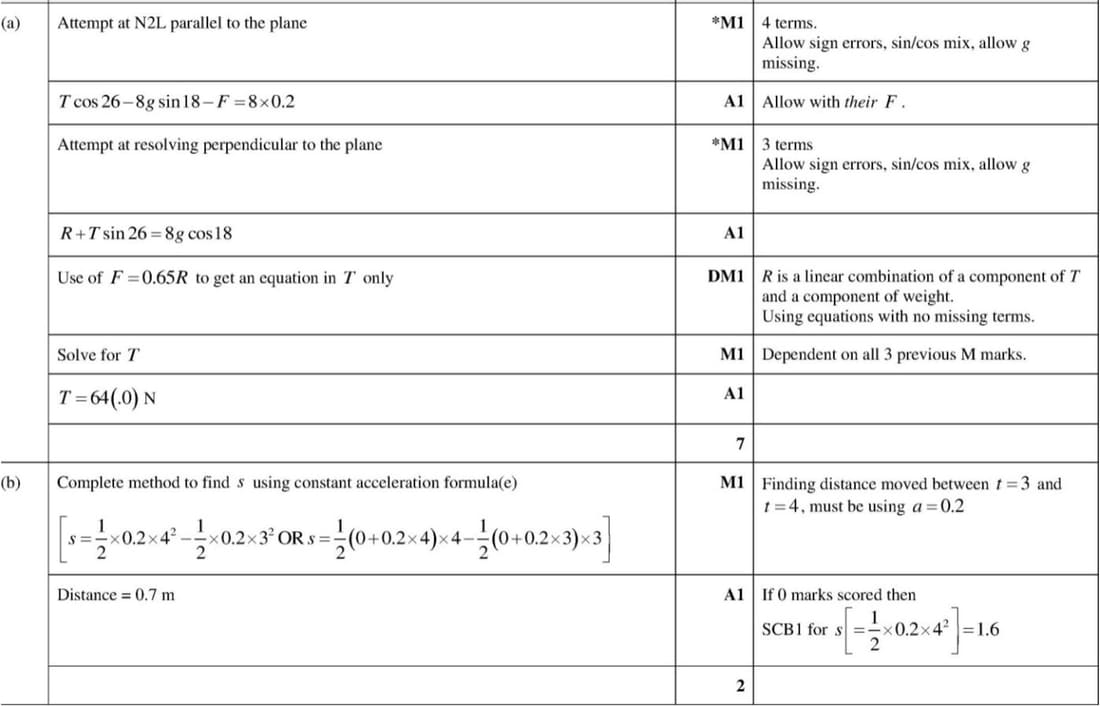
(a) The acceleration of the block is 0.2 m/s². Find \(T\).
(b) The block is initially at rest. Find the distance travelled by the block during the fourth second of motion.
9709 P43 - Jun 2021 - Q7
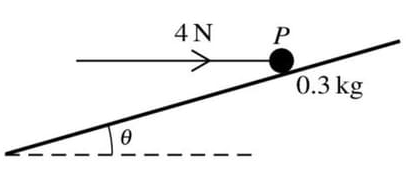
A particle P of mass 0.3 kg rests on a rough plane inclined at an angle \(\theta\) to the horizontal, where \(\sin \theta = \frac{7}{25}\). A horizontal force of magnitude 4 N, acting in the vertical plane containing a line of greatest slope of the plane, is applied to P (see diagram). The particle is on the point of sliding up the plane.
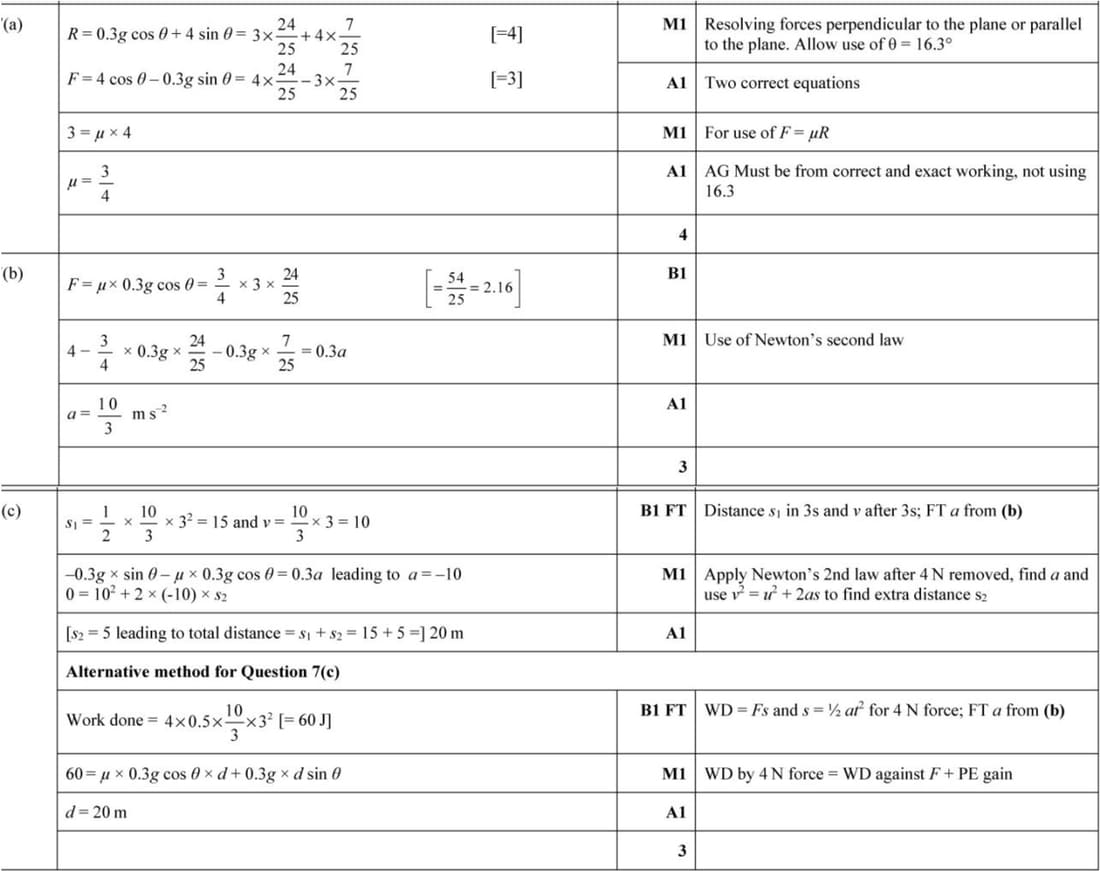
(a) Show that the coefficient of friction between the particle and the plane is \(\frac{3}{4}\).
The force acting horizontally is replaced by a force of magnitude 4 N acting up the plane parallel to a line of greatest slope.
(b) Find the acceleration of P.
(c) Starting with P at rest, the force of 4 N parallel to the plane acts for 3 seconds and is then removed. Find the total distance travelled until P comes to instantaneous rest.
9709 P42 - Jun 2019 - Q4
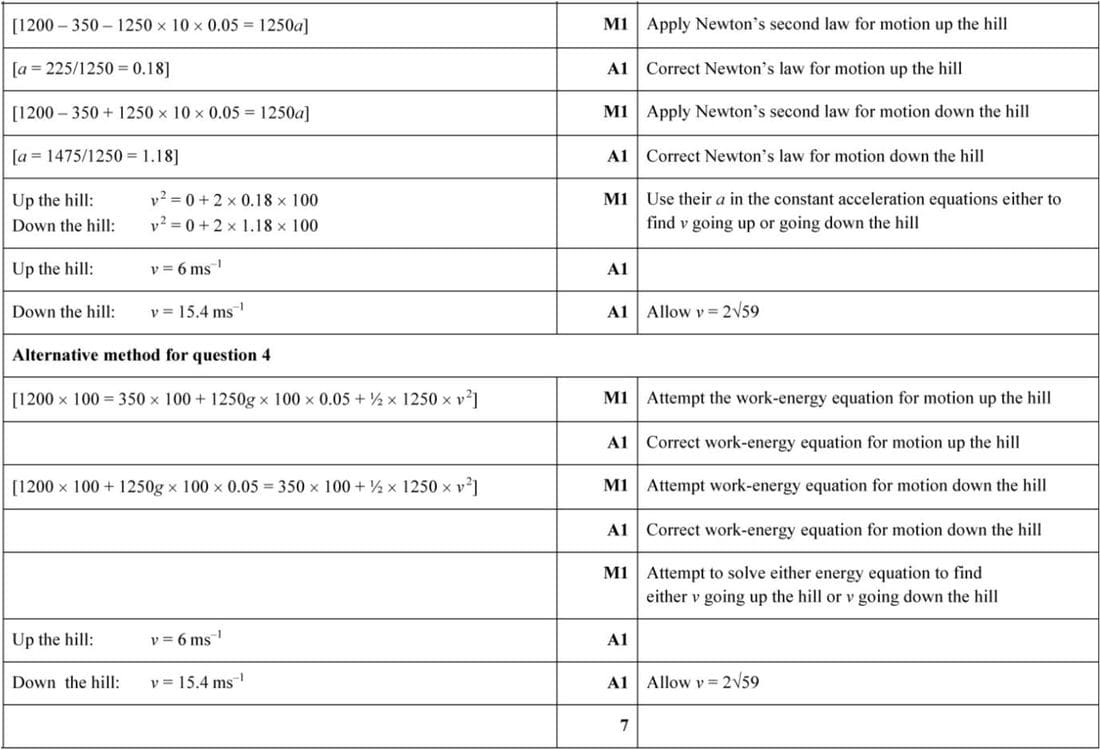
A constant resistance to motion of magnitude 350 N acts on a car of mass 1250 kg. The engine of the car exerts a constant driving force of 1200 N. The car travels along a road inclined at an angle of \(\theta\) to the horizontal, where \(\sin \theta = 0.05\). Find the speed of the car when it has moved 100 m from rest in each of the following cases:
- The car is moving up the hill.
- The car is moving down the hill.
9709 P42 - Nov 2018 - Q2
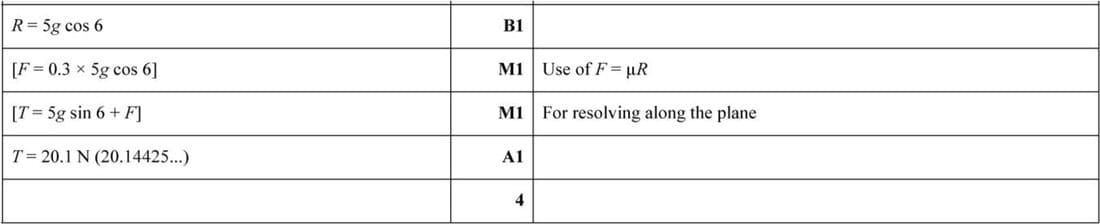
A block of mass 5 kg is being pulled by a rope up a rough plane inclined at 6° to the horizontal. The rope is parallel to a line of greatest slope of the plane and the block is moving at constant speed. The coefficient of friction between the block and the plane is 0.3. Find the tension in the rope.
9709 P42 - Nov 2017 - Q1
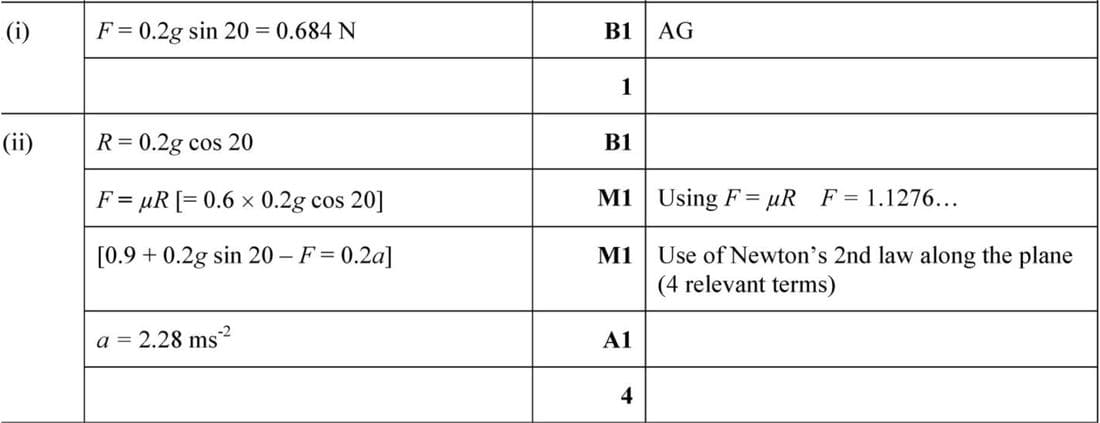
A particle of mass 0.2 kg is resting in equilibrium on a rough plane inclined at 20° to the horizontal.
- Show that the friction force acting on the particle is 0.684 N, correct to 3 significant figures.
The coefficient of friction between the particle and the plane is 0.6. A force of magnitude 0.9 N is applied to the particle down a line of greatest slope of the plane. The particle accelerates down the plane.
- Find this acceleration.
9709 P41 - Jun 2017 - Q2
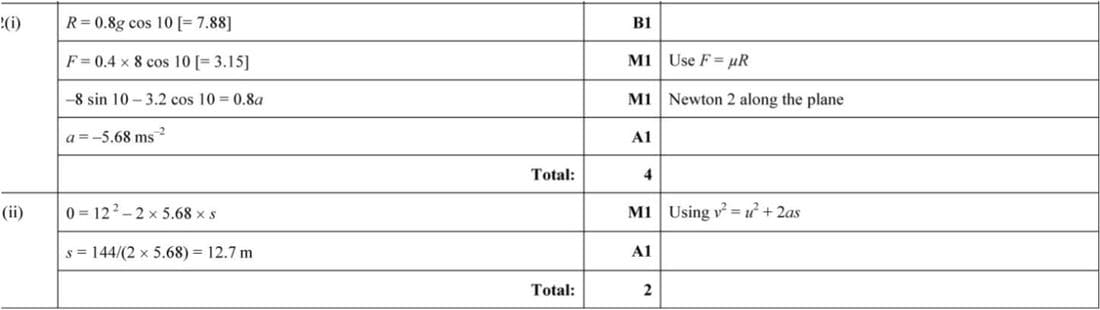
A particle of mass 0.8 kg is projected with a speed of 12 m s-1 up a line of greatest slope of a rough plane inclined at an angle of 10° to the horizontal. The coefficient of friction between the particle and the plane is 0.4.
(i) Find the acceleration of the particle. [4]
(ii) Find the distance the particle moves up the plane before coming to rest. [2]
9709 P42 - Mar 2016 - Q5
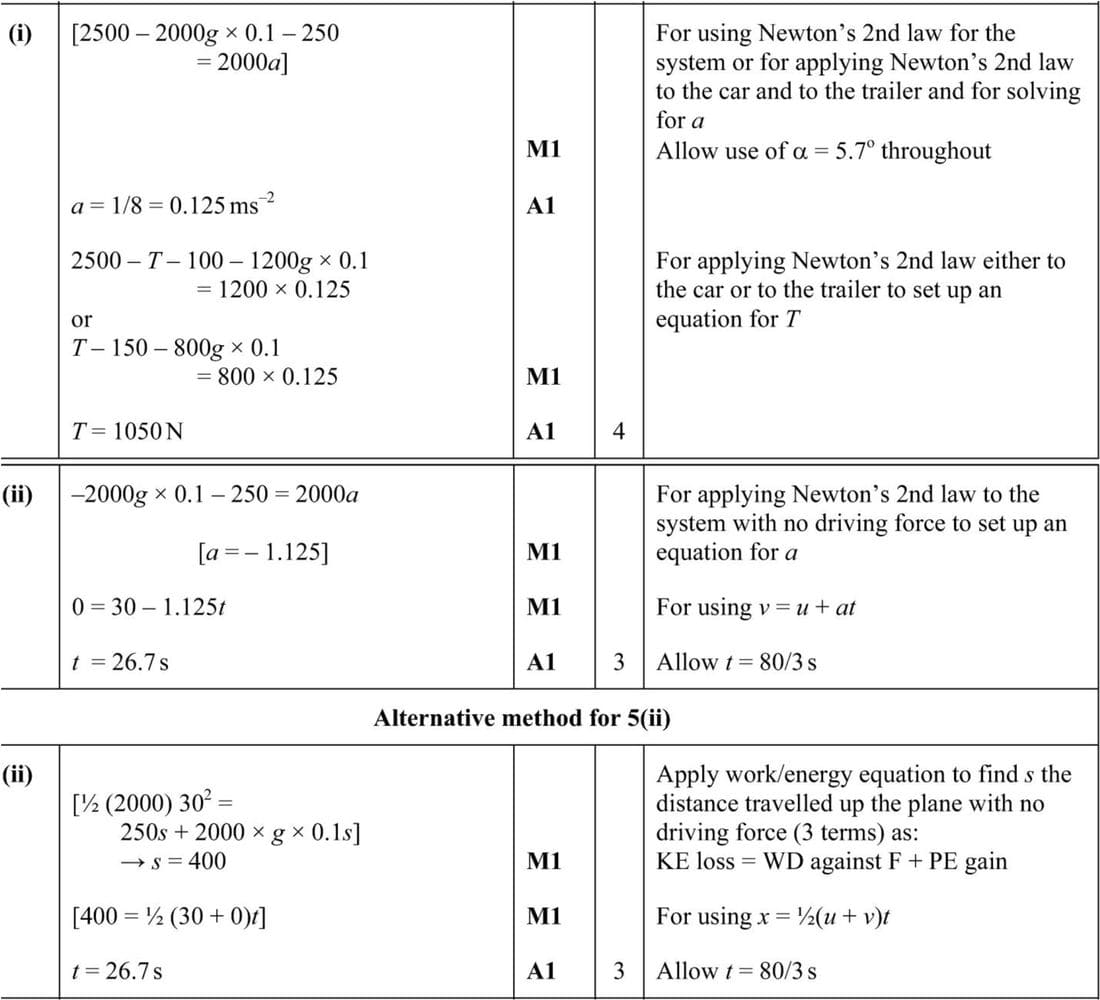
A car of mass 1200 kg is pulling a trailer of mass 800 kg up a hill inclined at an angle \(\alpha\) to the horizontal, where \(\sin \alpha = 0.1\). The system of the car and the trailer is modelled as two particles connected by a light inextensible cable. The driving force of the car’s engine is 2500 N and the resistances to the car and trailer are 100 N and 150 N respectively.
(i) Find the acceleration of the system and the tension in the cable.
(ii) When the car and trailer are travelling at a speed of 30 m s\(^{-1}\), the driving force becomes zero. The cable remains taut. Find the time, in seconds, before the system comes to rest.
9709 P43 - Nov 2023 - Q3
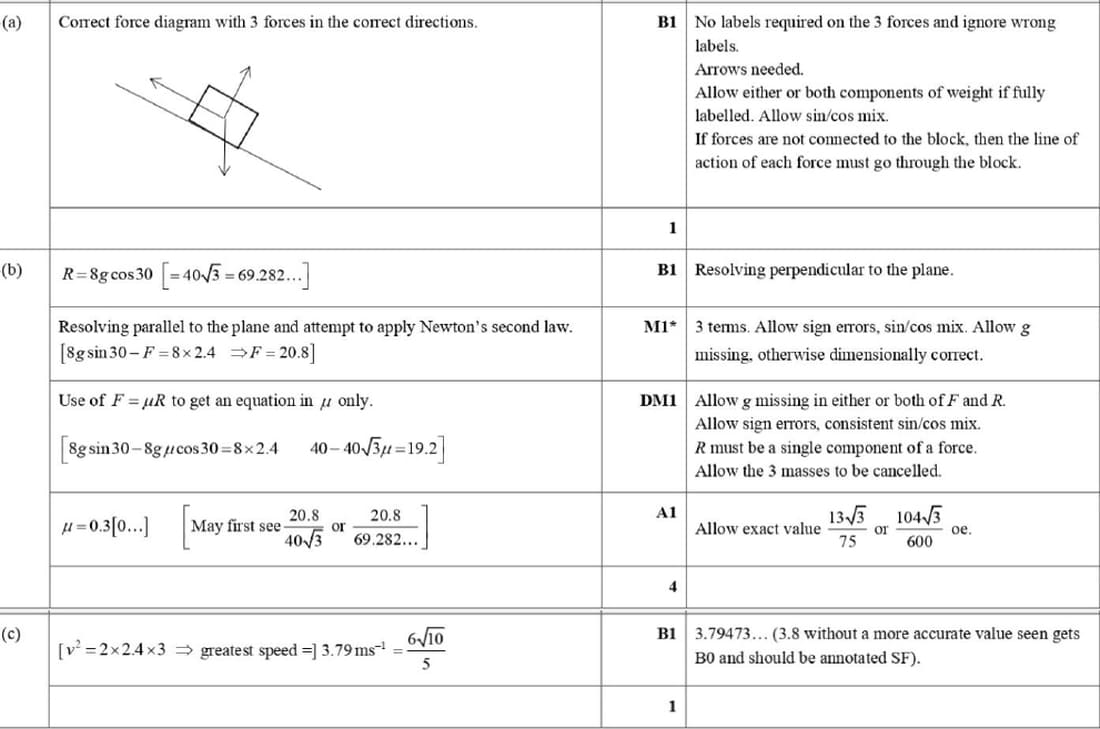
A block of mass 8 kg slides down a rough plane inclined at 30° to the horizontal, starting from rest. The coefficient of friction between the block and the plane is \(\mu\). The block accelerates uniformly down the plane at 2.4 m/s\(^2\).
(a) Draw a diagram showing the forces acting on the block.
(b) Find the value of \(\mu\).
(c) Find the speed of the block after it has moved 3 m down the plane.

9709 P42 - Jun 2013 - Q4
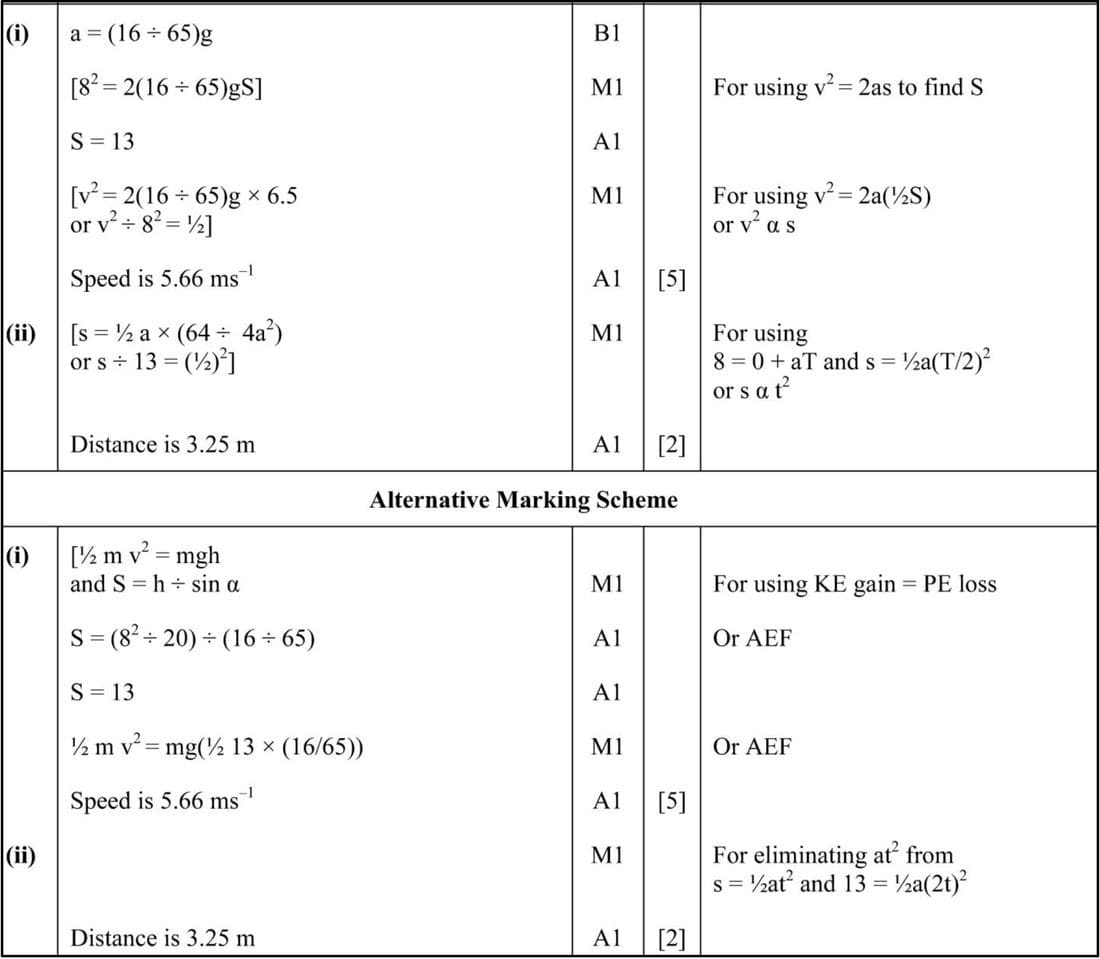
A particle P is released from rest at the top of a smooth plane which is inclined at an angle \(\alpha\) to the horizontal, where \(\sin \alpha = \frac{16}{65}\). The distance travelled by P from the top to the bottom is \(S\) metres, and the speed of P at the bottom is 8 m s-1.
- Find the value of \(S\) and hence find the speed of P when it has travelled \(\frac{1}{2}S\) metres.
- The time taken by P to travel from the top to the bottom of the plane is \(T\) seconds.
- Find the distance travelled by P at the instant when it has been moving for \(\frac{1}{2}T\) seconds.
9709 P42 - Nov 2012 - Q5
A, B, and C are three points on a line of greatest slope of a plane which is inclined at \(\theta^\circ\) to the horizontal, with A higher than B and B higher than C. Between A and B the plane is smooth, and between B and C the plane is rough. A particle P is released from rest on the plane at A and slides down the line ABC. At time 0.8 s after leaving A, the particle passes through B with speed 4 m s\(^{-1}\).
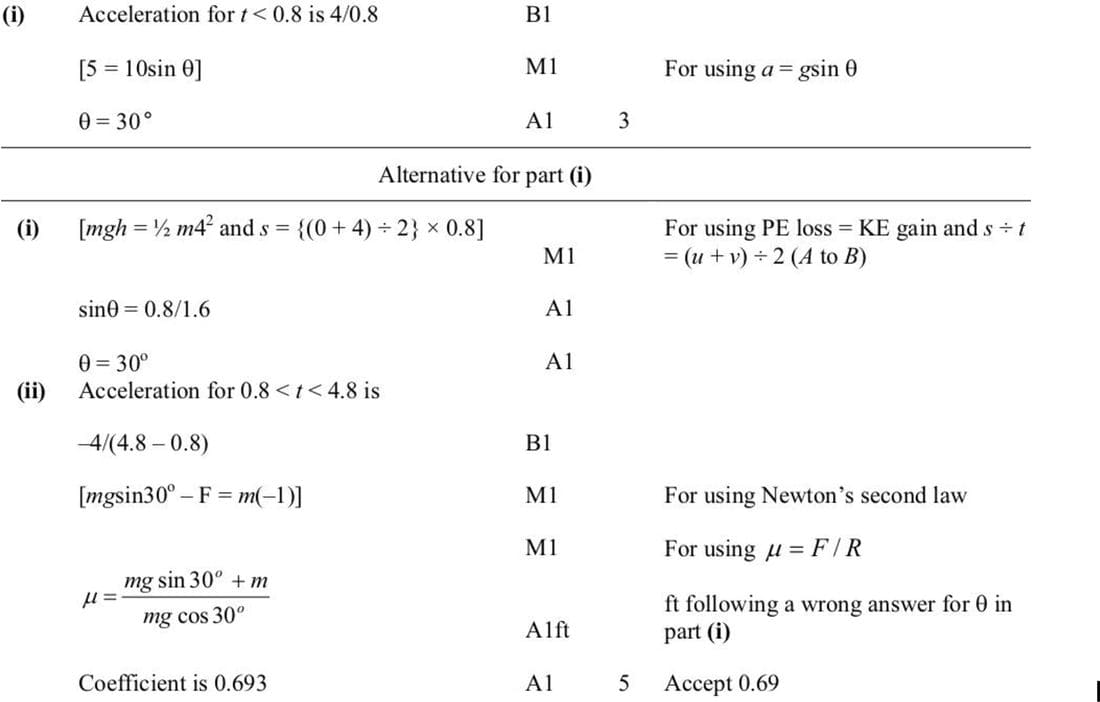
(i) Find the value of \(\theta\).
At time 4.8 s after leaving A, the particle comes to rest at C.
(ii) Find the coefficient of friction between P and the rough part of the plane.