Past Exam Questions
← Back9709 P42 - Mar 2021 - Q5
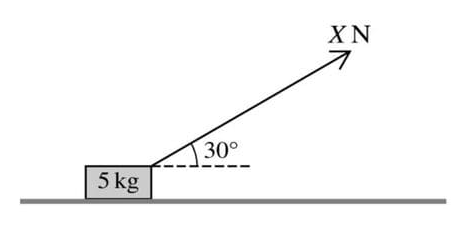
A block of mass 5 kg is being pulled along a rough horizontal floor by a force of magnitude X N acting at 30° above the horizontal (see diagram). The block starts from rest and travels 2 m in the first 5 s of its motion.
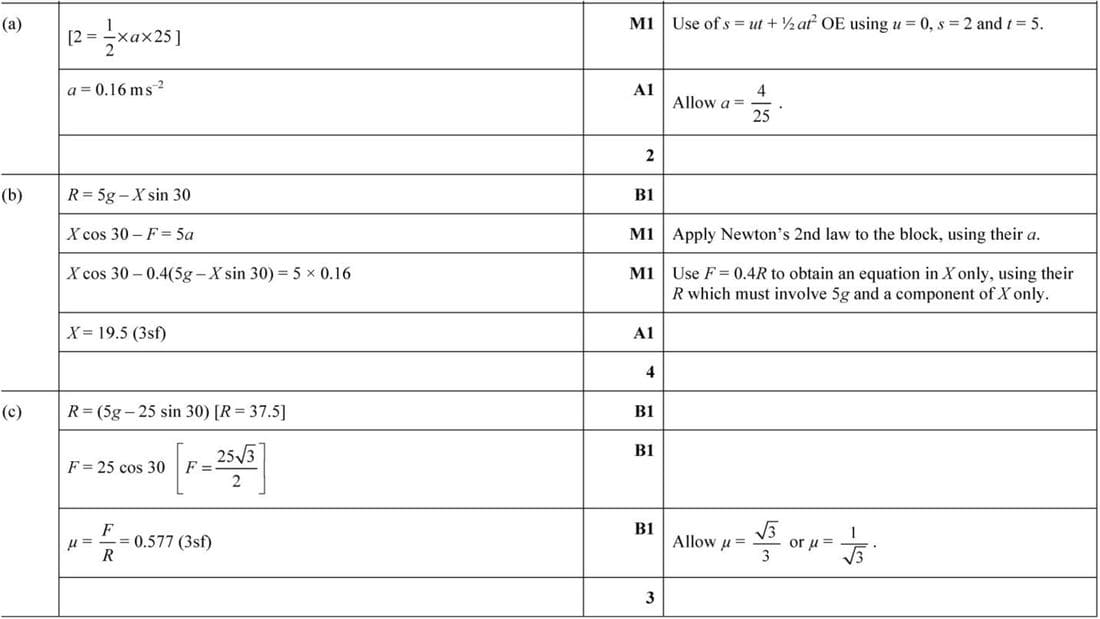
(a) Find the acceleration of the block. [2]
(b) Given that the coefficient of friction between the block and the floor is 0.4, find X. [4]
The block is now placed on a part of the floor where the coefficient of friction between the block and the floor has a different value. The value of X is changed to 25, and the block is now in limiting equilibrium.
(c) Find the value of the coefficient of friction between the block and this part of the floor. [3]
9709 P42 - Mar 2020 - Q2
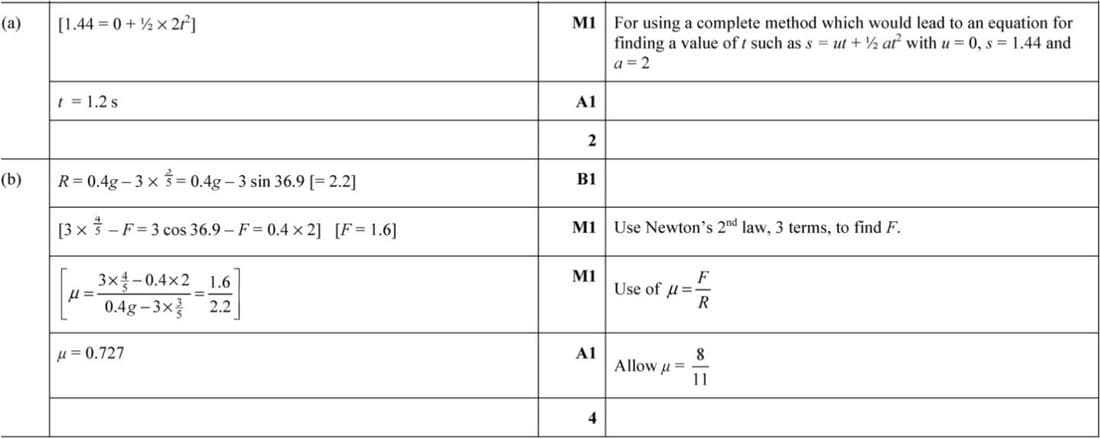
A particle P of mass 0.4 kg is on a rough horizontal floor. The coefficient of friction between P and the floor is \(\mu\). A force of magnitude 3 N is applied to P upwards at an angle \(\alpha\) above the horizontal, where \(\tan \alpha = \frac{3}{4}\). The particle is initially at rest and accelerates at 2 m/s\(^2\).
(a) Find the time it takes for P to travel a distance of 1.44 m from its starting point.
(b) Find \(\mu\).
9709 P43 - Nov 2019 - Q1
A crate of mass 500 kg is being pulled along rough horizontal ground by a horizontal rope attached to a winch. The winch produces a constant pulling force of 2500 N and the crate is moving at constant speed. Find the coefficient of friction between the crate and the ground.

9709 P42 - Nov 2019 - Q6
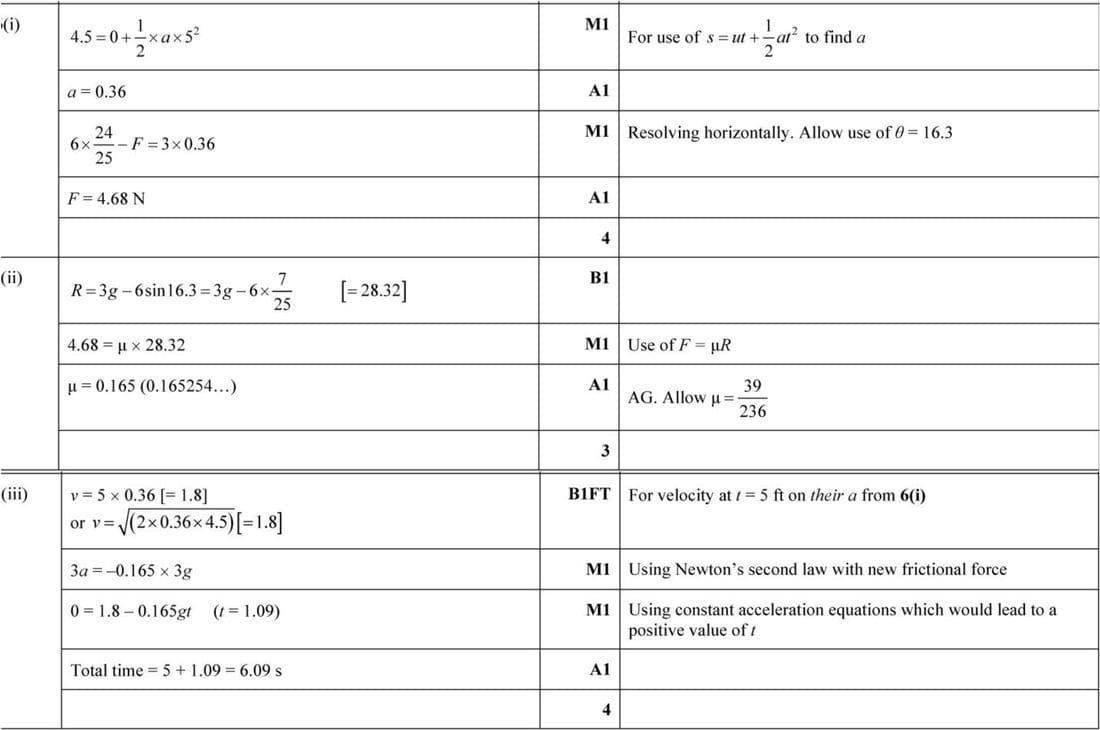
A block of mass 3 kg is initially at rest on a rough horizontal plane. A force of magnitude 6 N is applied to the block at an angle of \(\theta\) above the horizontal, where \(\cos \theta = \frac{24}{25}\). The force is applied for a period of 5 s, during which time the block moves a distance of 4.5 m.
- Find the magnitude of the frictional force on the block.
- Show that the coefficient of friction between the block and the plane is 0.165, correct to 3 significant figures.
- When the block has moved a distance of 4.5 m, the force of magnitude 6 N is removed and the block then decelerates to rest. Find the total time for which the block is in motion.
9709 P43 - Nov 2018 - Q2
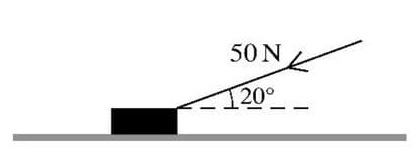
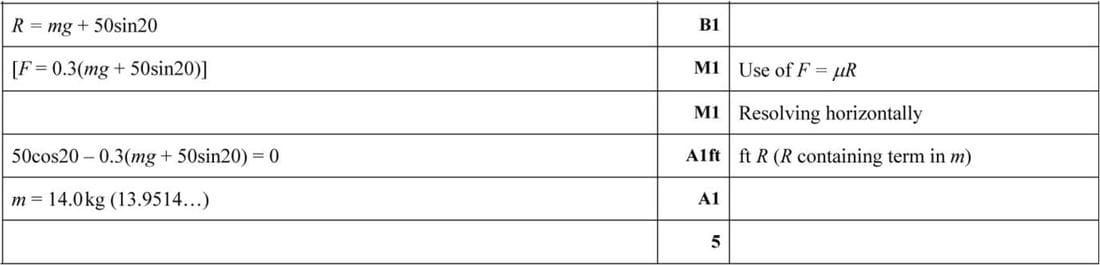
A block is pushed along a horizontal floor by a force of magnitude 50 N which acts at an angle of 20° to the horizontal (see diagram). The coefficient of friction between the block and the floor is 0.3. Given that the speed of the block is constant, find the mass of the block.
9709 P41 - Nov 2018 - Q1
A particle of mass 0.2 kg moving in a straight line experiences a constant resistance force of 1.5 N. When the particle is moving at speed 2.5 m s-1, a constant force of magnitude F N is applied to it in the direction in which it is moving. Given that the speed of the particle 5 seconds later is 4.5 m s-1, find the value of F.

9709 P41 - Nov 2011 - Q5
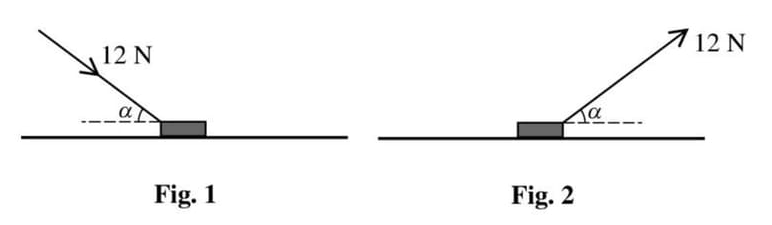
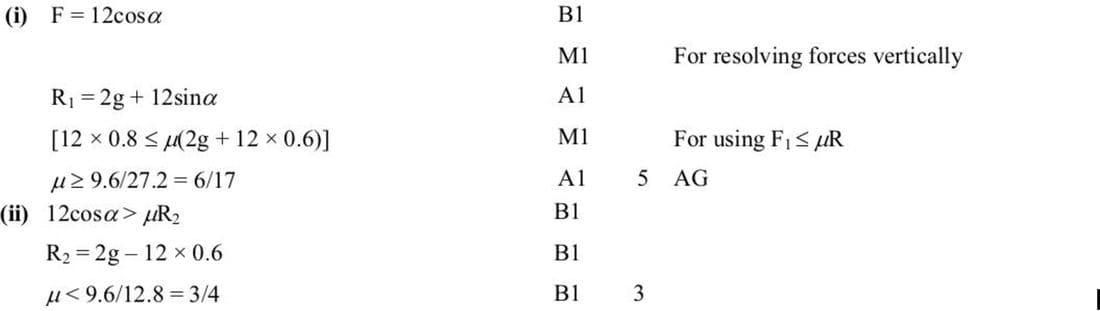
A block of mass 2 kg is at rest on a horizontal floor. The coefficient of friction between the block and the floor is \(\mu\). A force of magnitude 12 N acts on the block at an angle \(\alpha\) to the horizontal, where \(\tan \alpha = \frac{3}{4}\). When the applied force acts downwards as in Fig. 1 the block remains at rest.
- Show that \(\mu \geq \frac{6}{17}\).
When the applied force acts upwards as in Fig. 2 the block slides along the floor.
- Find another inequality for \(\mu\).
9709 P43 - Jun 2010 - Q7
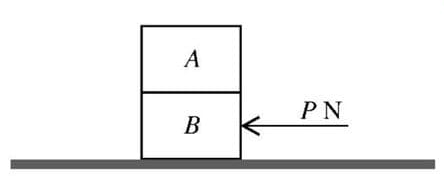
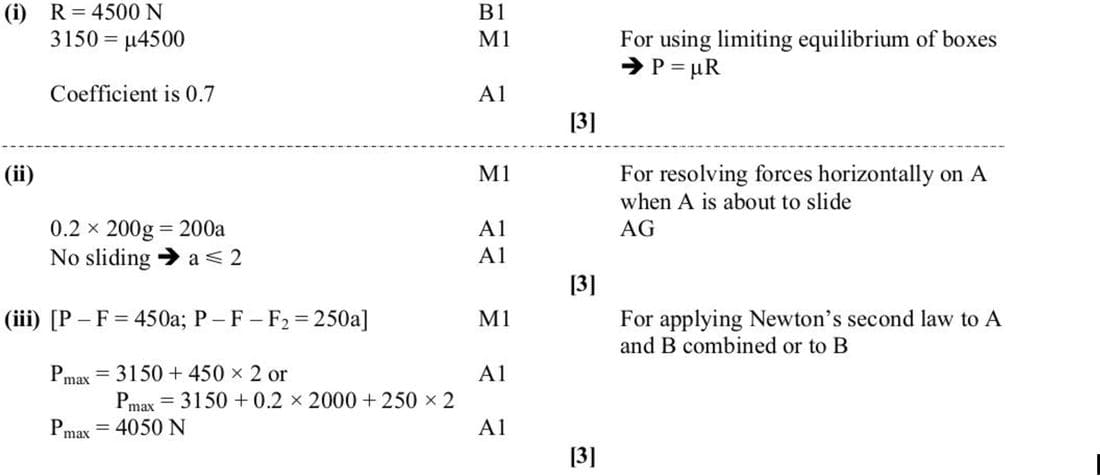
Two rectangular boxes A and B are of identical size. The boxes are at rest on a rough horizontal floor with A on top of B. Box A has mass 200 kg and box B has mass 250 kg. A horizontal force of magnitude P N is applied to B (see diagram). The boxes remain at rest if P \leq 3150 and start to move if P > 3150.
- Find the coefficient of friction between B and the floor.
- Given that P > 3150 and that no sliding takes place between the boxes, show that the acceleration of the boxes is not greater than 2 \text{ m s}^{-2}.
- Find the maximum possible value of P.
9709 P4 - Nov 2004 - Q6
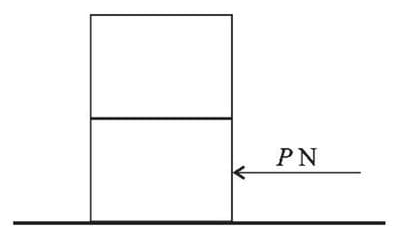
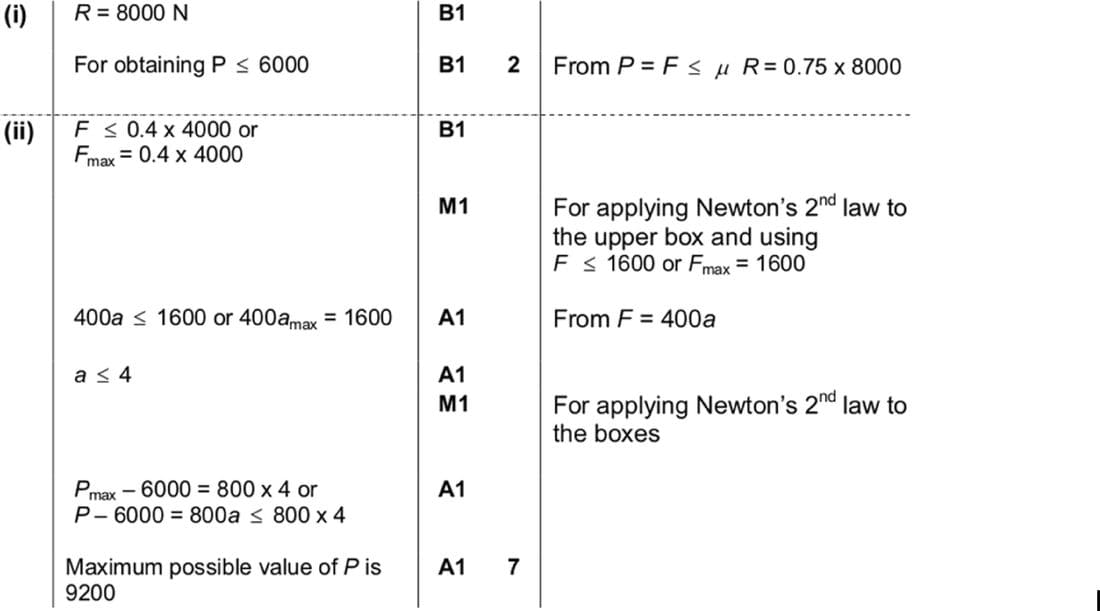
Two identical boxes, each of mass 400 kg, are at rest, with one on top of the other, on horizontal ground. A horizontal force of magnitude P newtons is applied to the lower box (see diagram). The coefficient of friction between the lower box and the ground is 0.75 and the coefficient of friction between the two boxes is 0.4.
(i) Show that the boxes will remain at rest if P ≤ 6000.
The boxes start to move with acceleration a m/s².
(ii) Given that no sliding takes place between the boxes, show that a ≤ 4 and deduce the maximum possible value of P.
9709 P41 - Nov 2019 - Q5
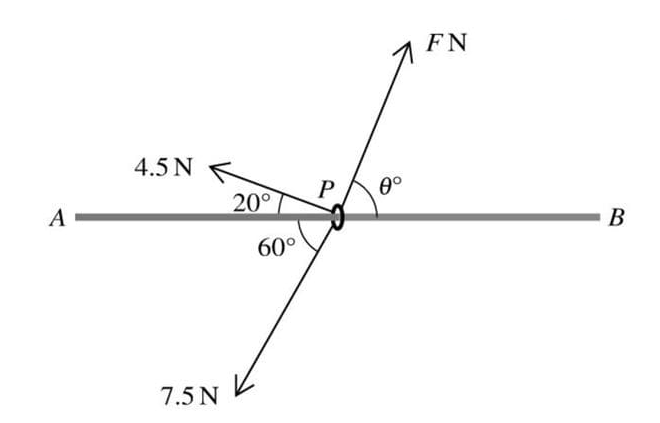
A small ring P is threaded on a fixed smooth horizontal rod AB. Three horizontal forces of magnitudes 4.5 N, 7.5 N and F N act on P (see diagram).
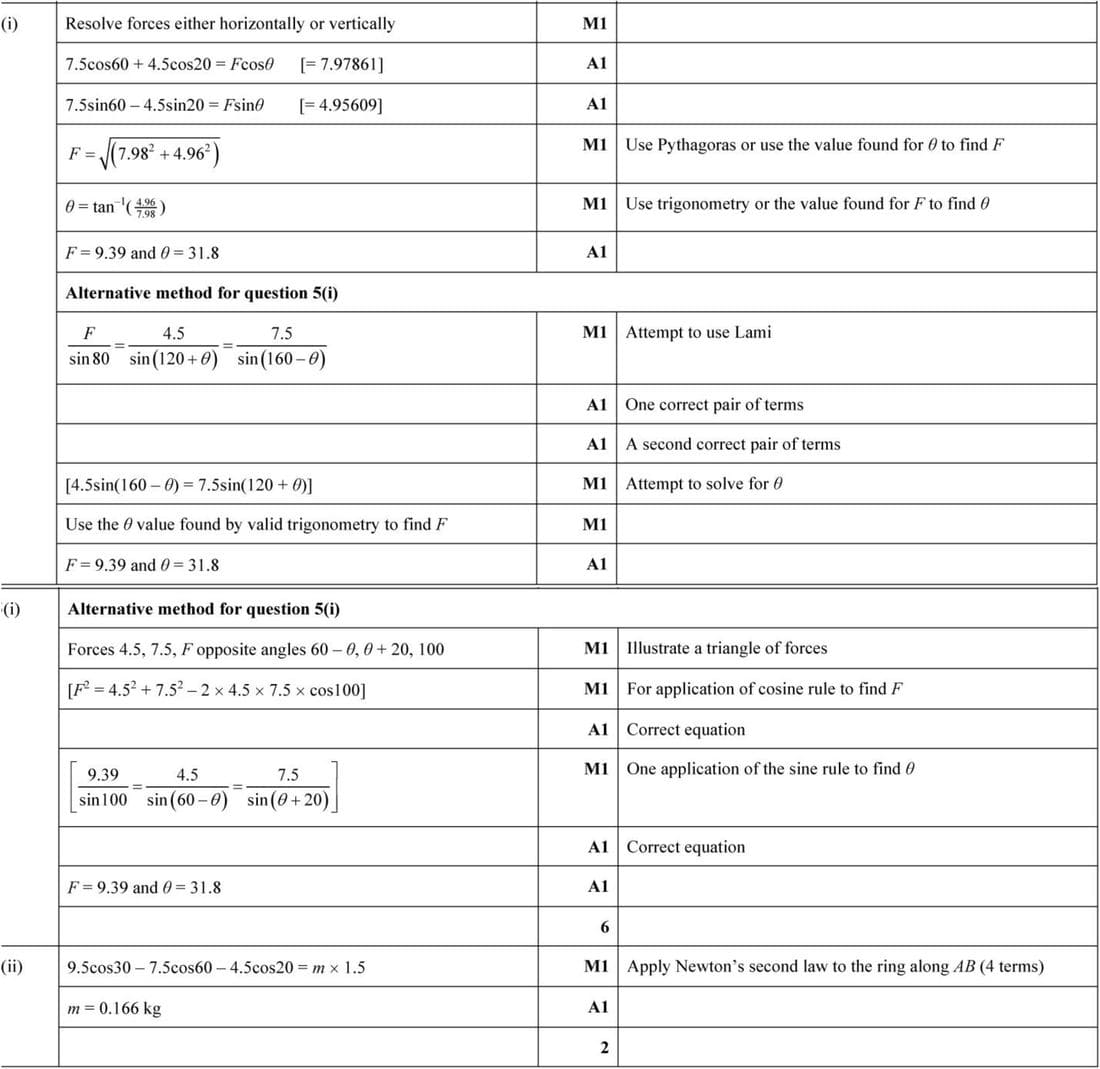
(i) Given that these three forces are in equilibrium, find the values of F and \(\theta\).
(ii) It is given instead that the values of F and \(\theta\) are 9.5 and 30 respectively, and the acceleration of the ring is 1.5 m s-2. Find the mass of the ring.
9709 P41 - Nov 2017 - Q1
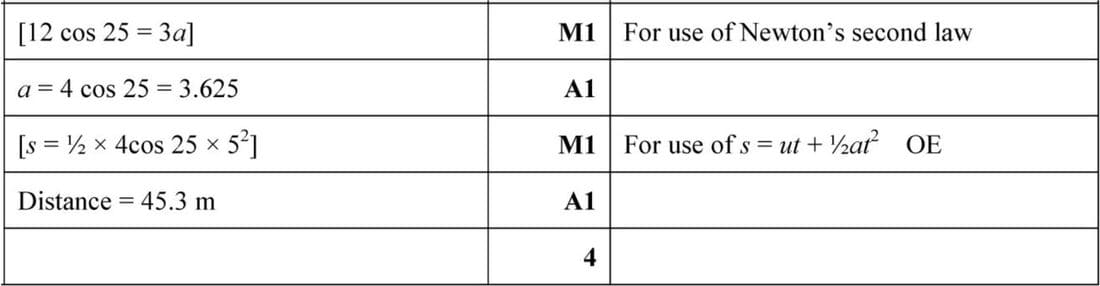
A block of mass 3 kg is initially at rest on a smooth horizontal floor. A force of 12 N, acting at an angle of 25° above the horizontal, is applied to the block. Find the distance travelled by the block in the first 5 seconds of its motion.
9709 P41 - Nov 2015 - Q5
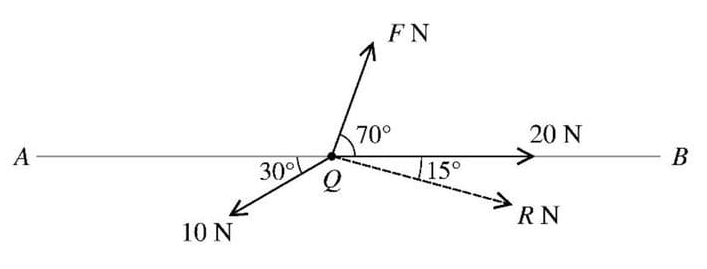
A small bead Q can move freely along a smooth horizontal straight wire AB of length 3 m. Three horizontal forces of magnitudes F N, 10 N, and 20 N act on the bead in the directions shown in the diagram. The magnitude of the resultant of the three forces is R N in the direction shown in the diagram.
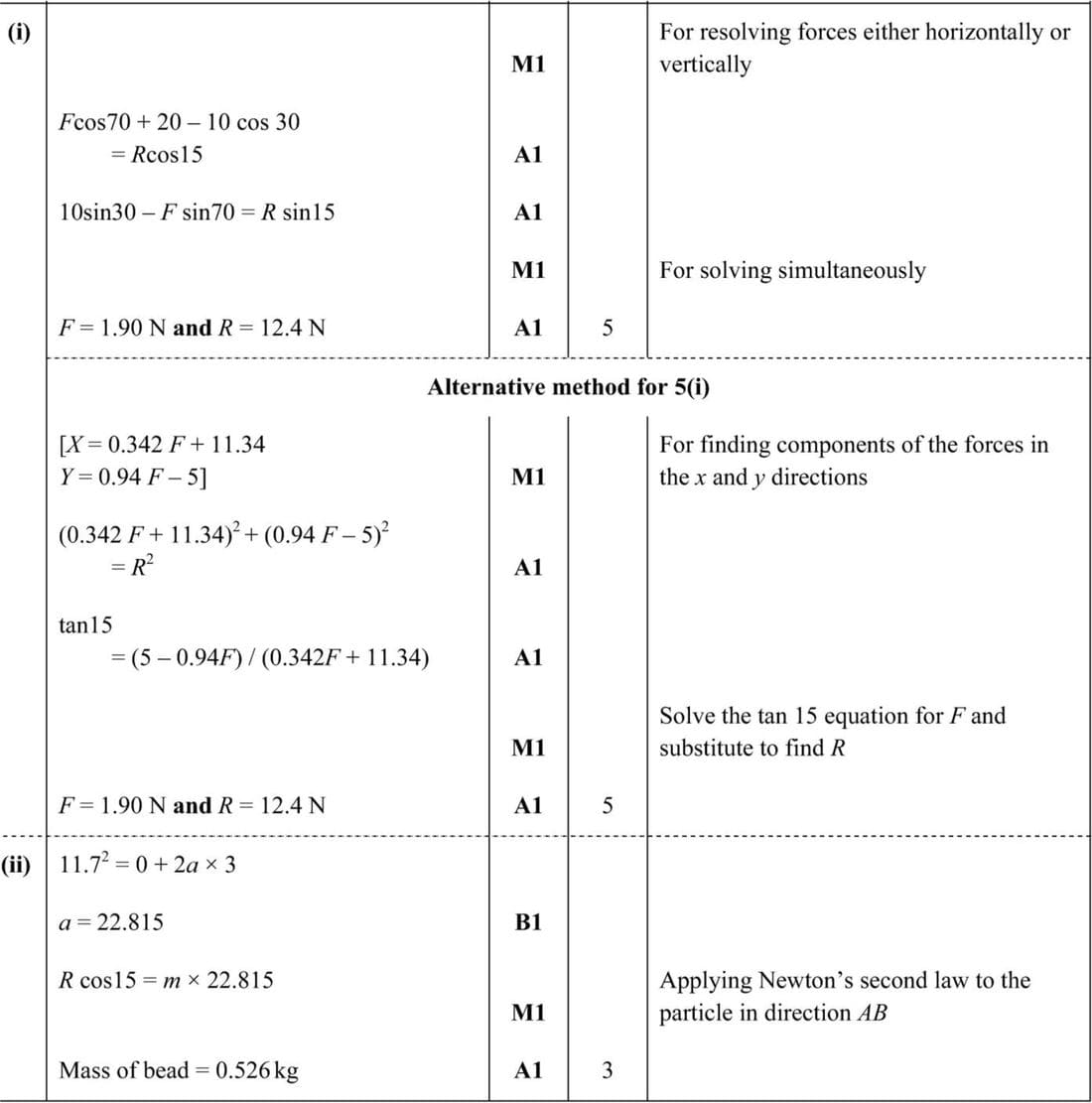
(i) Find the values of F and R.
(ii) Initially the bead is at rest at A. It reaches B with a speed of 11.7 m s-1. Find the mass of the bead.
9709 P41 - Jun 2013 - Q6
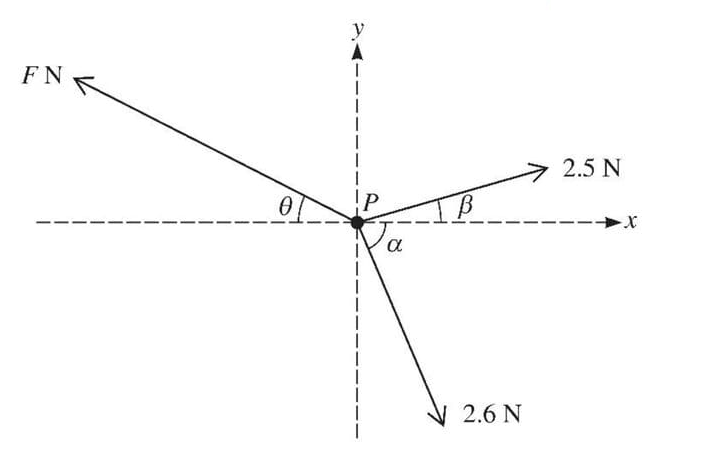
A particle P of mass 0.5 kg lies on a smooth horizontal plane. Horizontal forces of magnitudes F N, 2.5 N, and 2.6 N act on P. The directions of the forces are as shown in the diagram, where \(\tan \alpha = \frac{12}{5}\) and \(\tan \beta = \frac{7}{24}\).
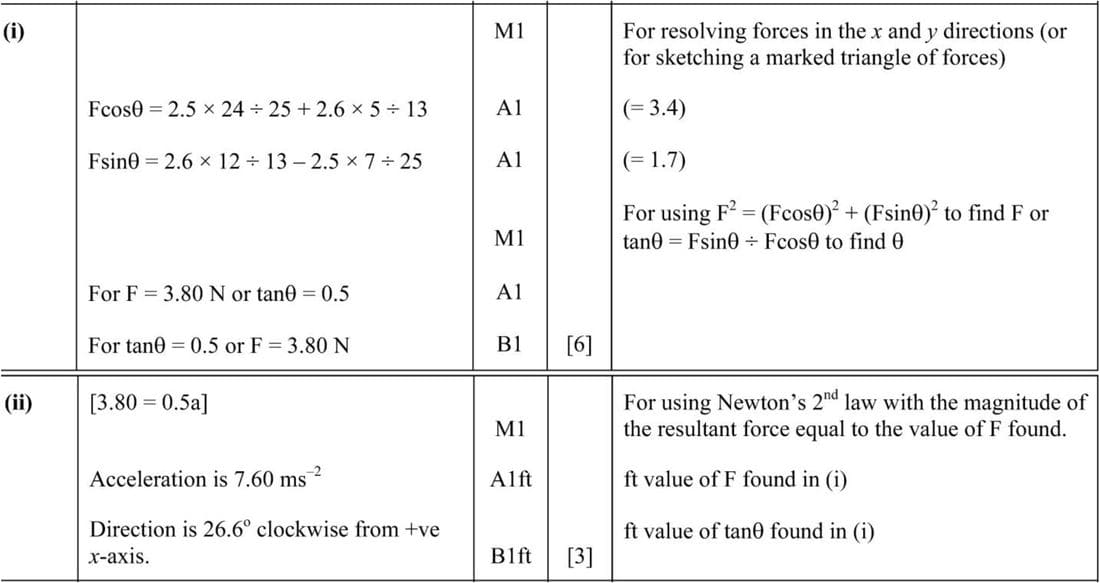
(i) Given that P is in equilibrium, find the values of F and \(\tan \theta\).
(ii) The force of magnitude F N is removed. Find the magnitude and direction of the acceleration with which P starts to move.
9709 P42 - Jun 2023 - Q5
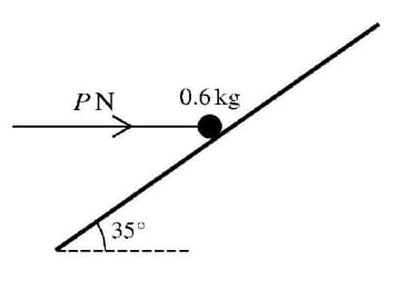
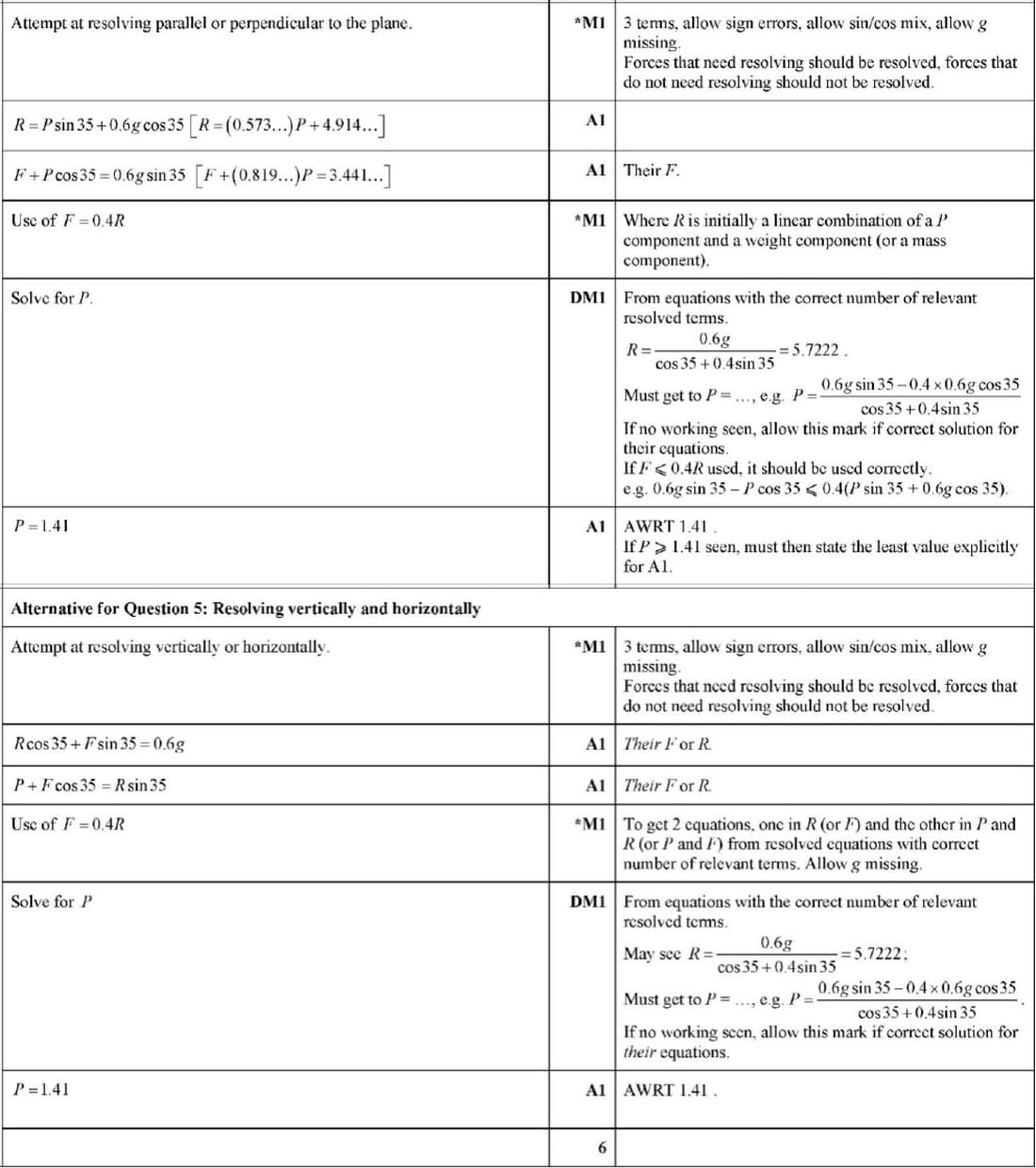
A particle of mass 0.6 kg is placed on a rough plane which is inclined at an angle of 35° to the horizontal. The particle is kept in equilibrium by a horizontal force of magnitude \(P\) N acting in a vertical plane containing a line of greatest slope (see diagram). The coefficient of friction between the particle and plane is 0.4.
Find the least possible value of \(P\).
9709 P42 - Jun 2017 - Q5
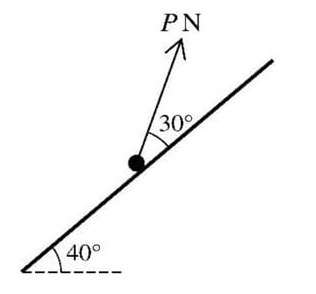
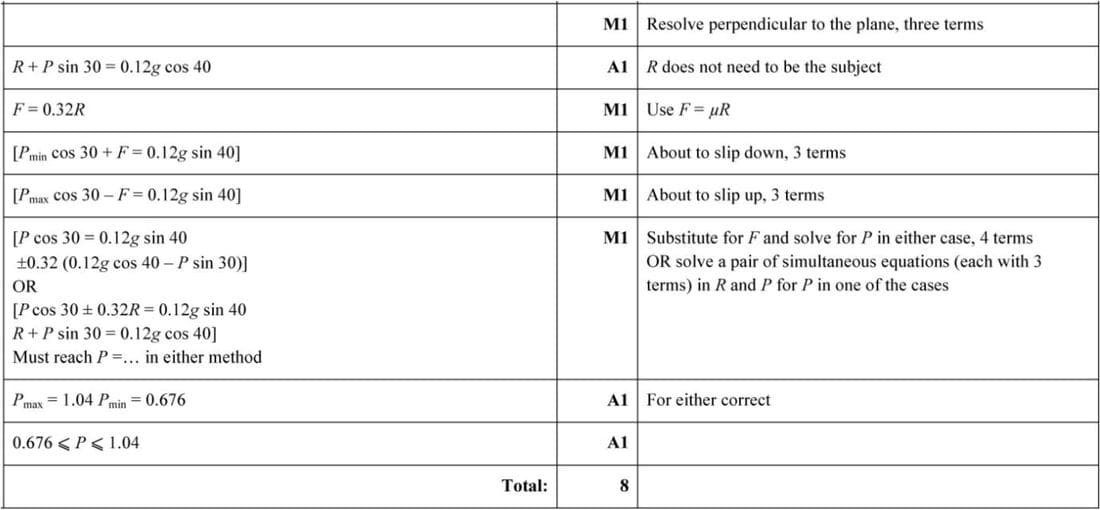
A particle of mass 0.12 kg is placed on a plane which is inclined at an angle of 40° to the horizontal. The particle is kept in equilibrium by a force of magnitude \(P N\) acting up the plane at an angle of 30° above a line of greatest slope, as shown in the diagram. The coefficient of friction between the particle and the plane is 0.32. Find the set of possible values of \(P\).
9709 P42 - Mar 2017 - Q3
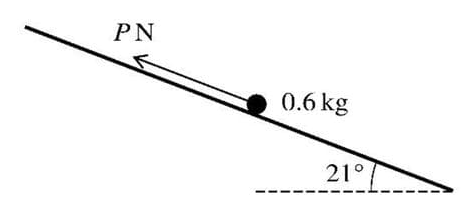
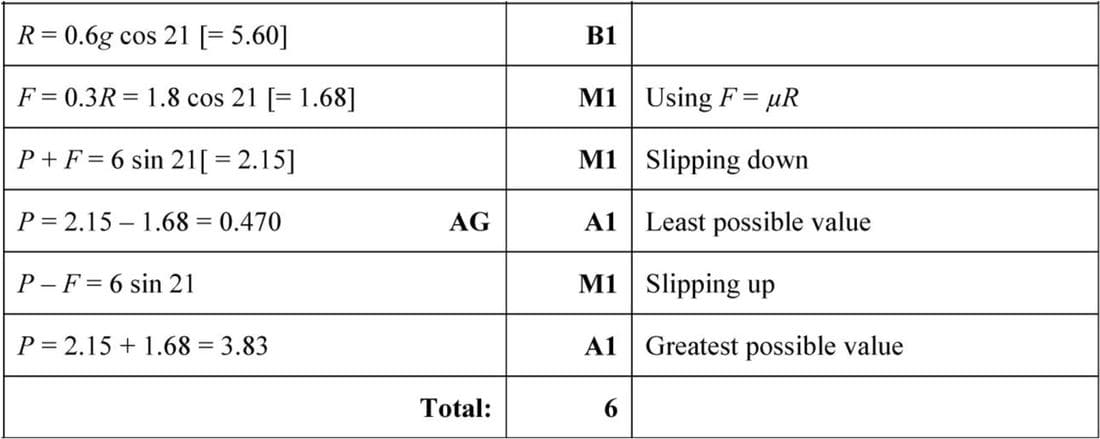
A particle of mass 0.6 kg is placed on a rough plane which is inclined at an angle of 21° to the horizontal. The particle is kept in equilibrium by a force of magnitude P N acting parallel to a line of greatest slope of the plane, as shown in the diagram. The coefficient of friction between the particle and the plane is 0.3. Show that the least possible value of P is 0.470, correct to 3 significant figures, and find the greatest possible value of P.
9709 P42 - Nov 2016 - Q5
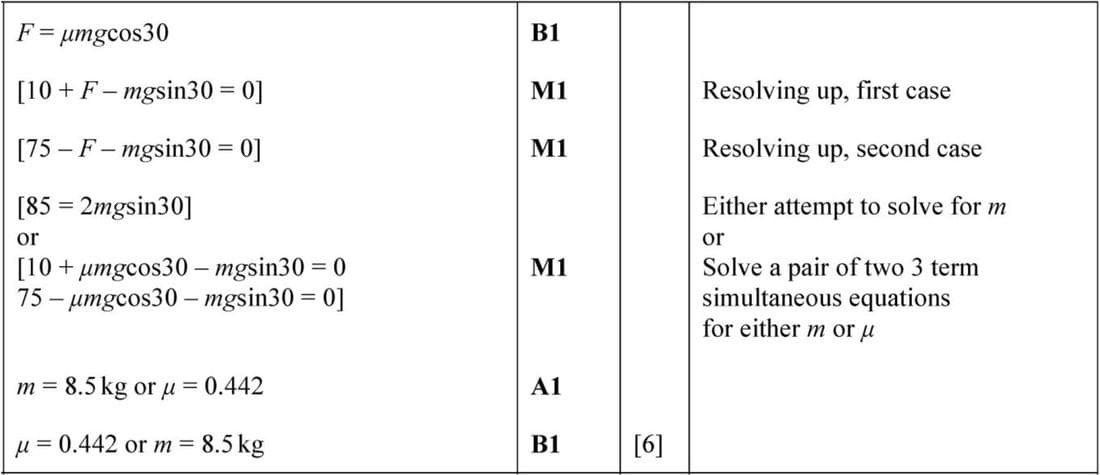
A particle of mass m kg is resting on a rough plane inclined at 30° to the horizontal. A force of magnitude 10 N applied to the particle up a line of greatest slope of the plane is just sufficient to stop the particle sliding down the plane. When a force of 75 N is applied to the particle up a line of greatest slope of the plane, the particle is on the point of sliding up the plane. Find m and the coefficient of friction between the particle and the plane.
9709 P43 - Jun 2016 - Q4
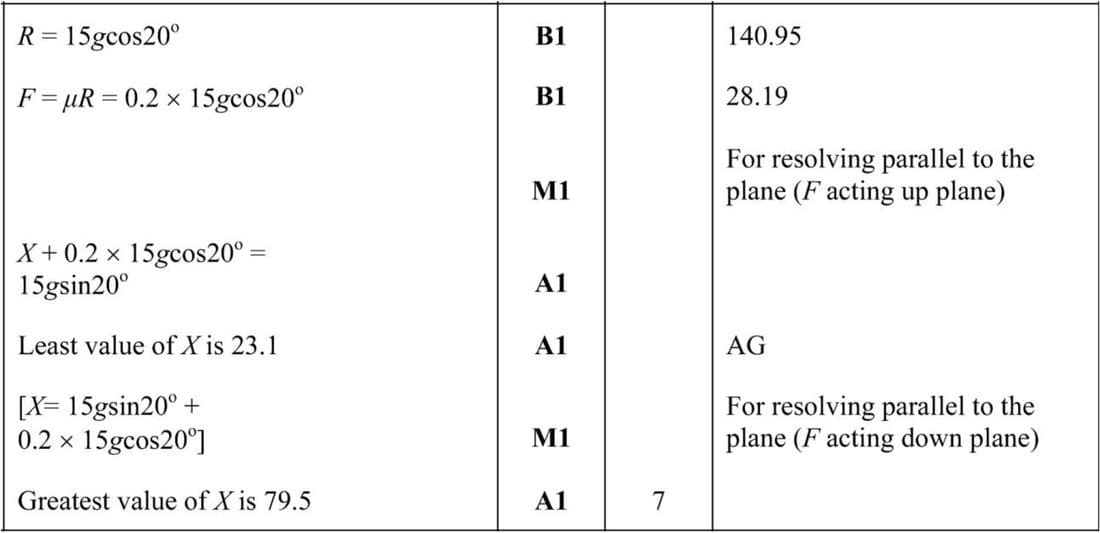
A particle of mass 15 kg is stationary on a rough plane inclined at an angle of 20° to the horizontal. The coefficient of friction between the particle and the plane is 0.2. A force of magnitude X N acting parallel to a line of greatest slope of the plane is used to keep the particle in equilibrium. Show that the least possible value of X is 23.1, correct to 3 significant figures, and find the greatest possible value of X.
9709 P42 - Jun 2016 - Q5
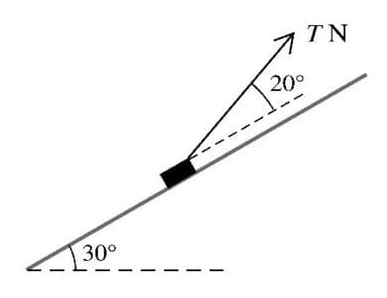
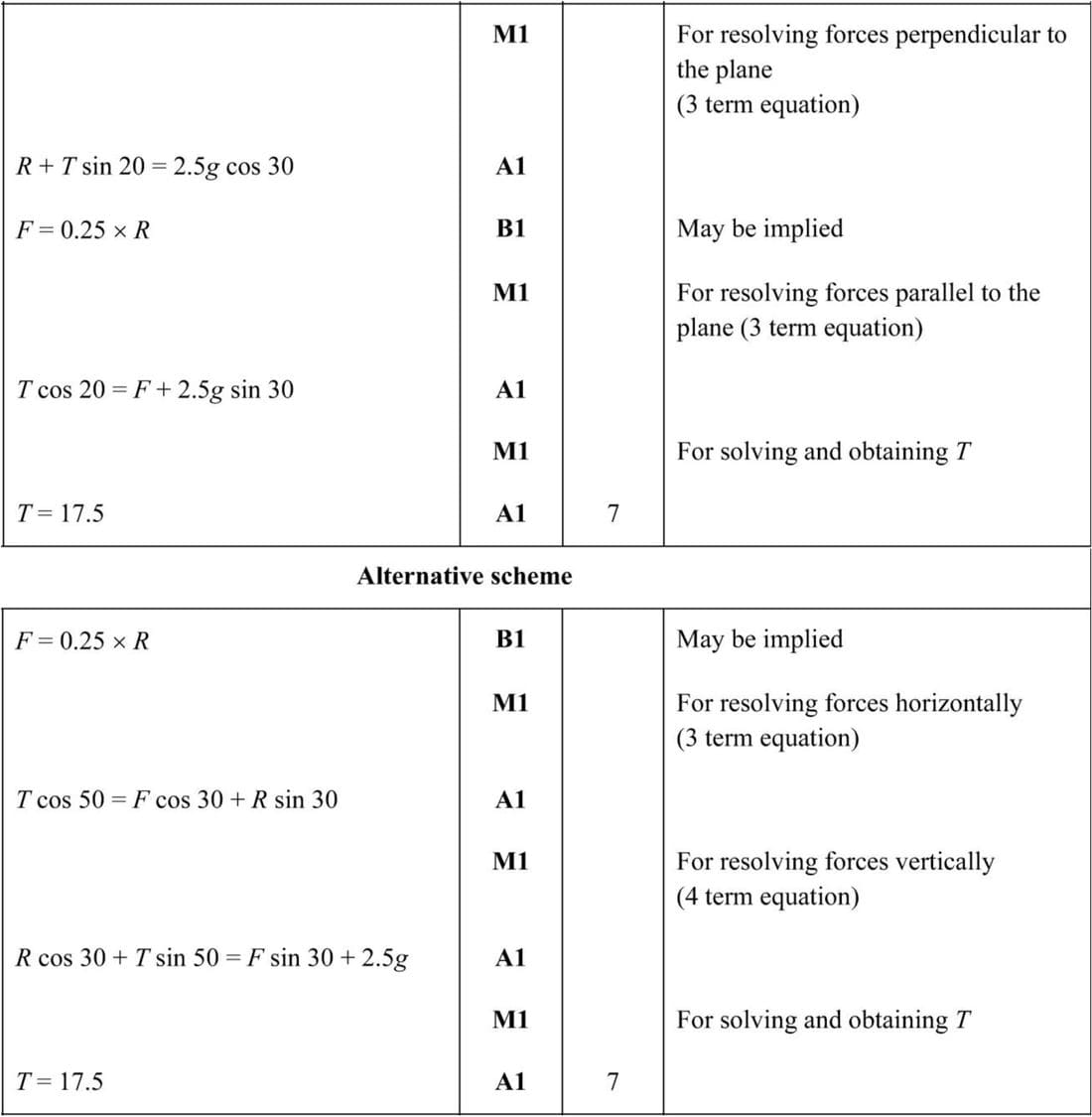
A block of mass 2.5 kg is placed on a plane which is inclined at an angle of 30° to the horizontal. The block is kept in equilibrium by a light string making an angle of 20° above a line of greatest slope. The tension in the string is T N, as shown in the diagram. The coefficient of friction between the block and plane is \(\frac{1}{4}\). The block is in limiting equilibrium and is about to move up the plane. Find the value of T.
9709 P41 - Jun 2014 - Q2
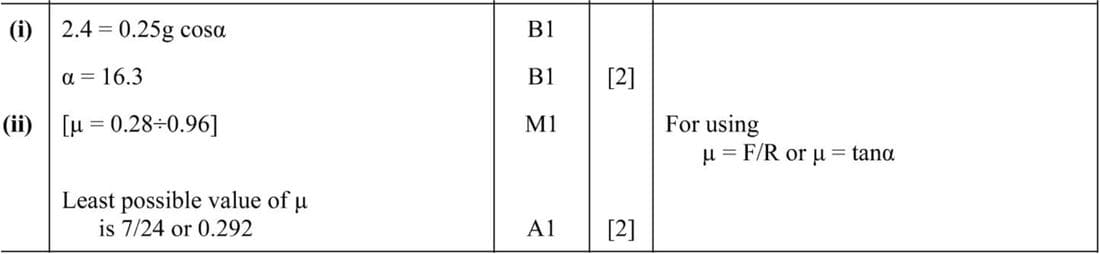
A rough plane is inclined at an angle of \(\alpha^\circ\) to the horizontal. A particle of mass 0.25 kg is in equilibrium on the plane. The normal reaction force acting on the particle has magnitude 2.4 N. Find
- the value of \(\alpha\),
- the least possible value of the coefficient of friction.