Past Exam Questions
← Back9709 P43 - Nov 2013 - Q4
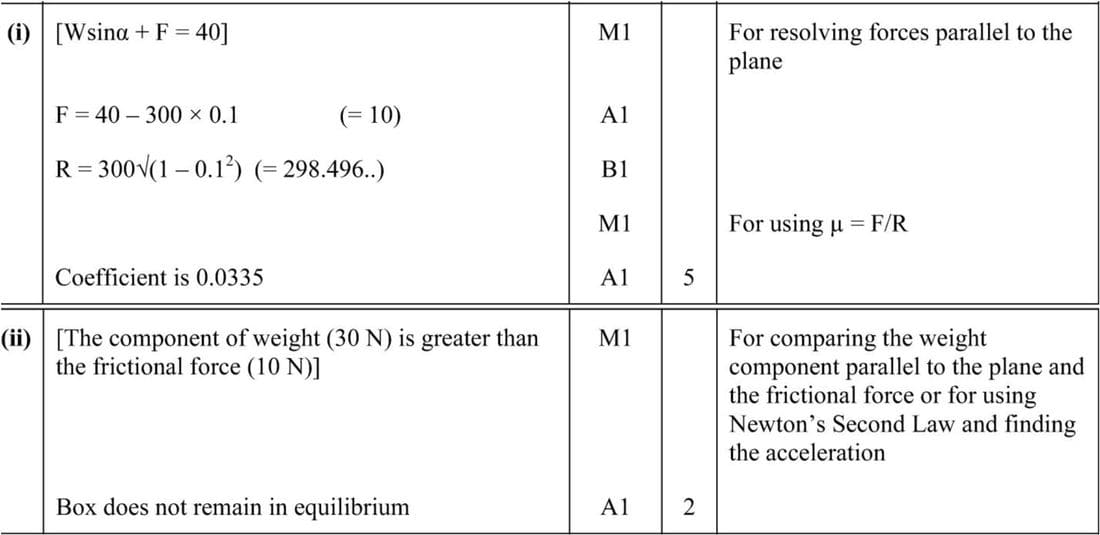
A box of mass 30 kg is at rest on a rough plane inclined at an angle \(\alpha\) to the horizontal, where \(\sin \alpha = 0.1\), acted on by a force of magnitude 40 N. The force acts upwards and parallel to a line of greatest slope of the plane. The box is on the point of slipping up the plane.
(i) Find the coefficient of friction between the box and the plane.
The force of magnitude 40 N is removed.
(ii) Determine, giving a reason, whether or not the box remains in equilibrium.
9709 P42 - Nov 2013 - Q4
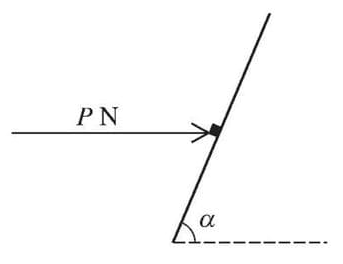
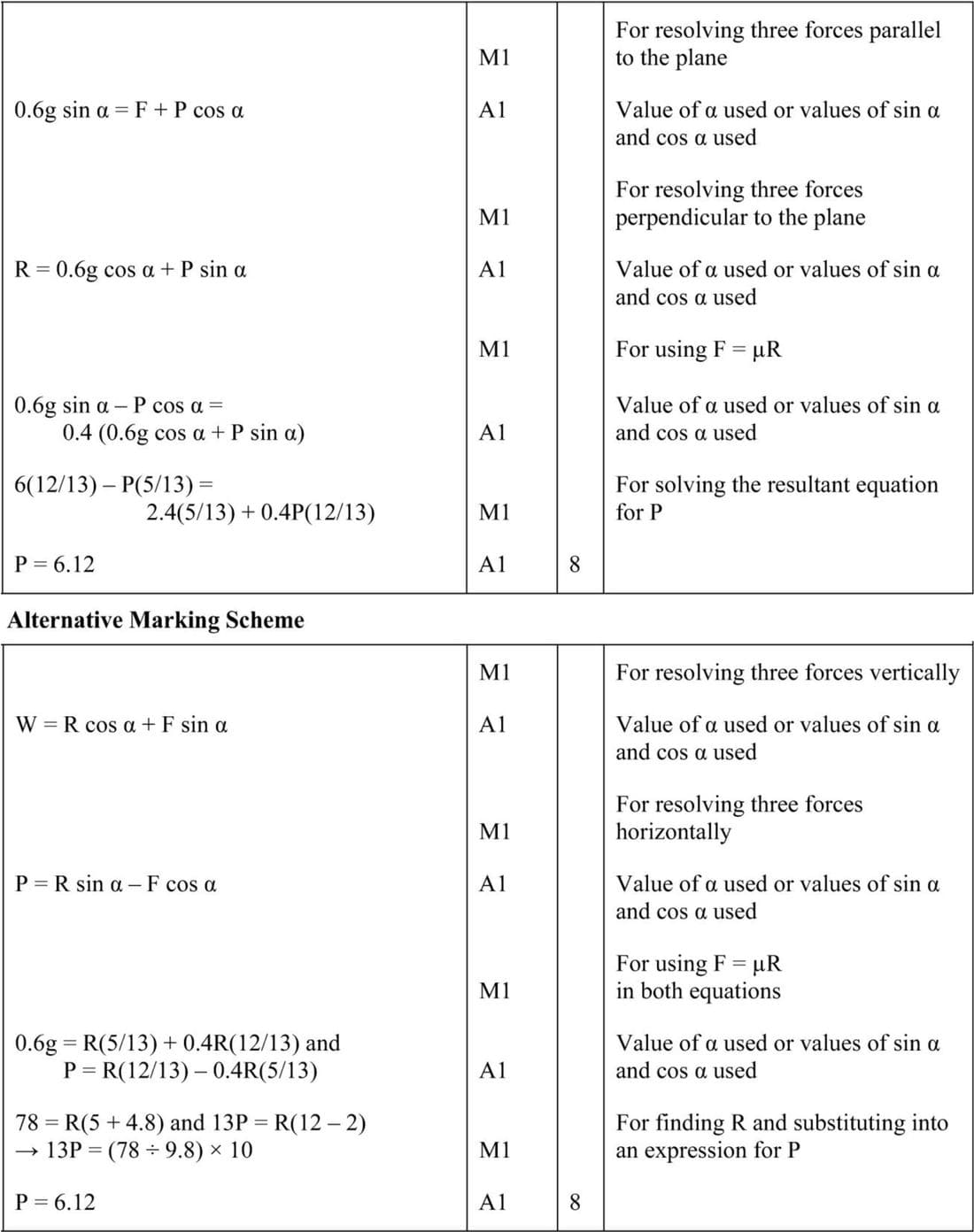
A rough plane is inclined at an angle \(\alpha\) to the horizontal, where \(\tan \alpha = 2.4\). A small block of mass 0.6 kg is held at rest on the plane by a horizontal force of magnitude \(PN\). This force acts in a vertical plane through a line of greatest slope (see diagram). The coefficient of friction between the block and the plane is 0.4. The block is on the point of slipping down the plane. By resolving forces parallel to and perpendicular to the inclined plane, or otherwise, find the value of \(P\).
9709 P43 - Nov 2012 - Q6
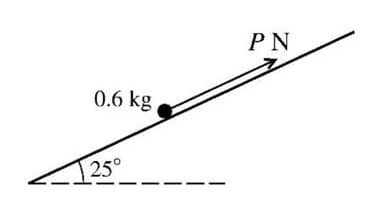
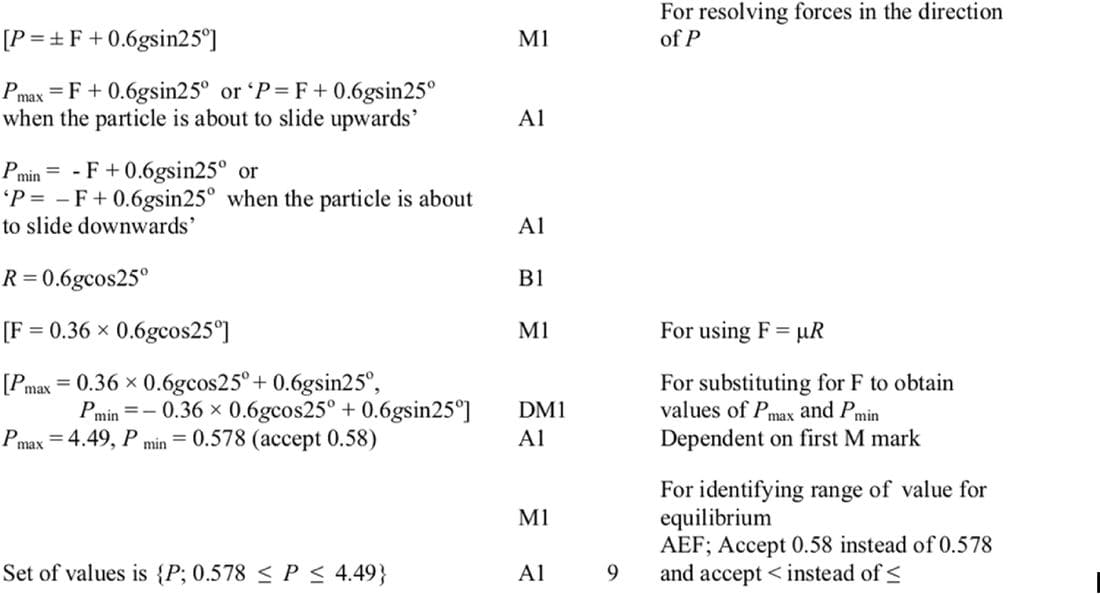
The diagram shows a particle of mass 0.6 kg on a plane inclined at 25° to the horizontal. The particle is acted on by a force of magnitude \(P\) N directed up the plane parallel to a line of greatest slope. The coefficient of friction between the particle and the plane is 0.36. Given that the particle is in equilibrium, find the set of possible values of \(P\).
9709 P41 - Nov 2012 - Q3
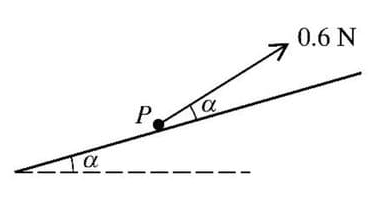
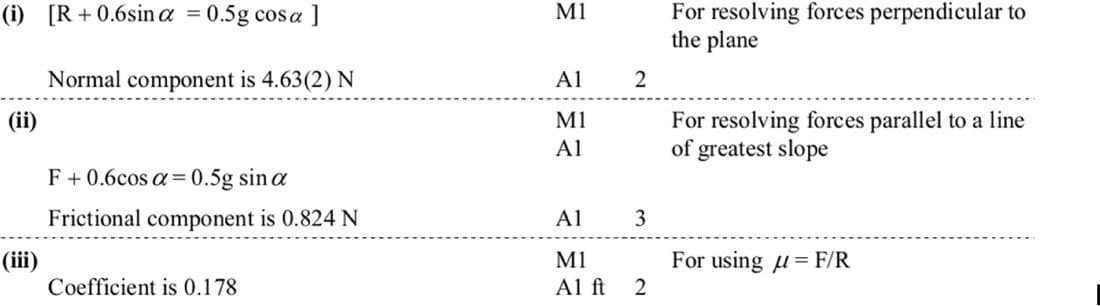
A particle P of mass 0.5 kg rests on a rough plane inclined at angle \(\alpha\) to the horizontal, where \(\sin \alpha = 0.28\). A force of magnitude 0.6 N, acting upwards on P at angle \(\alpha\) from a line of greatest slope of the plane, is just sufficient to prevent P sliding down the plane (see diagram). Find
- the normal component of the contact force on P,
- the frictional component of the contact force on P,
- the coefficient of friction between P and the plane.
9709 P42 - Jun 2022 - Q5
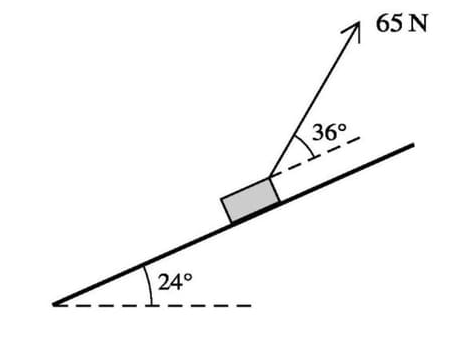
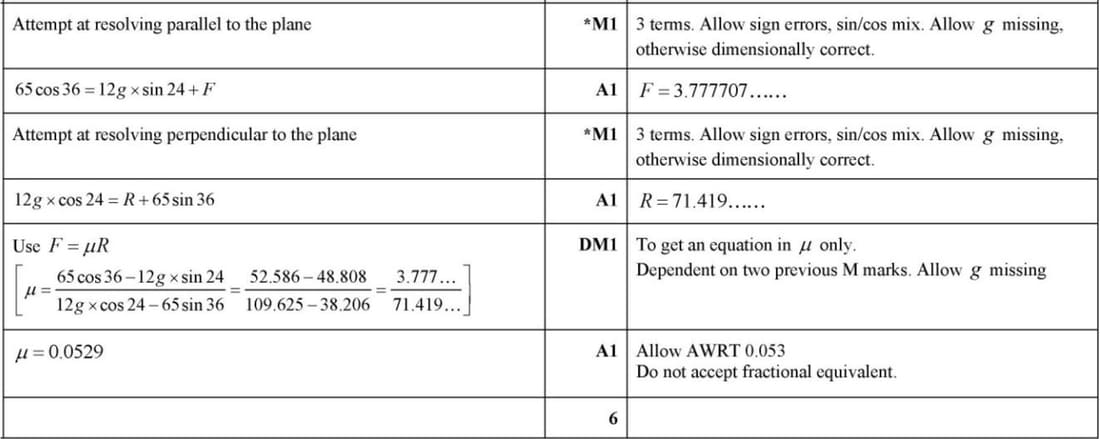
A block of mass 12 kg is placed on a plane which is inclined at an angle of 24° to the horizontal. A light string, making an angle of 36° above a line of greatest slope, is attached to the block. The tension in the string is 65 N (see diagram). The coefficient of friction between the block and plane is \(\mu\). The block is in limiting equilibrium and is on the point of sliding up the plane.
Find \(\mu\).
9709 P41 - Jun 2011 - Q4
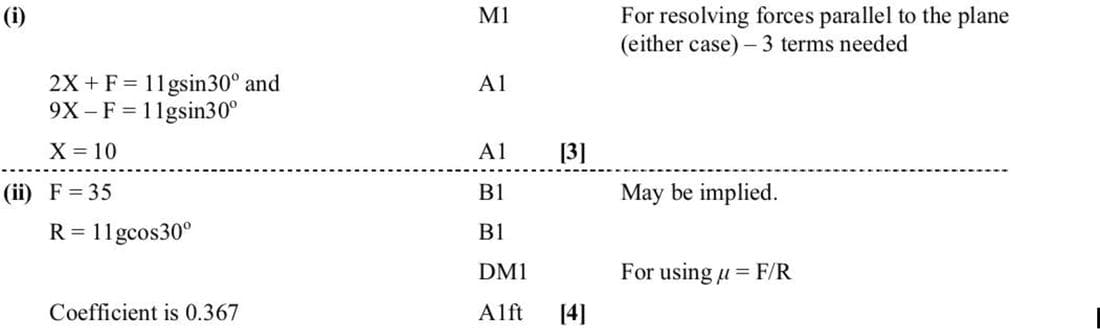
A block of mass 11 kg is at rest on a rough plane inclined at 30° to the horizontal. A force acts on the block in a direction up the plane parallel to a line of greatest slope. When the magnitude of the force is 2X N the block is on the point of sliding down the plane, and when the magnitude of the force is 9X N the block is on the point of sliding up the plane. Find
- the value of X,
- the coefficient of friction between the block and the plane.
9709 P4 - Jun 2009 - Q4
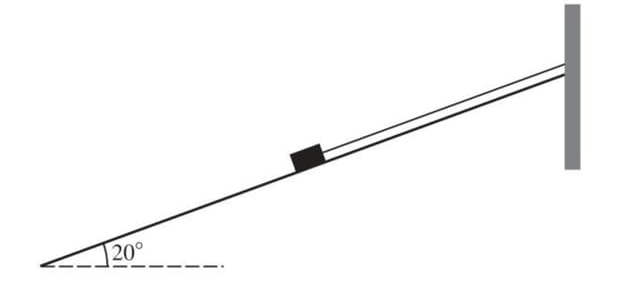
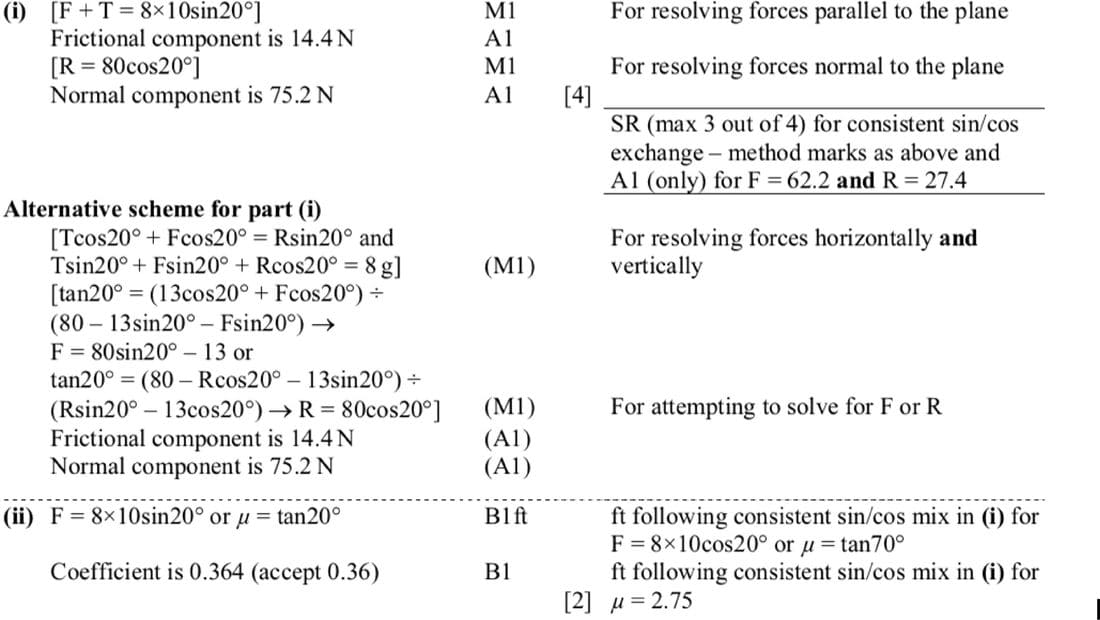
A block of mass 8 kg is at rest on a plane inclined at 20° to the horizontal. The block is connected to a vertical wall at the top of the plane by a string. The string is taut and parallel to a line of greatest slope of the plane (see diagram).
(i) Given that the tension in the string is 13 N, find the frictional and normal components of the force exerted on the block by the plane.
The string is cut; the block remains at rest, but is on the point of slipping down the plane.
(ii) Find the coefficient of friction between the block and the plane.
9709 P4 - Nov 2008 - Q2
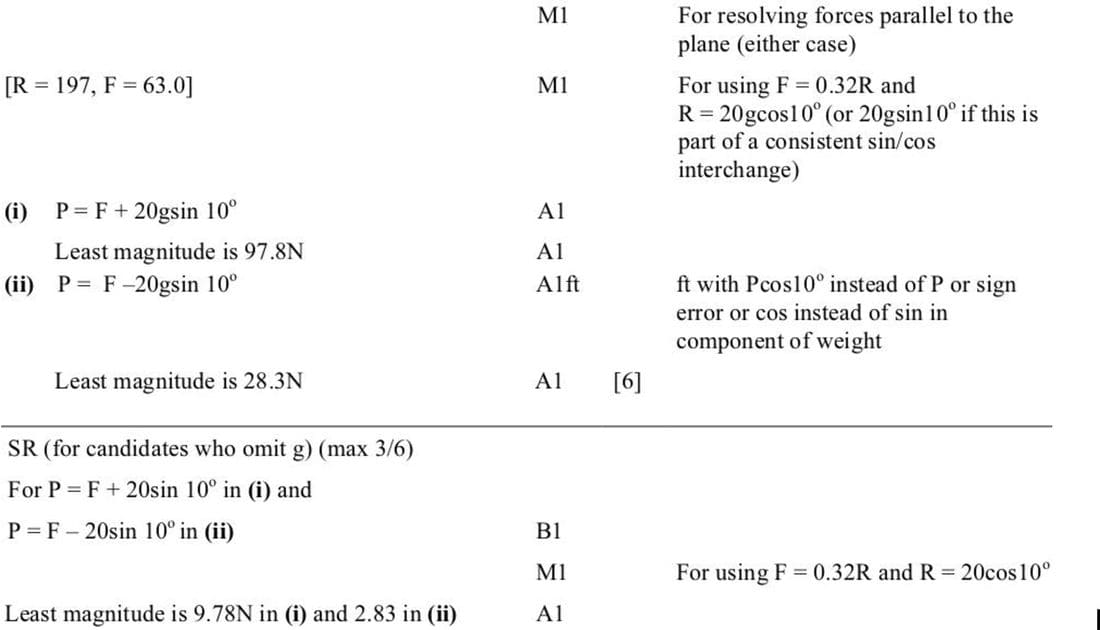
A block of mass 20 kg is at rest on a plane inclined at 10° to the horizontal. A force acts on the block parallel to a line of greatest slope of the plane. The coefficient of friction between the block and the plane is 0.32. Find the least magnitude of the force necessary to move the block,
- given that the force acts up the plane,
- given instead that the force acts down the plane.
9709 P4 - Nov 2002 - Q5
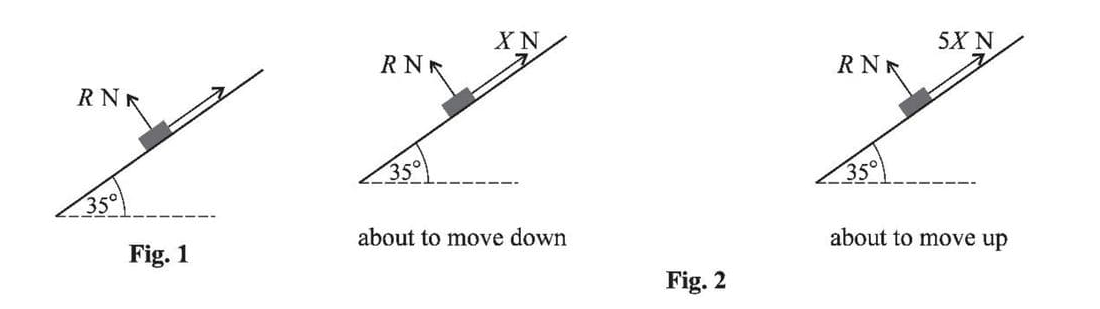
A force, whose direction is upwards parallel to a line of greatest slope of a plane inclined at 35° to the horizontal, acts on a box of mass 15 kg which is at rest on the plane. The normal component of the contact force on the box has magnitude \(R\) newtons (see Fig. 1).
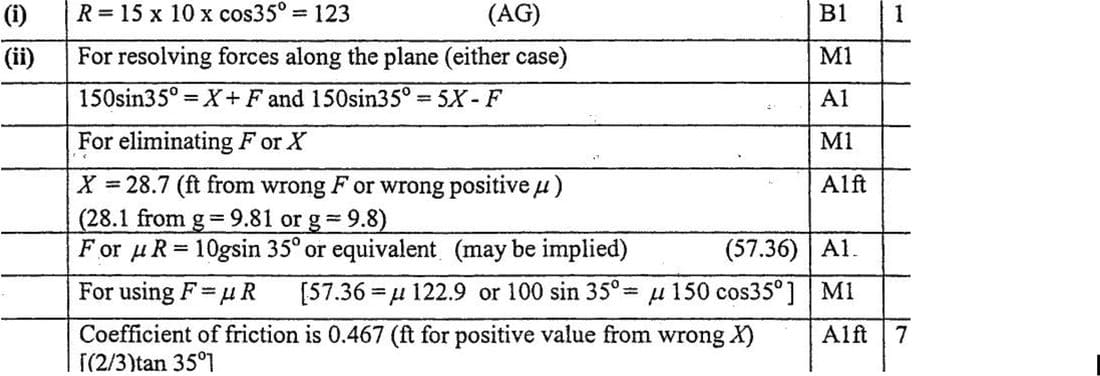
(i) Show that \(R = 123\), correct to 3 significant figures.
When the force parallel to the plane acting on the box has magnitude \(X\) newtons the box is about to move down the plane, and when this force has magnitude \(5X\) newtons the box is about to move up the plane (see Fig. 2).
(ii) Find the value of \(X\) and the coefficient of friction between the box and the plane.
9709 P41 - Nov 2021 - Q4
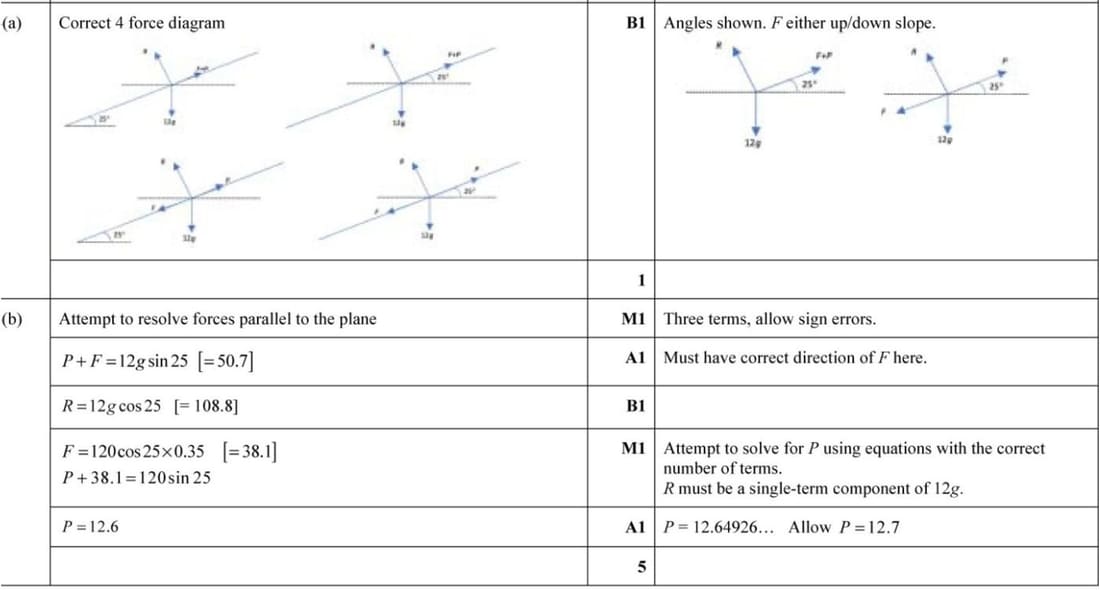
A particle of mass 12 kg is stationary on a rough plane inclined at an angle of 25° to the horizontal. A force of magnitude \(P\) N acting parallel to a line of greatest slope of the plane is used to prevent the particle sliding down the plane. The coefficient of friction between the particle and the plane is 0.35.
(a) Draw a sketch showing the forces acting on the particle.
(b) Find the least possible value of \(P\).

9709 P42 - Jun 2021 - Q4
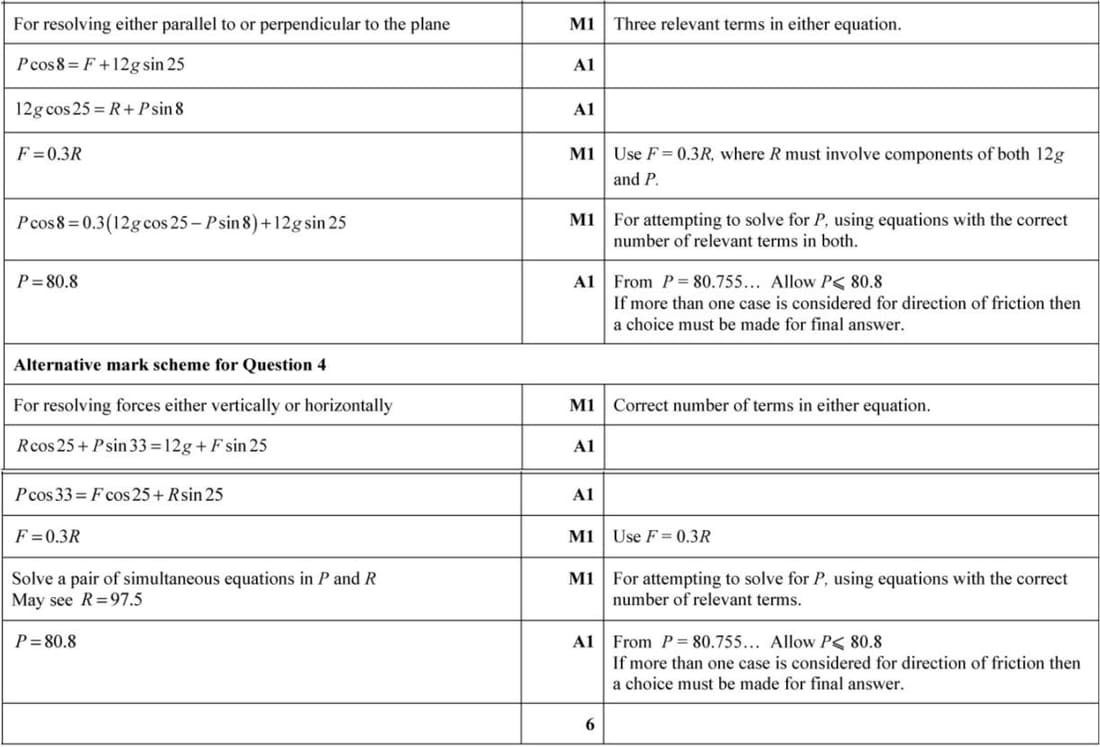
A particle of mass 12 kg is stationary on a rough plane inclined at an angle of 25° to the horizontal. A pulling force of magnitude \(P\) N acts at an angle of 8° above a line of greatest slope of the plane. This force is used to keep the particle in equilibrium. The coefficient of friction between the particle and the plane is 0.3.
Find the greatest possible value of \(P\).
9709 P42 - Jun 2020 - Q3
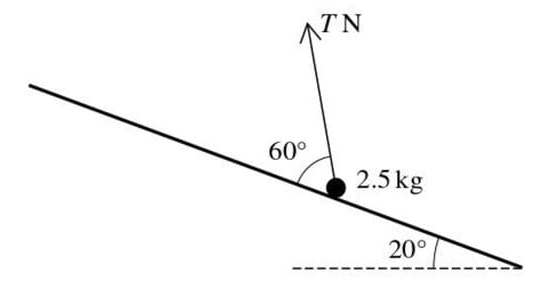
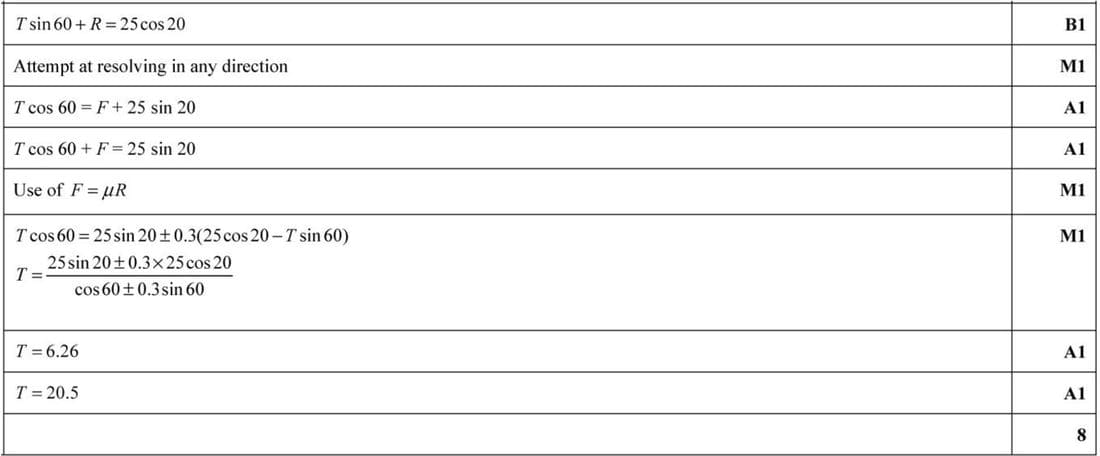
A particle of mass 2.5 kg is held in equilibrium on a rough plane inclined at 20° to the horizontal by a force of magnitude \(T\) N making an angle of 60° with a line of greatest slope of the plane (see diagram). The coefficient of friction between the particle and the plane is 0.3.
Find the greatest and least possible values of \(T\).
9709 P41 - Nov 2019 - Q3
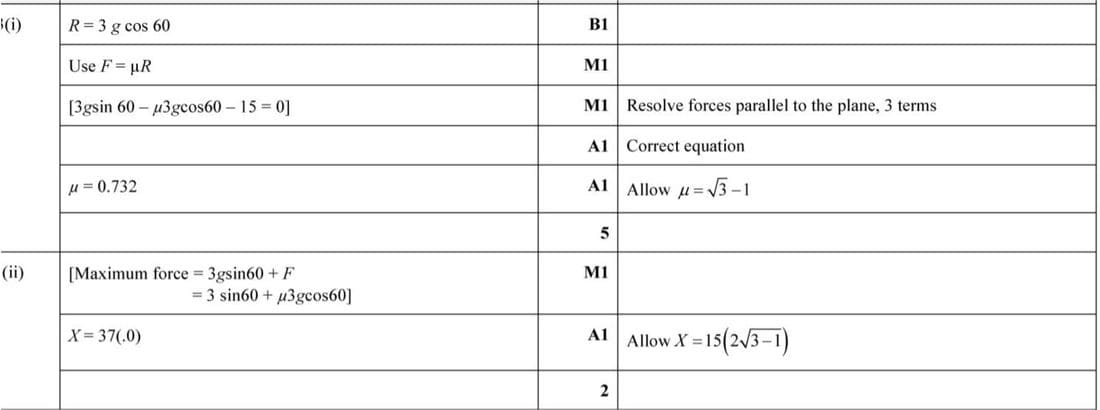
A block of mass 3 kg is at rest on a rough plane inclined at 60° to the horizontal. A force of magnitude 15 N acting up a line of greatest slope of the plane is just sufficient to prevent the block from sliding down the plane.
- Find the coefficient of friction between the block and the plane.
The force of magnitude 15 N is now replaced by a force of magnitude X N acting up the line of greatest slope.
- Find the greatest value of X for which the block does not move.
9709 P43 - Jun 2018 - Q5
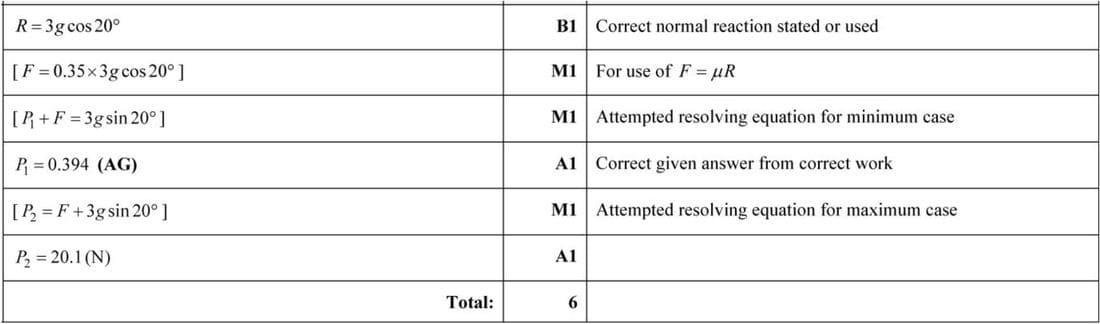
A particle of mass 3 kg is on a rough plane inclined at an angle of 20° to the horizontal. A force of magnitude \(P N\) acting parallel to a line of greatest slope of the plane is used to keep the particle in equilibrium. The coefficient of friction between the particle and the plane is 0.35. Show that the least possible value of \(P\) is 0.394, correct to 3 significant figures, and find the greatest possible value of \(P\).
9709 P42 - Jun 2018 - Q5
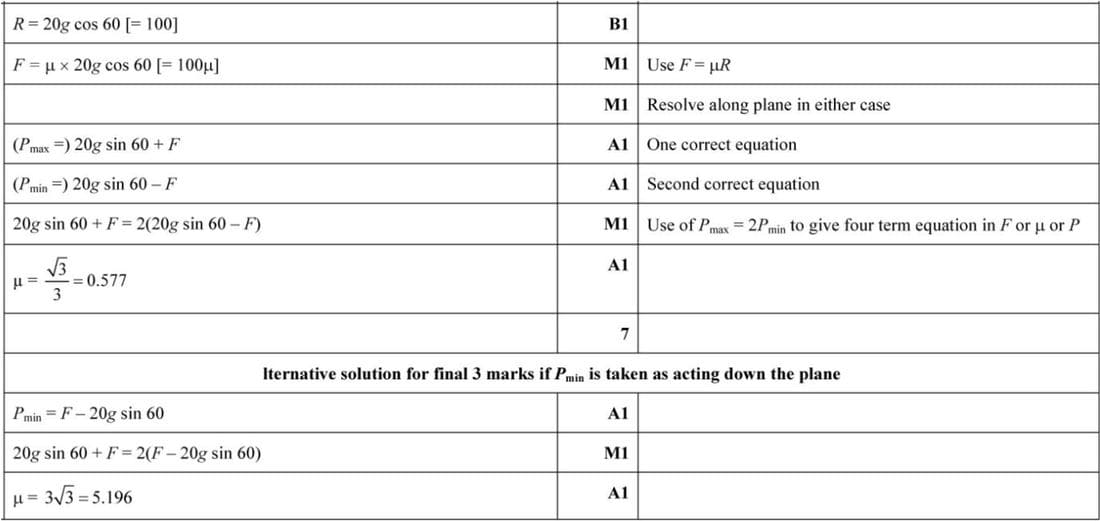
A particle of mass 20 kg is on a rough plane inclined at an angle of 60° to the horizontal. Equilibrium is maintained by a force of magnitude \(P \ N\) acting on the particle, in a direction parallel to a line of greatest slope of the plane. The greatest possible value of \(P\) is twice the least possible value of \(P\). Find the value of the coefficient of friction between the particle and the plane.
9709 P42 - Mar 2018 - Q4
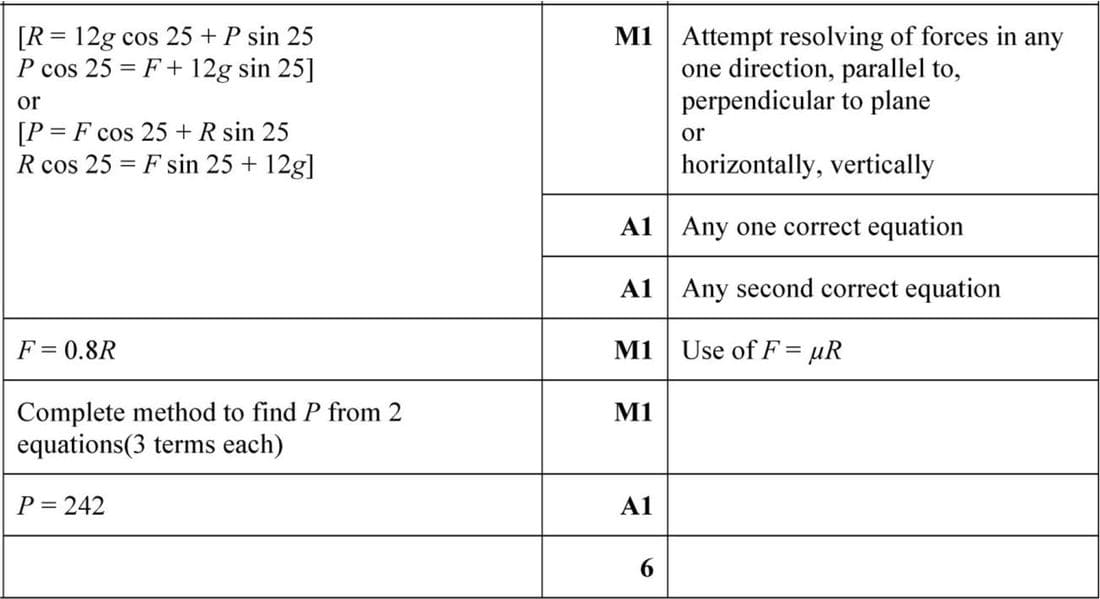
A particle of mass 12 kg is on a rough plane inclined at an angle of 25° to the horizontal. A force of magnitude \(P\) N acts on the particle. This force is horizontal and the particle is on the point of moving up a line of greatest slope of the plane. The coefficient of friction between the particle and the plane is 0.8. Find the value of \(P\).
9709 P42 - Mar 2023 - Q6
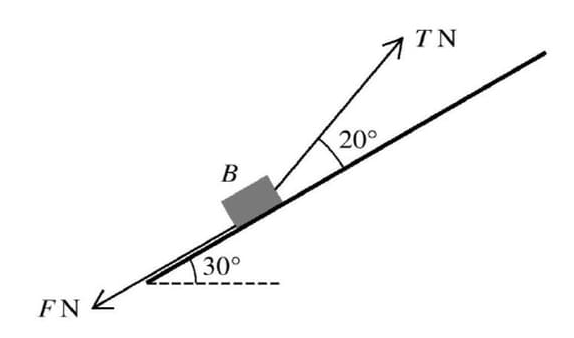
A block B, of mass 2 kg, lies on a rough inclined plane sloping at 30° to the horizontal. A light rope, inclined at an angle of 20° above a line of greatest slope, is attached to B. The tension in the rope is T N. There is a friction force of F N acting on B (see diagram). The coefficient of friction between B and the plane is μ.
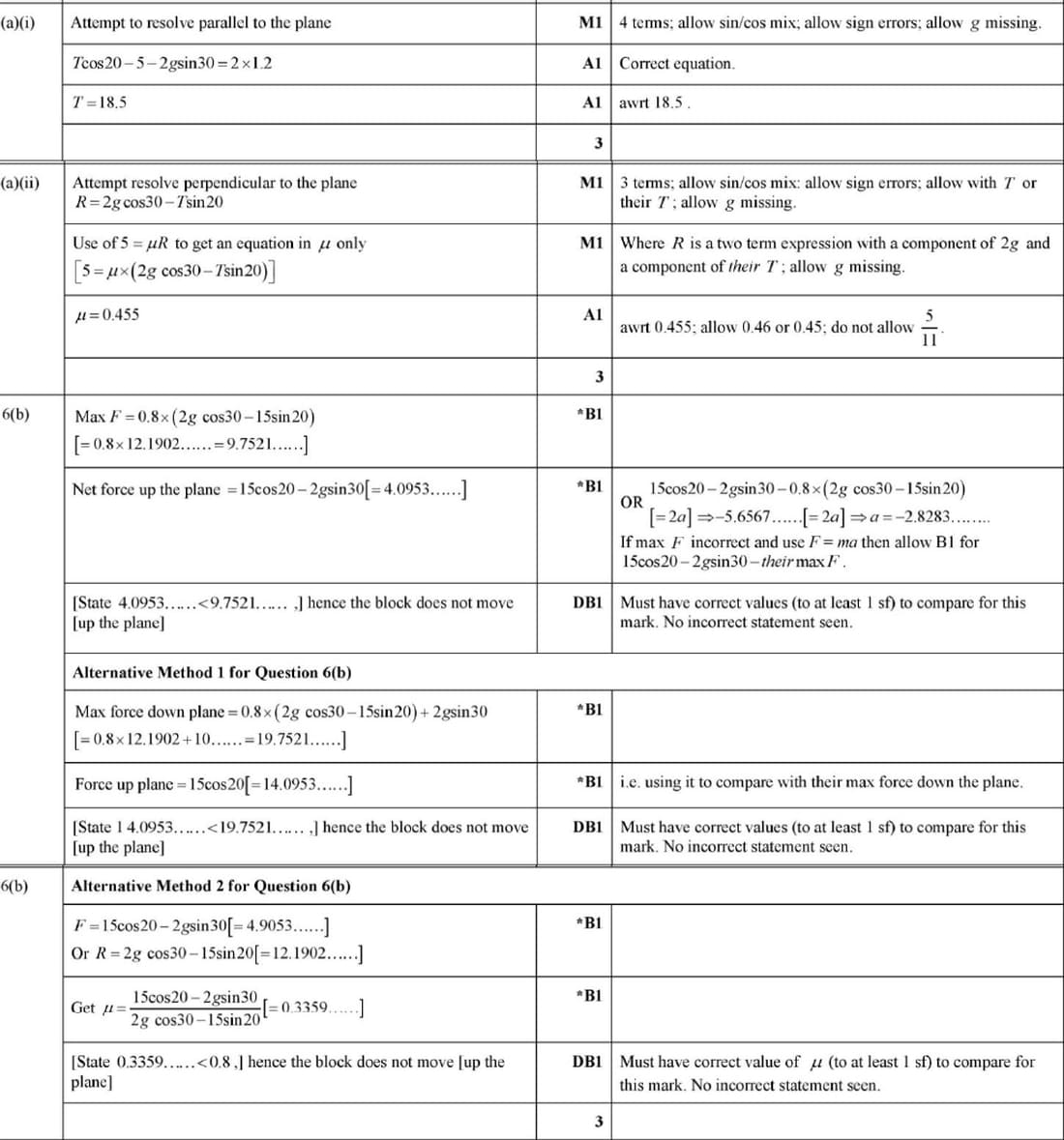
\((a) It is given that F = 5 and that the acceleration of B up the plane is 1.2 m/s².\)
- Find the value of T.
- Find the value of μ.
\((b) It is given instead that μ = 0.8 and T = 15.\)
Determine whether B will move up the plane.
9709 P43 - Jun 2015 - Q6
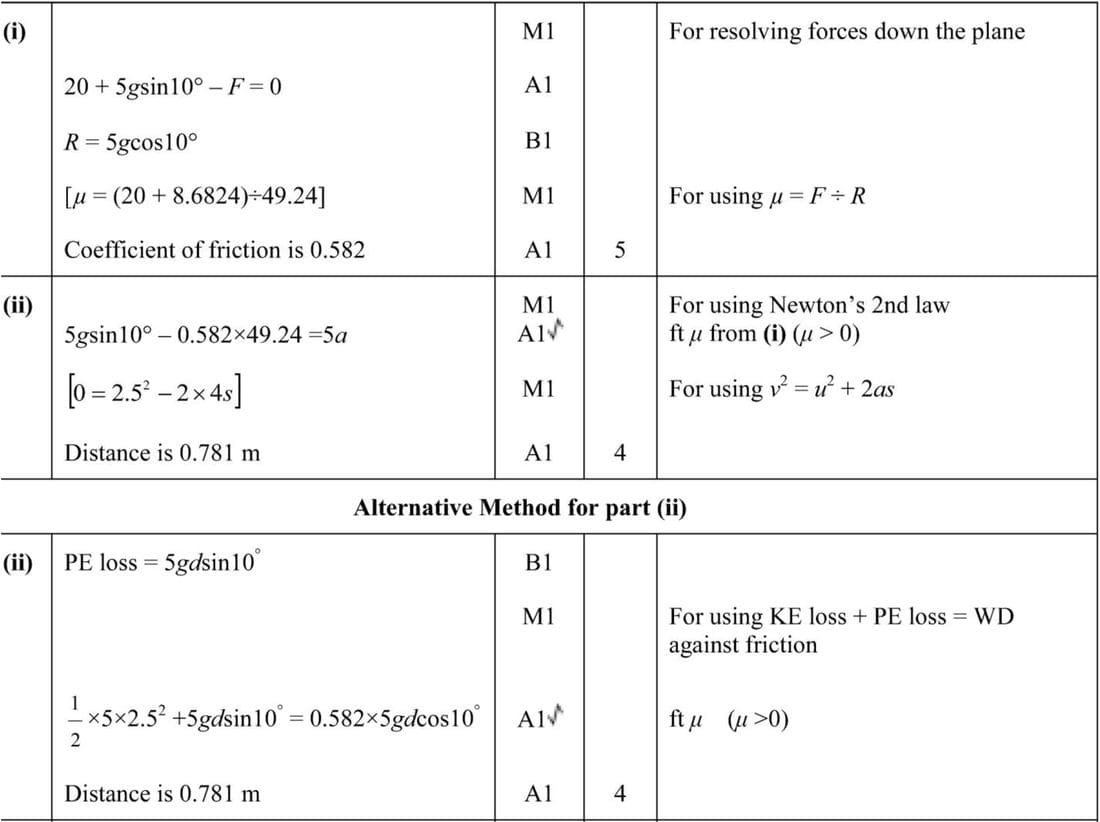
A small box of mass 5 kg is pulled at a constant speed of 2.5 m s-1 down a line of greatest slope of a rough plane inclined at 10° to the horizontal. The pulling force has magnitude 20 N and acts downwards parallel to a line of greatest slope of the plane.
(i) Find the coefficient of friction between the box and the plane.
The pulling force is removed while the box is moving at 2.5 m s-1.
(ii) Find the distance moved by the box after the instant at which the pulling force is removed.
9709 P43 - Jun 2015 - Q4
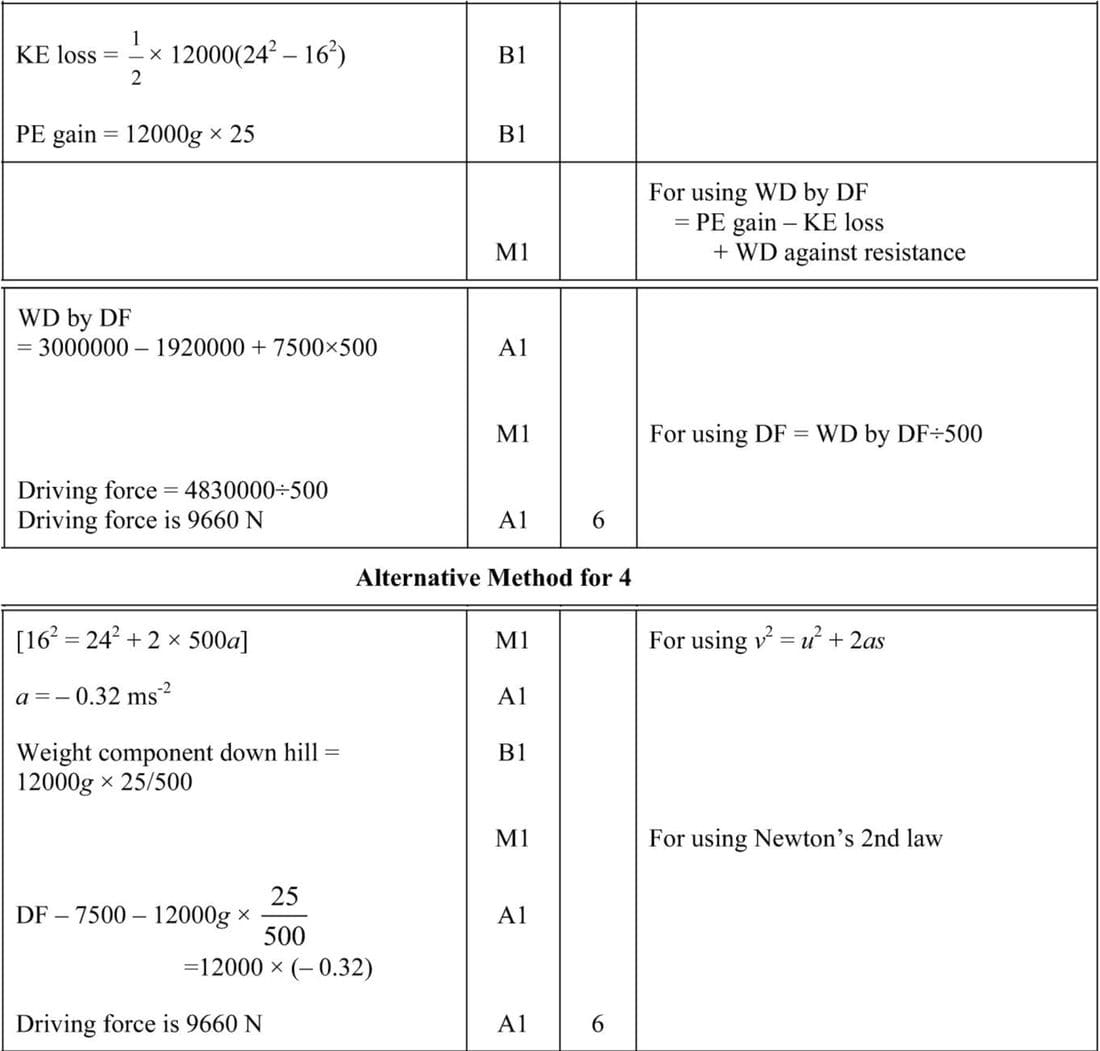
A lorry of mass 12,000 kg moves up a straight hill of length 500 m, starting at the bottom with a speed of 24 m s-1 and reaching the top with a speed of 16 m s-1. The top of the hill is 25 m above the level of the bottom of the hill. The resistance to motion of the lorry is 7500 N. Find the driving force of the lorry.
9709 P43 - Nov 2014 - Q5
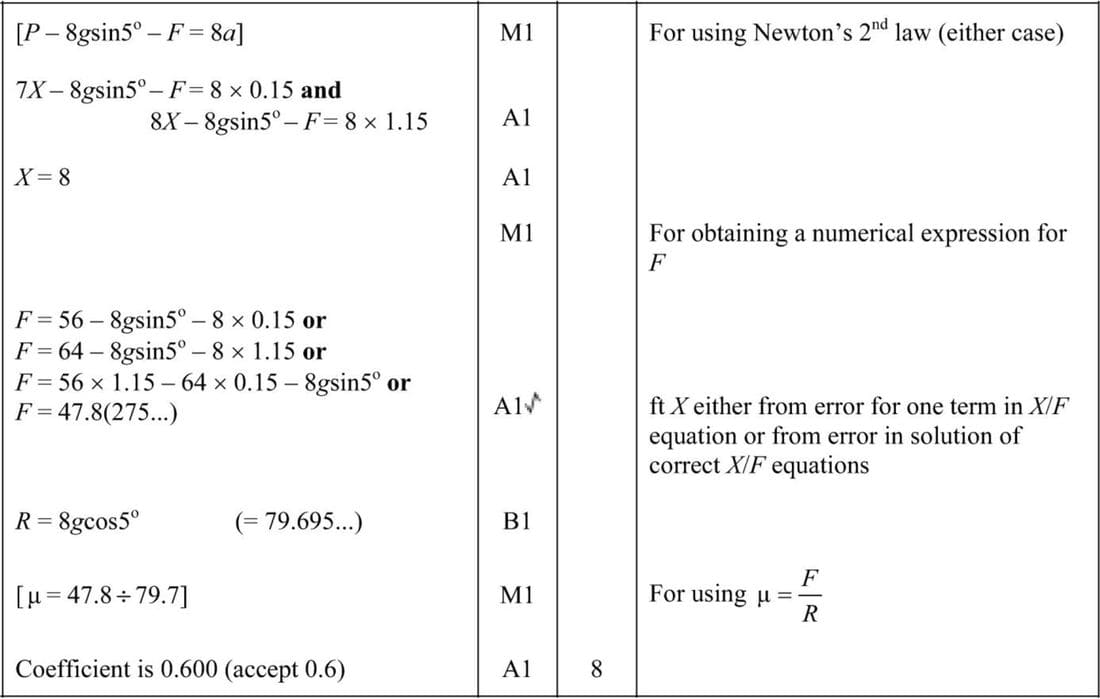
A box of mass 8 kg is on a rough plane inclined at 5° to the horizontal. A force of magnitude \(P\) N acts on the box in a direction upwards and parallel to a line of greatest slope of the plane. When \(P = 7X\) the box moves up the line of greatest slope with acceleration 0.15 m/s² and when \(P = 8X\) the box moves up the line of greatest slope with acceleration 1.15 m/s². Find the value of \(X\) and the coefficient of friction between the box and the plane.