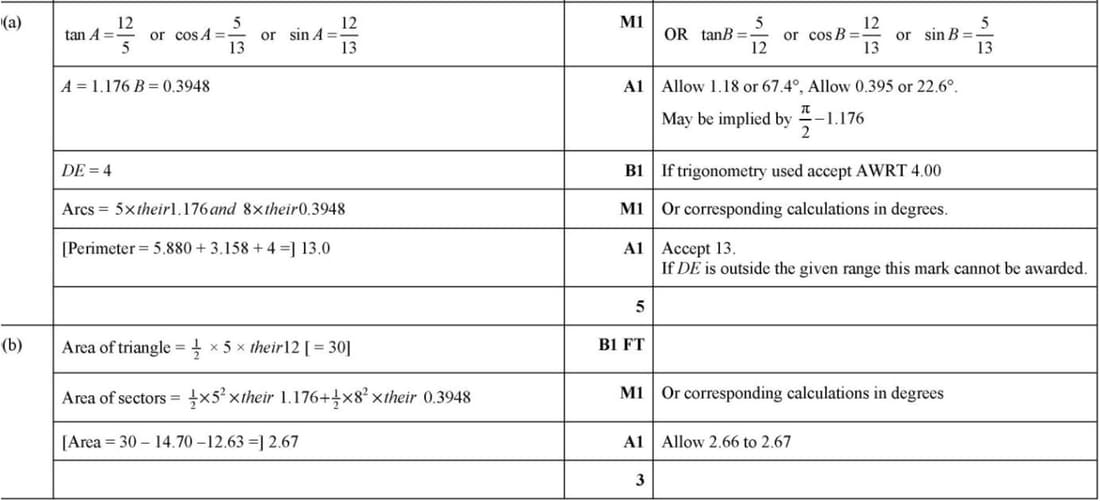
(a) To find the perimeter of the shaded region, we first calculate the angles at A and B using trigonometry. We have:
\(\tan A = \frac{12}{5}\) or \(\cos A = \frac{5}{13}\) or \(\sin A = \frac{12}{13}\).
This gives \(A = 1.176\) radians and \(B = 0.3948\) radians.
The length of DE is given as 4 cm.
The arc lengths are calculated as:
Arc on circle A: \(5 \times 1.176 = 5.880\) cm
Arc on circle B: \(8 \times 0.3948 = 3.158\) cm
Thus, the perimeter of the shaded region is \(5.880 + 3.158 + 4 = 13.0\) cm.
(b) To find the area of the shaded region, we calculate the area of triangle ADE and subtract the areas of the sectors:
Area of triangle ADE: \(\frac{1}{2} \times 5 \times 12 = 30\) cm²
Area of sector on circle A: \(\frac{1}{2} \times 5^2 \times 1.176 = 14.70\) cm²
Area of sector on circle B: \(\frac{1}{2} \times 8^2 \times 0.3948 = 12.63\) cm²
Thus, the area of the shaded region is \(30 - 14.70 - 12.63 = 2.67\) cm².