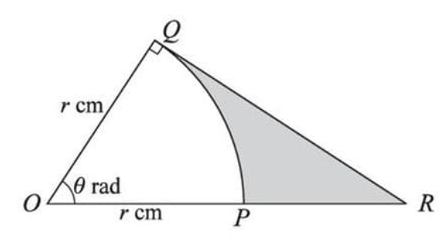
In the diagram, OPQ is a sector of a circle, centre O and radius r cm. Angle QOP = θ radians. The tangent to the circle at Q meets OP extended at R.
(i) Show that the area, A cm², of the shaded region is given by A = \frac{1}{2}r^2(\tan \theta - \theta).
(ii) In the case where θ = 0.8 and r = 15, evaluate the length of the perimeter of the shaded region.
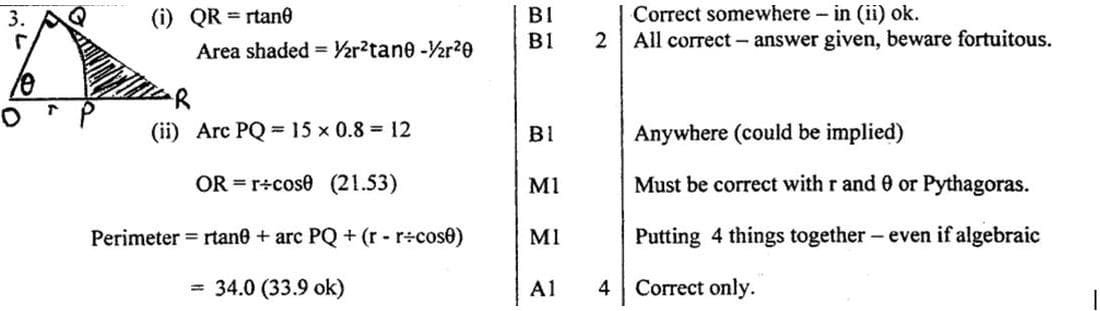
Solution
(i) To find the area of the shaded region, we need to calculate the area of triangle OQR and subtract the area of sector OPQ.
The length QR is given by QR = r \tan \theta.
The area of triangle OQR is \(\frac{1}{2} \times r \times r \tan \theta = \frac{1}{2}r^2 \tan \theta\).
The area of sector OPQ is \(\frac{1}{2}r^2 \theta\).
Thus, the area of the shaded region is \(\frac{1}{2}r^2 \tan \theta - \frac{1}{2}r^2 \theta = \frac{1}{2}r^2(\tan \theta - \theta)\).
(ii) Given θ = 0.8 and r = 15, we calculate the perimeter of the shaded region.
The arc length PQ is \(r \theta = 15 \times 0.8 = 12 \text{ cm}\).
The length OR is \(\frac{r}{\cos \theta} = \frac{15}{\cos 0.8} \approx 21.53 \text{ cm}\).
The perimeter of the shaded region is \(r \tan \theta + \text{arc } PQ + (r - r \cos \theta)\).
Substituting the values, we get \(15 \tan 0.8 + 12 + (15 - 15 \cos 0.8) \approx 34.0 \text{ cm}\).
Log in to record attempts.