Browsing as Guest. Progress, bookmarks and attempts are disabled.
Log in to track your work.
Problem 197
197
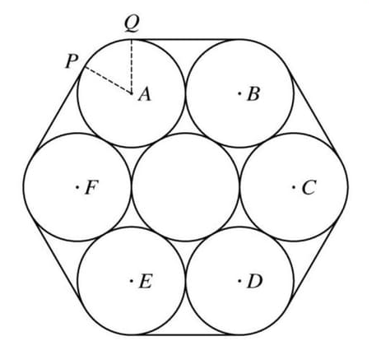
The diagram shows a cross-section of seven cylindrical pipes, each of radius 20 cm, held together by a thin rope which is wrapped tightly around the pipes. The centres of the six outer pipes are A, B, C, D, E and F. Points P and Q are situated where straight sections of the rope meet the pipe with centre A.
(a) Show that angle PAQ = \(\frac{1}{3} \pi\) radians.
(b) Find the length of the rope.
(c) Find the area of the hexagon ABCDEF, giving your answer in terms of \(\sqrt{3}\).
(d) Find the area of the complete region enclosed by the rope.
Solution
(a) By symmetry, there are six sectors around the diagram that make up a complete circle. Therefore, \(6 \times \angle PAQ = 2\pi\), so \(\angle PAQ = \frac{2\pi}{6} = \frac{\pi}{3}\) radians.
(b) Each straight section of rope has length 40 cm. Each curved section around each pipe has length \(r\theta = 20 \times \frac{\pi}{3}\). Total length = \(6 \times (40 + \frac{20\pi}{3}) = 240 + 40\pi \approx 366\) cm.
(c) The area of one equilateral triangle formed by the centers is \(\frac{1}{2} \times 40 \times 40 \times \sin(\frac{\pi}{3}) = 400 \sqrt{3}\). Total area of hexagon = \(6 \times 400 \sqrt{3} = 2400 \sqrt{3}\) cm\(^2\).
(d) The area of the complete region enclosed by the rope includes the hexagon and the sectors. Total area = \(2400 \sqrt{3} + 4800 + 400\pi \approx 7200\) cm\(^2\).