Browsing as Guest. Progress, bookmarks and attempts are disabled.
Log in to track your work.
Problem 199
199
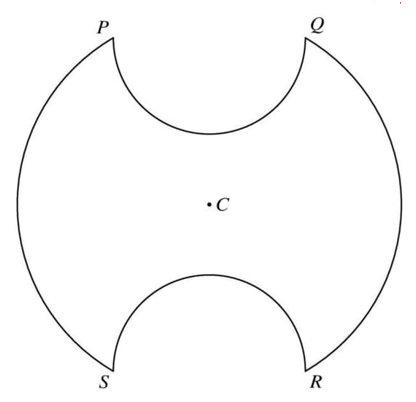
The diagram shows a symmetrical metal plate. The plate is made by removing two identical pieces from a circular disc with centre C. The boundary of the plate consists of two arcs PS and QR of the original circle and two semicircles with PQ and RS as diameters. The radius of the circle with centre C is 4 cm, and PQ = RS = 4 cm also.
(a) Show that angle PCS = \(\frac{2}{3} \pi\) radians.
(b) Find the exact perimeter of the plate.
(c) Show that the area of the plate is \(\left( \frac{20}{3} \pi + 8\sqrt{3} \right) \text{ cm}^2\).
Solution
(a) To show that angle PCS = \(\frac{2}{3} \pi\) radians, consider the triangle PCQ. Since PQ = 4 cm, the triangle PCQ is equilateral, making angle PCQ = \(\frac{\pi}{3}\). Therefore, angle PCS = \(\pi - \frac{\pi}{6} - \frac{\pi}{3} = \frac{2}{3} \pi\).
(b) The perimeter of the plate consists of the lengths of arcs PS and QR, and the circumferences of the semicircles PQ and RS. The length of each arc is \(\frac{2\pi}{3} \times 4 = \frac{8\pi}{3}\). The circumference of each semicircle is \(2 \times 2 = 4\). Therefore, the total perimeter is \(2 \times \frac{8\pi}{3} + 2 \times 2 = \frac{28\pi}{3}\).
(c) The area of the plate is calculated by subtracting the areas of the removed segments from the area of the original circle. The area of sector CPQ is \(\frac{1}{2} \times 4^2 \times \frac{\pi}{3} = \frac{8\pi}{3}\). The area of the segment is \(\frac{8\pi}{3} - \frac{1}{2} \times 4^2 \times \sin\left(\frac{\pi}{3}\right) = \frac{8\pi}{3} - 4\sqrt{3}\). The area of the small semicircle is \(\pi \times 2^2 = 4\pi\). Therefore, the area of the plate is \(\pi \times 4^2 - 2 \times 4\pi - 2 \times \left(\frac{8\pi}{3} - 4\sqrt{3}\right) = \frac{20\pi}{3} + 8\sqrt{3}\).