Past Exam Questions
← Back0606 P23 - Nov 2024 - Q9 - 4 marks
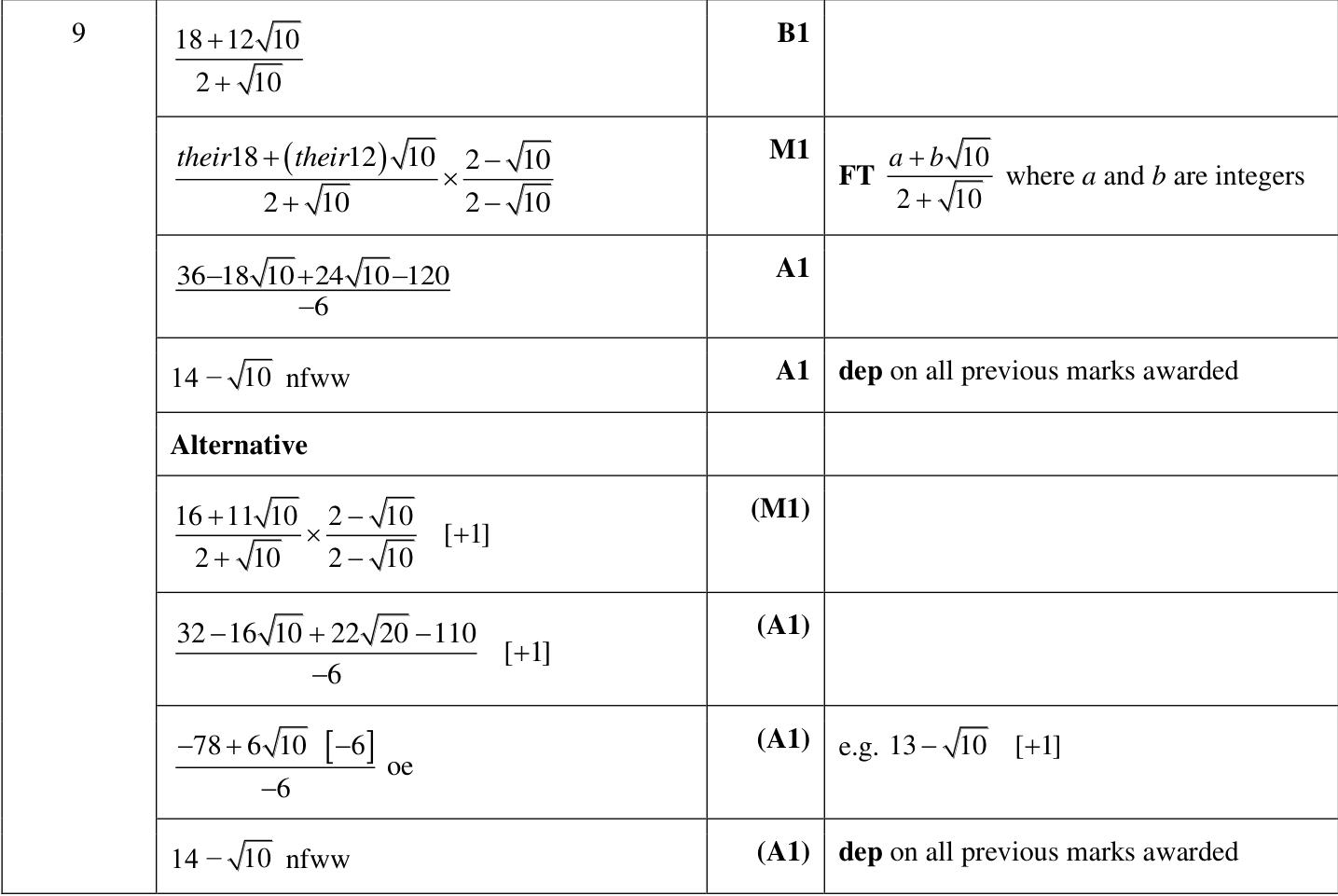
DO NOT USE A CALCULATOR IN THIS QUESTION. Write \(\frac{16+11 \sqrt{10}}{2+\sqrt{10}}+1\) in the form \(p+q \sqrt{10}\), where \(p\) and \(q\) are integers.
0606 P12 - Nov 2022 - Q3 - 4 marks
Write
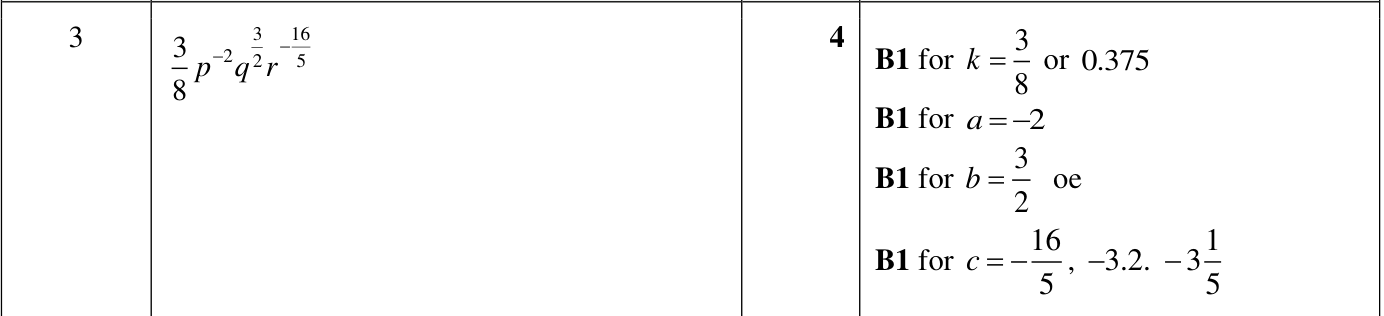
\(\frac{\sqrt{9p^2q}\times r^{-3}}{(2p)^3q^{-1}\sqrt[5]{r}}\)
in the form \(kp^aq^br^c\), where \(k\), \(a\), \(b\) and \(c\) are constants.
0606 P23 - Jun 2021 - Q1 - 3 marks
Do not use a calculator in this question.
Write
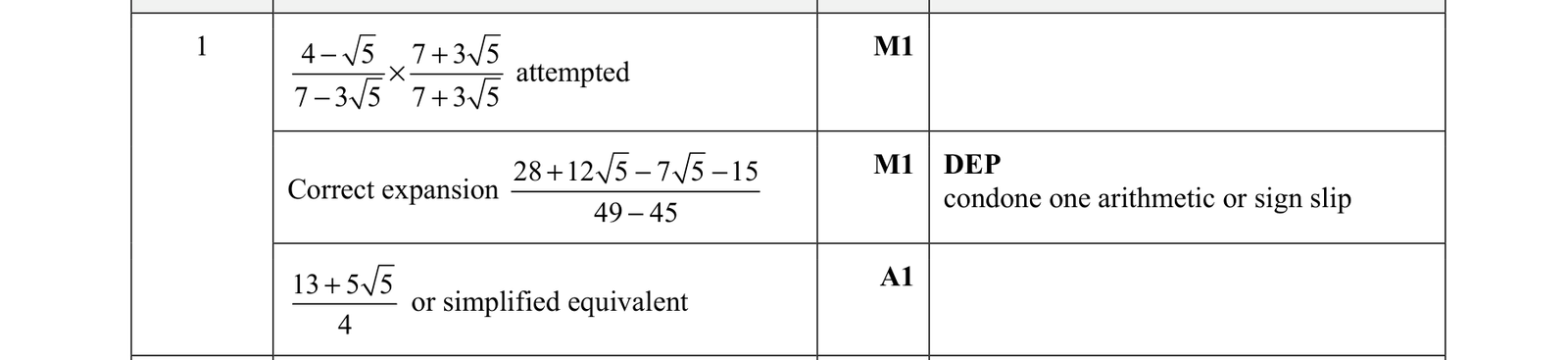
\(\frac{4-\sqrt5}{7-3\sqrt5}\)
with a rational denominator, simplifying your answer.
0606 P23 - Jun 2020 - Q5 - 6 marks
Do not use a calculator in this question.
(a) Simplify
\(\frac{\sqrt{128}}{\sqrt{72}}.\)
(b) Simplify
\(\frac{1}{1+\sqrt3}-\frac{\sqrt3}{3+2\sqrt3},\)
giving your answer as a fraction with an integer denominator.

0606 P21 - Jun 2019 - Q4 - 4 marks
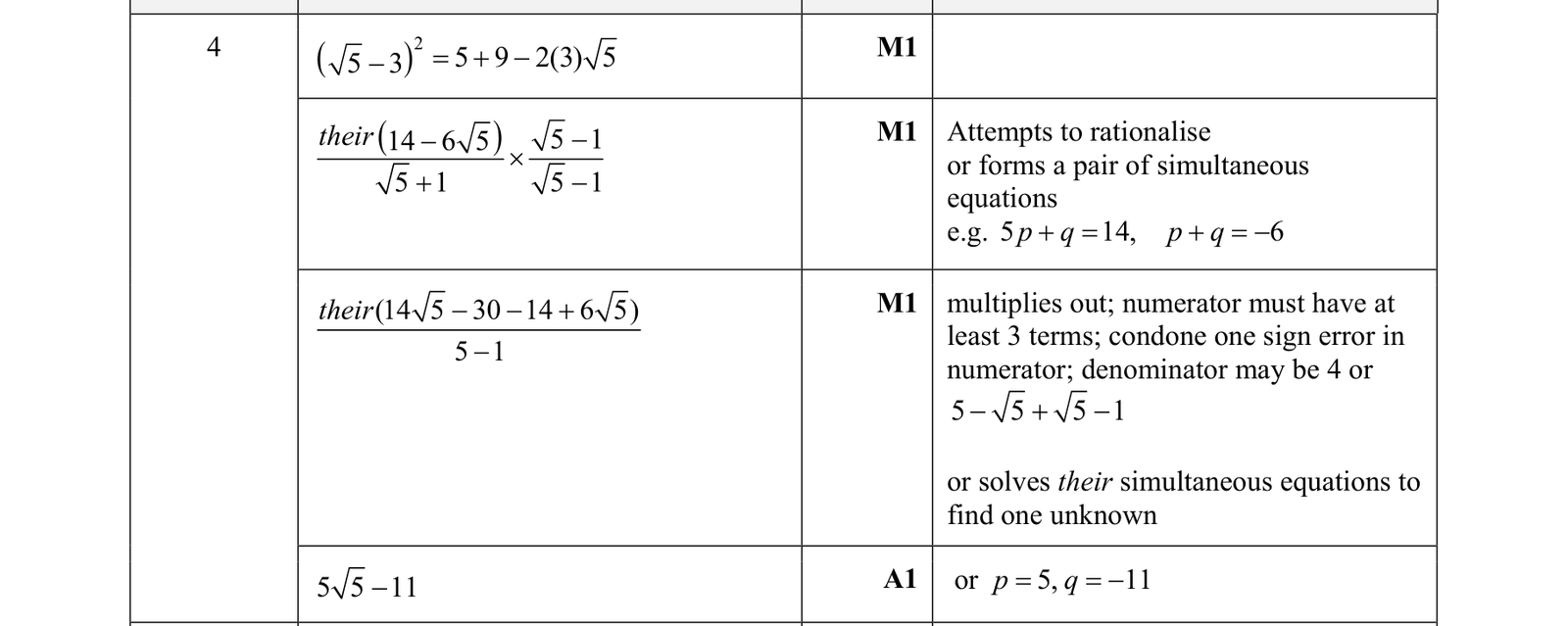
Without using a calculator, express \(\dfrac{(\sqrt5-3)^2}{\sqrt5+1}\) in the form \(p\sqrt5+q\), where \(p\) and \(q\) are integers.
0606 P12 - Mar 2018 - Q3 - 6 marks
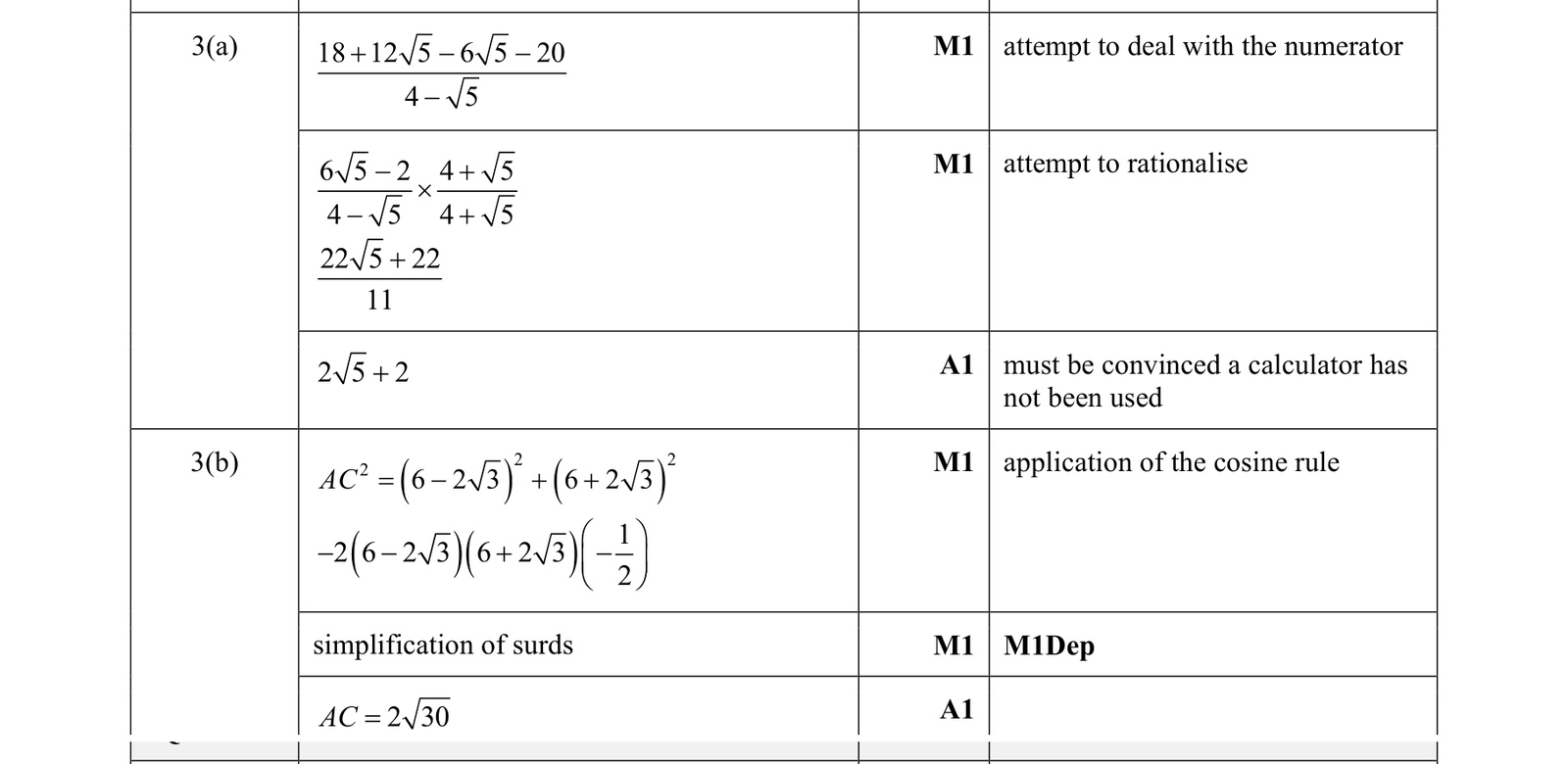
(a) Simplify \(\dfrac{(3+2\sqrt5)(6-2\sqrt5)}{4-\sqrt5}\), giving your answer in the form \(a+b\sqrt5\), where \(a\) and \(b\) are integers.
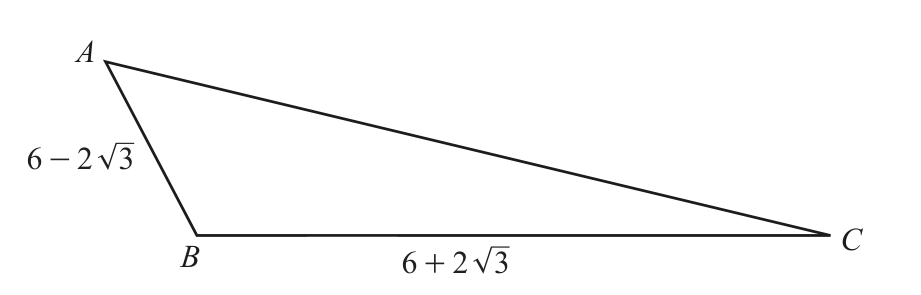
(b) Triangle \(ABC\) is such that \(AB=6-2\sqrt3\), \(BC=6+2\sqrt3\), and \(\cos ABC=-\dfrac12\). Find \(AC\), giving your answer in the form \(c\sqrt d\), where \(c\) and \(d\) are integers.
0606 P11 - Jun 2018 - Q10 - 9 marks
Do not use a calculator in this question.
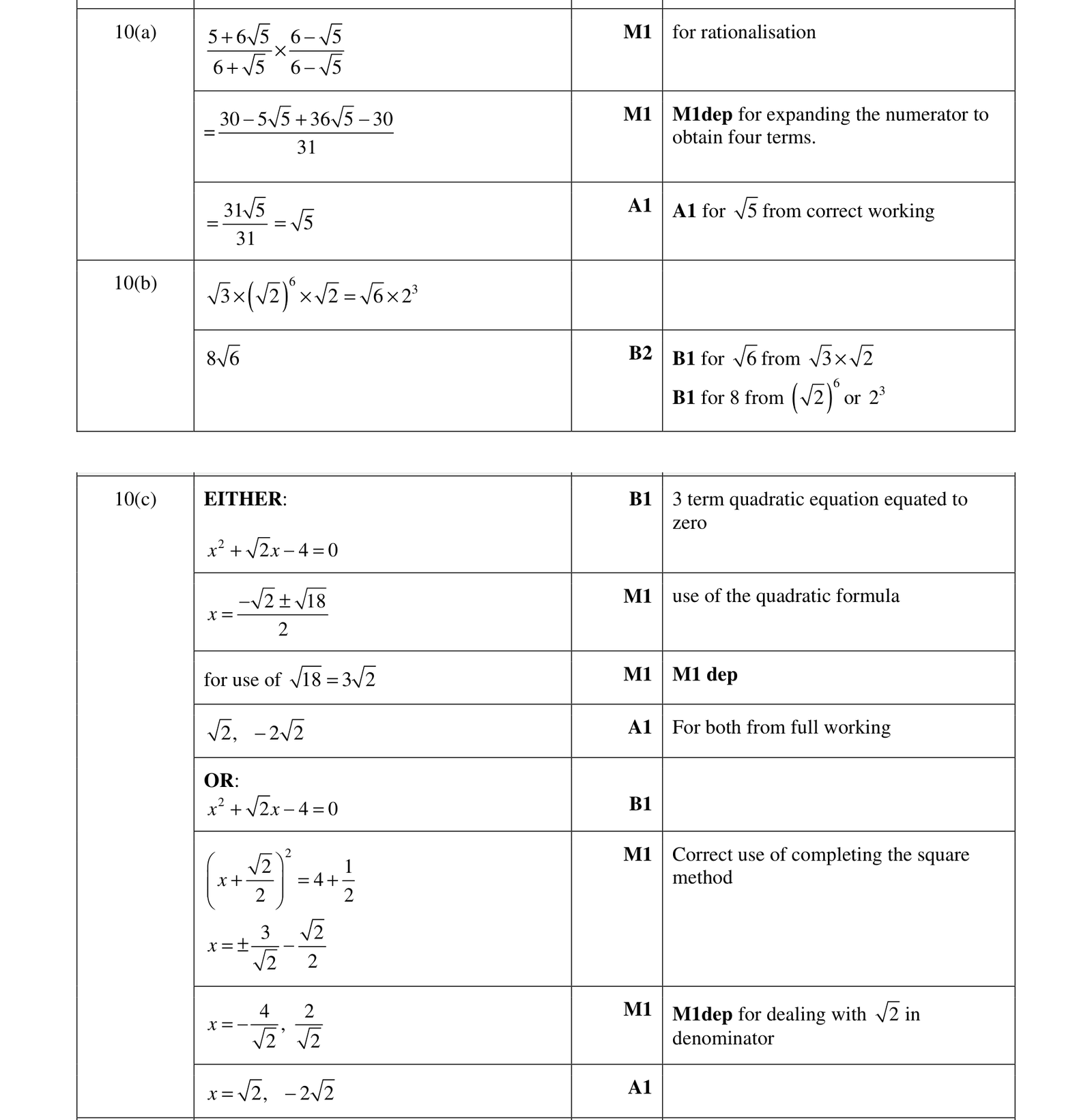
(a) Simplify
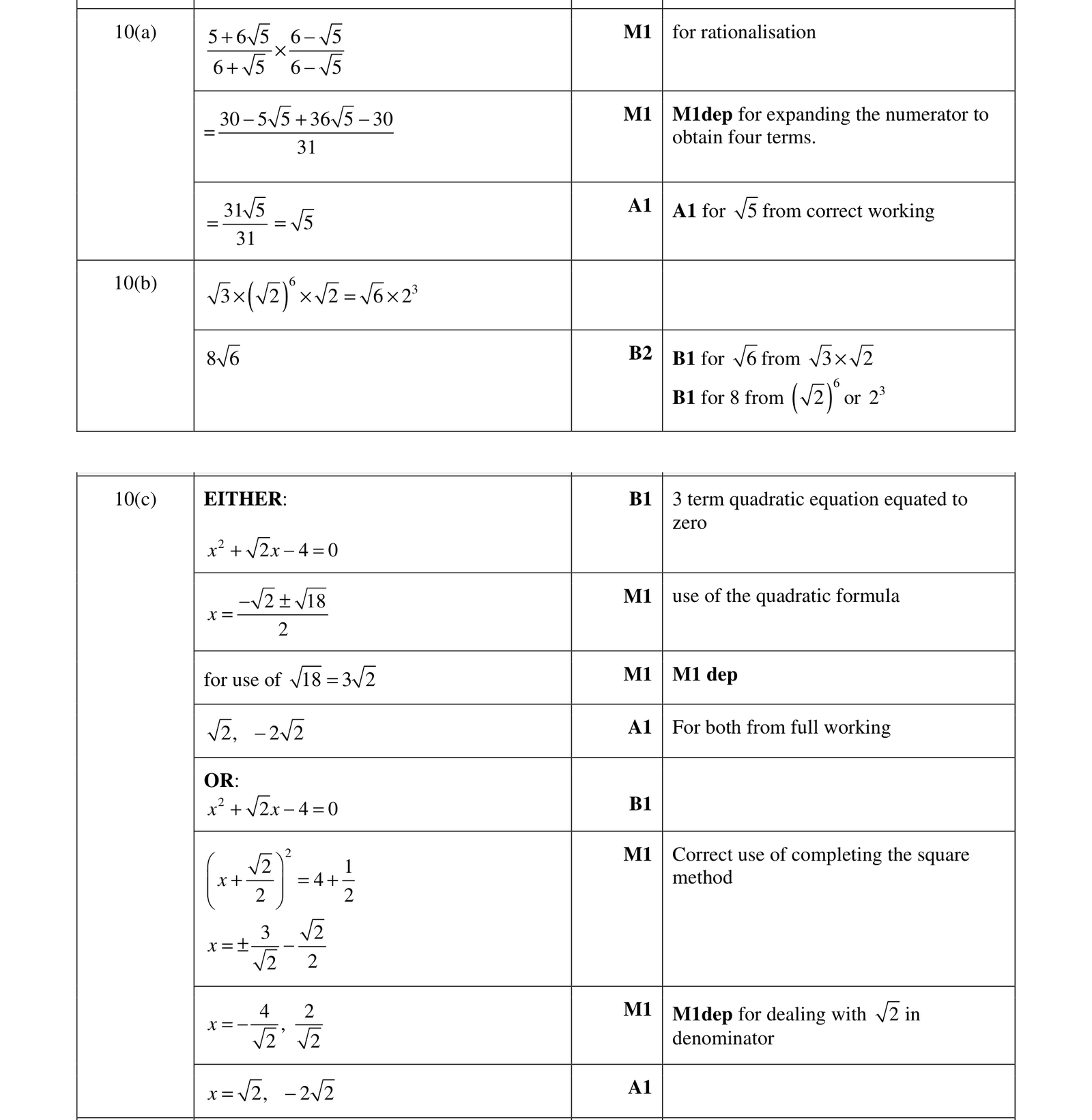
\(\frac{5+6\sqrt5}{6+\sqrt5}.\)
(b) Show that
\(3^{0.5}\times(\sqrt2)^7\)
can be written in the form \(a\sqrt b\), where \(a\) and \(b\) are integers and \(a\gt b\).
(c) Solve the equation
\(x+\sqrt2=\frac{4}{x},\)
giving your answers in simplest surd form.
0606 P13 - Jun 2018 - Q10 - 9 marks
Do not use a calculator in this question.
(a) Simplify
\(\frac{5+6\sqrt5}{6+\sqrt5}.\)
(b) Show that
\(3^{0.5}\times(\sqrt2)^7\)
can be written in the form \(a\sqrt b\), where \(a\) and \(b\) are integers and \(a\gt b\).
(c) Solve the equation
\(x+\sqrt2=\frac{4}{x},\)
giving your answers in simplest surd form.
0606 P21 - Nov 2018 - Q3 - 7 marks
Do not use a calculator in this question.
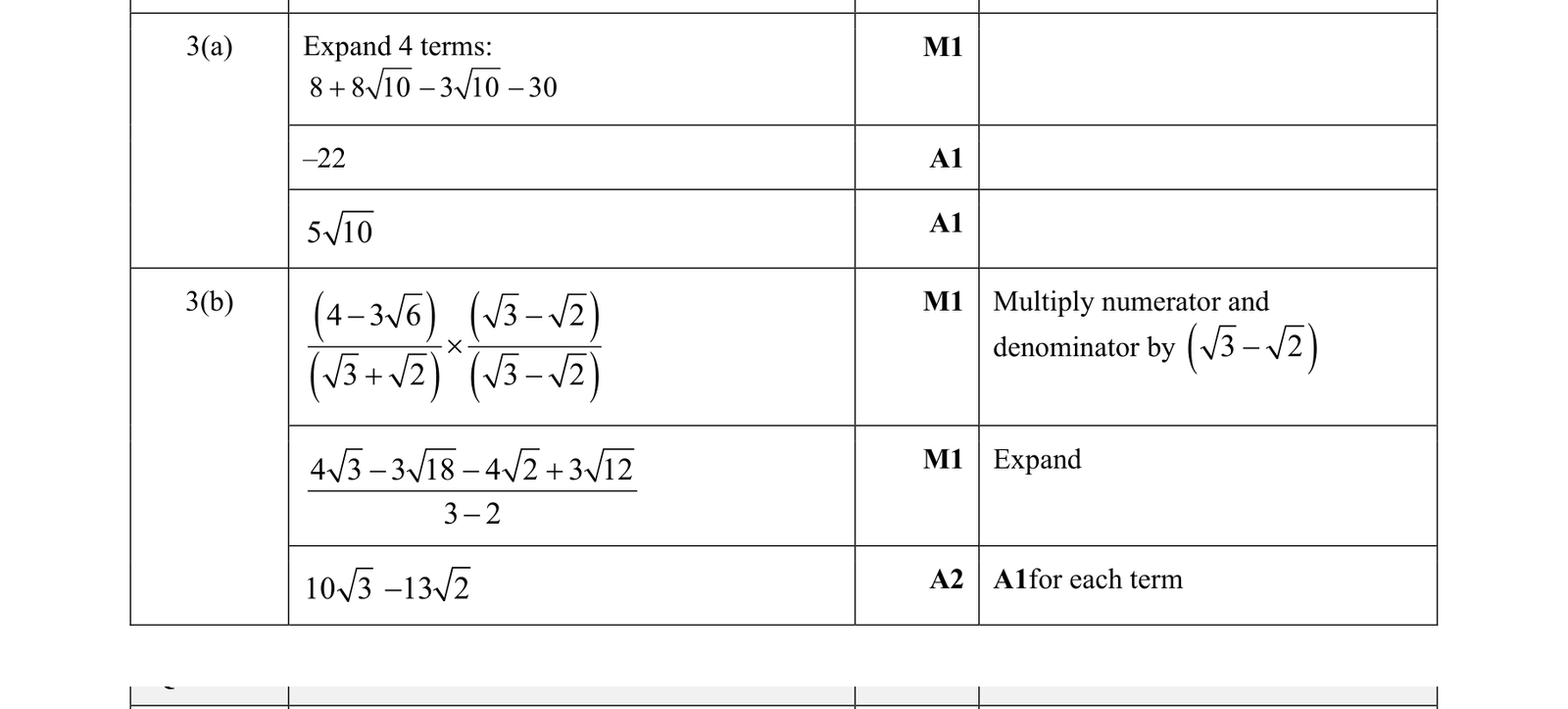
(a) Simplify
\((\sqrt2+2\sqrt5)(4\sqrt2-3\sqrt5),\)
giving your answer in the form \(a+b\sqrt c\), where \(a\), \(b\) and \(c\) are integers.
(b) Simplify
\(\frac{4-3\sqrt6}{\sqrt3+\sqrt2},\)
giving your answer in the form \(p\sqrt3+q\sqrt2\), where \(p\) and \(q\) are integers.
0606 P21 - Jun 2017 - Q2 - 6 marks
Do not use a calculator in this question.
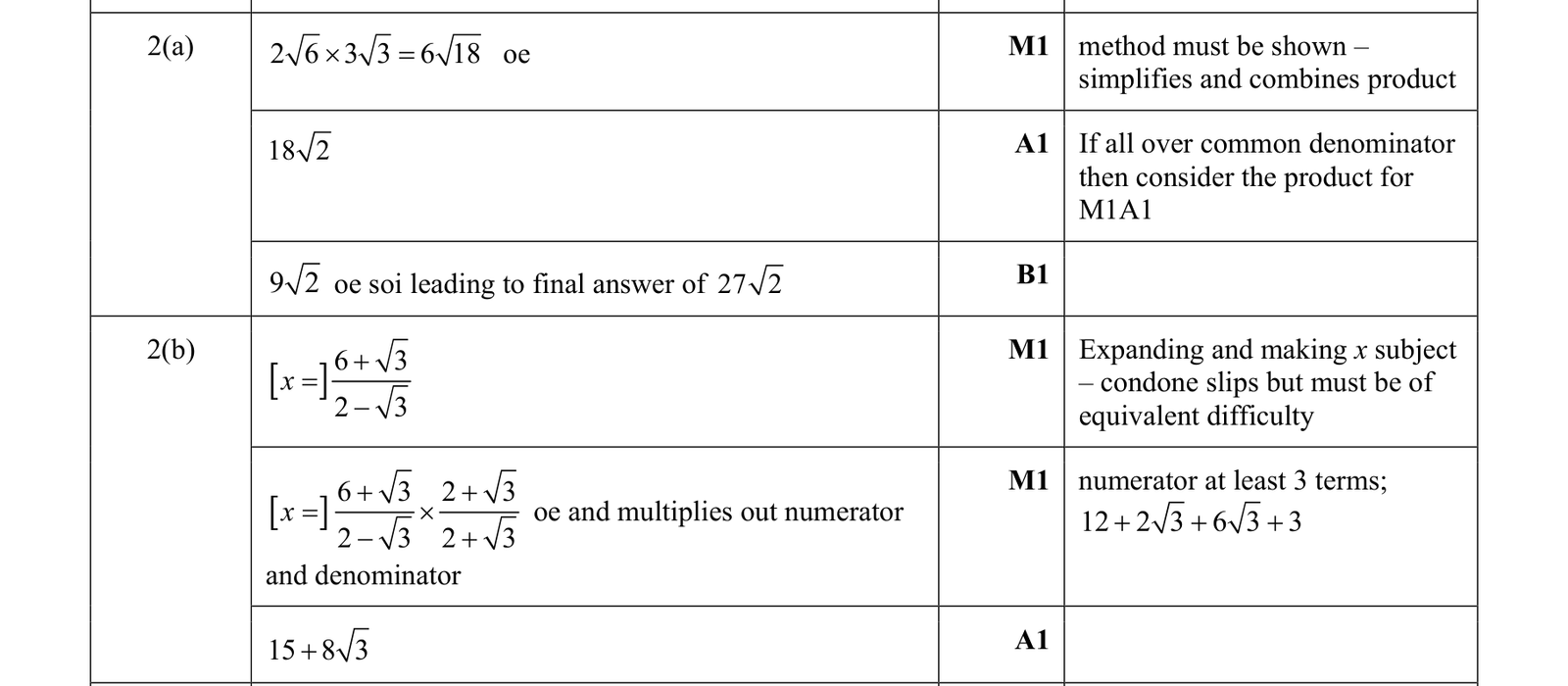
(a) Show that
\(\sqrt{24}\times\sqrt{27}+\frac{9\sqrt{30}}{\sqrt{15}}\)
can be written in the form \(a\sqrt2\), where \(a\) is an integer.
(b) Solve the equation \(\sqrt3(1+x)=2(x-3)\), giving your answer in the form \(b+c\sqrt3\), where \(b\) and \(c\) are integers.
0606 P22 - Jun 2017 - Q2 - 5 marks
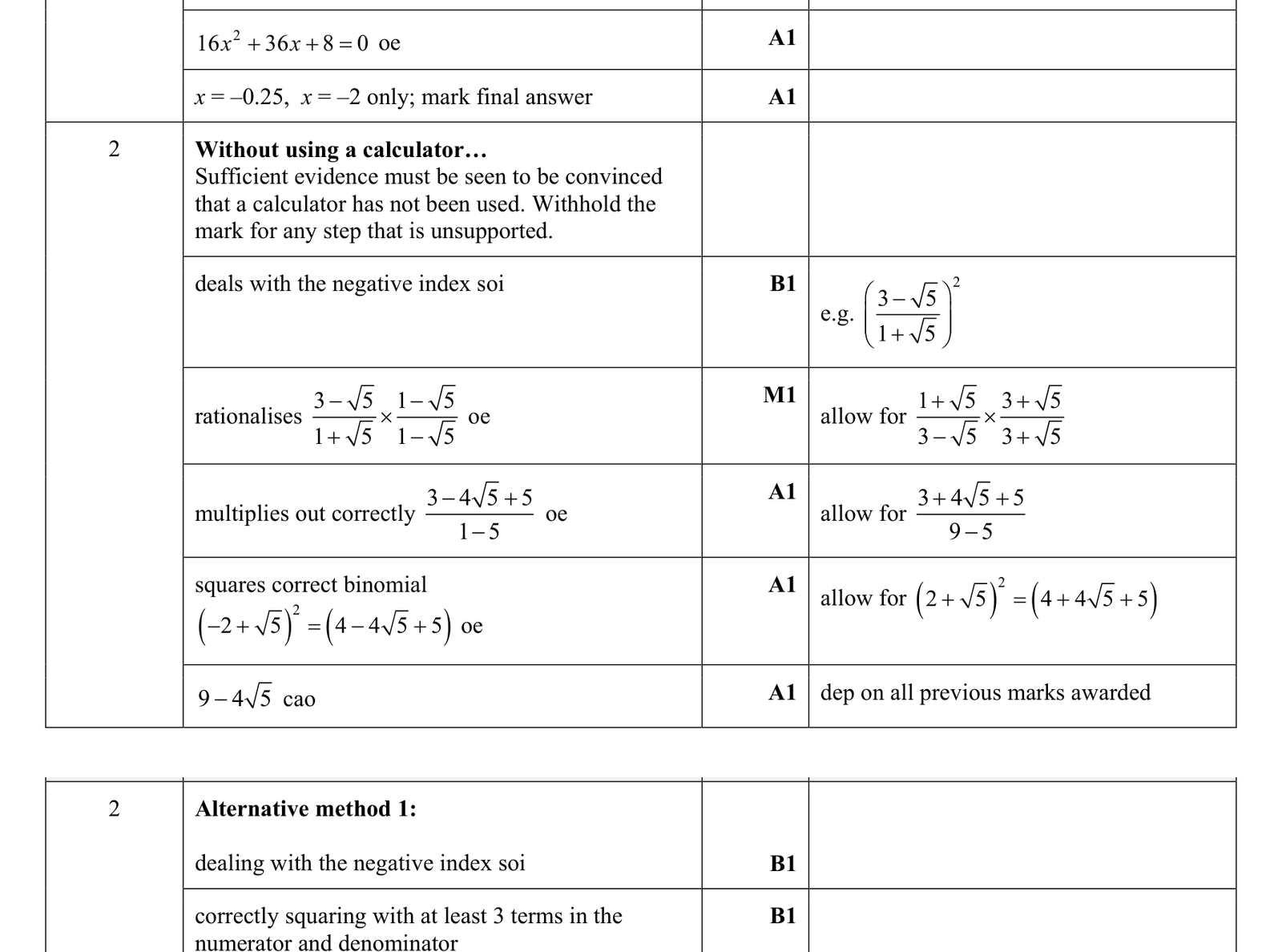
Without using a calculator, express
\(\left(\frac{1+\sqrt5}{3-\sqrt5}\right)^{-2}\)
in the form \(a+b\sqrt5\), where \(a\) and \(b\) are integers.
0606 P21 - Nov 2017 - Q8 - 6 marks
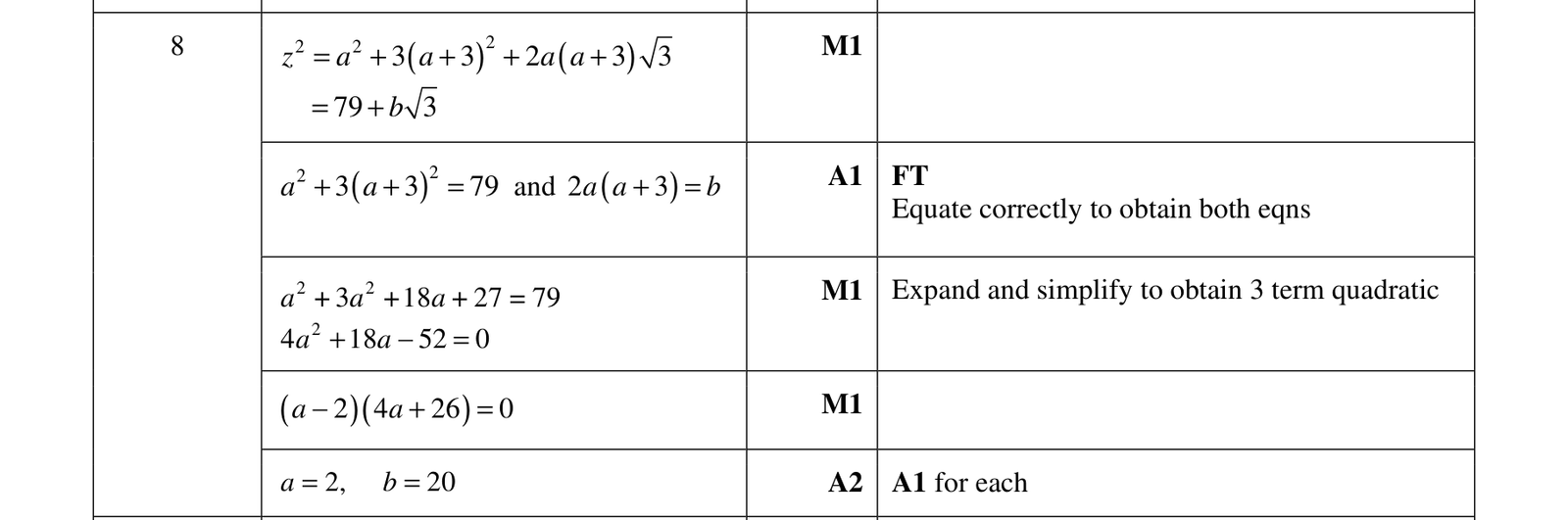
Given that \(z=a+(a+3)\sqrt3\) and \(z^2=79+b\sqrt3\), find the value of each of the integers \(a\) and \(b\).
0606 P22 - Nov 2017 - Q1 - 5 marks
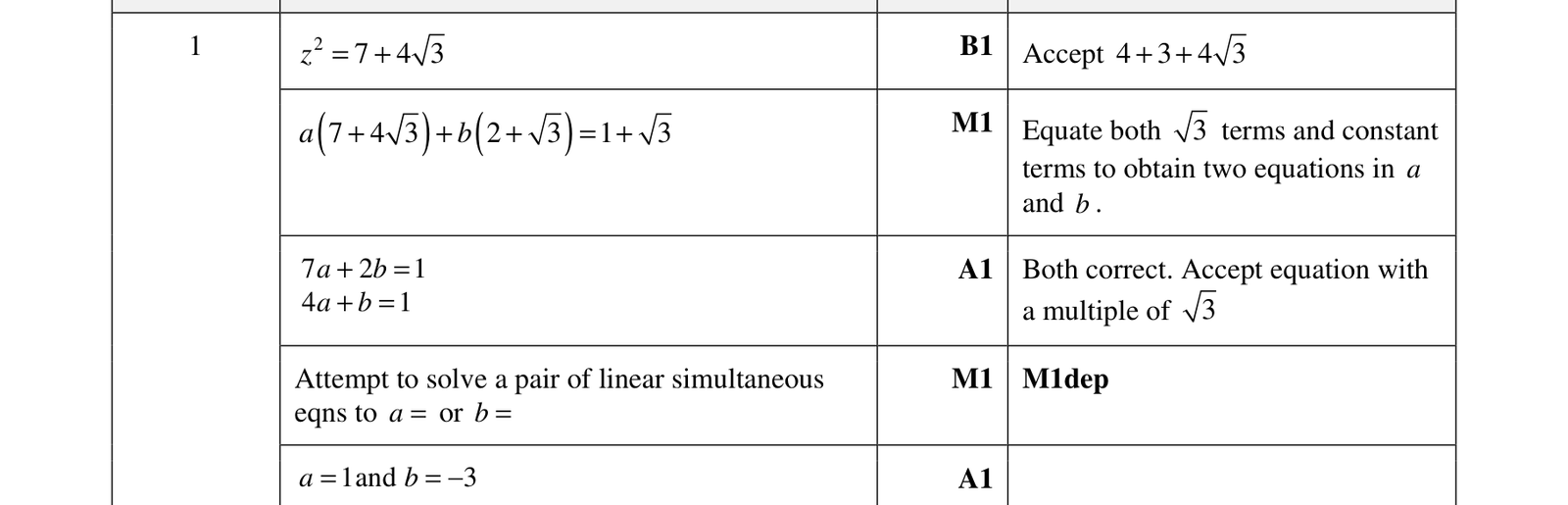
If \(z=2+\sqrt3\), find the integers \(a\) and \(b\) such that \(az^2+bz=1+\sqrt3\).
0606 P23 - Nov 2017 - Q3 - 4 marks
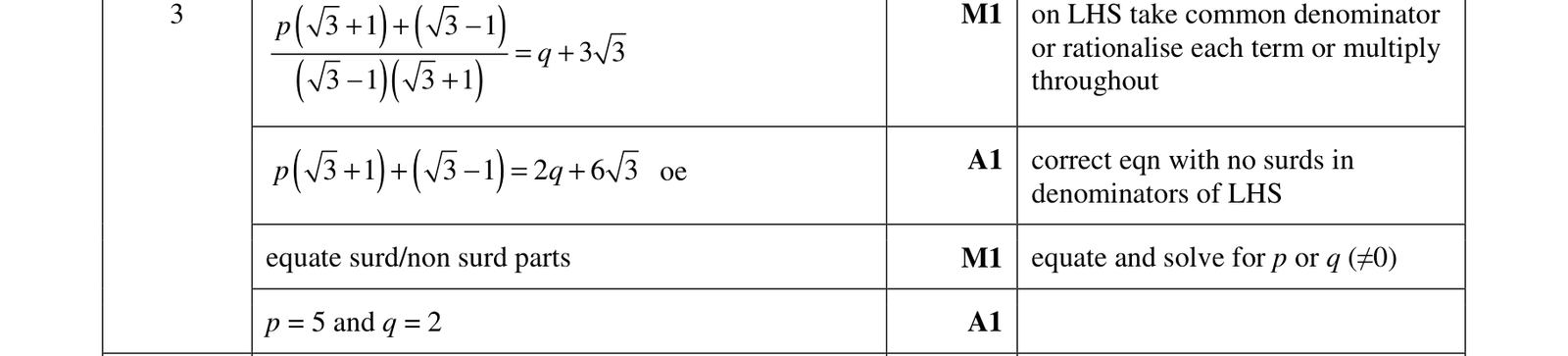
Find integers \(p\) and \(q\) such that
\(\dfrac{p}{\sqrt3-1}+\dfrac{1}{\sqrt3+1}=q+3\sqrt3.\)
0606 P11 - Jun 2024 - Q2 - 6 marks
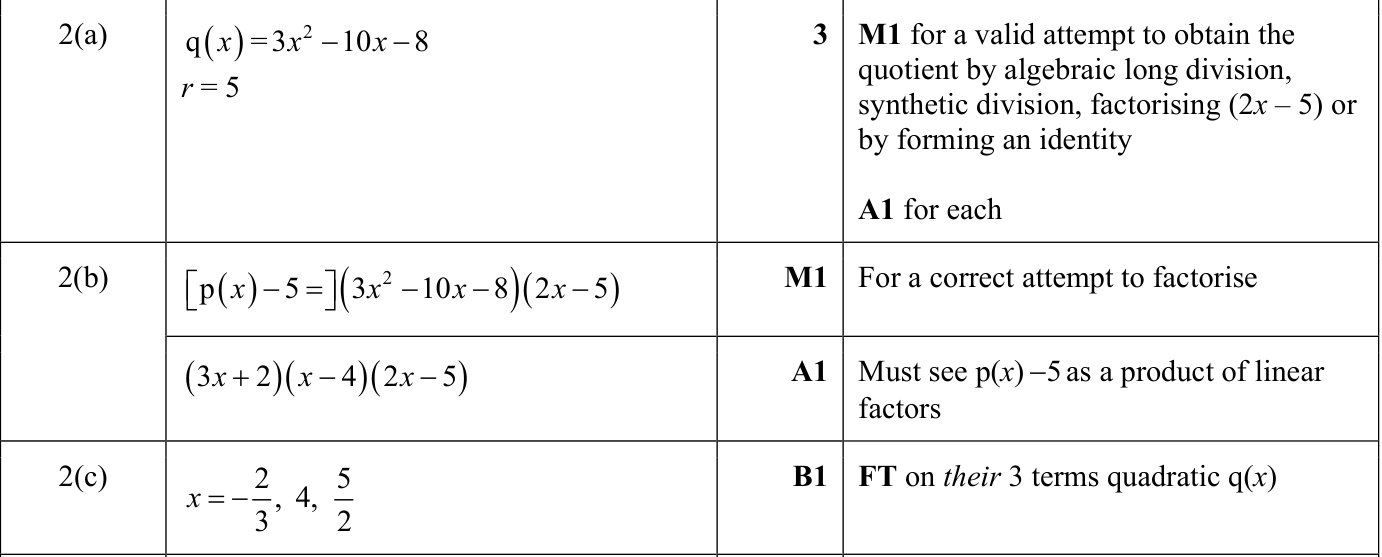
DO NOT USE A CALCULATOR IN THIS QUESTION. The polynomial p is such that \(\mathrm{p}(x)=6 x^{3}-35 x^{2}+34 x+45\). (a) Find \(\mathrm{p}(x)\) in the form \((2 x-5) \mathrm{q}(x)+r\), where \(\mathrm{q}(x)\) is a polynomial and \(r\) is a constant. (b) Hence write the expression \(\mathrm{p}(x)-5\) as a product of linear factors. (c) Hence write down the solutions of the equation \(\mathrm{p}(x)=5\).
0606 P12 - Jun 2025 - Q5 - 10 marks
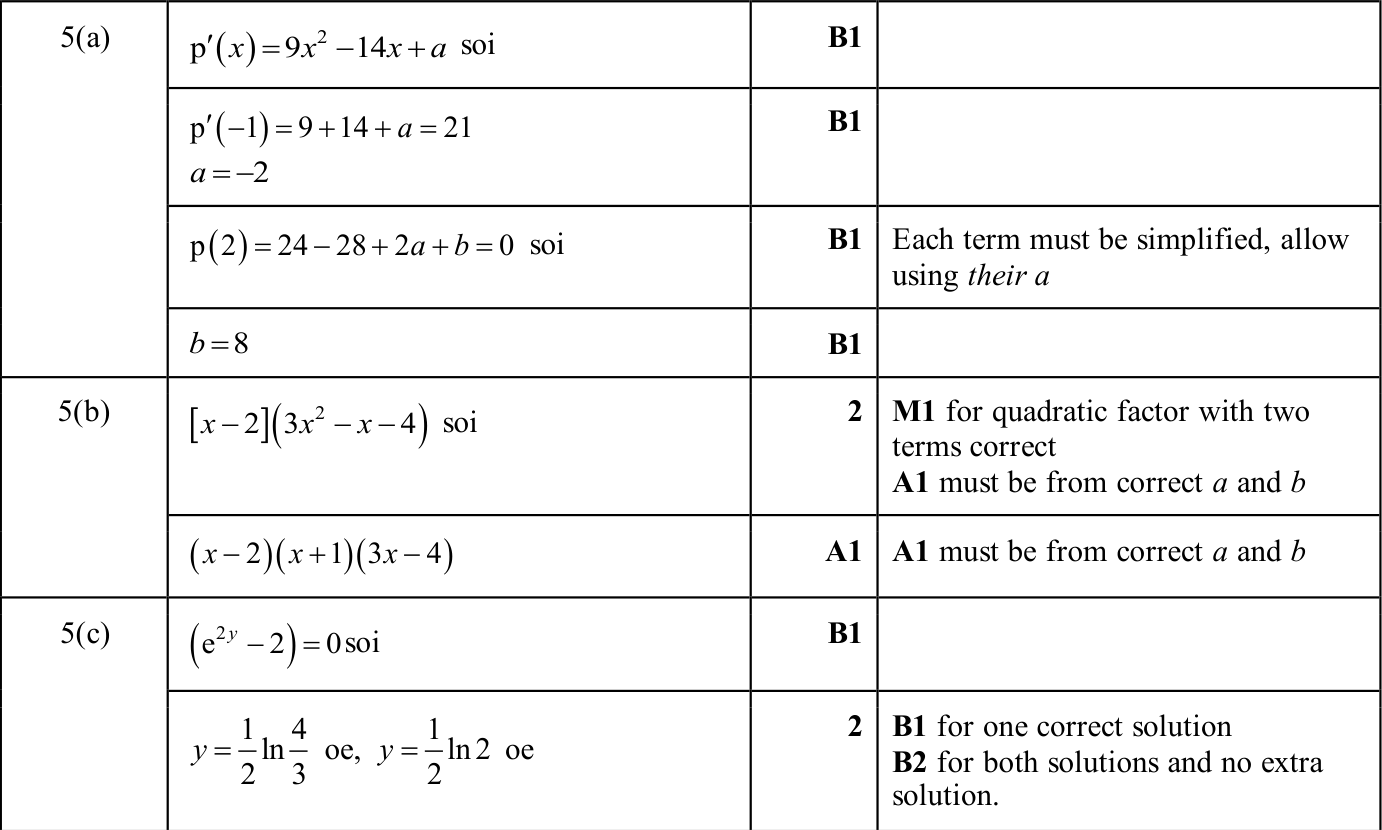
The polynomial \(\mathrm{p}\) is such that \(\mathrm{p}(x)=3x^3-7x^2+ax+b\), where \(a\) and \(b\) are integers.
It is given that \(\mathrm{p}'(-1)=21\) and that \(x-2\) is a factor of \(\mathrm{p}(x)\).
(a) Find the values of \(a\) and \(b\).
(b) Hence write \(\mathrm{p}(x)\) as a product of linear factors with integer coefficients.
(c) Using your values of \(a\) and \(b\), solve the equation \(3\mathrm{e}^{6y}-7\mathrm{e}^{4y}+a\mathrm{e}^{2y}+b=0\).
0606 P13 - Jun 2025 - Q3 - 5 marks
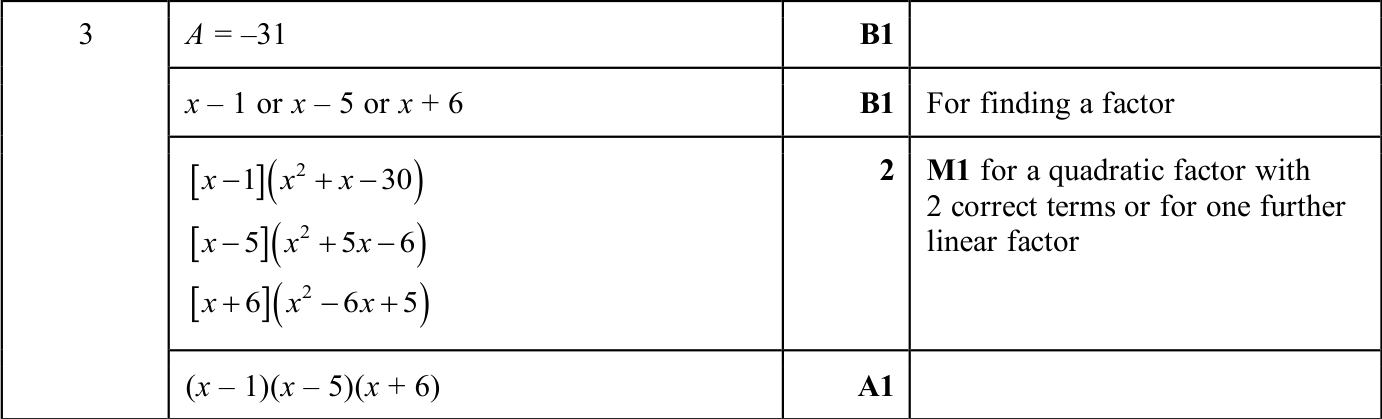
The polynomial p is such that \(\mathrm{p}(x)=x^{3}+A x+30\), where \(A\) is a constant. When \(\mathrm{p}(x)\) is divided by \(x+2\) the remainder is 84 . Write \(\mathrm{p}(x)\) as a product of linear factors.
0606 P12 - Mar 2025 - Q4 - 6 marks
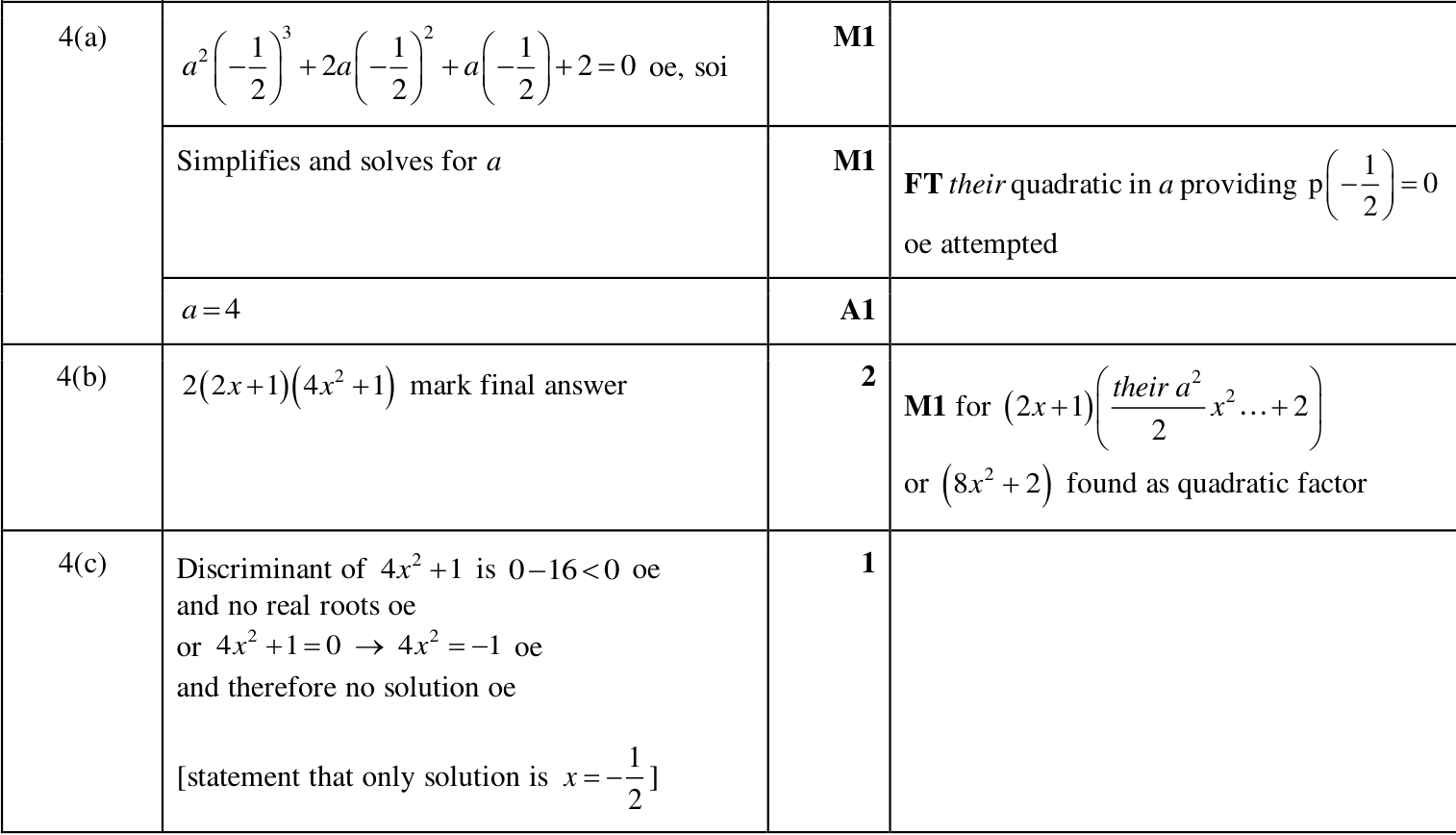
The polynomial \(\mathrm{p}\) is given by \(\mathrm{p}(x)=a^2x^3+2ax^2+ax+2\), where \(a\) is a positive integer.
It is given that \(2x+1\) is a factor of \(\mathrm{p}(x)\).
(a) Find the value of \(a\).
(b) Hence factorise \(\mathrm{p}(x)\).
(c) Hence show that the equation \(\mathrm{p}(x)=0\) has only one real root.
0606 P12 - Mar 2024 - Q5 - 13 marks
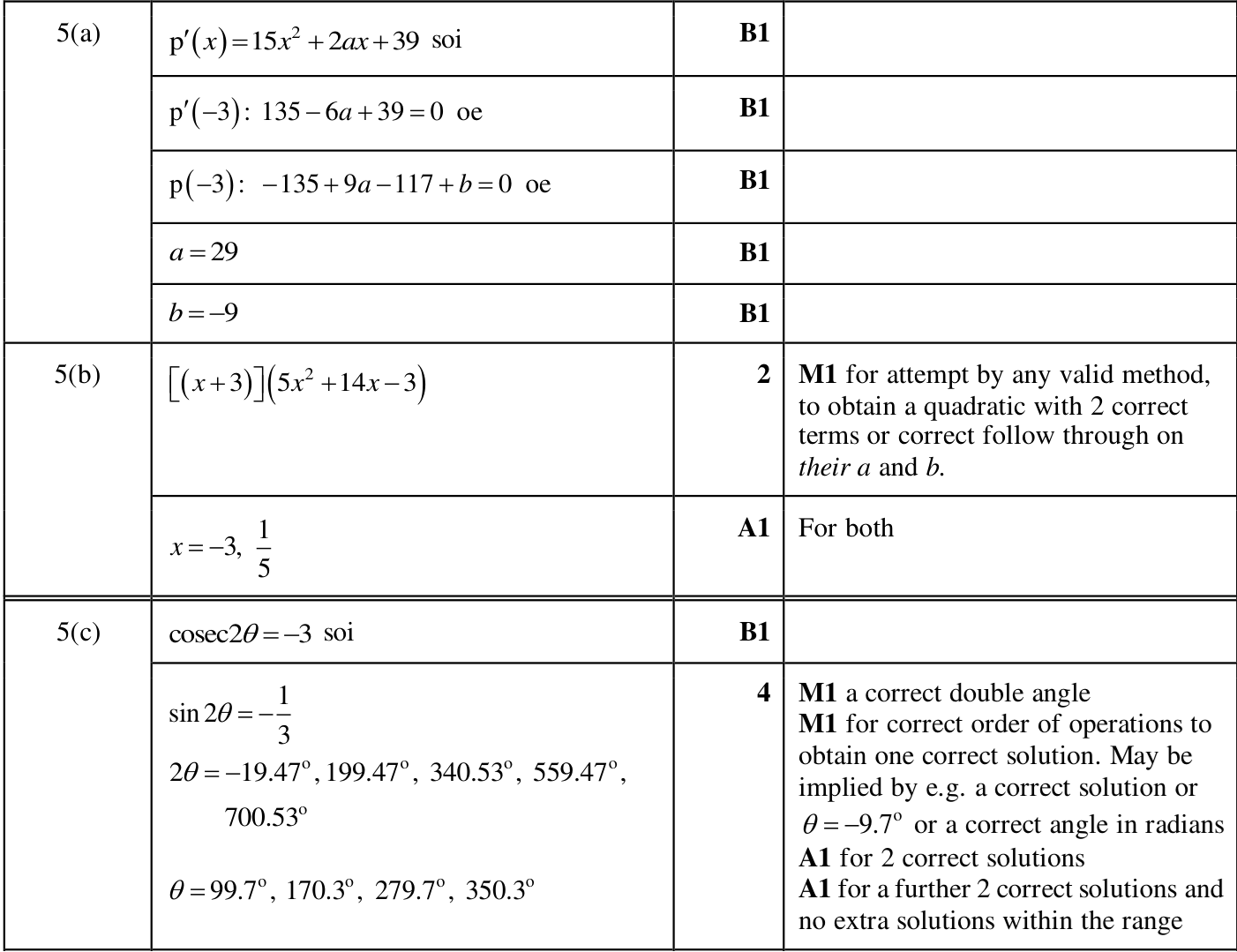
The polynomial p is such that \(\mathrm{p}(x)=5 x^{3}+a x^{2}+39 x+b\), where \(a\) and \(b\) are constants. (a) Given that \(x+3\) is a factor of both \(\mathrm{p}(x)\) and \(\mathrm{p}^{\prime}(x)\), find the values of \(a\) and \(b\).
(b) Hence solve the equation \(\mathrm{p}(x)=0\).
You must show your working.
(c) Hence, using your values for \(a\) and \(b\), solve the equation \(5 \operatorname{cosec}^{3} 2 \theta+a \operatorname{cosec}^{2} 2 \theta+39 \operatorname{cosec} 2 \theta+b=0 \text { for } 0^{\circ} \leqslant \theta \leqslant 360^{\circ} .\)
0606 P23 - Jun 2023 - Q4 - 5 marks
The polynomial \(p(x)\) is defined by
\(p(x)=2x^3+11x^2+22x+40.\)
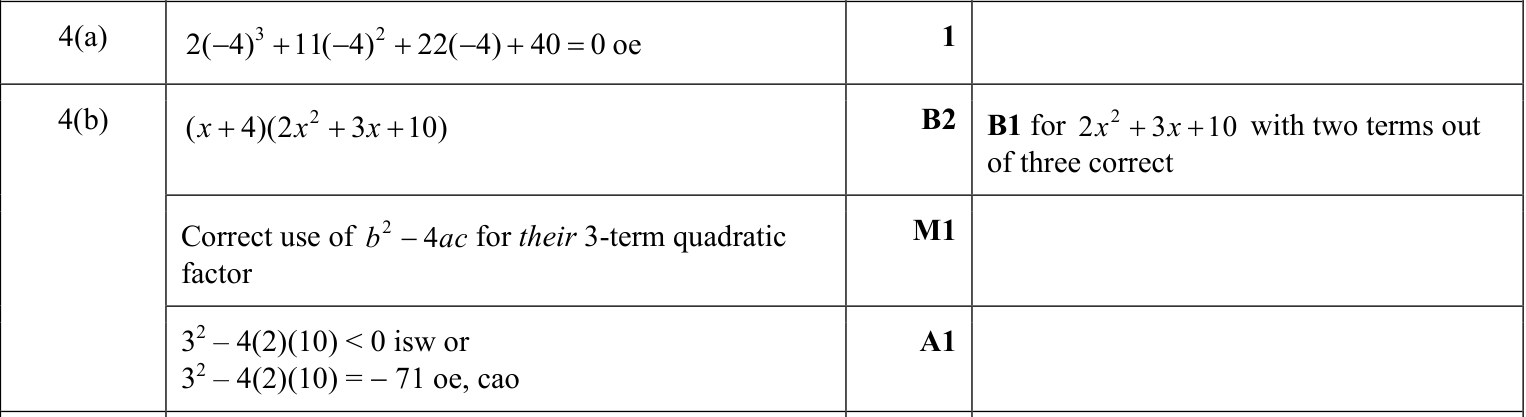
(a) Show that \(x=-4\) is a root of the equation \(p(x)=0\).
(b) Factorise \(p(x)\) and show that the equation \(p(x)=0\) has no other real roots.