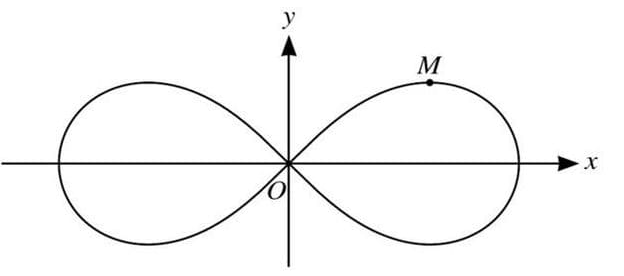
To find the coordinates of \(M\), we start by differentiating both sides of the equation \((x^2 + y^2)^2 = 2(x^2 - y^2)\) with respect to \(x\).
The left-hand side is \((x^2 + y^2)^2\). Using the chain rule, the derivative is:
\(2(x^2 + y^2) \cdot (2x + 2y \frac{dy}{dx})\).
The right-hand side is \(2(x^2 - y^2)\). Its derivative is:
\(4x - 4y \frac{dy}{dx}\).
Setting the derivatives equal gives:
\(2(x^2 + y^2)(2x + 2y \frac{dy}{dx}) = 4x - 4y \frac{dy}{dx}\).
Rearranging terms to solve for \(\frac{dy}{dx}\), we set \(\frac{dy}{dx} = 0\) to find horizontal tangents:
\(2(x^2 + y^2) \cdot 2x = 4x\).
Simplifying gives:
\((x^2 + y^2) = 1\).
Substituting \(x^2 + y^2 = 1\) into the original equation:
\((1)^2 = 2(x^2 - y^2)\).
This simplifies to:
\(1 = 2x^2 - 2y^2\).
Using \(x^2 + y^2 = 1\), we solve for \(x^2\) and \(y^2\):
\(x^2 = \frac{1}{2} + y^2\).
Substitute into \(1 = 2x^2 - 2y^2\):
\(1 = 2(\frac{1}{2} + y^2) - 2y^2\).
\(1 = 1 + 2y^2 - 2y^2\).
\(x^2 = \frac{3}{4}\), \(y^2 = \frac{1}{4}\).
Thus, \(x = \frac{1}{2} \sqrt{3}\) and \(y = \frac{1}{2}\).