Browsing as Guest. Progress, bookmarks and attempts are disabled.
Log in to track your work.
9709 P11 - Jun 2012 - Q3
263
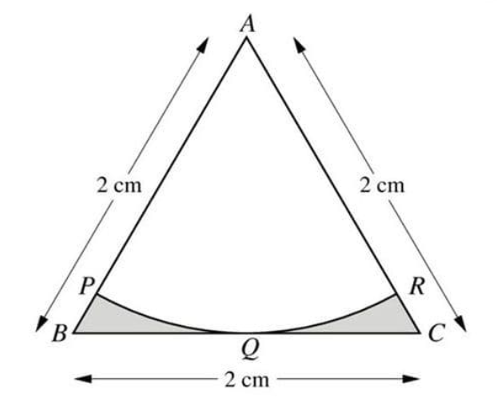
In the diagram, \(ABC\) is an equilateral triangle of side \(2 \text{ cm}\). The mid-point of \(BC\) is \(Q\). An arc of a circle with centre \(A\) touches \(BC\) at \(Q\), and meets \(AB\) at \(P\) and \(AC\) at \(R\). Find the total area of the shaded regions, giving your answer in terms of \(\pi\) and \(\sqrt{3}\).
Solution
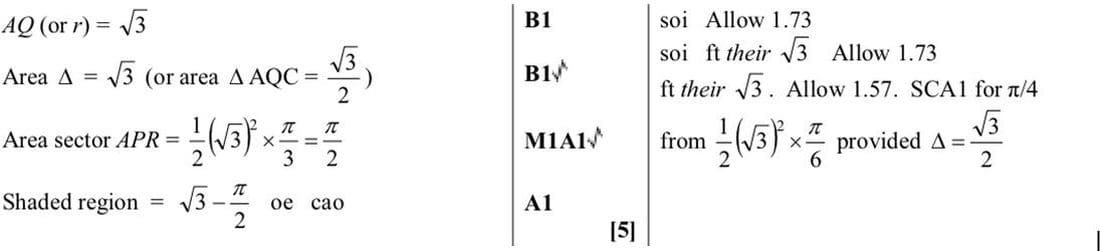
First, calculate the length \(AQ\) which is the radius of the arc. Since \(Q\) is the midpoint of \(BC\), and \(ABC\) is an equilateral triangle, \(AQ = \sqrt{3}\).
Next, calculate the area of triangle \(AQC\). The height from \(A\) to \(BC\) is \(\sqrt{3}\), so the area of \(\triangle AQC\) is \(\frac{1}{2} \times 2 \times \frac{\sqrt{3}}{2} = \frac{\sqrt{3}}{2}\).
Now, calculate the area of the sector \(APR\). The angle \(\angle BAC\) is \(60^\circ\) or \(\frac{\pi}{3}\) radians. The area of the sector is \(\frac{1}{2} \times (\sqrt{3})^2 \times \frac{\pi}{3} = \frac{\pi}{2}\).
The area of the shaded region is the area of \(\triangle AQC\) minus the area of the sector \(APR\):