Problem #276
Metadata not filled yet
276
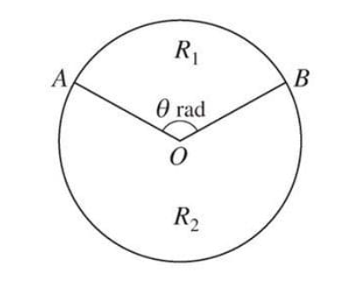
The diagram shows a circle with centre O. The circle is divided into two regions, R1 and R2, by the radii OA and OB, where angle AOB = \theta radians. The perimeter of the region R1 is equal to the length of the major arc AB.
(i) Show that \(\theta = \pi - 1\).
(ii) Given that the area of region R1 is 30 cm2, find the area of region R2, correct to 3 significant figures.
Solutions locked. Please sign in with access to view them.