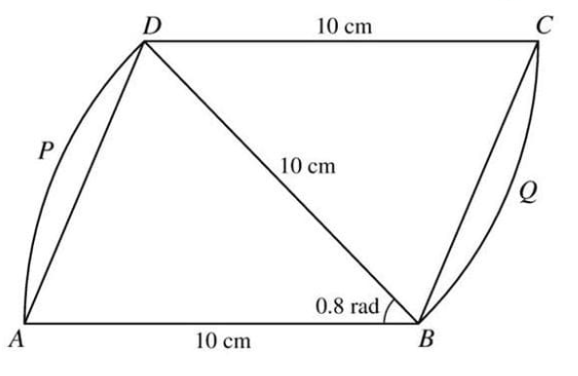
(i) The area of parallelogram ABCD can be found using the formula for the area of a parallelogram:
Area = AB × BD × sin(ABD)
Given AB = BD = 10 cm and ABD = 0.8 radians, the area is:
Area = 10 × 10 × sin(0.8) = 100 × sin(0.8) = 71.7
(ii) The area of the complete figure ABQCDP includes the area of parallelogram ABCD and the areas of sectors APD and BQC. Each sector has a radius of 10 cm and angle 0.8 radians.
Area of one sector = \(\frac{1}{2} \times 10^2 \times 0.8 = 40\)
Total area of sectors = 2 × 40 = 80
Total area of figure = Area of parallelogram + Total area of sectors = 71.7 + 8.3 = 80
(iii) The perimeter of the complete figure ABQCDP includes the sides AB, BC, CD, DA, and the arcs APD and BQC.
Length of one arc = 10 × 0.8 = 8
Total length of arcs = 2 × 8 = 16
Perimeter = AB + BC + CD + DA + Total length of arcs = 10 + 10 + 10 + 10 + 16 = 36