Past Exam Questions
← BackQuestion #204
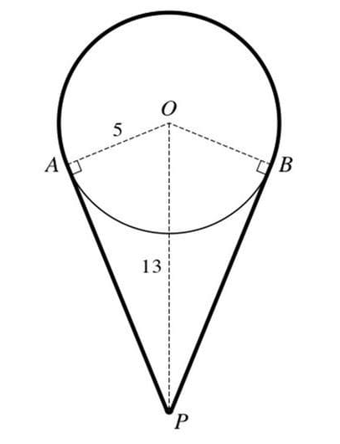
The diagram shows a cord going around a pulley and a pin. The pulley is modelled as a circle with centre O and radius 5 cm. The thickness of the cord and the size of the pin P can be neglected. The pin is situated 13 cm vertically below O. Points A and B are on the circumference of the circle such that AP and BP are tangents to the circle. The cord passes over the major arc AB of the circle and under the pin such that the cord is taut.
Calculate the length of the cord.
Question #205
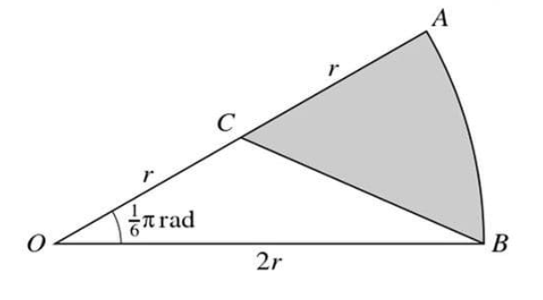
In the diagram, \(OAB\) is a sector of a circle with centre \(O\) and radius \(2r\), and angle \(AOB = \frac{1}{6} \pi\) radians. The point \(C\) is the midpoint of \(OA\).
(a) Show that the exact length of \(BC\) is \(r\sqrt{5} - 2\sqrt{3}\).
(b) Find the exact perimeter of the shaded region.
(c) Find the exact area of the shaded region.
Question #206
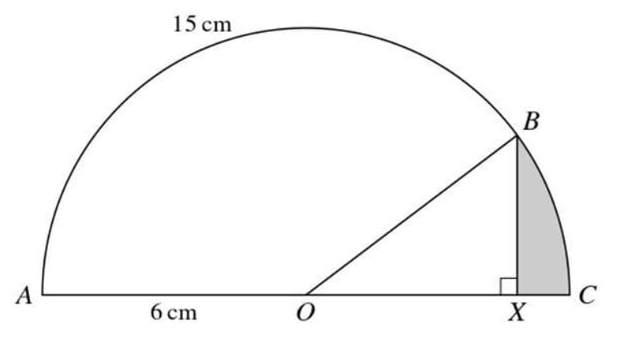
In the diagram, ABC is a semicircle with diameter AC, centre O and radius 6 cm. The length of the arc AB is 15 cm. The point X lies on AC and BX is perpendicular to AX.
Find the perimeter of the shaded region BXC.
Question #207
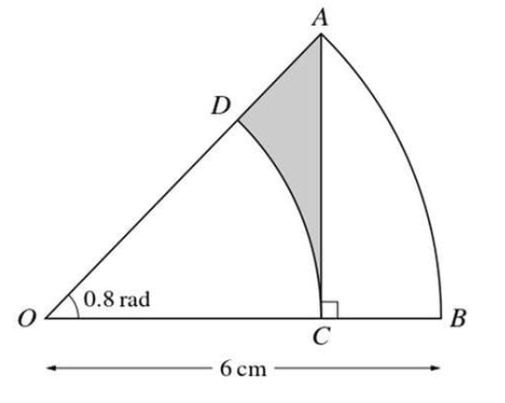
The diagram shows a sector AOB which is part of a circle with centre O and radius 6 cm and with angle AOB = 0.8 radians. The point C on OB is such that AC is perpendicular to OB. The arc CD is part of a circle with centre O, where D lies on OA.
Find the area of the shaded region.
Question #208
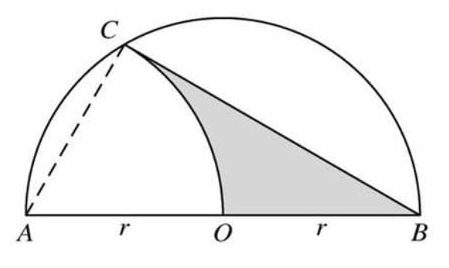
The diagram shows a semicircle ACB with centre O and radius r. Arc OC is part of a circle with centre A.
(i) Express angle CAO in radians in terms of \(\\pi\).
(ii) Find the area of the shaded region in terms of r, \(\\pi\) and \(\\sqrt{3}\), simplifying your answer.
Question #209
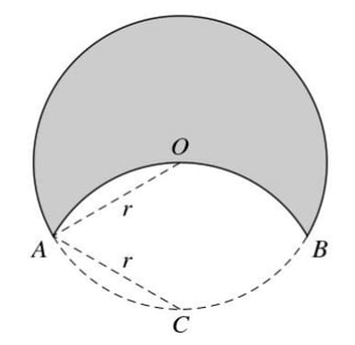
The diagram shows a motif formed by the major arc \(AB\) of a circle with radius \(r\) and centre \(O\), and the minor arc \(AOB\) of a circle, also with radius \(r\) but with centre \(C\). The point \(C\) lies on the circle with centre \(O\).
(a) Given that angle \(ACB = k\pi\) radians, state the value of the fraction \(k\).
(b) State the perimeter of the shaded motif in terms of \(\pi\) and \(r\).
(c) Find the area of the shaded motif, giving your answer in terms of \(\pi\), \(r\) and \(\sqrt{3}\).
Question #210
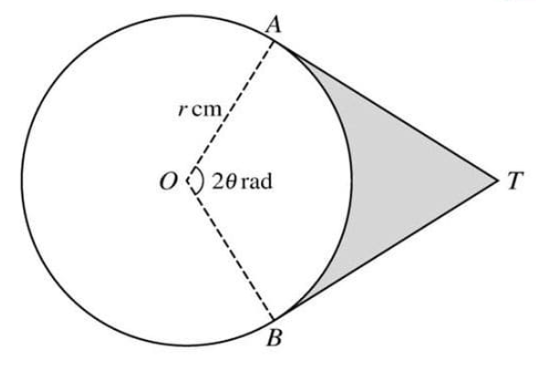
The diagram shows a circle with centre O and radius r cm. Points A and B lie on the circle and angle AOB = 2\theta radians. The tangents to the circle at A and B meet at T.
(i) Express the perimeter of the shaded region in terms of r and \theta.
(ii) In the case where r = 5 and \theta = 1.2, find the area of the shaded region.
Question #211
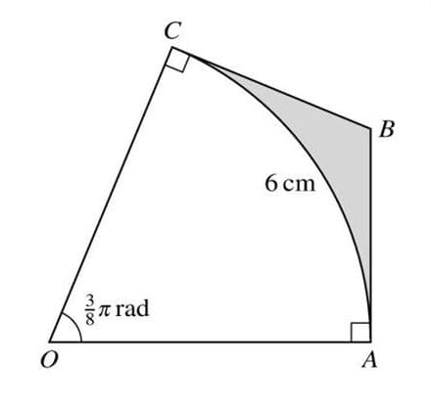
The diagram shows a sector OAC of a circle with centre O. Tangents AB and CB to the circle meet at B. The arc AC is of length 6 cm and angle AOC = \(\frac{3}{8} \pi\) radians.
(i) Find the length of OA correct to 4 significant figures.
(ii) Find the perimeter of the shaded region.
(iii) Find the area of the shaded region.
Question #212
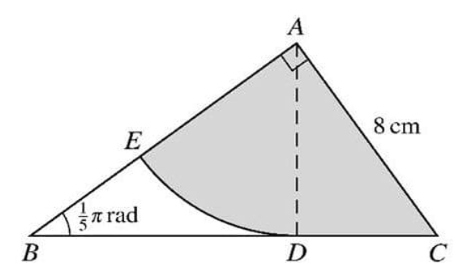
The diagram shows triangle ABC which is right-angled at A. Angle ABC = \frac{1}{5}\pi radians and AC = 8 cm. The points D and E lie on BC and BA respectively. The sector ADE is part of a circle with centre A and is such that BDC is the tangent to the arc DE at D.
(i) Find the length of AD.
(ii) Find the area of the shaded region.
Question #213
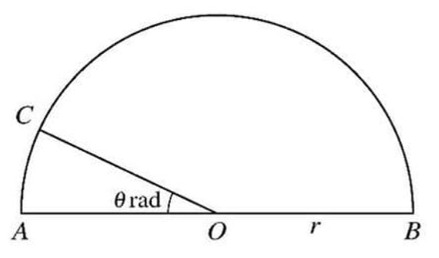
The diagram shows a semicircle with diameter \(AB\), centre \(O\) and radius \(r\). The point \(C\) lies on the circumference and angle \(AOC = \theta\) radians. The perimeter of sector \(BOC\) is twice the perimeter of sector \(AOC\). Find the value of \(\theta\) correct to 2 significant figures.
Question #214
A sector of a circle of radius r cm has an area of A cm2. Express the perimeter of the sector in terms of r and A.
Question #215
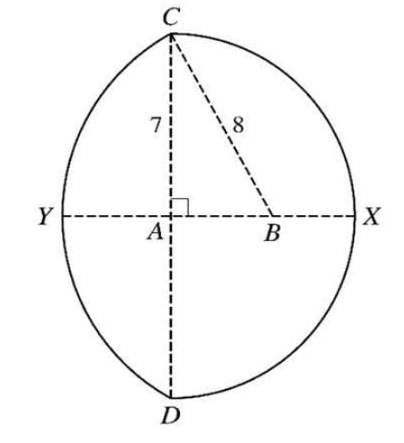
In the diagram, CXD is a semicircle of radius 7 cm with centre A and diameter CD. The straight line YABX is perpendicular to CD, and the arc CYD is part of a circle with centre B and radius 8 cm. Find the total area of the region enclosed by the two arcs.
Question #216
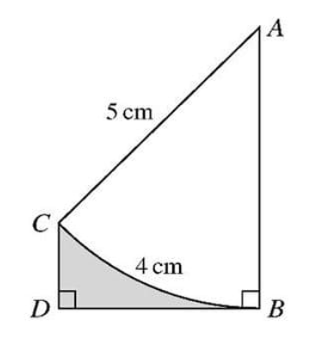
The diagram shows an arc BC of a circle with centre A and radius 5 cm. The length of the arc BC is 4 cm. The point D is such that the line BD is perpendicular to BA and DC is parallel to BA.
(i) Find angle BAC in radians.
(ii) Find the area of the shaded region BDC.
Question #217
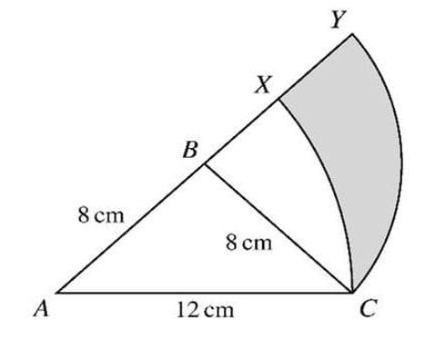
The diagram shows an isosceles triangle ACB in which AB = BC = 8 ext{ cm} and AC = 12 ext{ cm}. The arc XC is part of a circle with centre A and radius 12 ext{ cm}, and the arc YC is part of a circle with centre B and radius 8 ext{ cm}. The points A, B, X and Y lie on a straight line.
(i) Show that angle CBY = 1.445 radians, correct to 4 significant figures.
(ii) Find the perimeter of the shaded region.
Question #218
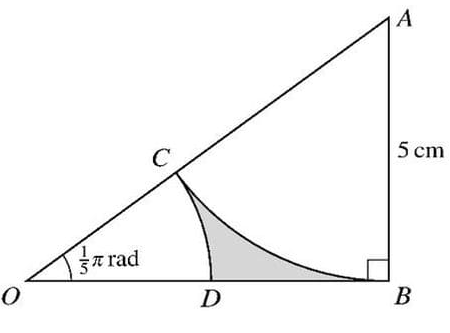
The diagram shows a triangle OAB in which angle ABO is a right angle, angle AOB = \frac{1}{5}\pi radians and AB = 5 \text{ cm}. The arc BC is part of a circle with centre A and meets OA at C. The arc CD is part of a circle with centre O and meets OB at D. Find the area of the shaded region.
Question #219
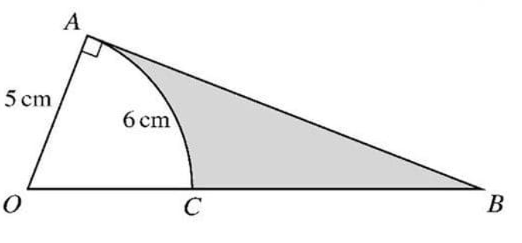
The diagram shows a triangle OAB in which angle OAB = 90° and OA = 5 cm. The arc AC is part of a circle with centre O. The arc has length 6 cm and it meets OB at C. Find the area of the shaded region.
Question #220
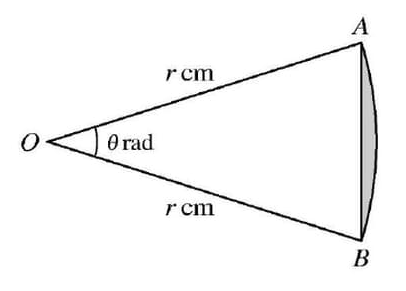
The diagram shows a sector OAB of a circle with centre O and radius r cm. Angle AOB = θ radians. It is given that the length of the arc AB is 9.6 cm and that the area of the sector OAB is 76.8 cm².
(a) Find the area of the shaded region.
(b) Find the perimeter of the shaded region.
Question #221
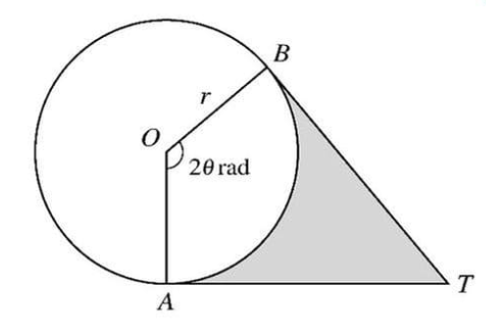
The diagram shows points A and B on a circle with centre O and radius r. The tangents to the circle at A and B meet at T. The shaded region is bounded by the minor arc AB and the lines AT and BT. Angle AOB is 2θ radians.
(i) In the case where the area of the sector AOB is the same as the area of the shaded region, show that tan θ = 2θ.
(ii) In the case where r = 8 cm and the length of the minor arc AB is 19.2 cm, find the area of the shaded region.
Question #222
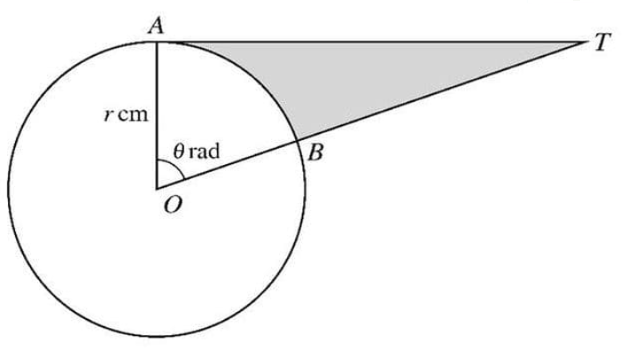
The diagram shows a circle with centre O and radius r cm. The points A and B lie on the circle and AT is a tangent to the circle. Angle AOB = \theta radians and OBT is a straight line.
(i) Express the area of the shaded region in terms of r and \theta.
(ii) In the case where r = 3 and \theta = 1.2, find the perimeter of the shaded region.
Question #223
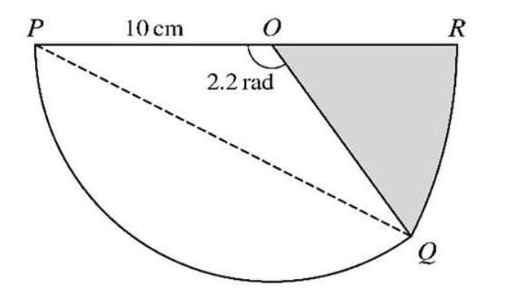
The diagram shows a sector POQ of a circle of radius 10 cm and centre O. Angle POQ is 2.2 radians. QR is an arc of a circle with centre P and POR is a straight line.
(i) Show that the length of PQ is 17.8 cm, correct to 3 significant figures.
(ii) Find the perimeter of the shaded region.