Past Exam Questions
← Back0606 P13 - Nov 2023 - Q4 - 8 marks
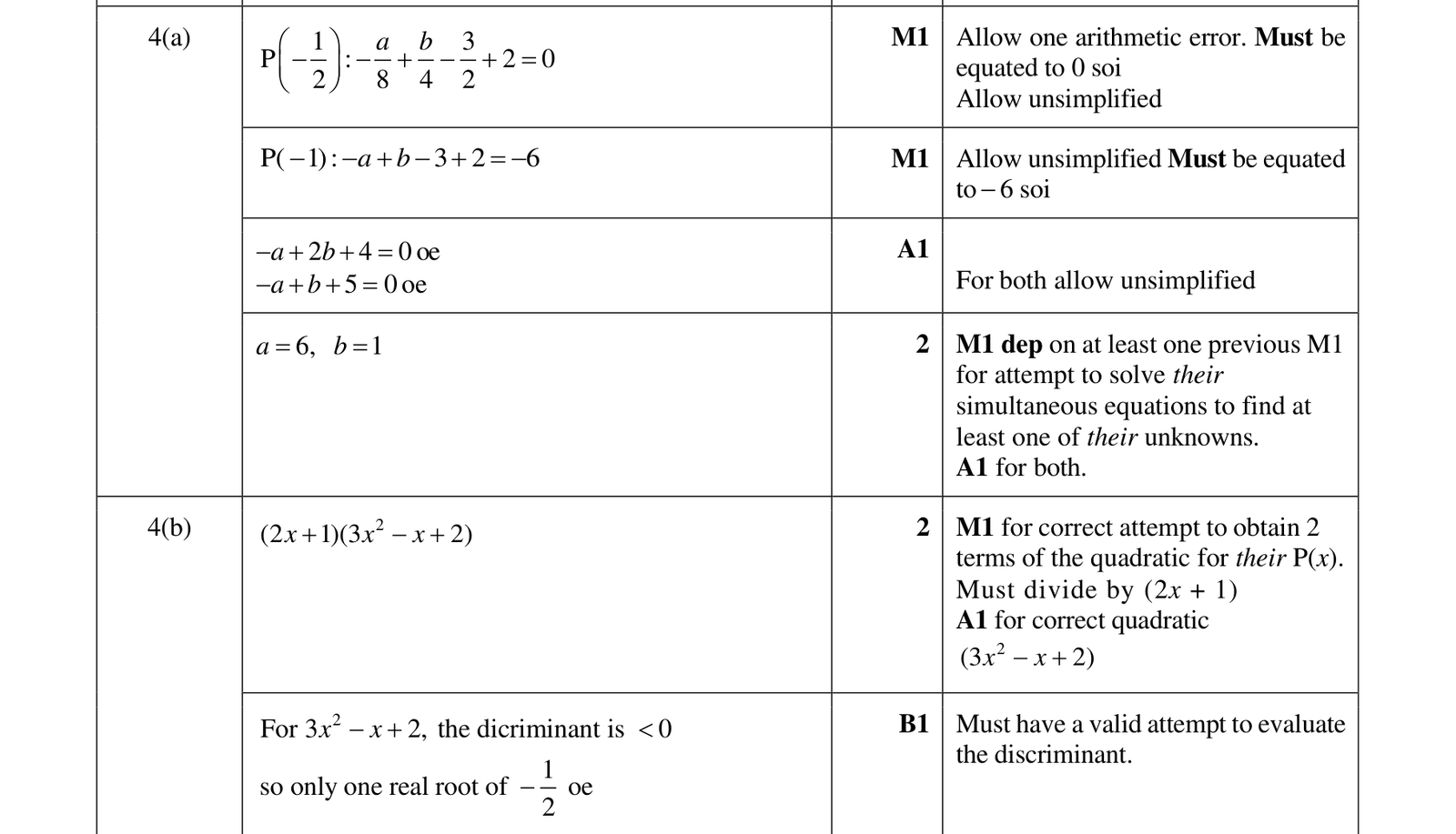
The polynomial \(\mathrm P\) is given by
\(\mathrm P(x)=ax^3+bx^2+3x+2\),
where \(a\) and \(b\) are integers. \(\mathrm P(x)\) has a factor of \(2x+1\). \(\mathrm P(x)\) has a remainder of \(-6\) when divided by \(x+1\).
(a) Find the values of \(a\) and \(b\).
(b) Show that the equation \(\mathrm P(x)=0\) has only one real root.
0606 P21 - Jun 2022 - Q4 - 6 marks
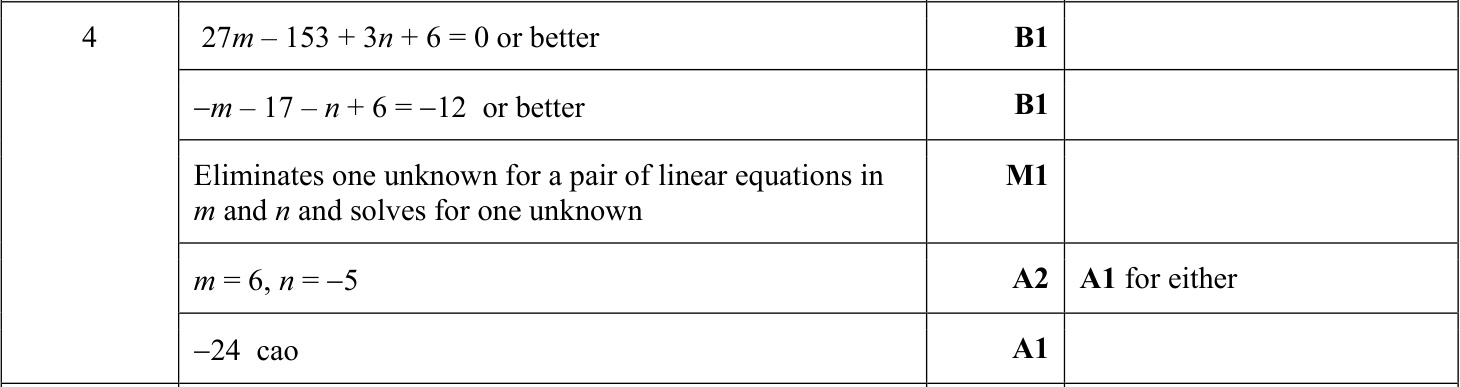
The polynomial \(p(x)=mx^3-17x^2+nx+6\), where \(m\) and \(n\) are constants, has a factor \(x-3\). When \(p(x)\) is divided by \(x+1\), the remainder is \(-12\). Find the remainder when \(p(x)\) is divided by \(x-2\).
0606 P11 - Jun 2021 - Q3 - 8 marks
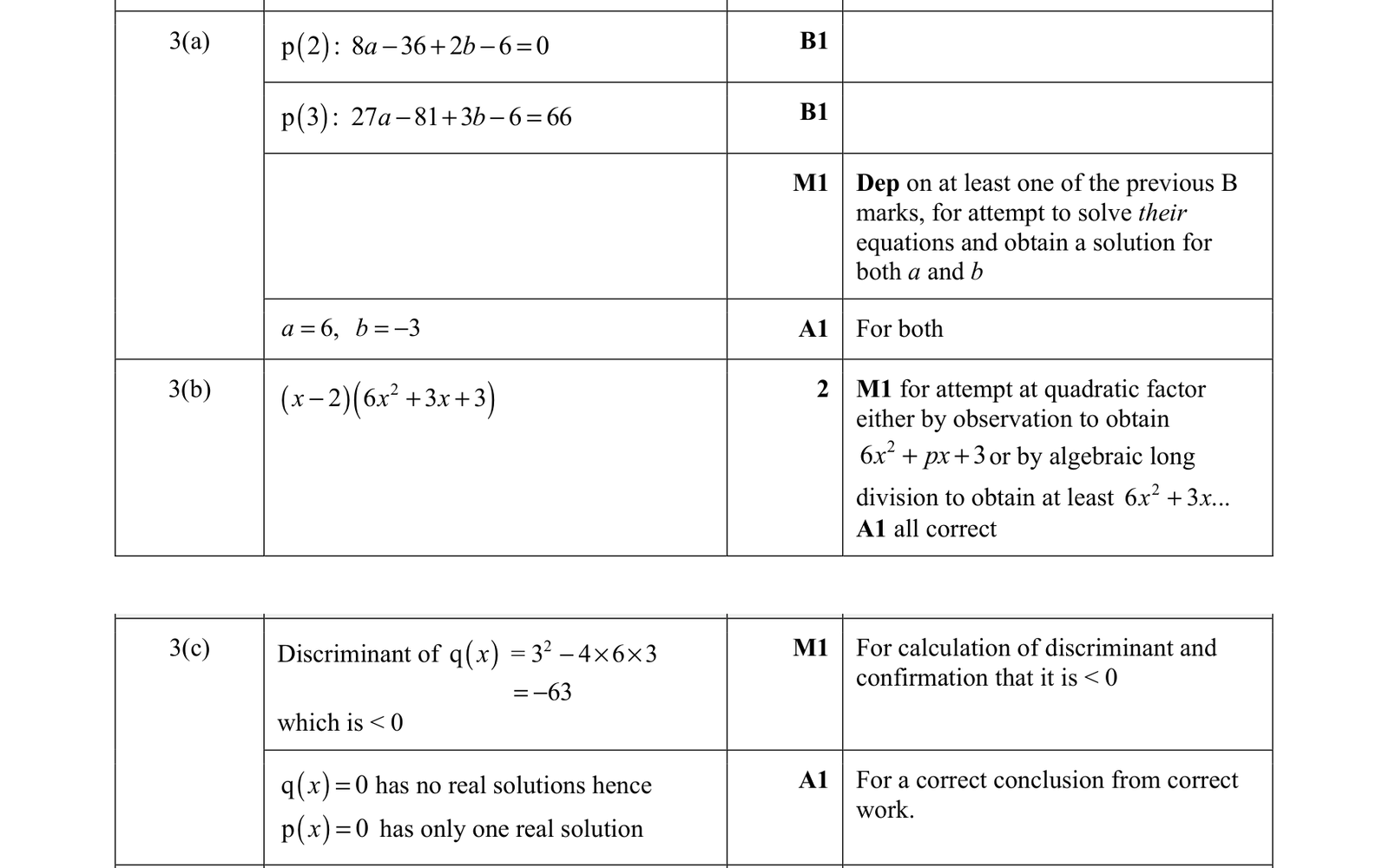
The polynomial
\(\mathrm p(x)=ax^3-9x^2+bx-6,\)
where \(a\) and \(b\) are constants, has a factor of \(x-2\). The polynomial has a remainder of \(66\) when divided by \(x-3\).
(a) Find the value of \(a\) and of \(b\).
(b) Using your values of \(a\) and \(b\), show that
\(\mathrm p(x)=(x-2)\mathrm q(x),\)
where \(\mathrm q(x)\) is a quadratic factor to be found.
(c) Hence show that the equation \(\mathrm p(x)=0\) has only one real solution.
0606 P22 - Jun 2021 - Q4 - 6 marks
The polynomial
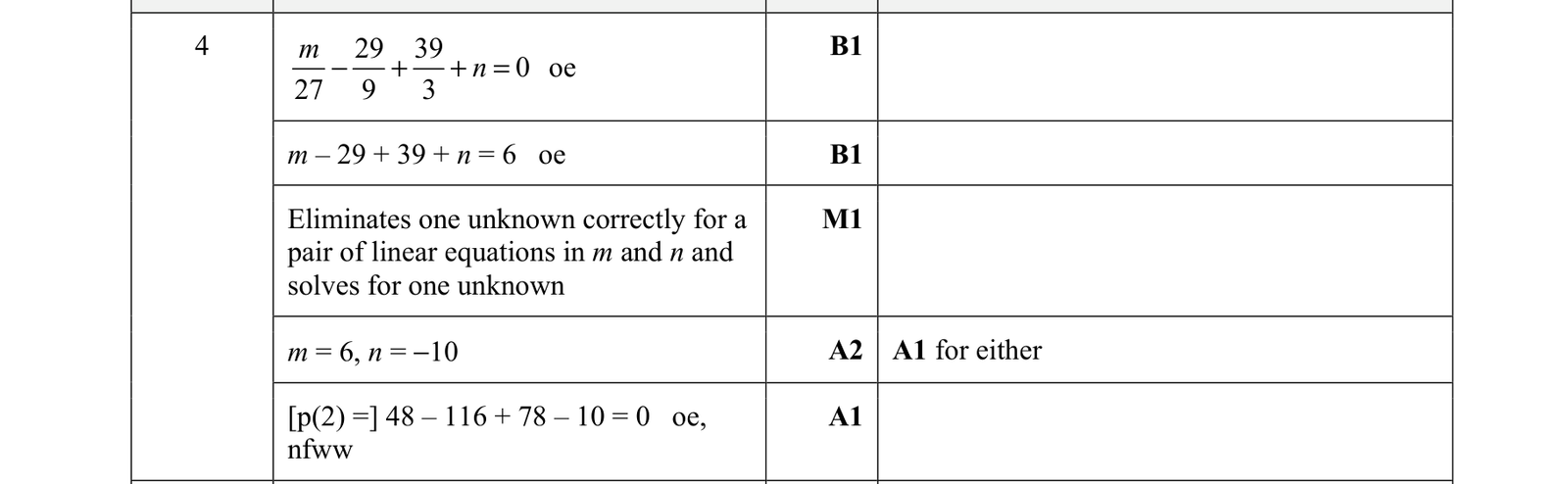
\(\mathrm p(x)=mx^3-29x^2+39x+n,\)
where \(m\) and \(n\) are constants, has a factor \(3x-1\), and remainder \(6\) when divided by \(x-1\).
Show that \(x-2\) is a factor of \(\mathrm p(x)\).
0606 P11 - Nov 2021 - Q5 - 7 marks
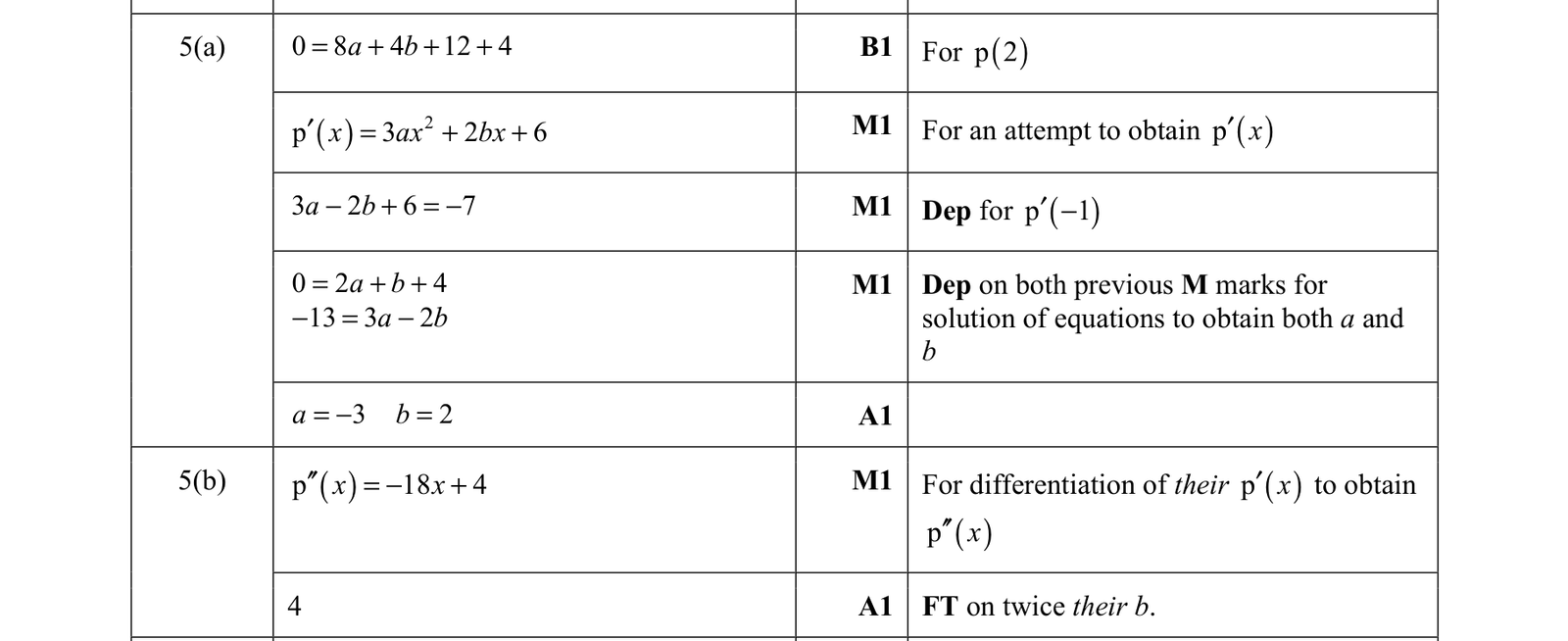
The polynomial \(\mathrm p(x)=ax^3+bx^2+6x+4\), where \(a\) and \(b\) are integers, is divisible by \(x-2\). When \(\mathrm p'(x)\) is divided by \(x+1\), the remainder is \(-7\).
(a) Find the value of \(a\) and of \(b\).
(b) Using your answers to part (a), find the remainder when \(\mathrm p''(x)\) is divided by \(x\).
0606 P12 - Nov 2020 - Q10 - 8 marks
The polynomial \(\mathrm{p}(x)\) is given by
\(\mathrm{p}(x)=6x^3+ax^2+bx+2,\)
where \(a\) and \(b\) are constants. It is given that \(x-2\) is a factor of \(\mathrm{p}(x)\), and that \(\mathrm{p}(1)=-2\mathrm{p}(0)\).
(a) Find the values of \(a\) and \(b\).
(b) Find the remainder when \(\mathrm{p}(x)\) is divided by \(2x-1\).
(c) Factorise \(\mathrm{p}(x)\) completely.

0606 P11 - Jun 2019 - Q3 - 6 marks
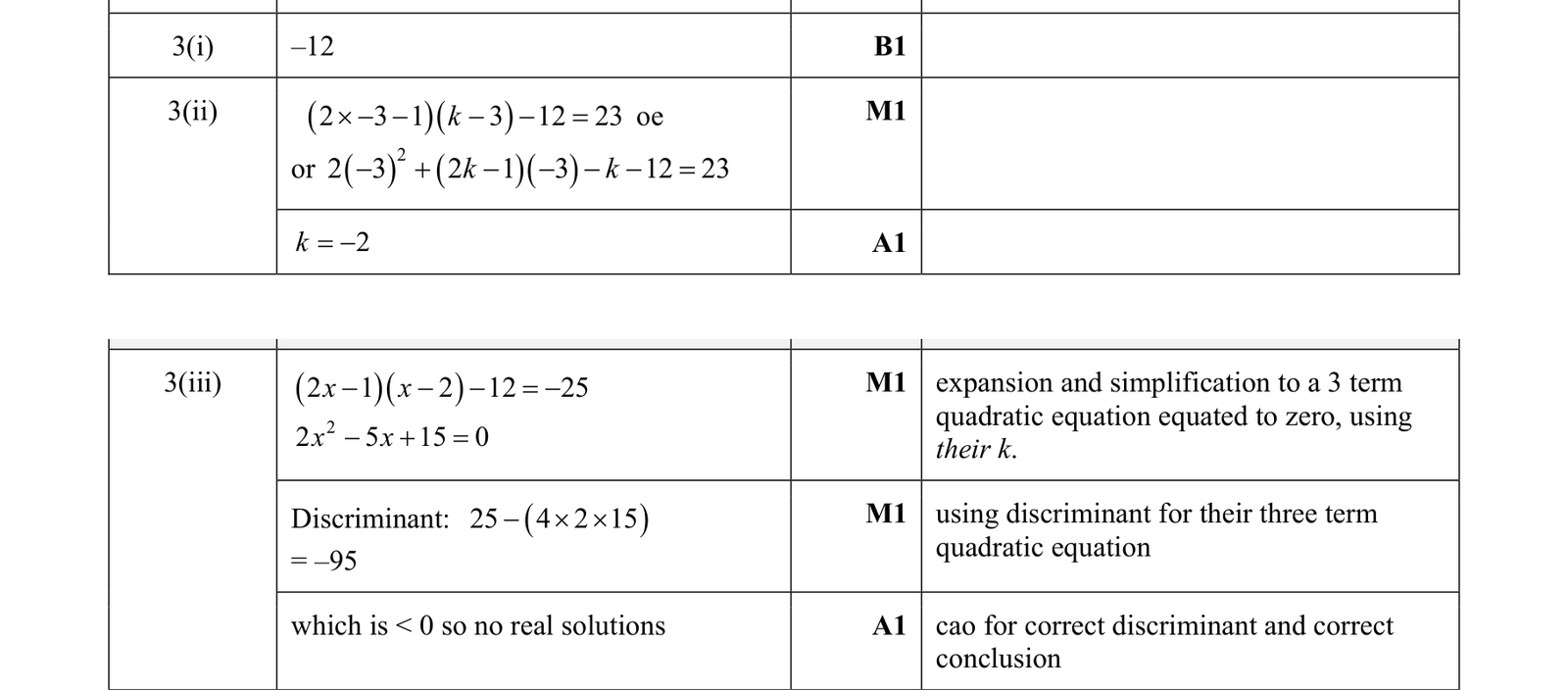
The polynomial \(p(x)=(2x-1)(x+k)-12\), where \(k\) is a constant.
(i) Write down the value of \(p(-k)\).
When \(p(x)\) is divided by \(x+3\), the remainder is \(23\).
(ii) Find the value of \(k\).
(iii) Using your value of \(k\), show that the equation \(p(x)=-25\) has no real solutions.
0606 P12 - Mar 2018 - Q1 - 5 marks
The polynomial \(p(x)\) is given by
\(p(x)=x^3+ax^2-3x+b\),
where \(a\) and \(b\) are constants. The remainder when \(p(x)\) is divided by \(x+3\) is twice the remainder when \(p(x)\) is divided by \(x-2\). It is also given that \(p(x)\) is exactly divisible by \(x+1\). Find the values of \(a\) and \(b\).

0606 P22 - Jun 2018 - Q3 - 6 marks
It is given that \(x+3\) is a factor of the polynomial
\(p(x)=2x^3+ax^2-24x+b.\)
The remainder when \(p(x)\) is divided by \(x-2\) is \(-15\). Find the remainder when \(p(x)\) is divided by \(x+1\).

0606 P11 - Nov 2018 - Q2 - 6 marks
\(p(x)=2x^3+5x^2+4x+a,\qquad q(x)=4x^2+3ax+b.\)
Given that \(p(x)\) has a remainder of 2 when divided by \(2x+1\) and that \(q(x)\) is divisible by \(x+2\),
(i) find the value of each of the constants \(a\) and \(b\).
Given that \(r(x)=p(x)-q(x)\), and using your values of \(a\) and \(b\),
(ii) find the exact remainder when \(r(x)\) is divided by \(3x-2\).

0606 P12 - Nov 2018 - Q9 - 8 marks
The polynomial \(p(x)=ax^3+bx^2+cx-9\) is divisible by \(x+3\). It is given that \(p'(0)=36\) and \(p''(0)=86\).
(i) Find the value of each of the constants \(a\), \(b\) and \(c\).
(ii) Using your values of \(a\), \(b\) and \(c\), find the remainder when \(p(x)\) is divided by \(2x-1\).

0606 P11 - Jun 2017 - Q2 - 5 marks
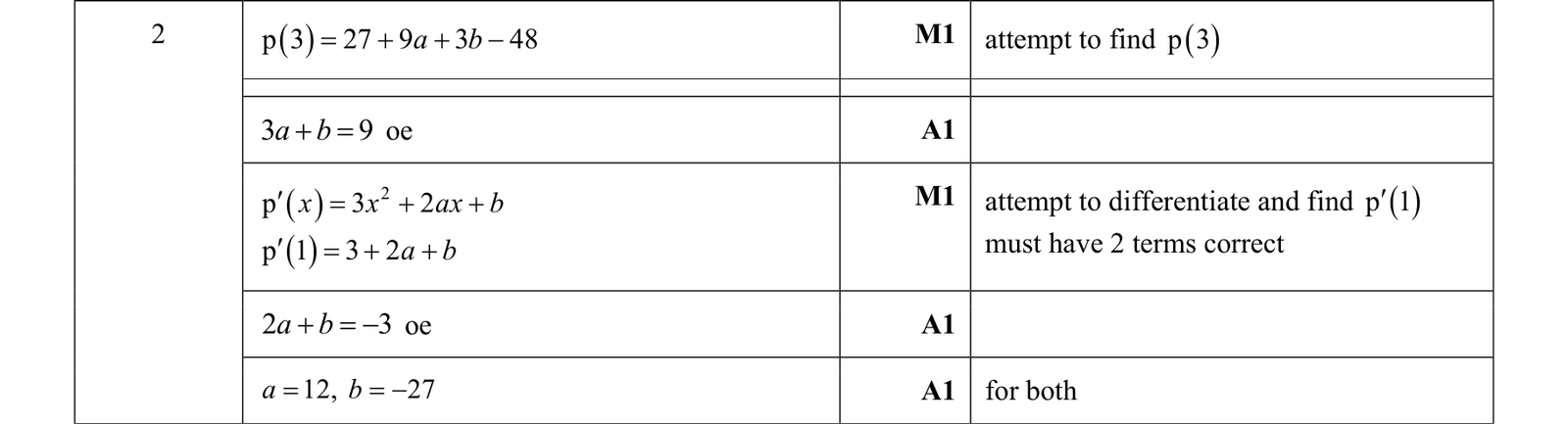
It is given that \(p(x)=x^3+ax^2+bx-48\). When \(p(x)\) is divided by \(x-3\), the remainder is \(6\).
Given that \(p'(1)=0\), find \(a\) and \(b\).
9709 P11 - Jun 2023 - Q4
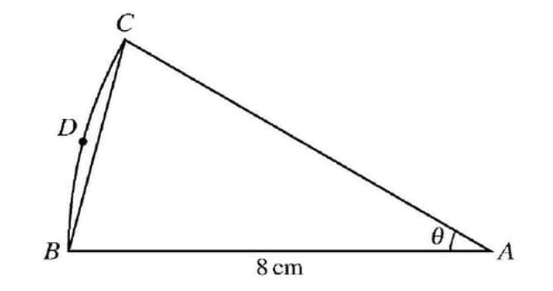
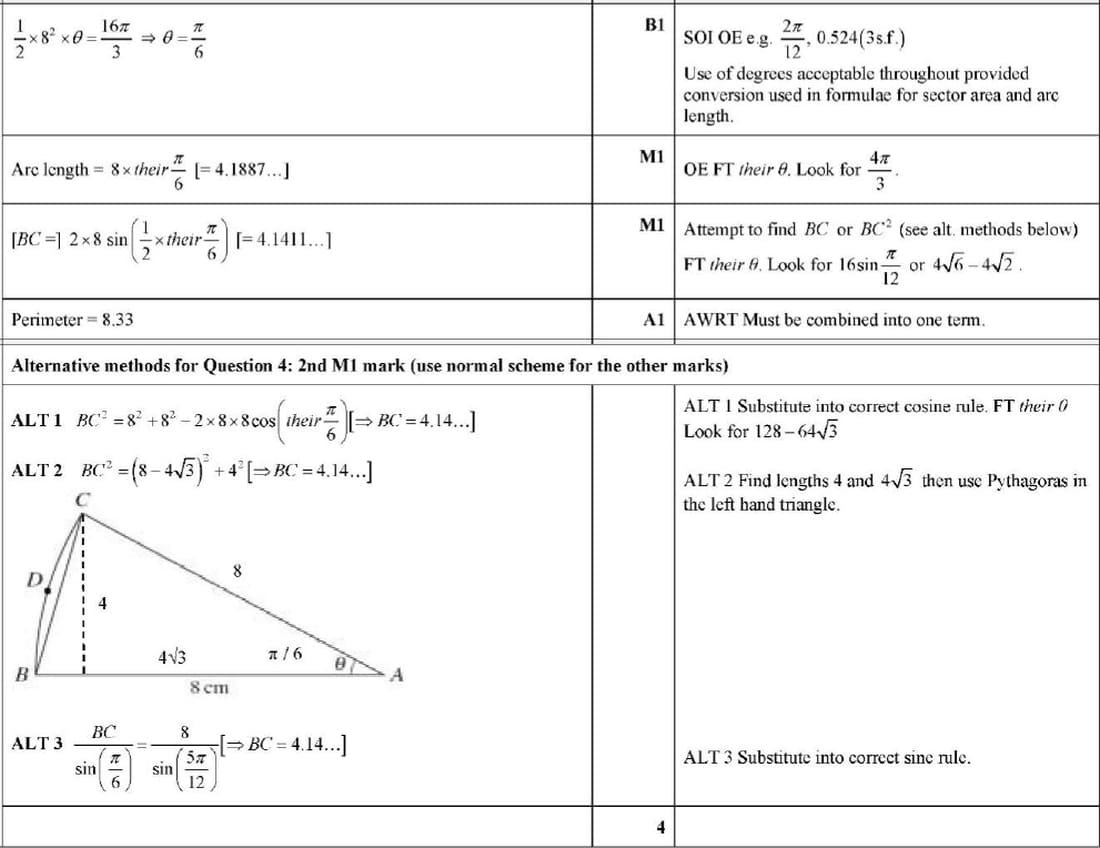
The diagram shows a sector ABC of a circle with centre A and radius 8 cm. The area of the sector is \(\frac{16}{3} \pi \text{ cm}^2\). The point D lies on the arc BC.
Find the perimeter of the segment BCD.
9709 P13 - Jun 2014 - Q3
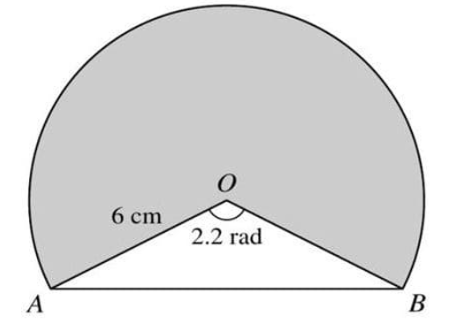
The diagram shows part of a circle with centre O and radius 6 cm. The chord AB is such that angle AOB = 2.2 radians. Calculate:
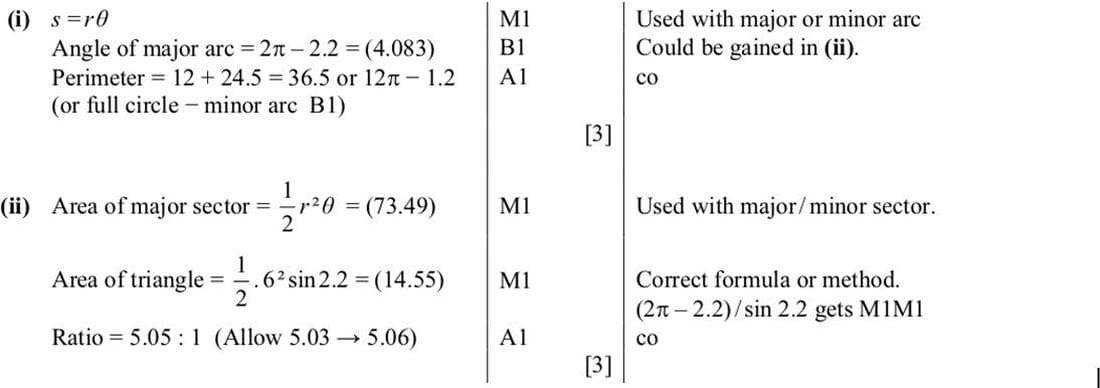
(i) the perimeter of the shaded region,
(ii) the ratio of the area of the shaded region to the area of the triangle AOB, giving your answer in the form k : 1.
9709 P13 - Nov 2013 - Q6
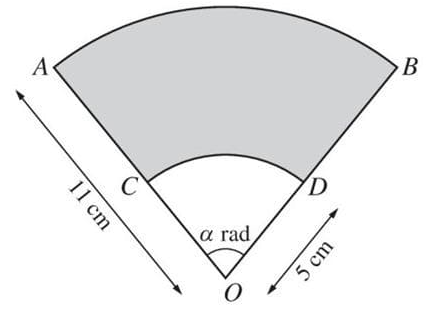
The diagram shows sector OAB with centre O and radius 11 cm. Angle AOB = \(\alpha\) radians. Points C and D lie on OA and OB respectively. Arc CD has centre O and radius 5 cm.
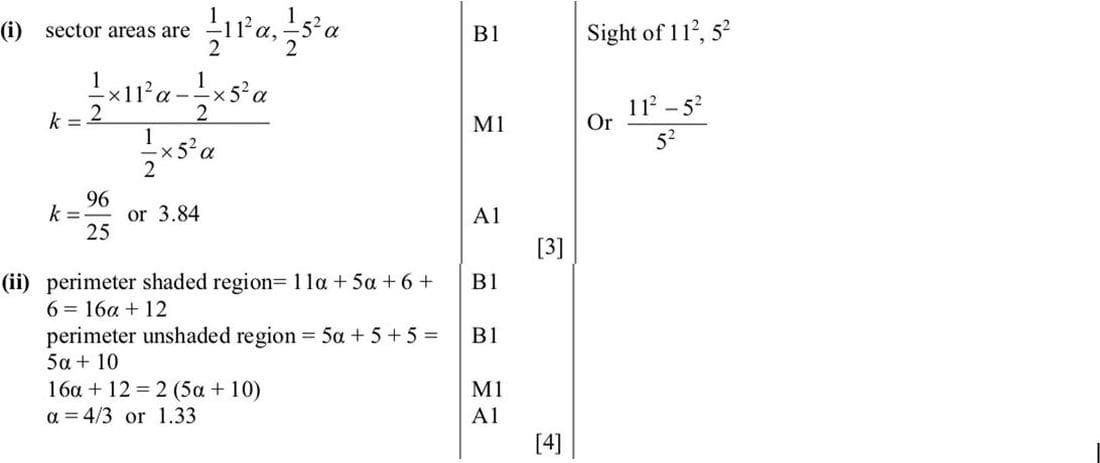
(i) The area of the shaded region ABDC is equal to \(k\) times the area of the unshaded region OCD. Find \(k\).
(ii) The perimeter of the shaded region ABDC is equal to twice the perimeter of the unshaded region OCD. Find the exact value of \(\alpha\).
Question #271
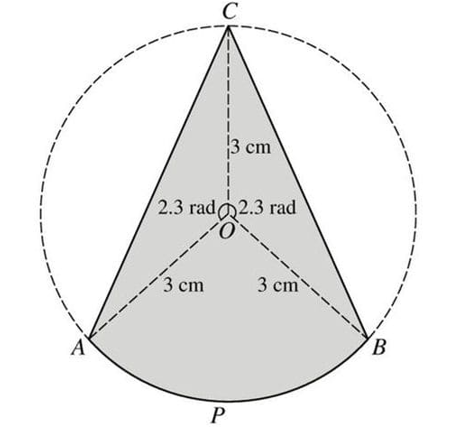
The diagram shows points A, C, B, P on the circumference of a circle with centre O and radius 3 cm. Angle AOC = angle BOC = 2.3 radians.
(i) Find angle AOB in radians, correct to 4 significant figures.
(ii) Find the area of the shaded region ACBP, correct to 3 significant figures.
Question #284
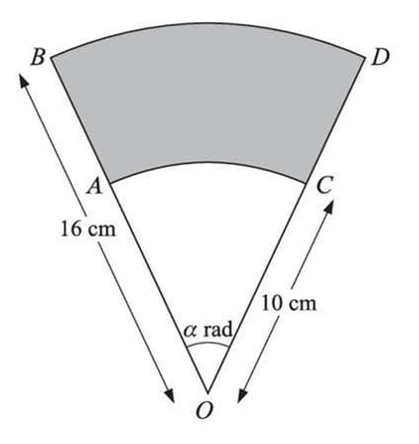
In the diagram, OAB and OCD are radii of a circle, centre O and radius 16 cm. Angle AOC = \(\alpha\) radians. AC and BD are arcs of circles, centre O and radii 10 cm and 16 cm respectively.
(i) In the case where \(\alpha = 0.8\), find the area of the shaded region.
(ii) Find the value of \(\alpha\) for which the perimeter of the shaded region is 28.9 cm.
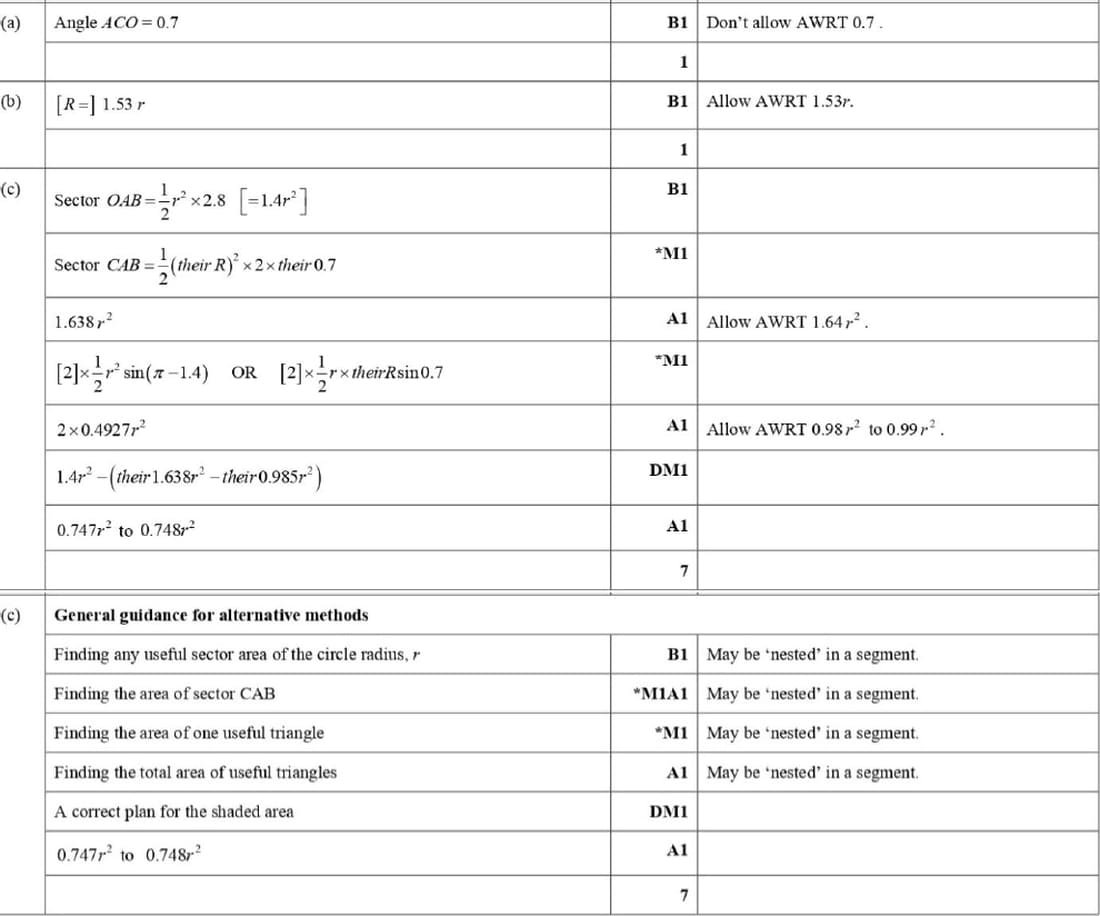
9709 P13 - Nov 2023 - Q10 - 9 marks
The diagram shows points A, B and C lying on a circle with centre O and radius r. Angle AOB is 2.8 radians. The shaded region is bounded by two arcs. The upper arc is part of the circle with centre O and radius r. The lower arc is part of a circle with centre C and radius R.
(a) State the size of angle ACO in radians.
(b) Find R in terms of r.
(c) Find the area of the shaded region in terms of r.

9709 P11 - Nov 2022 - Q5
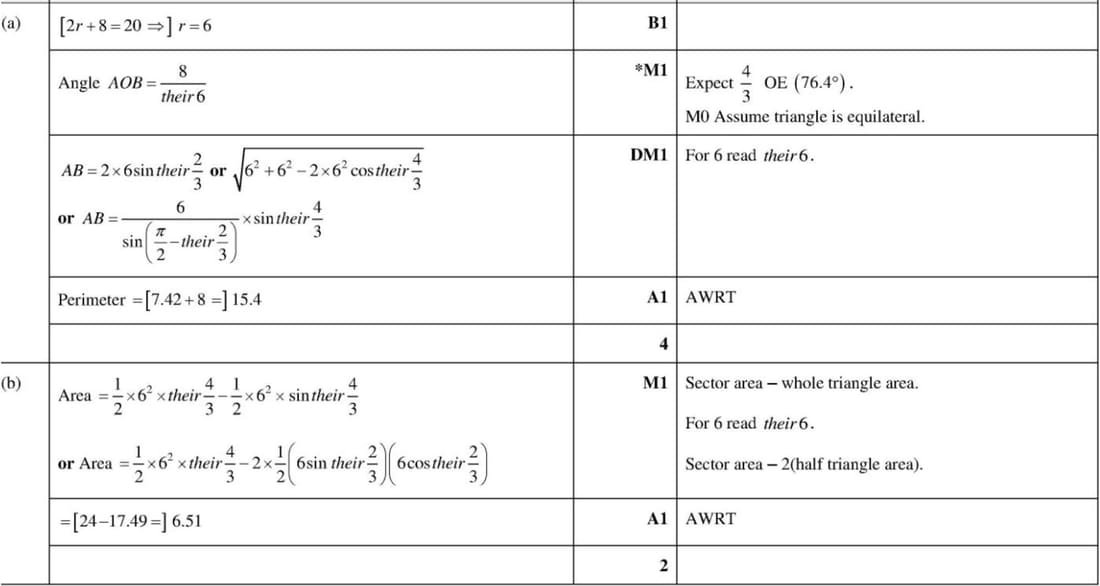
The diagram shows a sector OAB of a circle with centre O. The length of the arc AB is 8 cm. It is given that the perimeter of the sector is 20 cm.
(a) Find the perimeter of the shaded segment.
(b) Find the area of the shaded segment.

9709 P1 - Nov 2004 - Q3
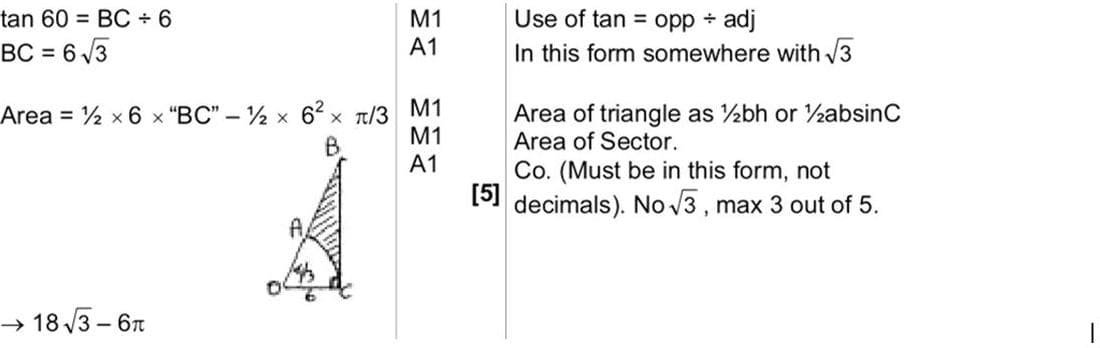
In the diagram, AC is an arc of a circle, centre O and radius 6 cm. The line BC is perpendicular to OC and OAB is a straight line. Angle AOC = \(\frac{1}{3} \pi\) radians. Find the area of the shaded region, giving your answer in terms of \(\pi\) and \(\sqrt{3}\).