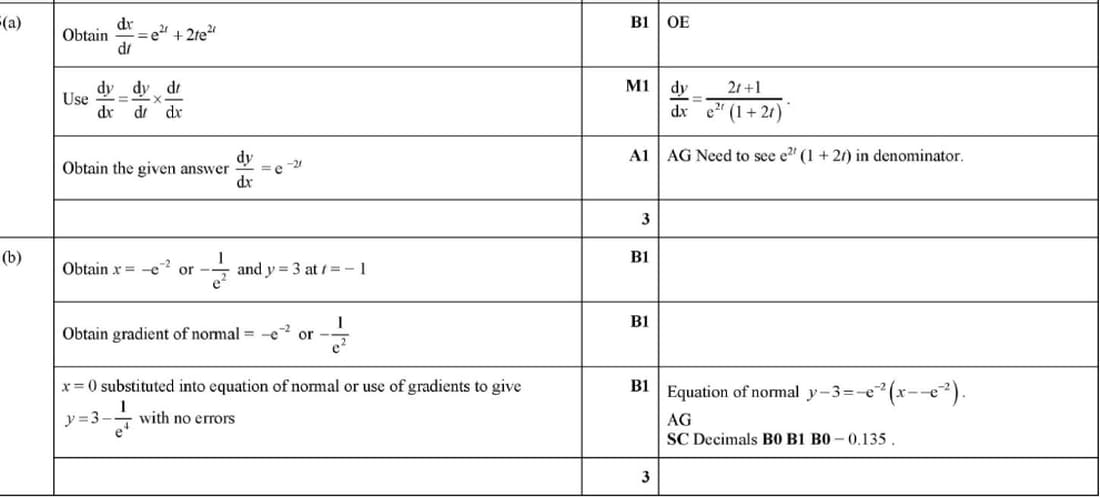
(a) Differentiate \(x = te^{2t}\) with respect to \(t\):
\(\frac{dx}{dt} = e^{2t} + 2te^{2t}\).
Differentiate \(y = t^2 + t + 3\) with respect to \(t\):
\(\frac{dy}{dt} = 2t + 1\).
Use the chain rule to find \(\frac{dy}{dx}\):
\(\frac{dy}{dx} = \frac{\frac{dy}{dt}}{\frac{dx}{dt}} = \frac{2t + 1}{e^{2t}(1 + 2t)}\).
Simplify to obtain \(\frac{dy}{dx} = e^{-2t}\).
(b) At \(t = -1\), find \(x\) and \(y\):
\(x = -\frac{1}{e^2}\), \(y = 3\).
The gradient of the tangent is \(e^{-2(-1)} = e^2\), so the gradient of the normal is \(-\frac{1}{e^2}\).
The equation of the normal is \(y - 3 = -\frac{1}{e^2}(x + \frac{1}{e^2})\).
Substitute \(x = 0\) to find \(y\):
\(y = 3 - \frac{1}{e^4}\).
Thus, the normal passes through \(\left( 0, 3 - \frac{1}{e^4} \right)\).