Past Exam Questions
← Back9709 P1 - Jun 2004 - Q5
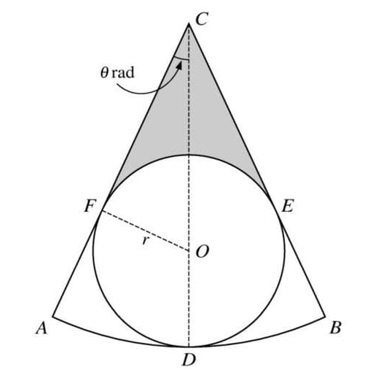
In the diagram, OCD is an isosceles triangle with OC = OD = 10 ext{ cm} and angle COD = 0.8 radians. The points A and B, on OC and OD respectively, are joined by an arc of a circle with centre O and radius 6 ext{ cm}. Find
- the area of the shaded region,
- the perimeter of the shaded region.

9709 P1 - Nov 2003 - Q6
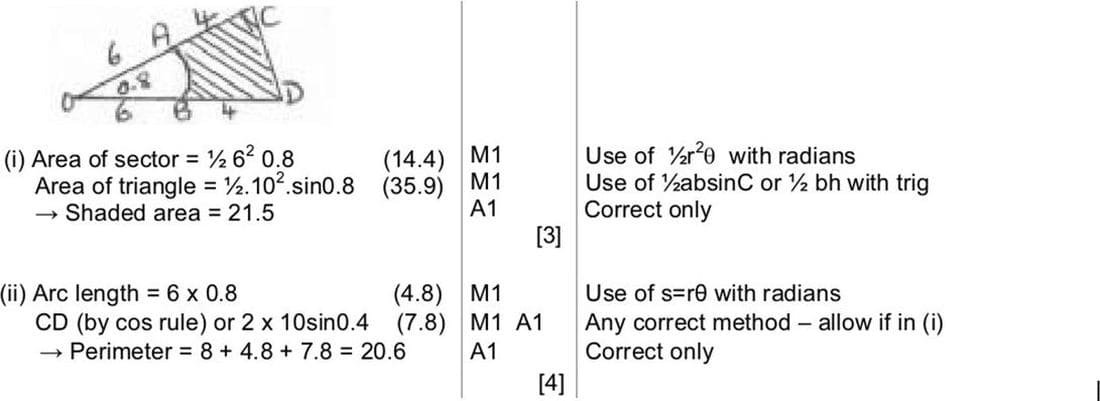
The diagram shows the sector OPQ of a circle with centre O and radius r cm. The angle POQ is \(\theta\) radians and the perimeter of the sector is 20 cm.
(i) Show that \(\theta = \frac{20}{r} - 2\).
(ii) Hence express the area of the sector in terms of r.
(iii) In the case where \(r = 8\), find the length of the chord PQ.

9709 P1 - Jun 2003 - Q9
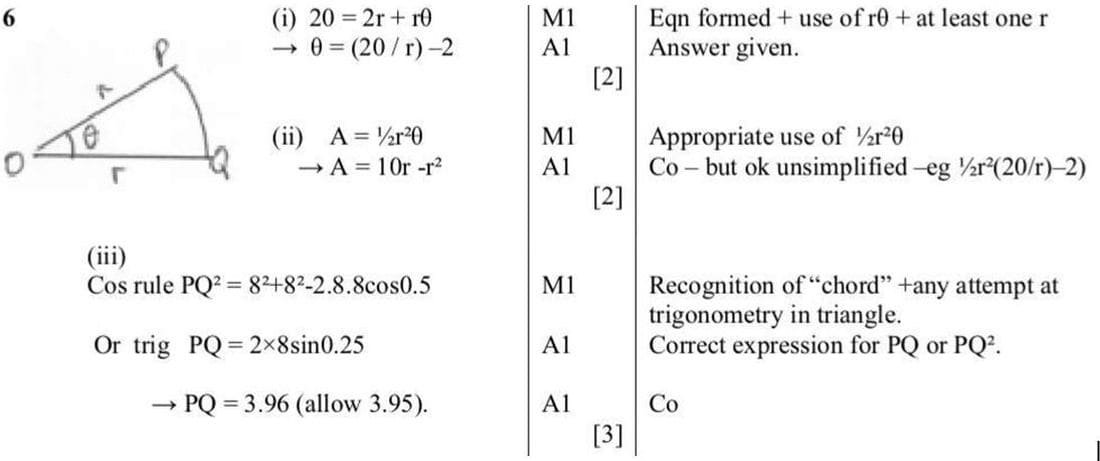
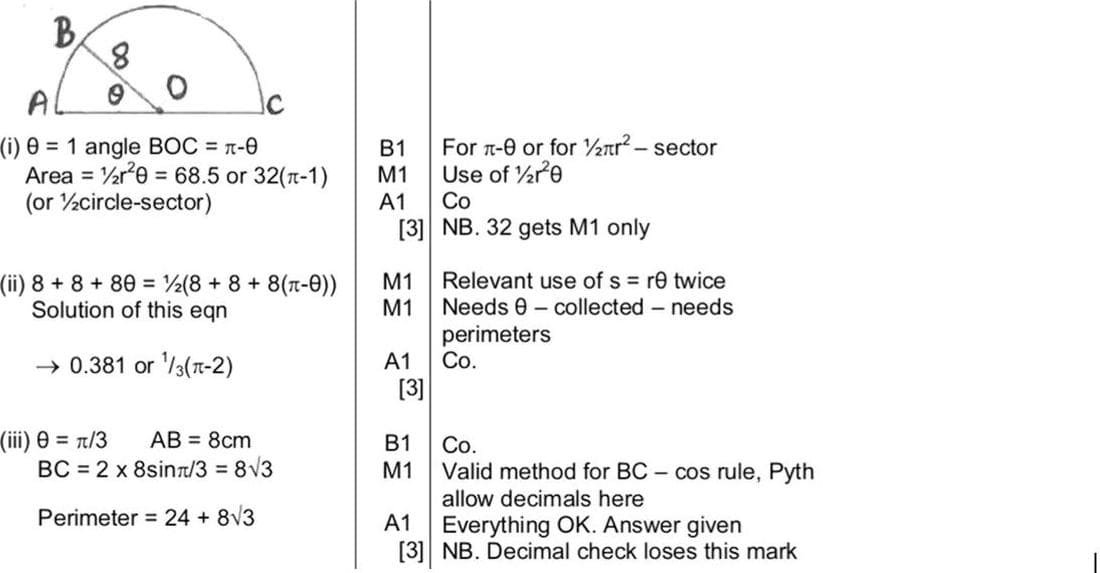
The diagram shows a semicircle ABC with centre O and radius 8 cm. Angle AOB = \(\theta\) radians.
(i) In the case where \(\theta = 1\), calculate the area of the sector BOC.
(ii) Find the value of \(\theta\) for which the perimeter of sector AOB is one half of the perimeter of sector BOC.
(iii) In the case where \(\theta = \frac{1}{3}\pi\), show that the exact length of the perimeter of triangle ABC is \((24 + 8\sqrt{3})\) cm.
9709 P1 - Nov 2002 - Q3
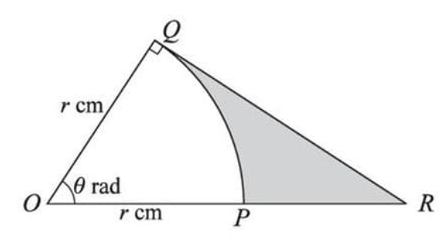
In the diagram, OPQ is a sector of a circle, centre O and radius r cm. Angle QOP = θ radians. The tangent to the circle at Q meets OP extended at R.
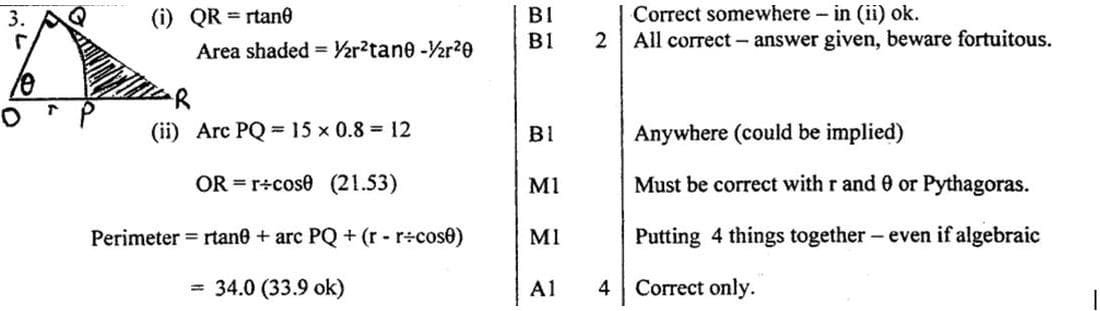
(i) Show that the area, A cm², of the shaded region is given by A = \frac{1}{2}r^2(\tan \theta - \theta).
(ii) In the case where θ = 0.8 and r = 15, evaluate the length of the perimeter of the shaded region.
9709 P1 - Jun 2002 - Q7
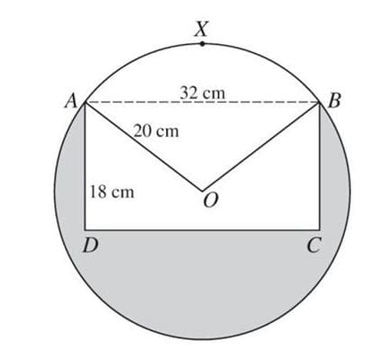
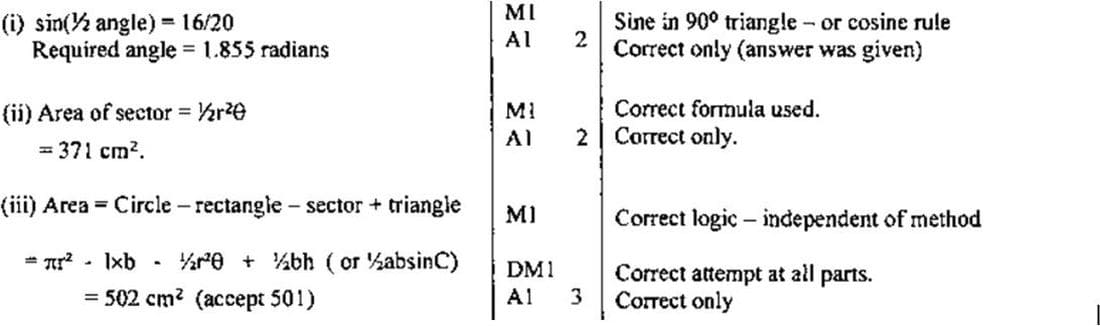
The diagram shows the circular cross-section of a uniform cylindrical log with centre O and radius 20 cm. The points A, X, and B lie on the circumference of the cross-section and AB = 32 cm.
- Show that angle AOB = 1.855 radians, correct to 3 decimal places.
- Find the area of the sector AXBO.
The section AXBCD, where ABCD is a rectangle with AD = 18 cm, is removed.
- Find the area of the new cross-section (shown shaded in the diagram).
9709 P13 - Jun 2022 - Q9
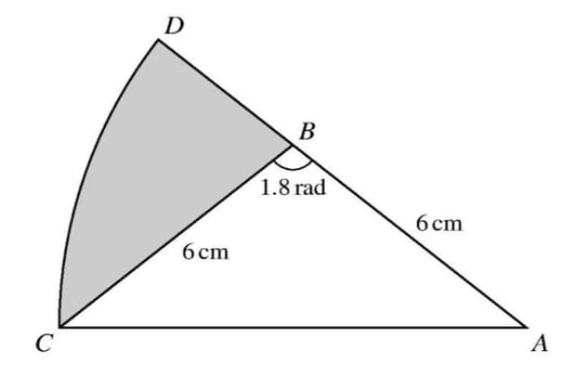
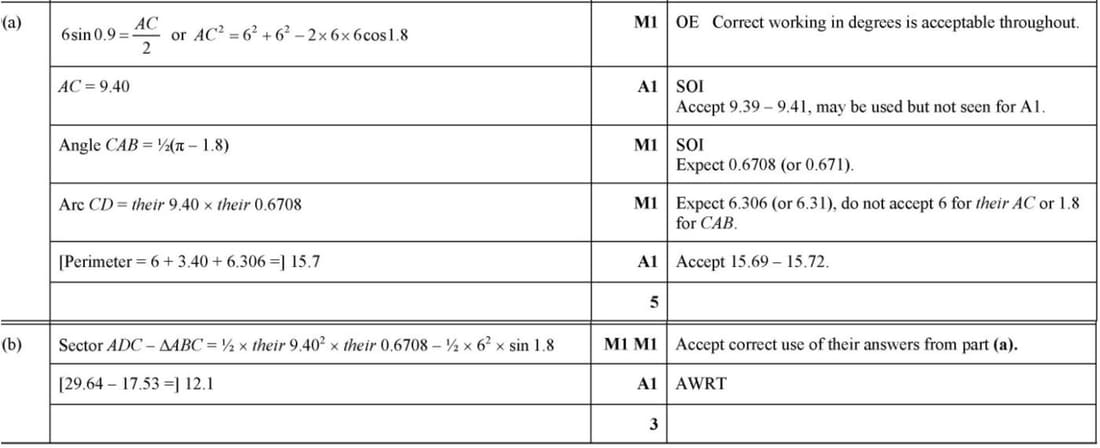
The diagram shows triangle ABC with AB = BC = 6 cm and angle ABC = 1.8 radians. The arc CD is part of a circle with centre A and ABD is a straight line.
(a) Find the perimeter of the shaded region.
(b) Find the area of the shaded region.
9709 P12 - Jun 2022 - Q7
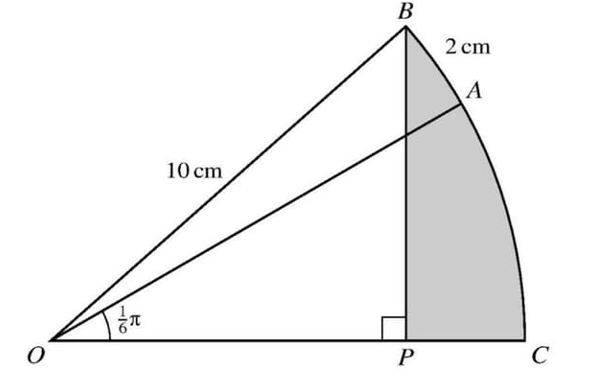
The diagram shows a sector OBAC of a circle with centre O and radius 10 cm. The point P lies on OC and BP is perpendicular to OC. Angle AOC = \(\frac{1}{6} \pi\) and the length of the arc AB is 2 cm.
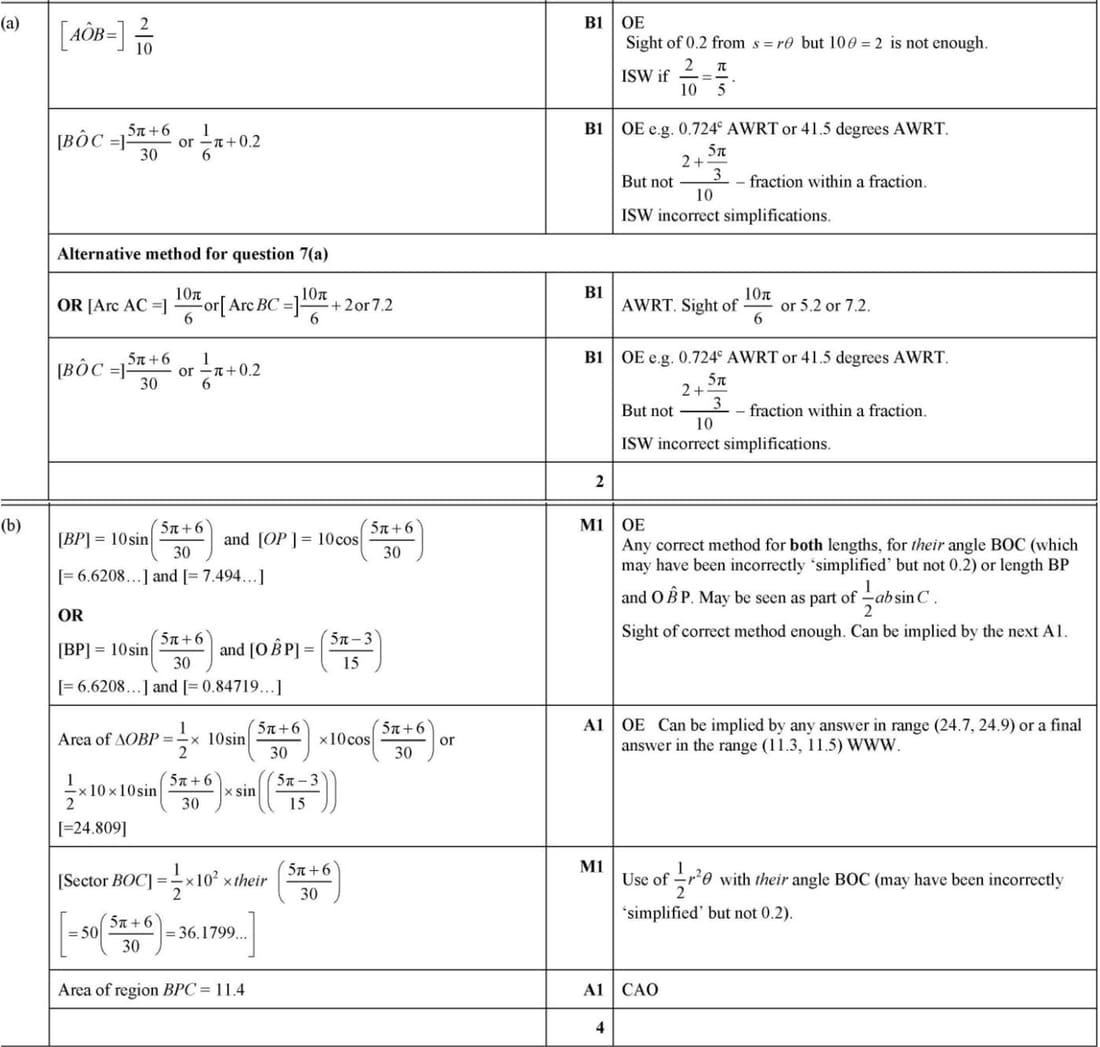
(a) Find the angle BOC.
(b) Hence find the area of the shaded region BPC giving your answer correct to 3 significant figures.
9709 P11 - Jun 2022 - Q5
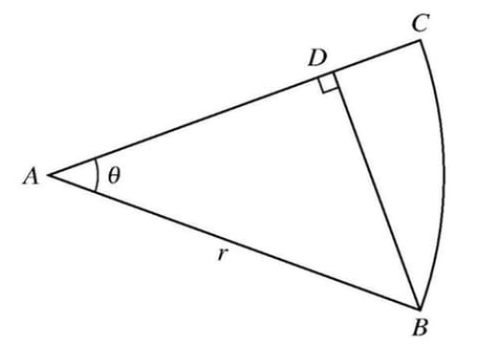
The diagram shows a sector ABC of a circle with centre A and radius r. The line BD is perpendicular to AC. Angle CAB is \(\theta\) radians.
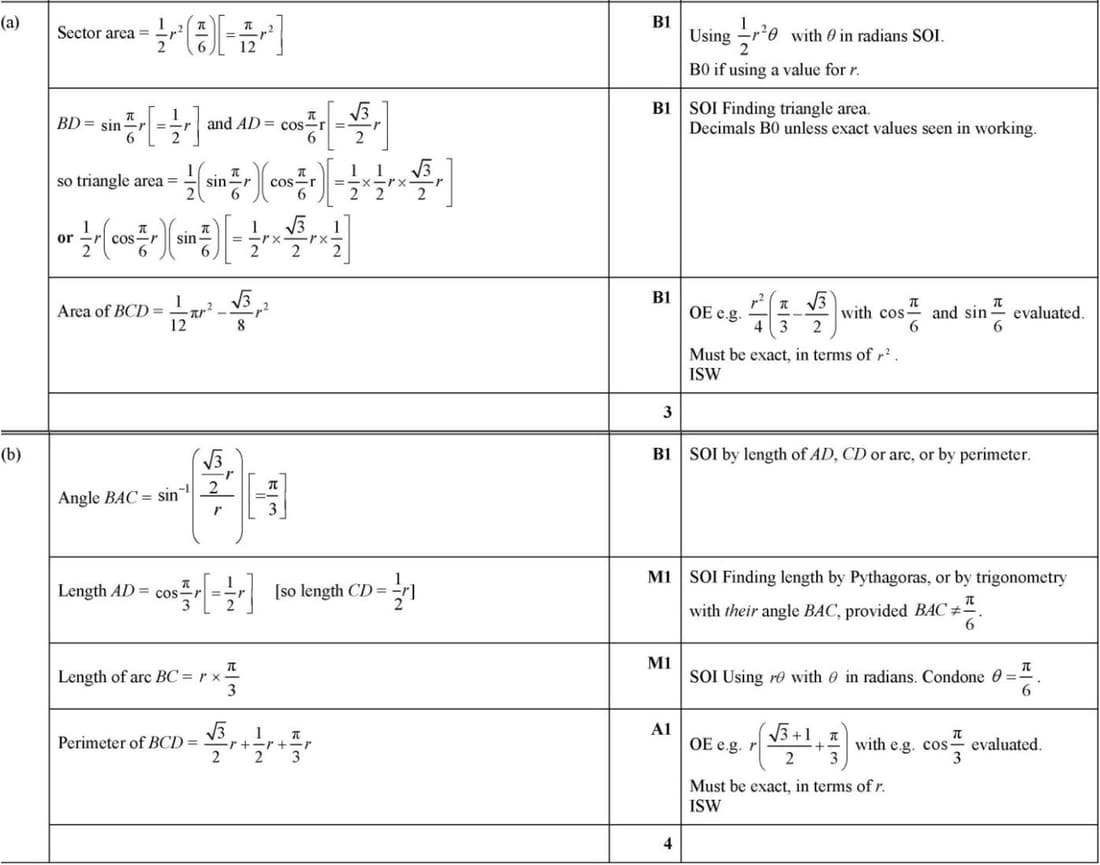
(a) Given that \(\theta = \frac{\pi}{6}\), find the exact area of BCD in terms of r.
(b) Given instead that the length of \(BD = \frac{\sqrt{3}}{2}r\), find the exact perimeter of BCD in terms of r.
9709 P12 - Mar 2022 - Q10
The diagram shows a circle with centre A of radius 5 cm and a circle with centre B of radius 8 cm. The circles touch at the point C so that ACB is a straight line. The tangent at the point D on the smaller circle intersects the larger circle at E and passes through B.
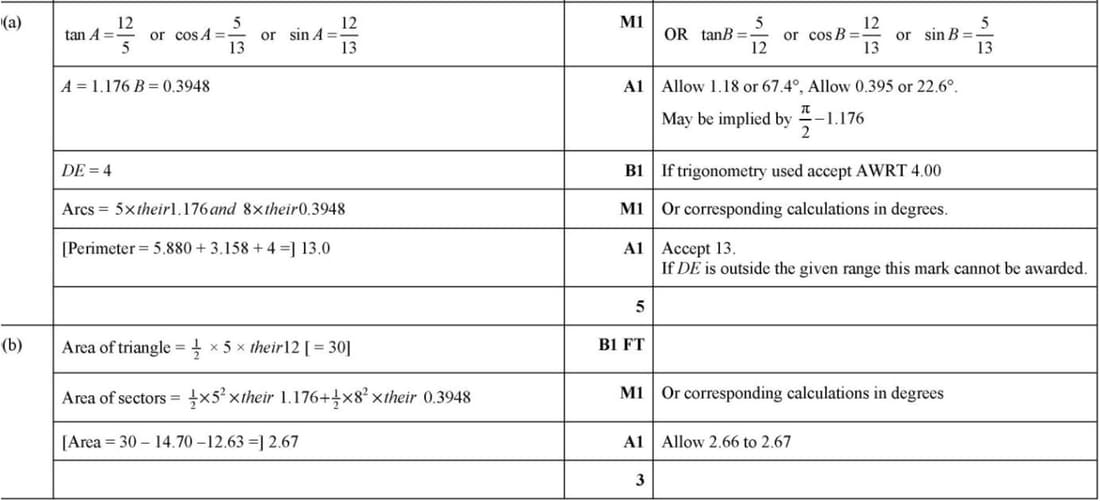
(a) Find the perimeter of the shaded region.
(b) Find the area of the shaded region.

9709 P13 - Nov 2021 - Q5
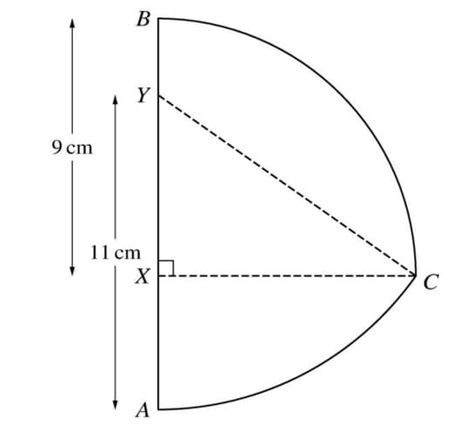
In the diagram, X and Y are points on the line AB such that BX = 9 ext{ cm} and AY = 11 ext{ cm}. Arc BC is part of a circle with centre X and radius 9 ext{ cm}, where CX is perpendicular to AB. Arc AC is part of a circle with centre Y and radius 11 ext{ cm}.
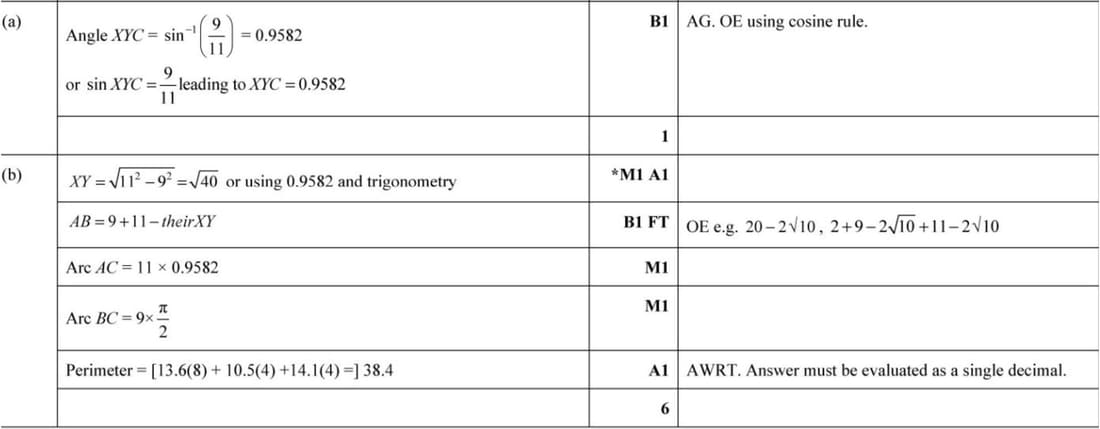
(a) Show that angle XYC = 0.9582 radians, correct to 4 significant figures.
(b) Find the perimeter of ABC.
9709 P12 - Nov 2021 - Q7
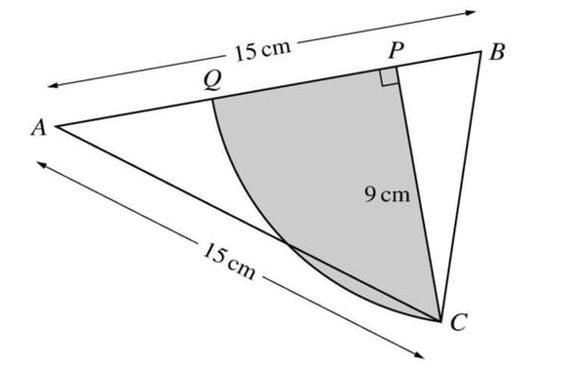
In the diagram the lengths of \(AB\) and \(AC\) are both 15 cm. The point \(P\) is the foot of the perpendicular from \(C\) to \(AB\). The length \(CP = 9\) cm. An arc of a circle with centre \(B\) passes through \(C\) and meets \(AB\) at \(Q\).
(a) Show that angle \(ABC = 1.25\) radians, correct to 3 significant figures.
(b) Calculate the area of the shaded region which is bounded by the arc \(CQ\) and the lines \(CP\) and \(PQ\).

9709 P11 - Nov 2021 - Q6
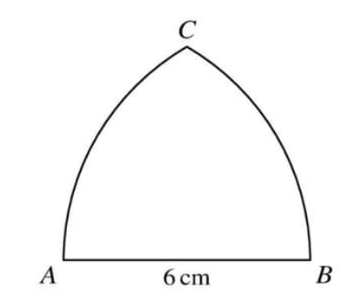
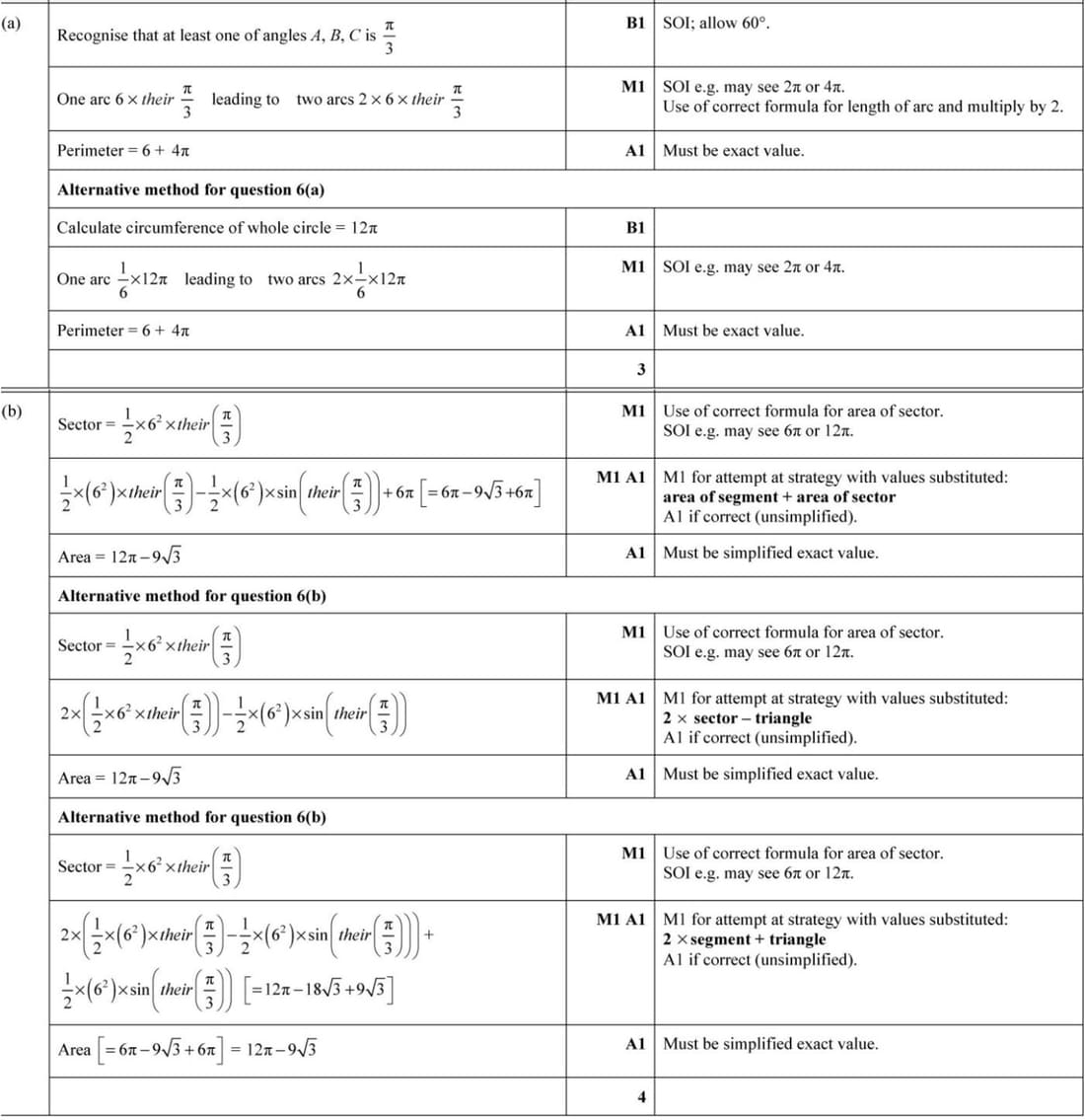
The diagram shows a metal plate ABC in which the sides are the straight line AB and the arcs AC and BC. The line AB has length 6 cm. The arc AC is part of a circle with centre B and radius 6 cm, and the arc BC is part of a circle with centre A and radius 6 cm.
(a) Find the perimeter of the plate, giving your answer in terms of \(\pi\).
(b) Find the area of the plate, giving your answer in terms of \(\pi\) and \(\sqrt{3}\).
9709 P13 - Jun 2021 - Q5
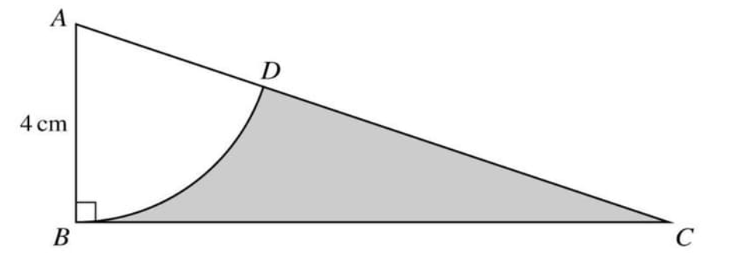
The diagram shows a triangle ABC, in which angle \(ABC = 90^\circ\) and \(AB = 4\text{ cm}\). The sector \(ABD\) is part of a circle with centre \(A\). The area of the sector is \(10\text{ cm}^2\).
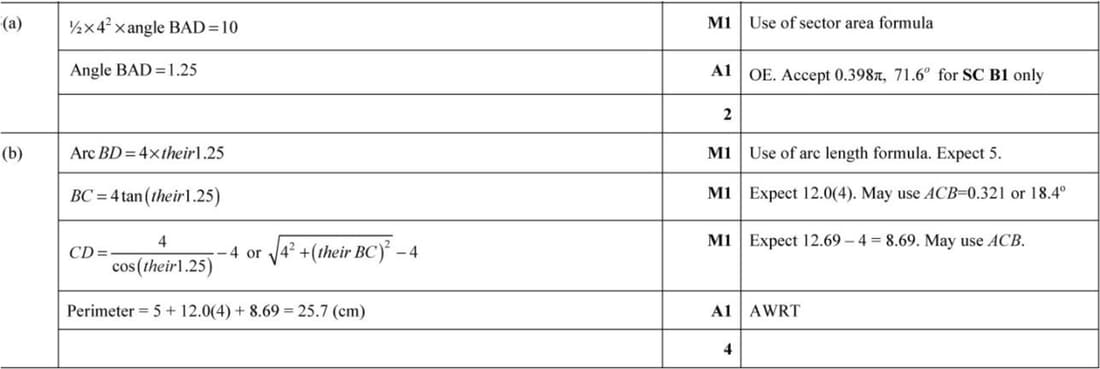
(a) Find angle \(BAD\) in radians.
(b) Find the perimeter of the shaded region.
9709 P12 - Jun 2021 - Q12 - 11 marks
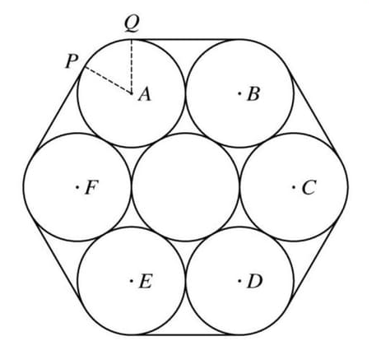
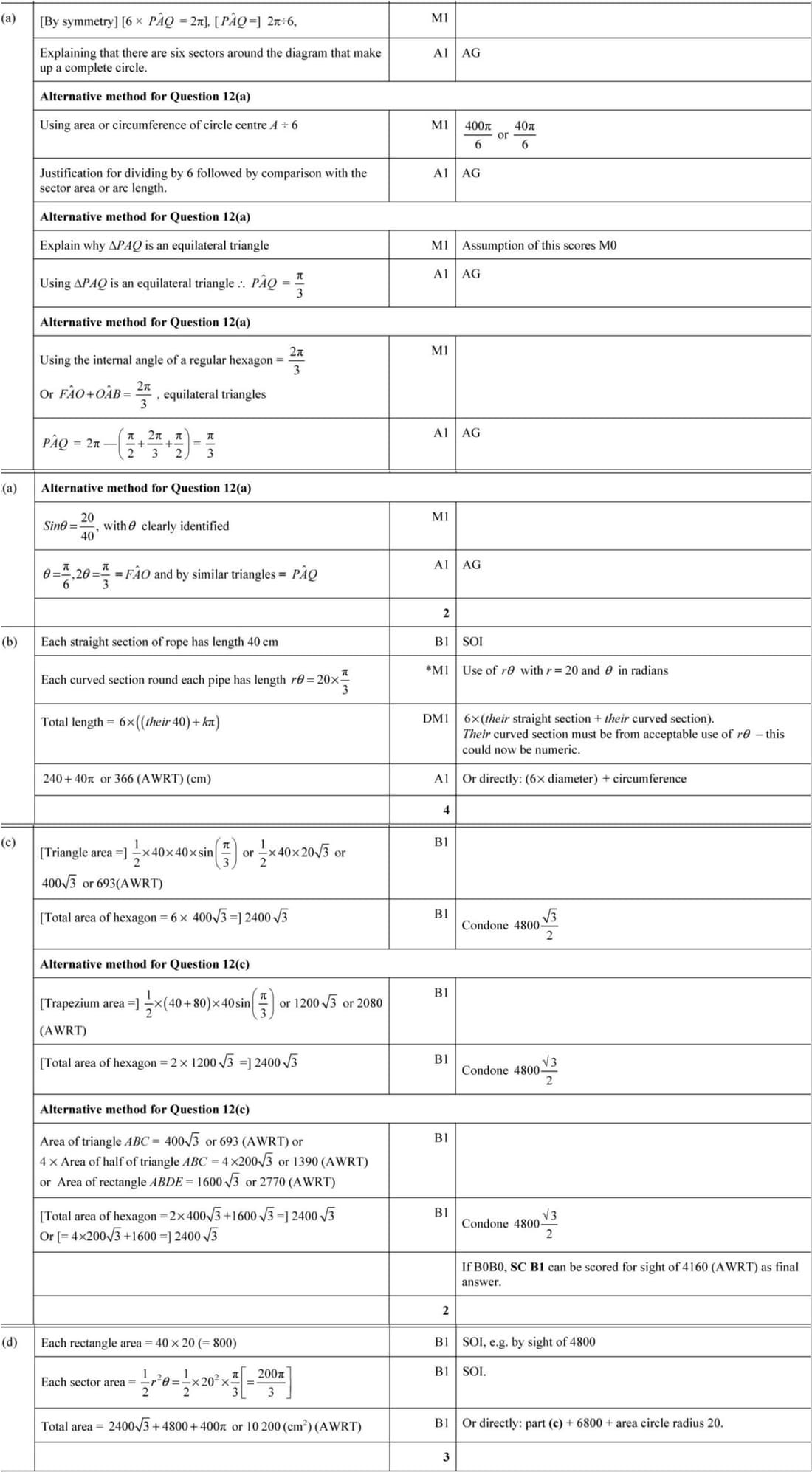
The diagram shows a cross-section of seven cylindrical pipes, each of radius 20 cm, held together by a thin rope which is wrapped tightly around the pipes. The centres of the six outer pipes are A, B, C, D, E and F. Points P and Q are situated where straight sections of the rope meet the pipe with centre A.
(a) Show that angle PAQ = \(\frac{1}{3} \pi\) radians.
(b) Find the length of the rope.
(c) Find the area of the hexagon ABCDEF, giving your answer in terms of \(\sqrt{3}\).
(d) Find the area of the complete region enclosed by the rope.
9709 P12 - Nov 2023 - Q4
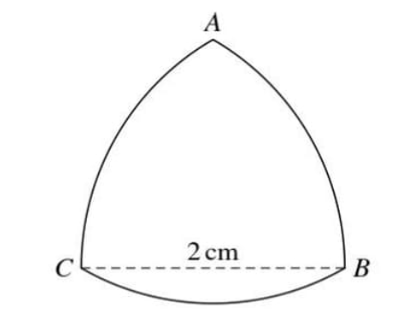
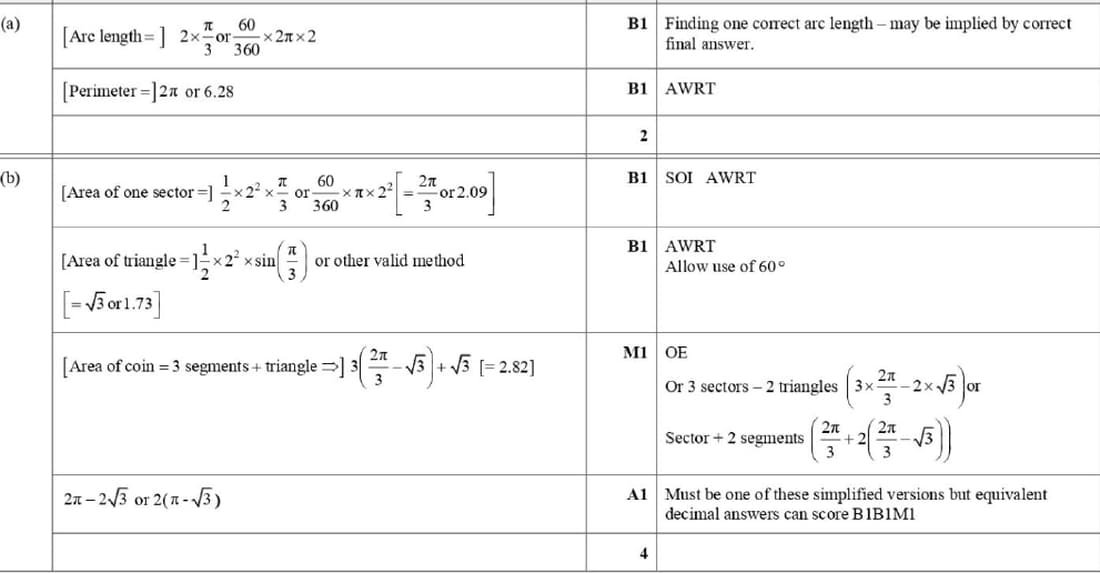
The diagram shows the shape of a coin. The three arcs AB, BC, and CA are parts of circles with centres C, A, and B respectively. ABC is an equilateral triangle with sides of length 2 cm.
(a) Find the perimeter of the coin.
(b) Find the area of the face ABC of the coin, giving the answer in terms of \(\pi\) and \(\sqrt{3}\).
9709 P11 - Jun 2021 - Q8 - 10 marks
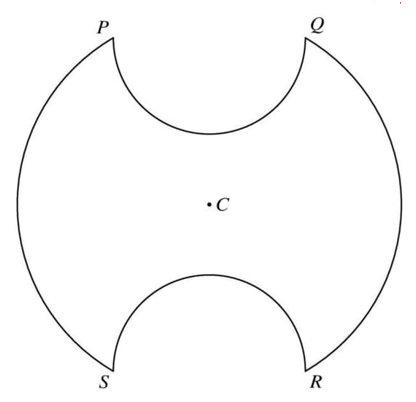
The diagram shows a symmetrical metal plate. The plate is made by removing two identical pieces from a circular disc with centre C. The boundary of the plate consists of two arcs PS and QR of the original circle and two semicircles with PQ and RS as diameters. The radius of the circle with centre C is 4 cm, and PQ = RS = 4 cm also.
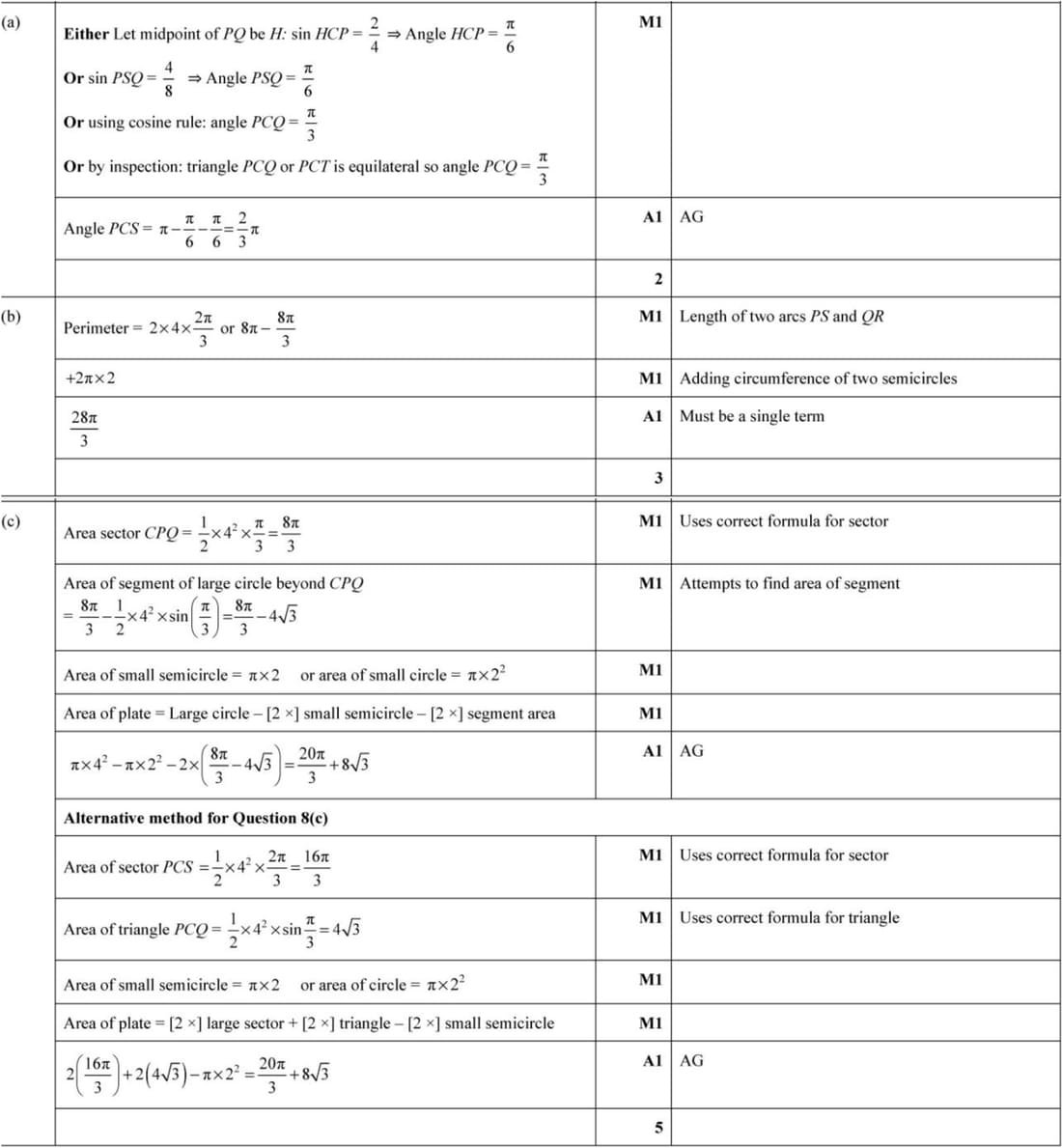
(a) Show that angle PCS = \(\frac{2}{3} \pi\) radians.
(b) Find the exact perimeter of the plate.
(c) Show that the area of the plate is \(\left( \frac{20}{3} \pi + 8\sqrt{3} \right) \text{ cm}^2\).
Question #200
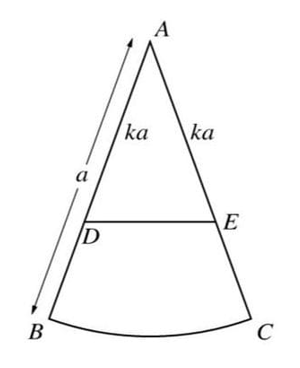
The diagram shows a sector ABC which is part of a circle of radius a. The points D and E lie on AB and AC respectively and are such that AD = AE = ka, where k < 1. The line DE divides the sector into two regions which are equal in area.
(a) For the case where angle BAC = \frac{1}{6}\pi radians, find k correct to 4 significant figures.
(b) For the general case in which angle BAC = \theta radians, where 0 < \theta < \frac{1}{2}\pi, it is given that \frac{\theta}{\sin \theta} > 1. Find the set of possible values of k.
9709 P13 - Nov 2020 - Q9
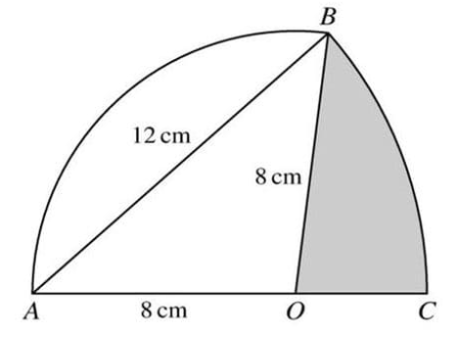
In the diagram, arc AB is part of a circle with centre O and radius 8 cm. Arc BC is part of a circle with centre A and radius 12 cm, where AOC is a straight line.
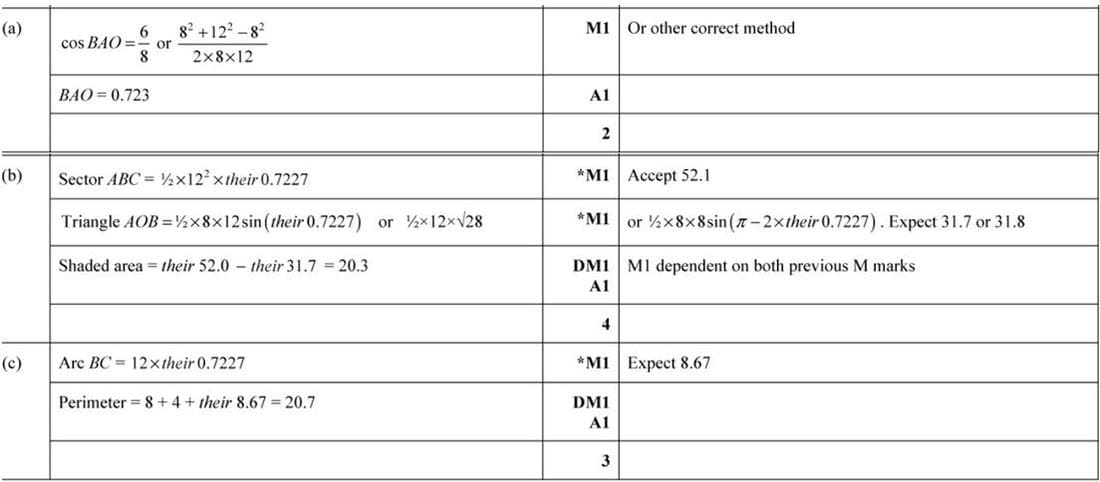
(a) Find angle BAO in radians.
(b) Find the area of the shaded region.
(c) Find the perimeter of the shaded region.
Question #202
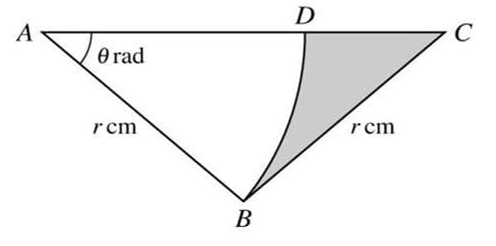
In the diagram, ABC is an isosceles triangle with AB = BC = r cm and angle BAC = θ radians. The point D lies on AC and ABD is a sector of a circle with centre A.
(a) Express the area of the shaded region in terms of r and θ.
(b) In the case where r = 10 and θ = 0.6, find the perimeter of the shaded region.
Question #203
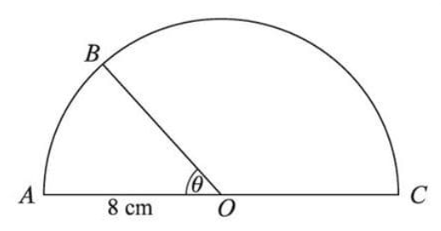
The diagram shows a sector CAB which is part of a circle with centre C. A circle with centre O and radius r lies within the sector and touches it at D, E and F, where COD is a straight line and angle ACD is \(\theta \\) radians.
(a) Find CD in terms of r and \(\sin \theta \\).
It is now given that \(r = 4 \\) and \(\theta = \frac{1}{6} \pi \\).
(b) Find the perimeter of sector CAB in terms of \(\pi \\).
(c) Find the area of the shaded region in terms of \(\pi \\) and \(\sqrt{3} \\).