Past Exam Questions
← BackQuestion #224
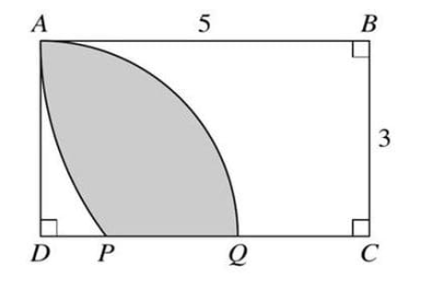
The diagram shows a rectangle ABCD in which AB = 5 units and BC = 3 units. Point P lies on DC and AP is an arc of a circle with centre B. Point Q lies on DC and AQ is an arc of a circle with centre D.
(i) Show that angle ABP = 0.6435 radians, correct to 4 decimal places.
(ii) Calculate the areas of the sectors BAP and DAQ.
(iii) Calculate the area of the shaded region.
Question #225
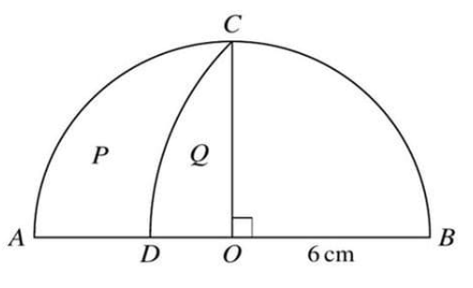
The diagram shows a semicircle with centre O and radius 6 cm. The radius OC is perpendicular to the diameter AB. The point D lies on AB, and DC is an arc of a circle with centre B.
(i) Calculate the length of the arc DC.
(ii) Find the value of \(\frac{\text{area of region } P}{\text{area of region } Q}\), giving your answer correct to 3 significant figures.
9709 P11 - Nov 2017 - Q5 - 6 marks
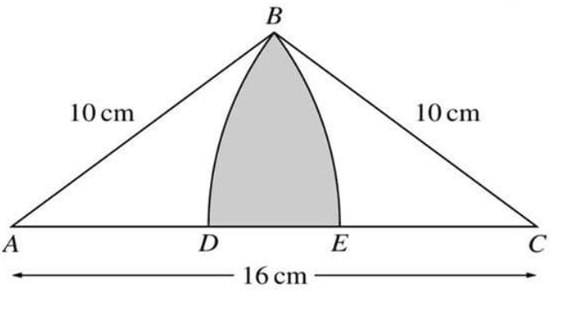
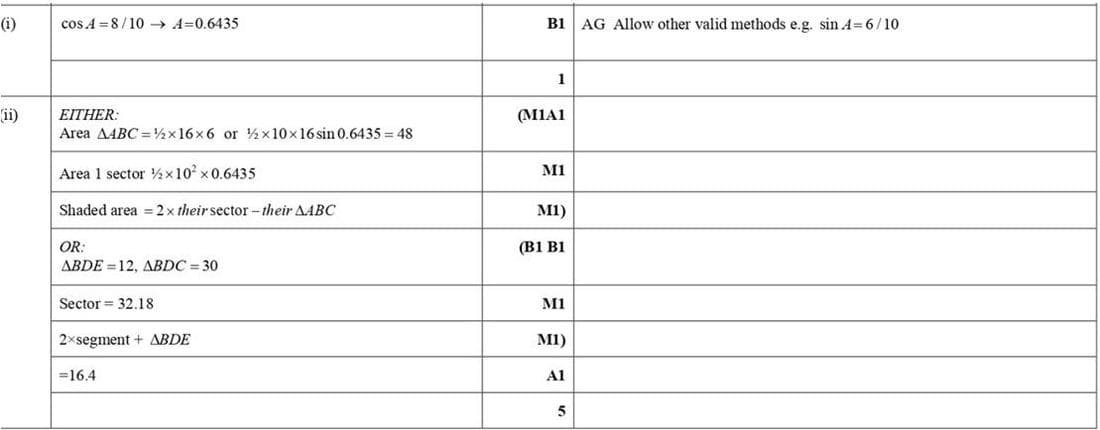
The diagram shows an isosceles triangle ABC in which AC = 16 ext{ cm} and AB = BC = 10 ext{ cm}. The circular arcs BE and BD have centres at A and C respectively, where D and E lie on AC.
(i) Show that angle BAC = 0.6435 radians, correct to 4 decimal places.
(ii) Find the area of the shaded region.
9709 P13 - Jun 2017 - Q7 - 7 marks
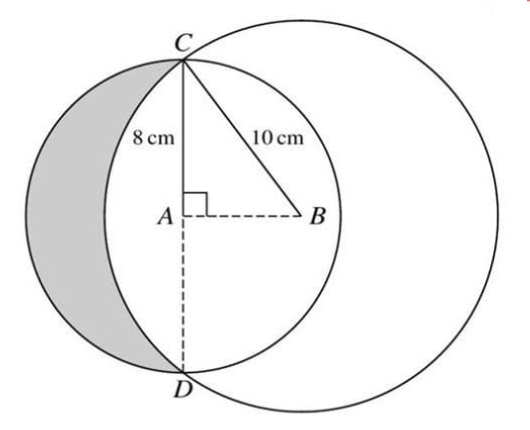
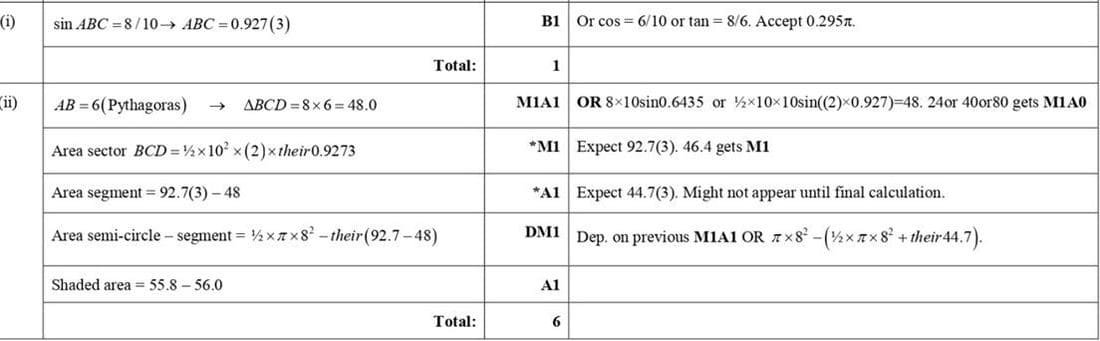
The diagram shows two circles with centres A and B having radii 8 cm and 10 cm respectively. The two circles intersect at C and D where CAD is a straight line and AB is perpendicular to CD.
(i) Find angle ABC in radians.
(ii) Find the area of the shaded region.
9709 P12 - Jun 2017 - Q4 - 7 marks
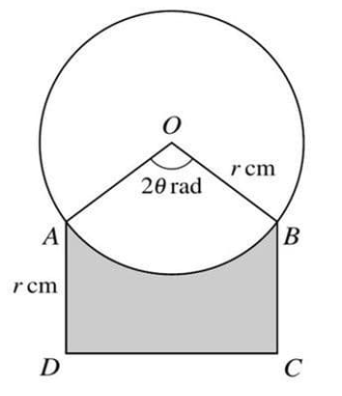
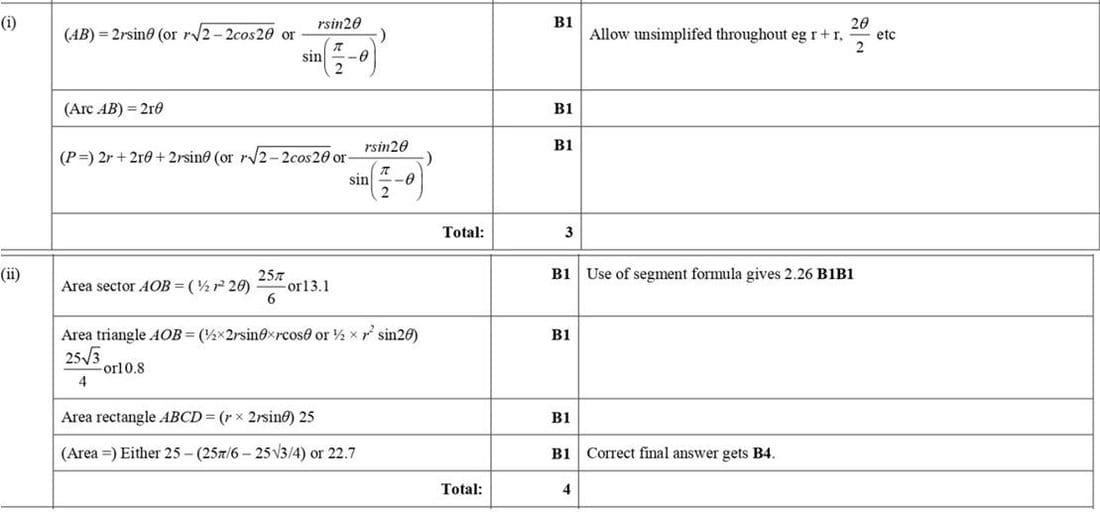
The diagram shows a circle with radius r cm and centre O. Points A and B lie on the circle and ABCD is a rectangle. Angle AOB = 2θ radians and AD = r cm.
(i) Express the perimeter of the shaded region in terms of r and θ.
(ii) In the case where r = 5 and θ = \(\frac{1}{6} \pi\), find the area of the shaded region.
9709 P11 - Jun 2017 - Q8 - 9 marks
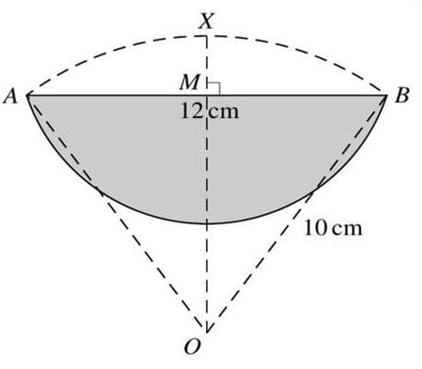
In the diagram, \(OAXB\) is a sector of a circle with centre \(O\) and radius 10 cm. The length of the chord \(AB\) is 12 cm. The line \(OX\) passes through \(M\), the mid-point of \(AB\), and \(OX\) is perpendicular to \(AB\). The shaded region is bounded by the chord \(AB\) and by the arc of a circle with centre \(X\) and radius \(XA\).
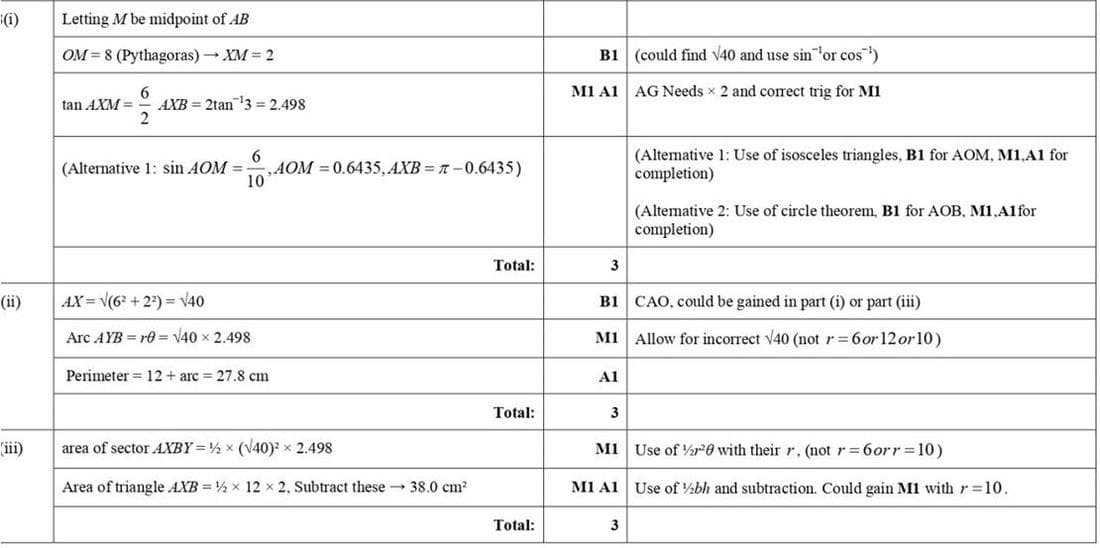
(i) Show that angle \(AXB\) is 2.498 radians, correct to 3 decimal places.
(ii) Find the perimeter of the shaded region.
(iii) Find the area of the shaded region.
9709 P12 - Mar 2017 - Q4
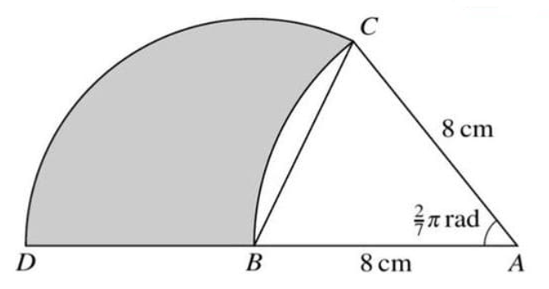
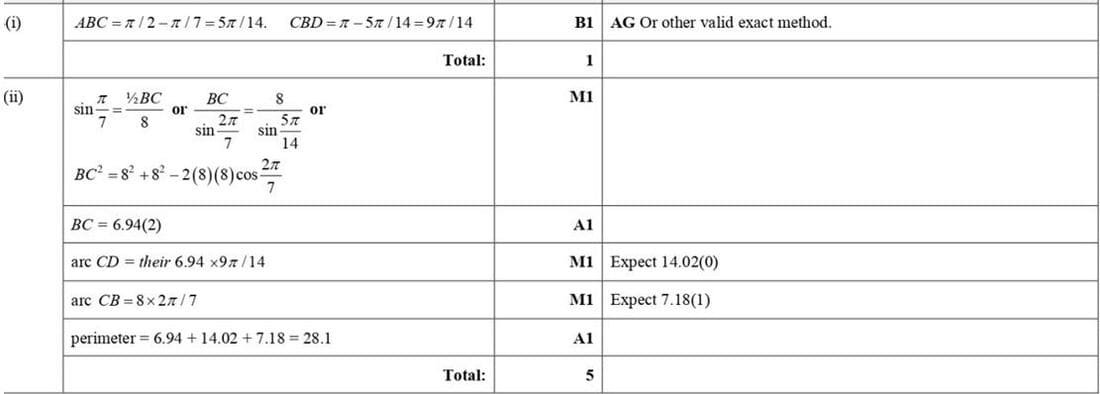
In the diagram, \(AB = AC = 8 \text{ cm}\) and angle \(CAB = \frac{2}{7} \pi\) radians. The circular arc \(BC\) has centre \(A\), the circular arc \(CD\) has centre \(B\) and \(ABD\) is a straight line.
(i) Show that angle \(CBD = \frac{9}{14} \pi\) radians.
(ii) Find the perimeter of the shaded region.
9709 P12 - Jun 2023 - Q6
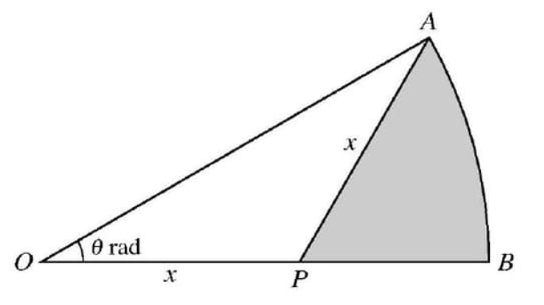
The diagram shows a sector OAB of a circle with centre O. Angle AOB = \(\theta\) radians and \(OP = AP = x\).
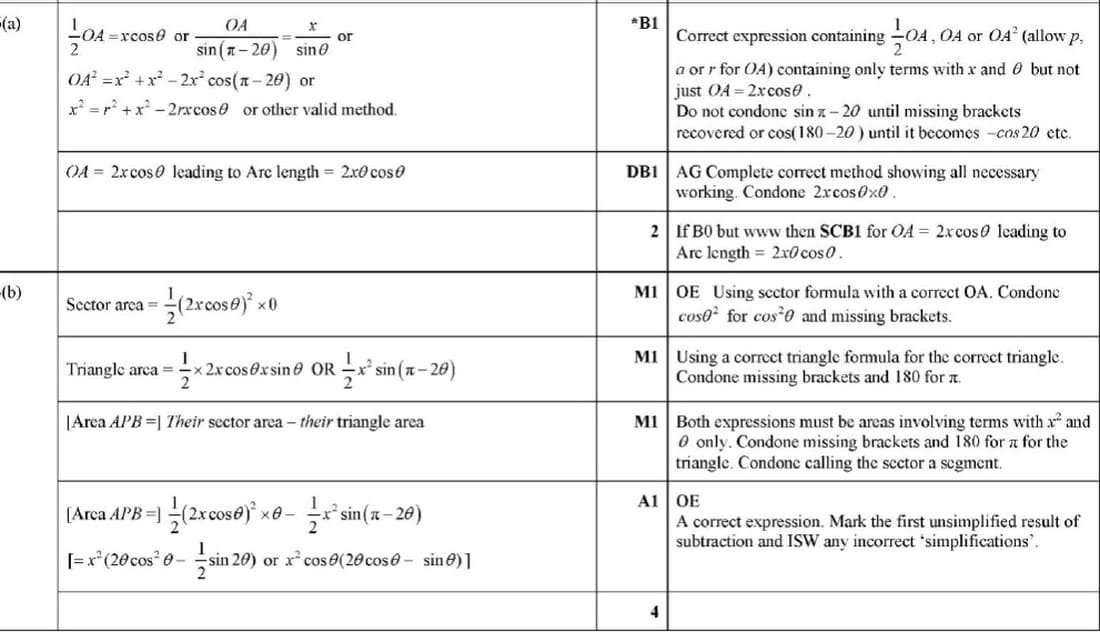
(a) Show that the arc length AB is \(2x\theta \cos \theta\).
(b) Find the area of the shaded region APB in terms of \(x\) and \(\theta\).
9709 P13 - Nov 2016 - Q5 - 6 marks
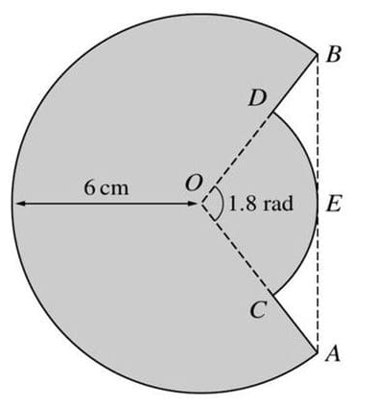
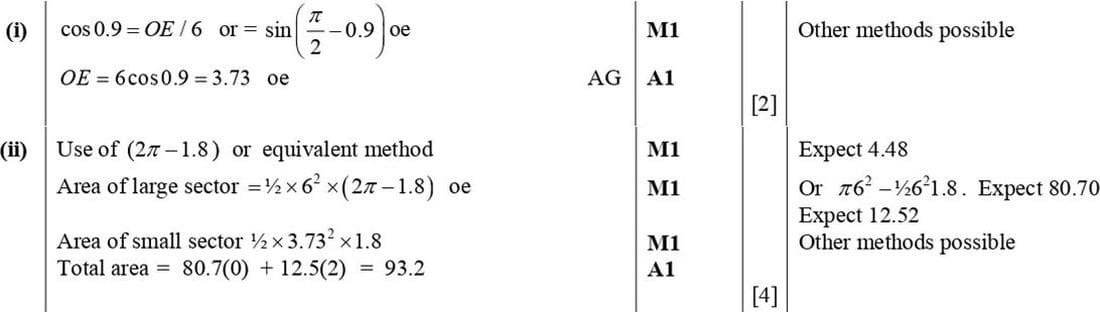
The diagram shows a major arc \(AB\) of a circle with centre \(O\) and radius 6 cm. Points \(C\) and \(D\) on \(OA\) and \(OB\) respectively are such that the line \(AB\) is a tangent at \(E\) to the arc \(CED\) of a smaller circle also with centre \(O\). Angle \(COD = 1.8\) radians.
(i) Show that the radius of the arc \(CED\) is 3.73 cm, correct to 3 significant figures.
(ii) Find the area of the shaded region.
9709 P12 - Nov 2016 - Q6 - 8 marks
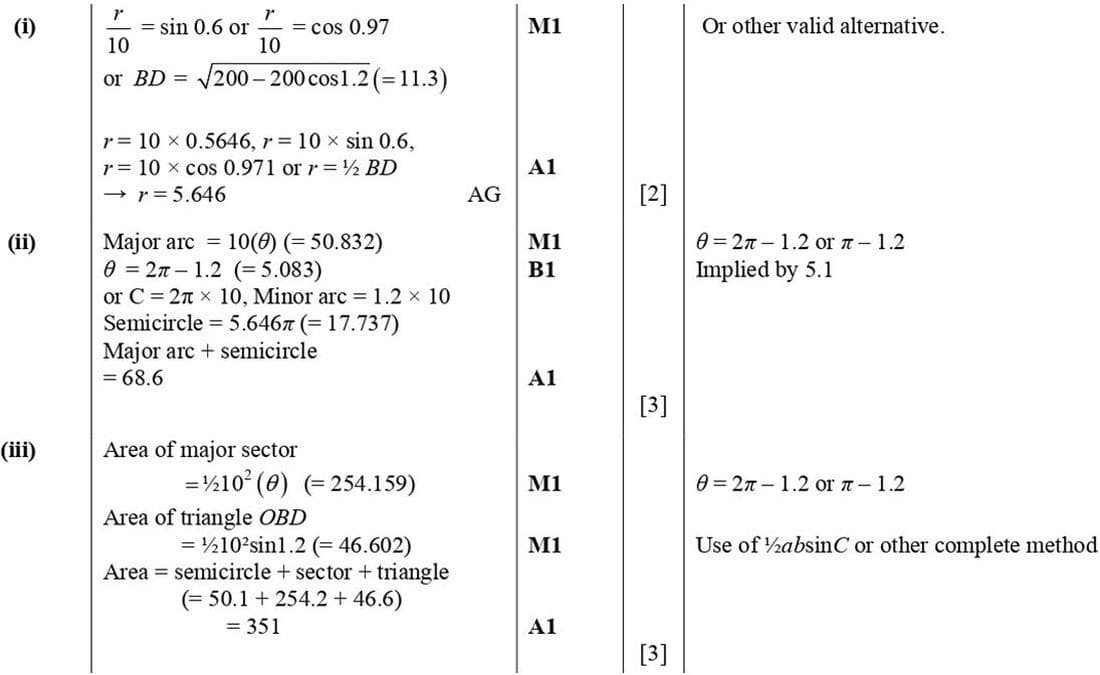
The diagram shows a metal plate ABCD made from two parts. The part BCD is a semicircle. The part DAB is a segment of a circle with centre O and radius 10 cm. Angle BOD is 1.2 radians.
(i) Show that the radius of the semicircle is 5.646 cm, correct to 3 decimal places.
(ii) Find the perimeter of the metal plate.
(iii) Find the area of the metal plate.

9709 P11 - Nov 2016 - Q3
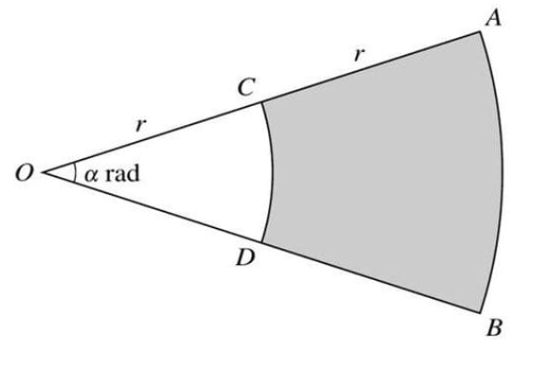
In the diagram, OCA and ODB are radii of a circle with centre O and radius 2r cm. Angle AOB = α radians. CD and AB are arcs of circles with centre O and radii r cm and 2r cm respectively. The perimeter of the shaded region ABDC is 4.4r cm.
(i) Find the value of α.
(ii) It is given that the area of the shaded region is 30 cm². Find the value of r.

9709 P13 - Jun 2016 - Q6
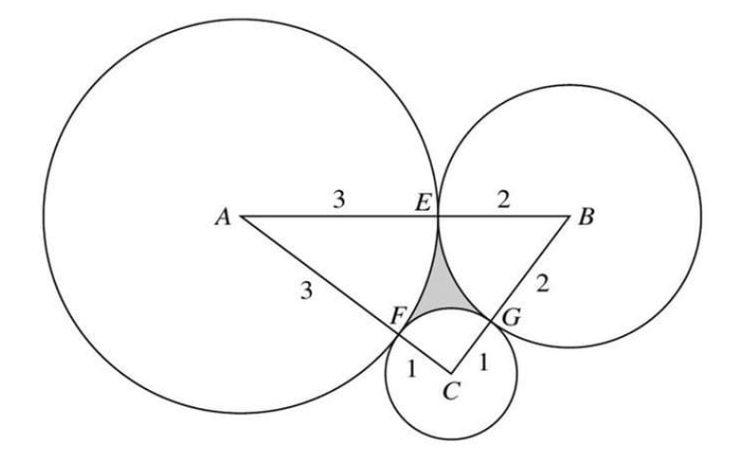
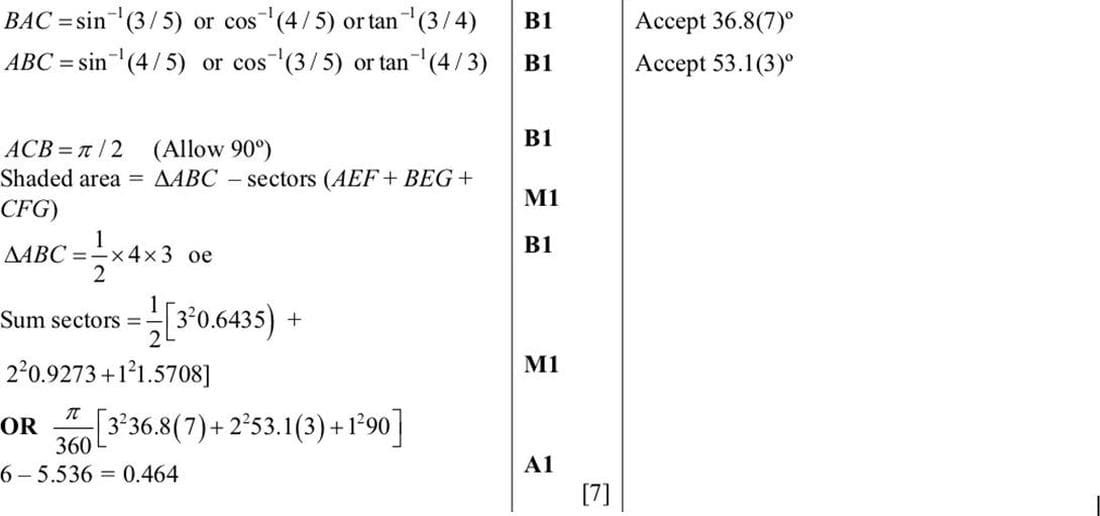
The diagram shows triangle ABC where AB = 5 cm, AC = 4 cm and BC = 3 cm. Three circles with centres at A, B and C have radii 3 cm, 2 cm and 1 cm respectively. The circles touch each other at points E, F and G, lying on AB, AC and BC respectively. Find the area of the shaded region EFG.
9709 P12 - Jun 2016 - Q6
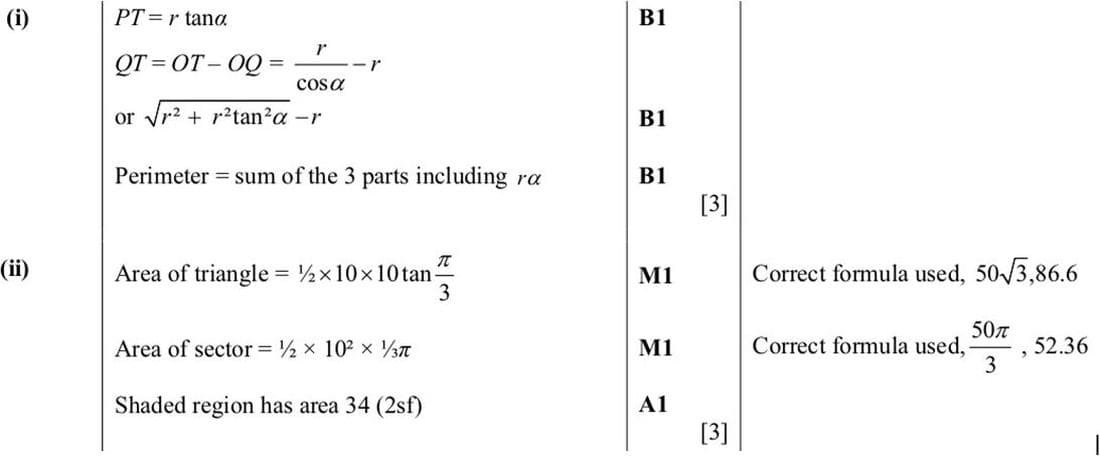
The diagram shows a circle with radius r cm and centre O. The line PT is the tangent to the circle at P and angle POT = α radians. The line OT meets the circle at Q.
(i) Express the perimeter of the shaded region PQT in terms of r and α.
(ii) In the case where α = \(\frac{1}{3} \pi\) and r = 10, find the area of the shaded region correct to 2 significant figures.

9709 P11 - Jun 2016 - Q7
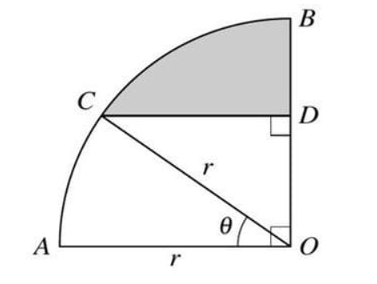
In the diagram, AOB is a quarter circle with centre O and radius r. The point C lies on the arc AB and the point D lies on OB. The line CD is parallel to AO and angle AOC = θ radians.
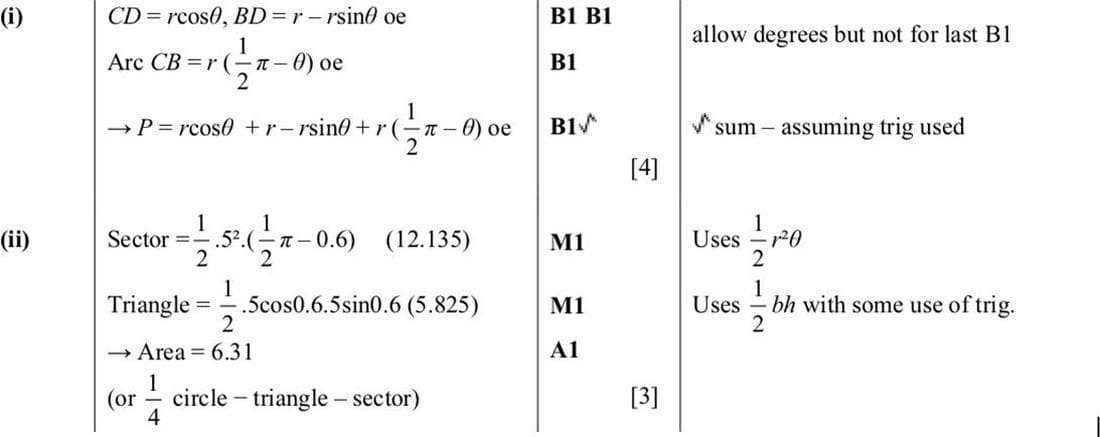
(i) Express the perimeter of the shaded region in terms of r, θ and π.
(ii) For the case where r = 5 cm and θ = 0.6, find the area of the shaded region.
9709 P12 - Mar 2016 - Q9 - 10 marks
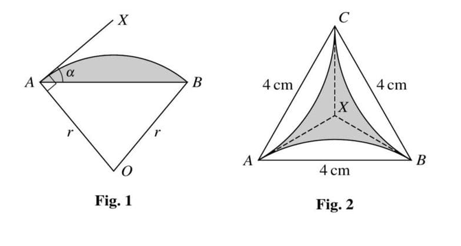
(a) In Fig. 1, \(OAB\) is a sector of a circle with centre \(O\) and radius \(r\). \(AX\) is the tangent at \(A\) to the arc \(AB\) and angle \(BAX = \alpha\).
(i) Show that angle \(AOB = 2\alpha\).
(ii) Find the area of the shaded segment in terms of \(r\) and \(\alpha\).
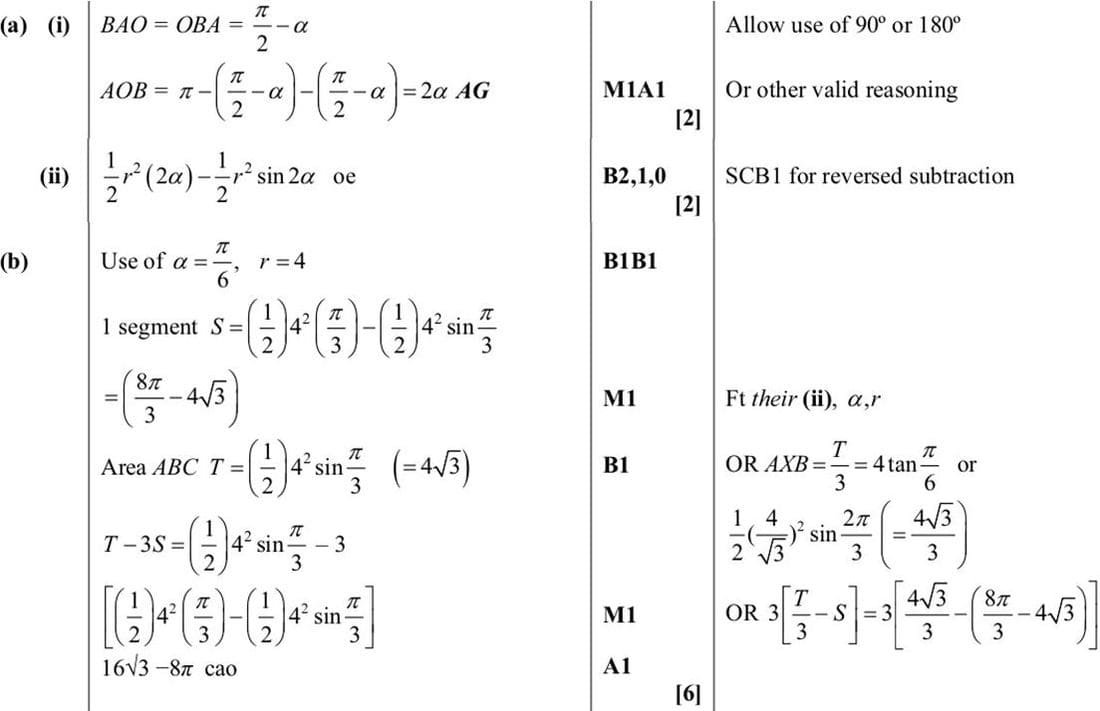
(b) In Fig. 2, \(ABC\) is an equilateral triangle of side 4 cm. The lines \(AX, BX\) and \(CX\) are tangents to the equal circular arcs \(AB, BC\) and \(CA\). Use the results in part (a) to find the area of the shaded region, giving your answer in terms of \(\pi\) and \(\sqrt{3}\).
9709 P13 - Nov 2015 - Q4 - 7 marks
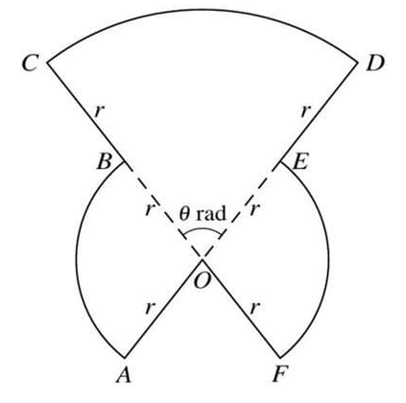
The diagram shows a metal plate OABCDEF consisting of 3 sectors, each with centre O. The radius of sector COD is 2r and angle COD is θ radians. The radius of each of the sectors BOA and FOE is r, and AOED and CBOF are straight lines.
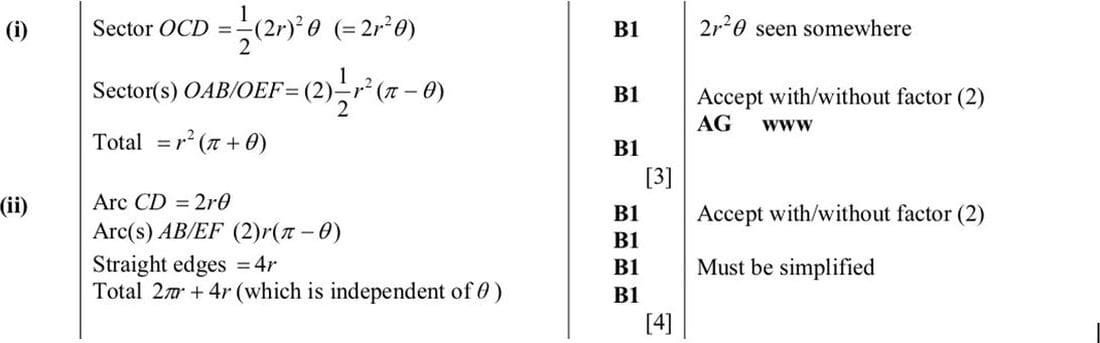
(i) Show that the area of the metal plate is r^2(π + θ).
(ii) Show that the perimeter of the metal plate is independent of θ.
9709 P12 - Nov 2015 - Q5 - 7 marks
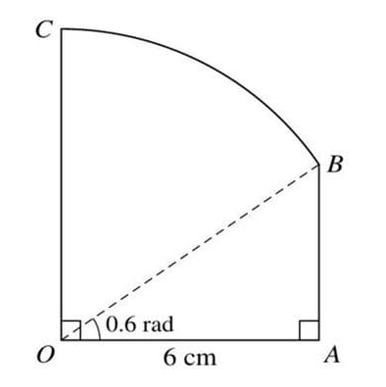
The diagram shows a metal plate OABC, consisting of a right-angled triangle OAB and a sector OBC of a circle with centre O. Angle AOB = 0.6 radians, OA = 6 cm and OA is perpendicular to OC.
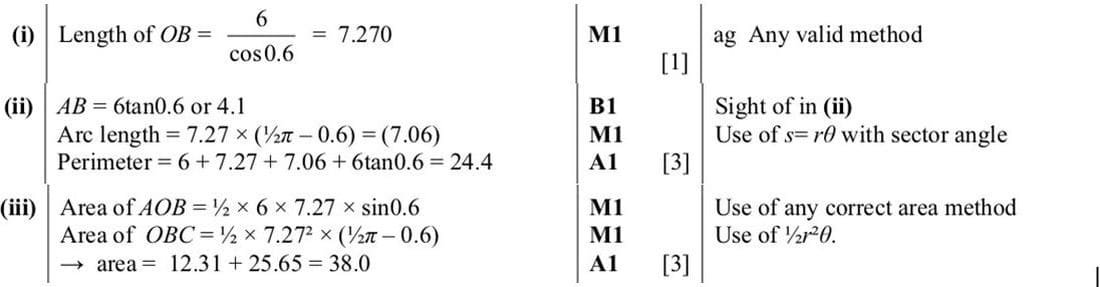
(i) Show that the length of OB is 7.270 cm, correct to 3 decimal places.
(ii) Find the perimeter of the metal plate.
(iii) Find the area of the metal plate.
9709 P11 - Nov 2015 - Q7 - 7 marks
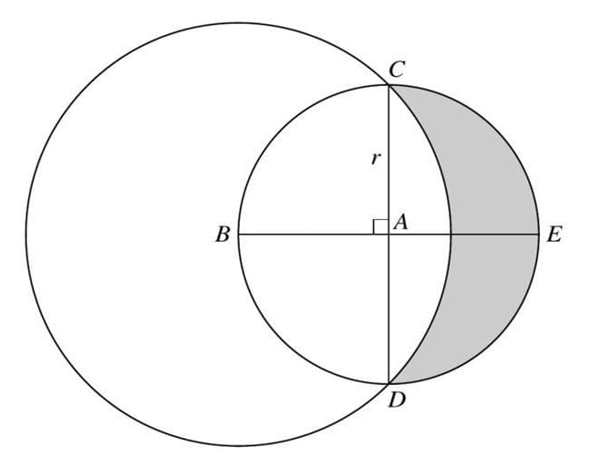
The diagram shows a circle with centre A and radius r. Diameters CAD and BAE are perpendicular to each other. A larger circle has centre B and passes through C and D.
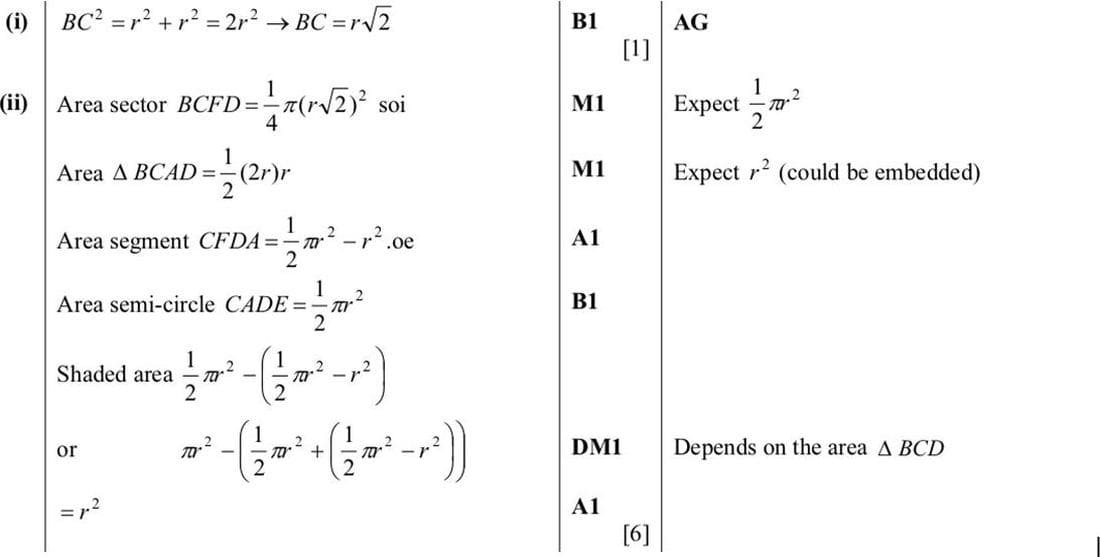
(i) Show that the radius of the larger circle is r√2.
(ii) Find the area of the shaded region in terms of r.
9709 P13 - Jun 2015 - Q11 - 10 marks
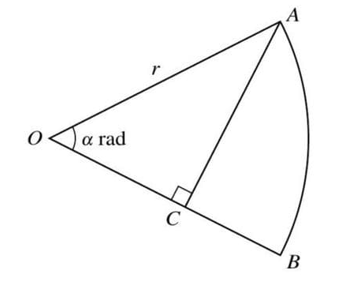
In the diagram, OAB is a sector of a circle with centre O and radius r. The point C on OB is such that angle ACO is a right angle. Angle AOB is α radians and is such that AC divides the sector into two regions of equal area.
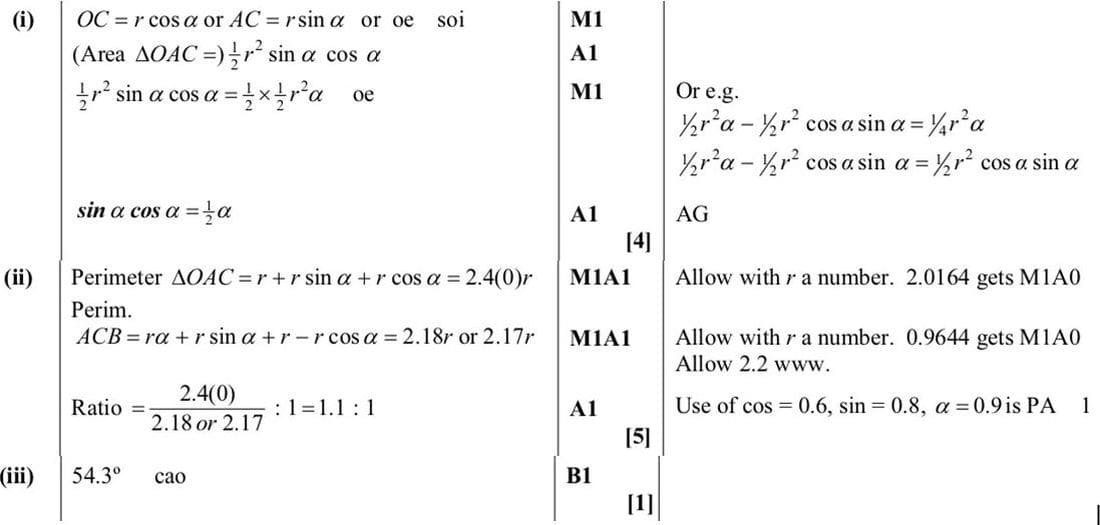
(i) Show that \(\sin \alpha \cos \alpha = \frac{1}{2} \alpha\).
It is given that the solution of the equation in part (i) is \(\alpha = 0.9477\), correct to 4 decimal places.
(ii) Find the ratio perimeter of region OAC : perimeter of region ACB, giving your answer in the form k : 1, where k is given correct to 1 decimal place.
(iii) Find angle AOB in degrees.
9709 P12 - Jun 2015 - Q2
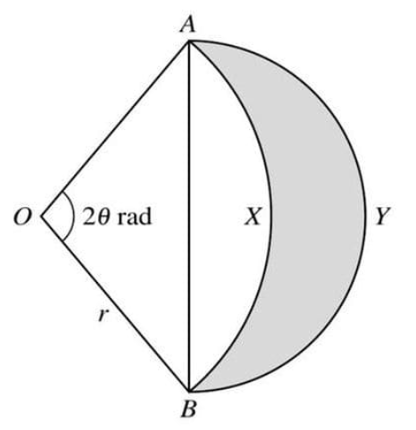
In the diagram, AYB is a semicircle with AB as diameter and OAXB is a sector of a circle with centre O and radius r. Angle AOB = 2θ radians. Find an expression, in terms of r and θ, for the area of the shaded region.