Past Exam Questions
← Back9709 P13 - Nov 2014 - Q2
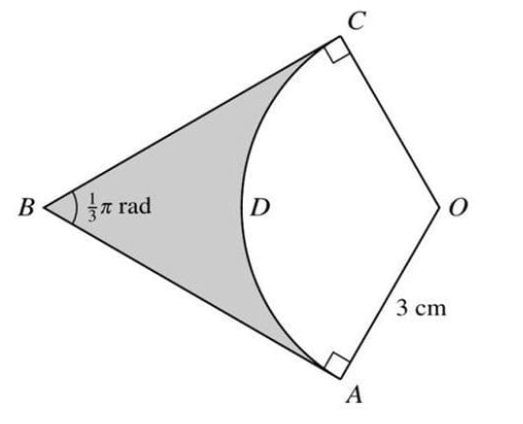
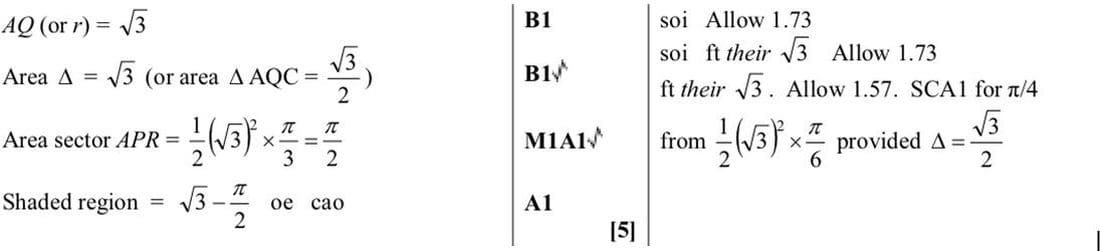
In the diagram, OADC is a sector of a circle with centre O and radius 3 cm. AB and CB are tangents to the circle and angle ABC = \(\frac{1}{3} \pi\) radians. Find, giving your answer in terms of \(\sqrt{3}\) and \(\pi\),
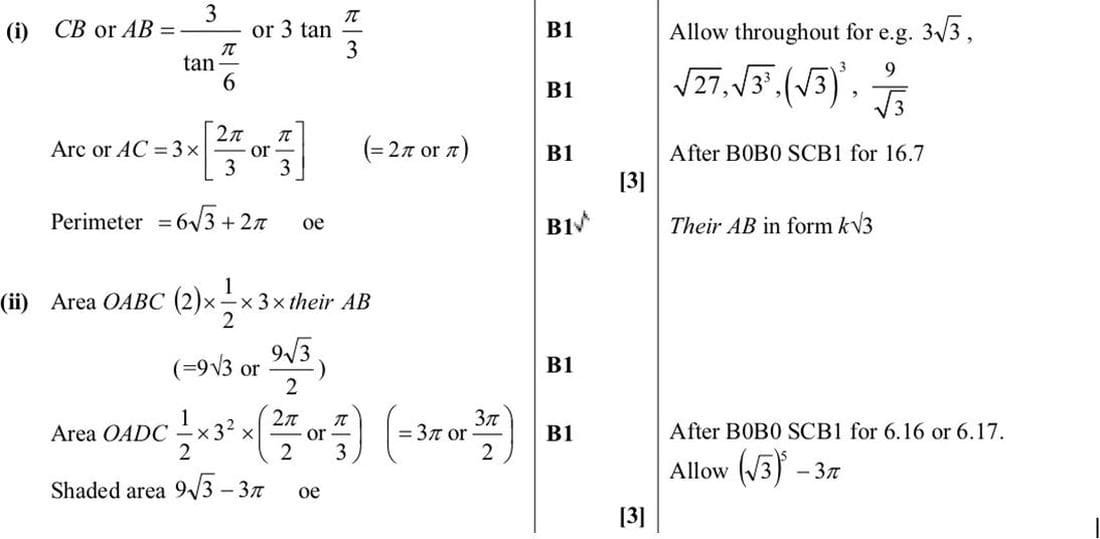
(i) the perimeter of the shaded region,
(ii) the area of the shaded region.
9709 P12 - Nov 2014 - Q2
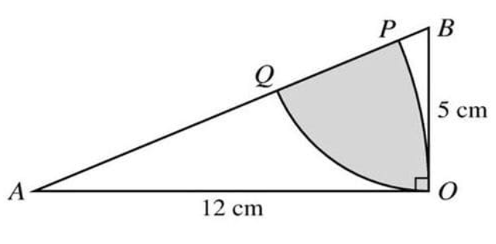
The diagram shows a triangle AOB in which OA is 12 cm, OB is 5 cm and angle AOB is a right angle. Point P lies on AB and OP is an arc of a circle with centre A. Point Q lies on AB and OQ is an arc of a circle with centre B.
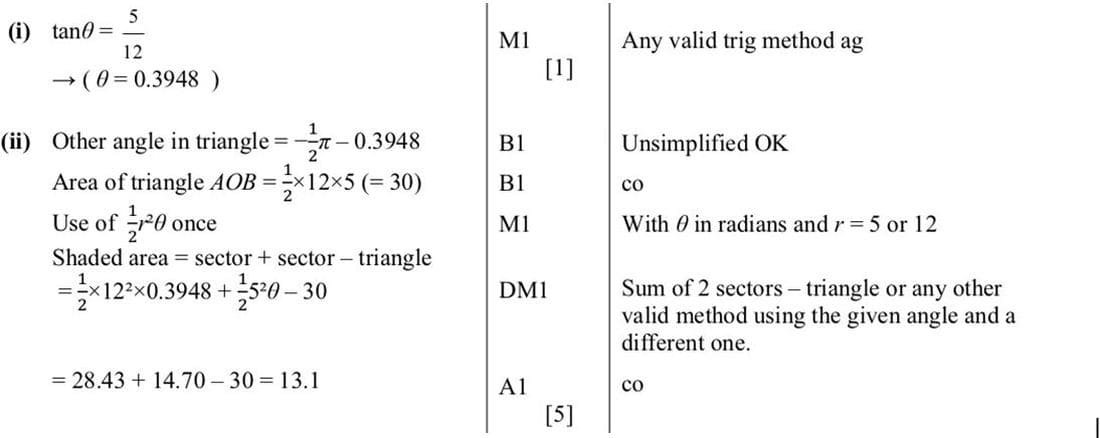
(i) Show that angle BAO is 0.3948 radians, correct to 4 decimal places.
(ii) Calculate the area of the shaded region.
9709 P11 - Nov 2014 - Q8
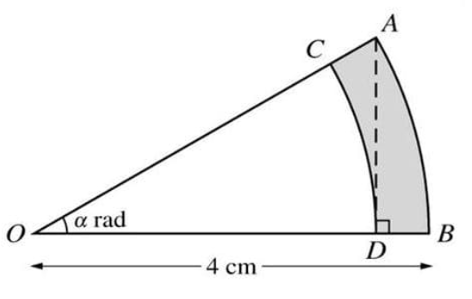
In the diagram, AB is an arc of a circle with centre O and radius 4 cm. Angle AOB is \(\alpha\) radians. The point D on OB is such that AD is perpendicular to OB. The arc DC, with centre O, meets OA at C.
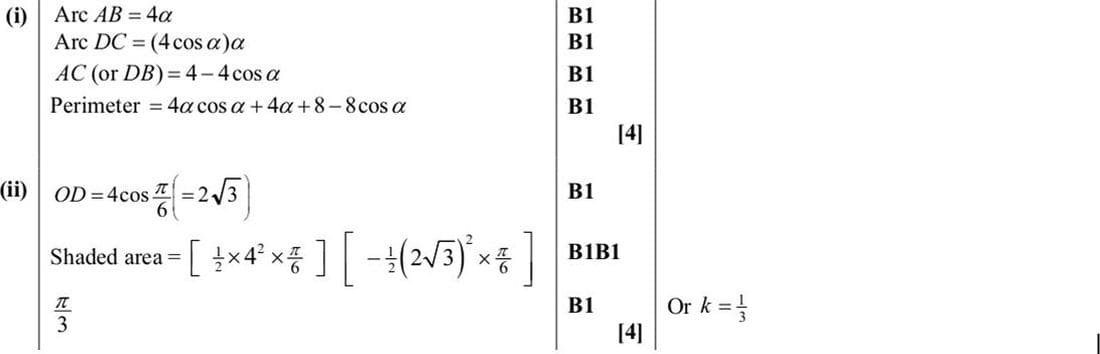
(i) Find an expression in terms of \(\alpha\) for the perimeter of the shaded region ABDC.
(ii) For the case where \(\alpha = \frac{1}{6}\pi\), find the area of the shaded region ABDC, giving your answer in the form \(k\pi\), where \(k\) is a constant to be determined.
9709 P12 - Jun 2014 - Q4
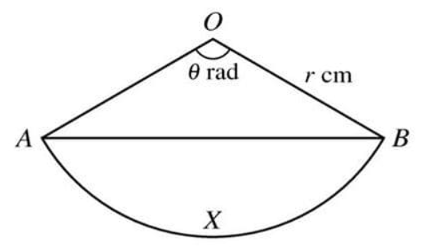
The diagram shows a sector of a circle with radius r cm and centre O. The chord AB divides the sector into a triangle AOB and a segment AXB. Angle AOB is θ radians.
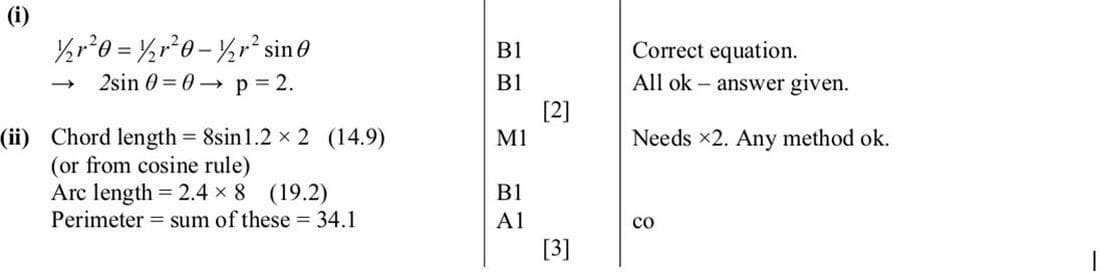
(i) In the case where the areas of the triangle AOB and the segment AXB are equal, find the value of the constant p for which θ = p \, \sin \, θ.
(ii) In the case where r = 8 and θ = 2.4, find the perimeter of the segment AXB.
9709 P11 - Jun 2014 - Q6
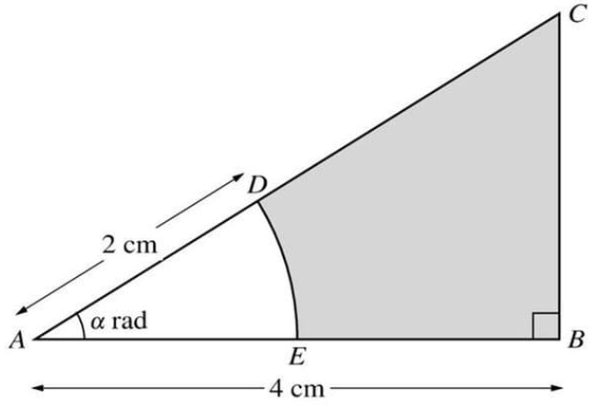
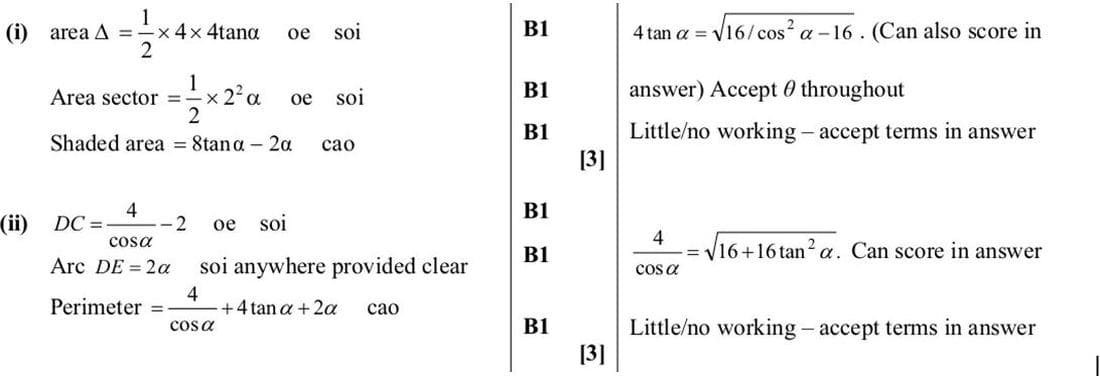
The diagram shows triangle ABC in which AB is perpendicular to BC. The length of AB is 4 cm and angle CAB is \(\alpha\) radians. The arc DE with centre A and radius 2 cm meets AC at D and AB at E. Find, in terms of \(\alpha\),
(i) the area of the shaded region,
9709 P12 - Nov 2013 - Q2 - 6 marks
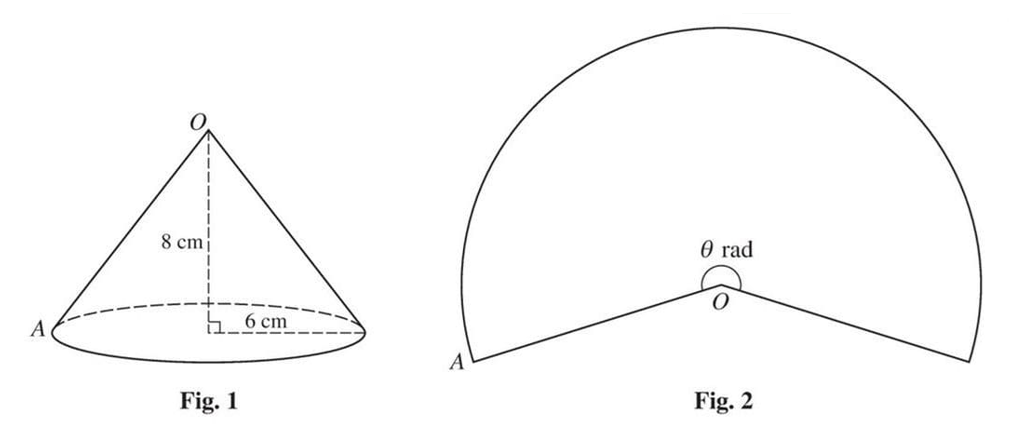
Fig. 1 shows a hollow cone with no base, made of paper. The radius of the cone is 6 cm and the height is 8 cm. The paper is cut from A to O and opened out to form the sector shown in Fig. 2. The circular bottom edge of the cone in Fig. 1 becomes the arc of the sector in Fig. 2. The angle of the sector is \(\theta\) radians. Calculate
(i) the value of \(\theta\),
(ii) the area of paper needed to make the cone.

9709 P12 - Mar 2023 - Q8 - 8 marks
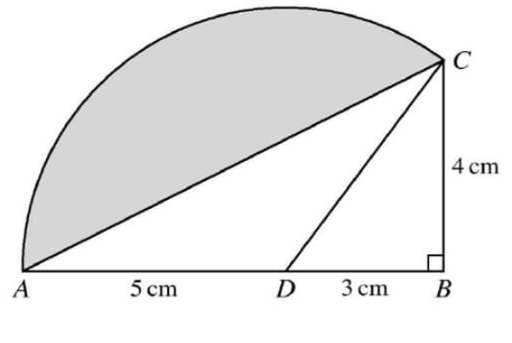
The diagram shows triangle ABC in which angle B is a right angle. The length of AB is 8 cm and the length of BC is 4 cm. The point D on AB is such that AD = 5 cm. The sector DAC is part of a circle with centre D.
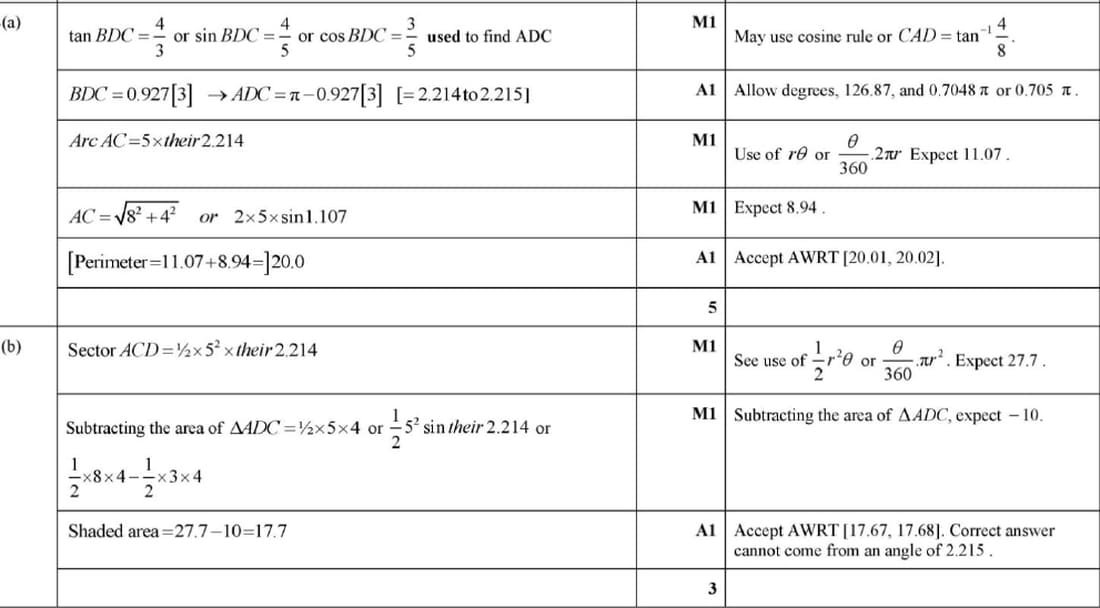
(a) Find the perimeter of the shaded region.
(b) Find the area of the shaded region.
9709 P11 - Nov 2013 - Q6 - 8 marks
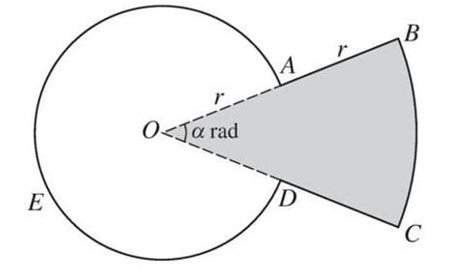
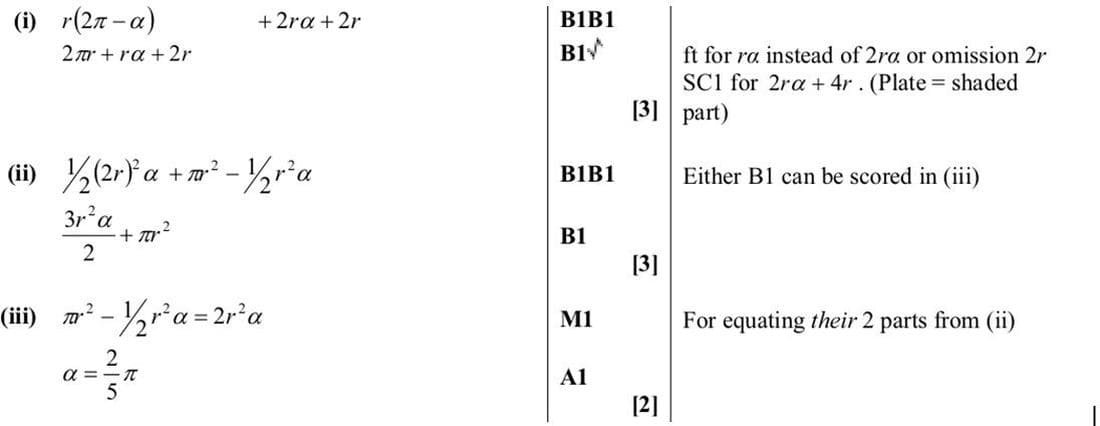
The diagram shows a metal plate made by fixing together two pieces, OABCD (shaded) and OAED (unshaded). The piece OABCD is a minor sector of a circle with centre O and radius 2r. The piece OAED is a major sector of a circle with centre O and radius r. Angle AOD is \(\alpha\) radians. Simplifying your answers where possible, find, in terms of \(\alpha\), \(\pi\) and \(r\),
(i) the perimeter of the metal plate,
(ii) the area of the metal plate.
It is now given that the shaded and unshaded pieces are equal in area.
(iii) Find \(\alpha\) in terms of \(\pi\).
9709 P13 - Jun 2013 - Q2
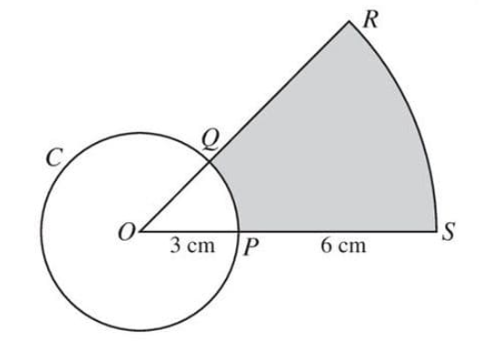
The diagram shows a circle C with centre O and radius 3 cm. The radii OP and OQ are extended to S and R respectively so that ORS is a sector of a circle with centre O. Given that PS = 6 cm and that the area of the shaded region is equal to the area of circle C,
- show that angle POQ = \frac{1}{4}\pi radians,
- find the perimeter of the shaded region.

9709 P12 - Jun 2013 - Q4 - 7 marks
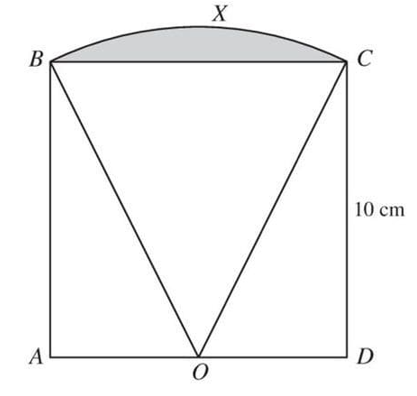
The diagram shows a square ABCD of side 10 cm. The mid-point of AD is O and BXC is an arc of a circle with centre O.
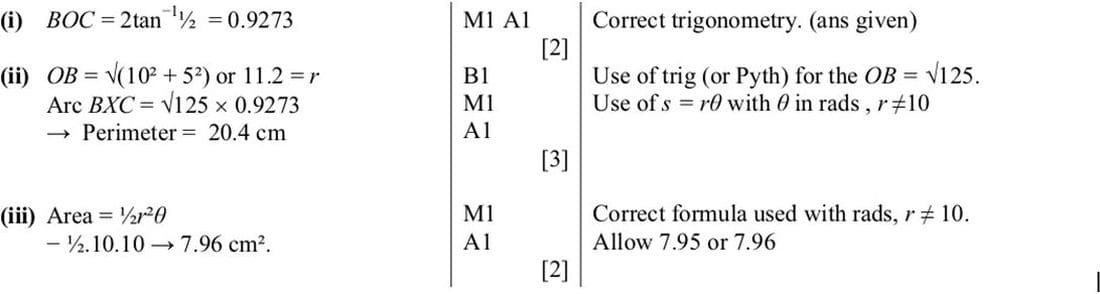
- Show that angle BOC is 0.9273 radians, correct to 4 decimal places.
- Find the perimeter of the shaded region.
- Find the area of the shaded region.
9709 P11 - Jun 2013 - Q3
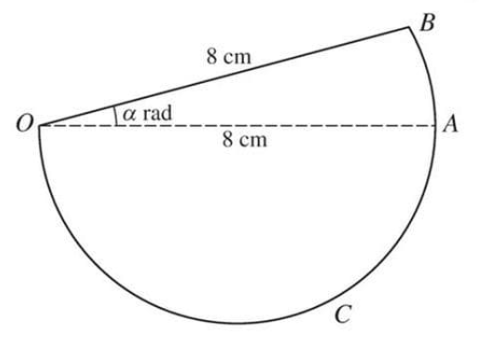
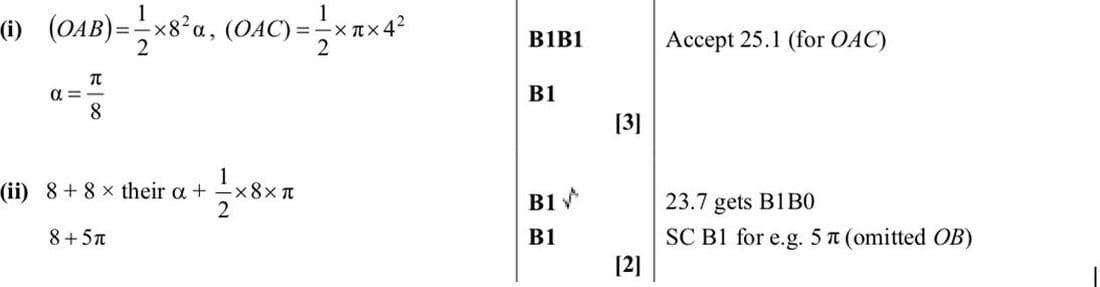
In the diagram, OAB is a sector of a circle with centre O and radius 8 cm. Angle BOA is \(\alpha\) radians. OAC is a semicircle with diameter OA. The area of the semicircle OAC is twice the area of the sector OAB.
(i) Find \(\alpha\) in terms of \(\pi\).
(ii) Find the perimeter of the complete figure in terms of \(\pi\).
9709 P13 - Nov 2012 - Q4
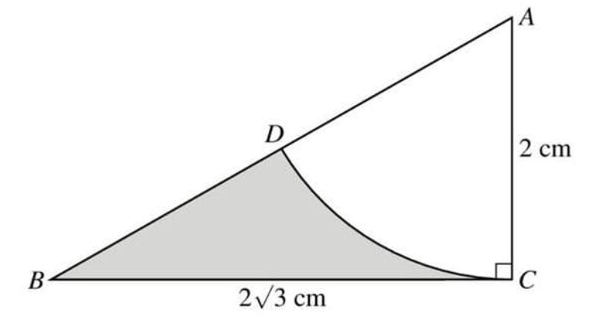
In the diagram, D lies on the side AB of triangle ABC and CD is an arc of a circle with centre A and radius 2 cm. The line BC is of length \(2\sqrt{3}\) cm and is perpendicular to AC. Find the area of the shaded region BDC, giving your answer in terms of \(\pi\) and \(\sqrt{3}\).

9709 P12 - Nov 2012 - Q11 - 10 marks
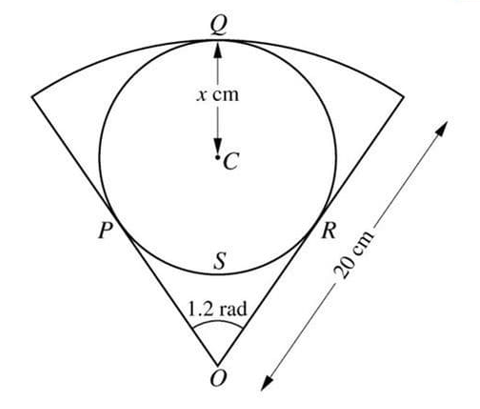
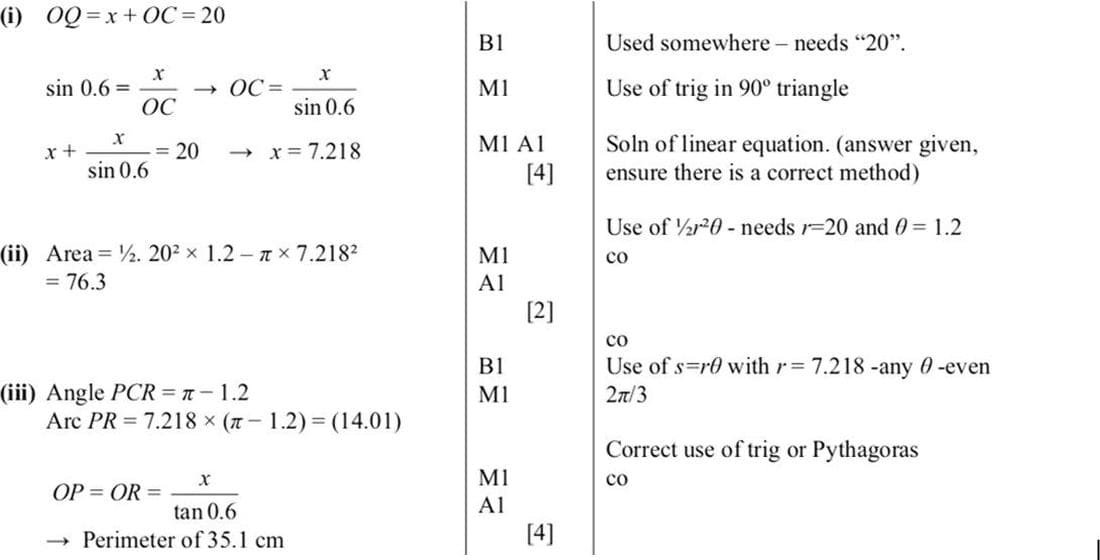
The diagram shows a sector of a circle with centre O and radius 20 cm. A circle with centre C and radius x cm lies within the sector and touches it at P, Q, and R. Angle POR = 1.2 radians.
(i) Show that x = 7.218, correct to 3 decimal places.
(ii) Find the total area of the three parts of the sector lying outside the circle with centre C.
(iii) Find the perimeter of the region OPSR bounded by the arc PSR and the lines OP and OR.
9709 P11 - Nov 2012 - Q6
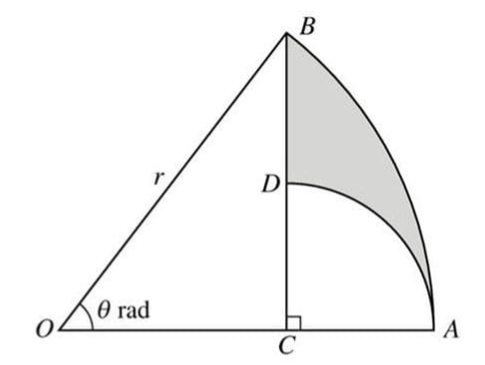
The diagram shows a sector OAB of a circle with centre O and radius r. Angle AOB is \(\theta\) radians. The point C on OA is such that BC is perpendicular to OA. The point D is on BC and the circular arc AD has centre C.
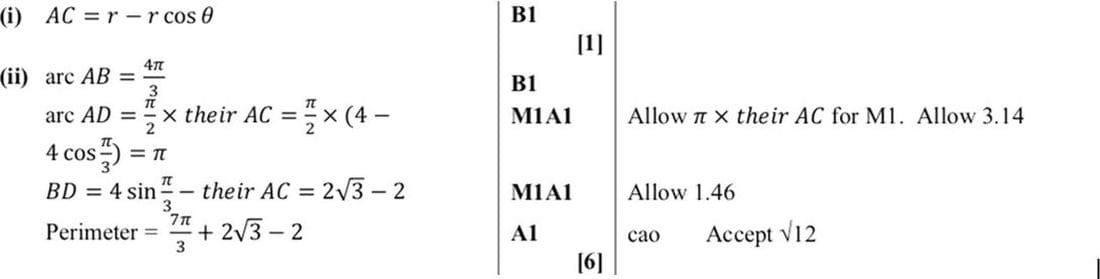
(i) Find AC in terms of r and \(\theta\).
(ii) Find the perimeter of the shaded region ABD when \(\theta = \frac{1}{3} \pi\) and r = 4, giving your answer as an exact value.
9709 P13 - Jun 2012 - Q8 - 7 marks
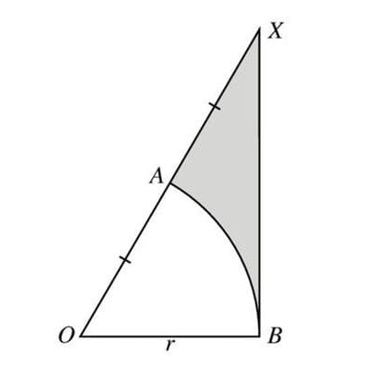
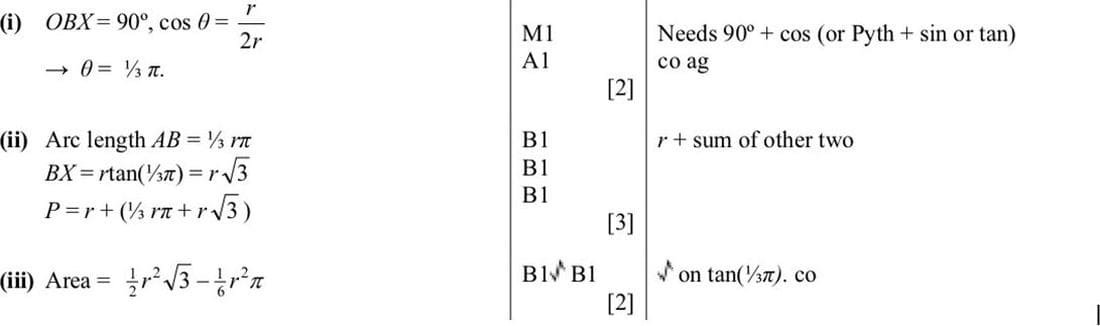
In the diagram, AB is an arc of a circle with centre O and radius r. The line XB is a tangent to the circle at B and A is the mid-point of OX.
(i) Show that angle AOB = \frac{1}{3}\pi radians.
Express each of the following in terms of r, \pi and \sqrt{3}:
(ii) the perimeter of the shaded region,
(iii) the area of the shaded region.
9709 P12 - Jun 2012 - Q6
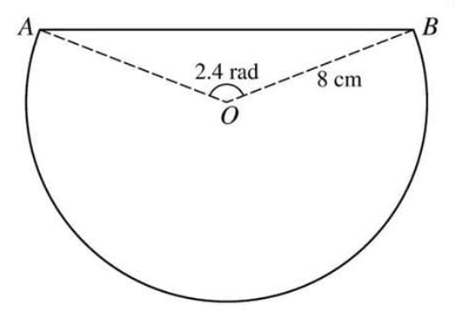
The diagram shows a metal plate made by removing a segment from a circle with centre O and radius 8 cm. The line AB is a chord of the circle and angle AOB = 2.4 radians. Find
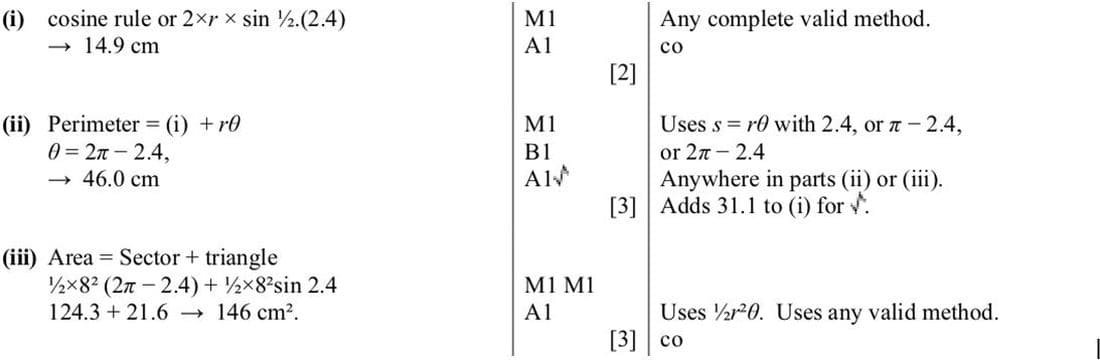
- the length of AB,
- the perimeter of the plate,
- the area of the plate.
9709 P11 - Jun 2012 - Q3
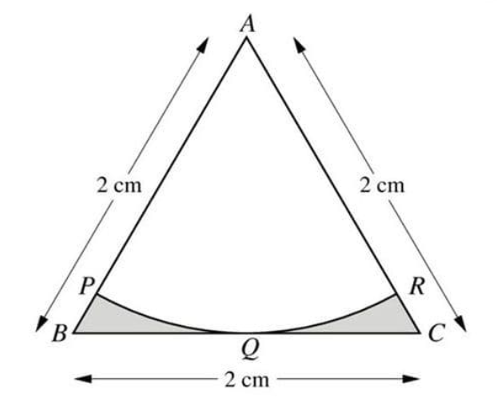
In the diagram, \(ABC\) is an equilateral triangle of side \(2 \text{ cm}\). The mid-point of \(BC\) is \(Q\). An arc of a circle with centre \(A\) touches \(BC\) at \(Q\), and meets \(AB\) at \(P\) and \(AC\) at \(R\). Find the total area of the shaded regions, giving your answer in terms of \(\pi\) and \(\sqrt{3}\).
9709 P13 - Nov 2022 - Q8
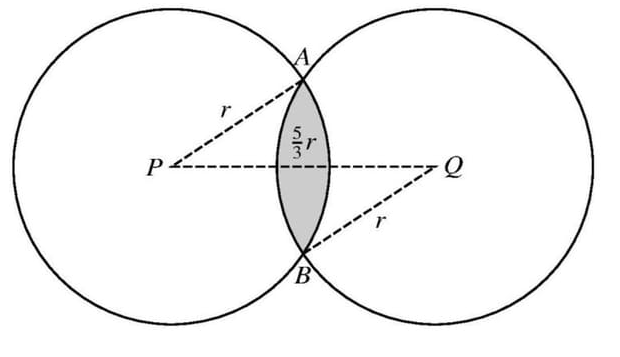
The diagram shows two identical circles intersecting at points A and B and with centres at P and Q. The radius of each circle is \(r\) and the distance \(PQ\) is \(\frac{5}{3}r\).
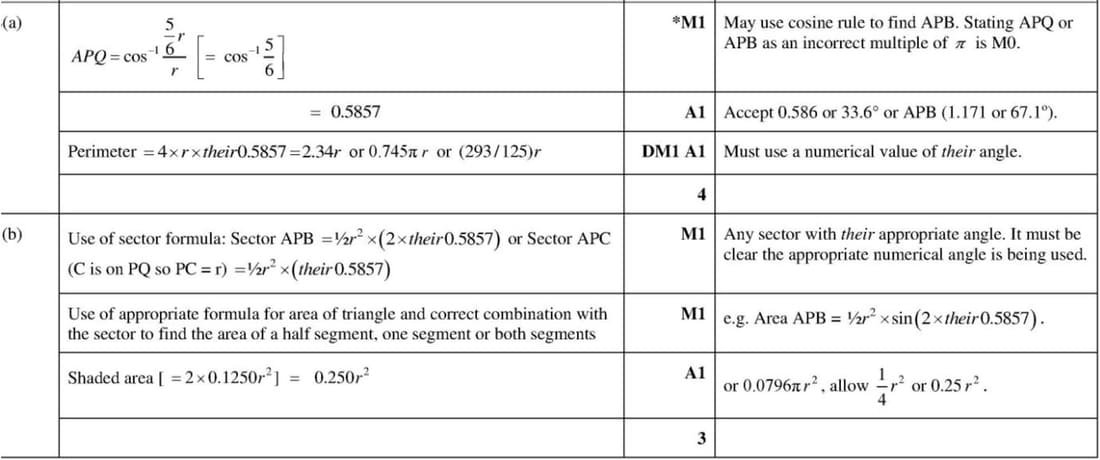
(a) Find the perimeter of the shaded region in terms of \(r\).
(b) Find the area of the shaded region in terms of \(r\).
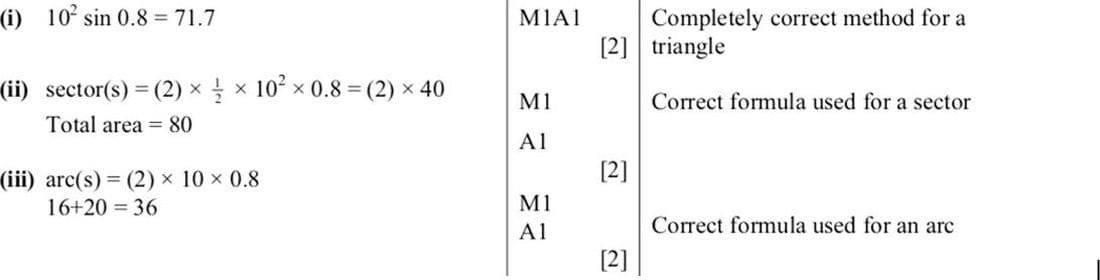
9709 P13 - Nov 2011 - Q4
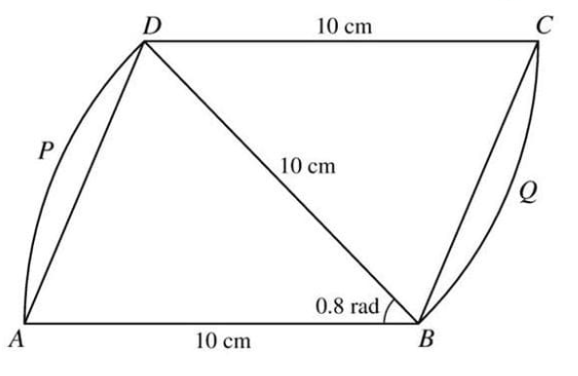
In the diagram, ABCD is a parallelogram with AB = BD = DC = 10 cm and angle ABD = 0.8 radians. APD and BQC are arcs of circles with centres B and D respectively.
- Find the area of the parallelogram ABCD.
- Find the area of the complete figure ABQCDP.
- Find the perimeter of the complete figure ABQCDP.
9709 P13 - Nov 2011 - Q8 - 8 marks
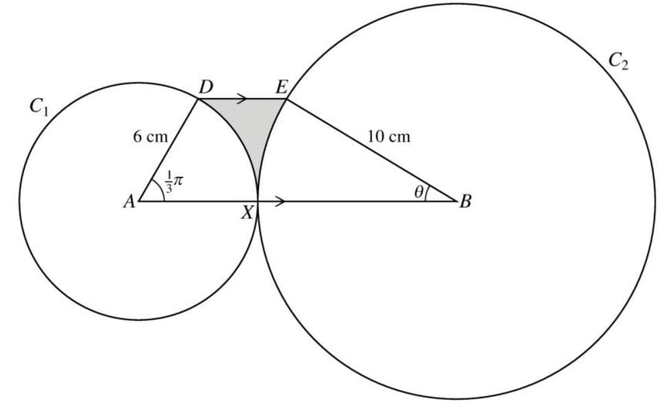
The diagram shows a circle \(C_1\) touching a circle \(C_2\) at a point \(X\). Circle \(C_1\) has centre \(A\) and radius 6 cm, and circle \(C_2\) has centre \(B\) and radius 10 cm. Points \(D\) and \(E\) lie on \(C_1\) and \(C_2\) respectively and \(DE\) is parallel to \(AB\). Angle \(DAX = \frac{1}{3}\pi\) radians and angle \(EBX = \theta\) radians.
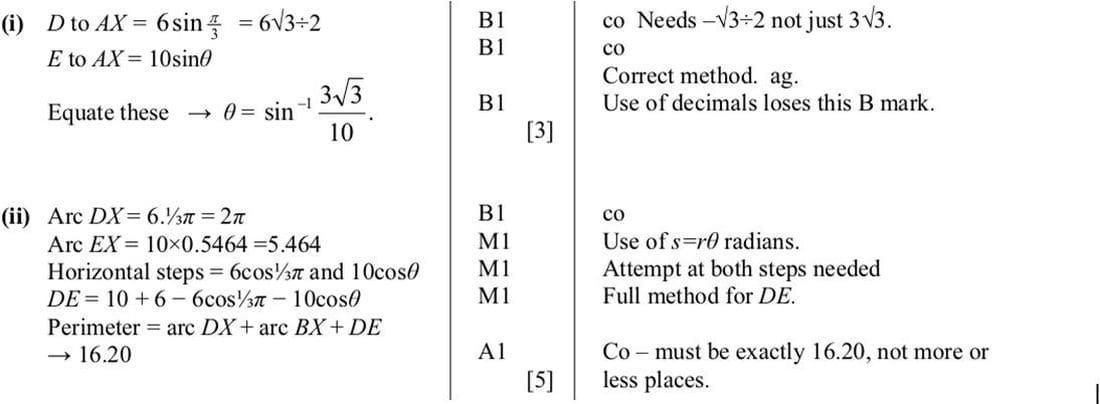
(i) By considering the perpendicular distances of \(D\) and \(E\) from \(AB\), show that the exact value of \(\theta\) is \(\sin^{-1}\left(\frac{3\sqrt{3}}{10}\right)\).
(ii) Find the perimeter of the shaded region, correct to 4 significant figures.