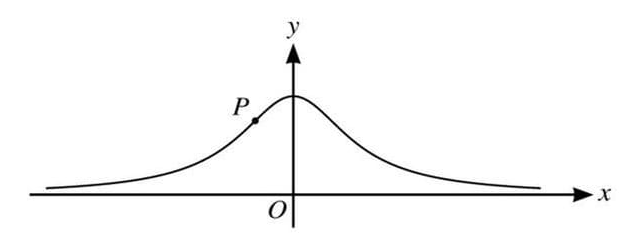
The diagram shows the curve with parametric equations
\(x = \tan \theta, \quad y = \cos^2 \theta\),
for \(-\frac{1}{2}\pi < \theta < \frac{1}{2}\pi\).
(a) Show that the gradient of the curve at the point with parameter \(\theta\) is \(-2 \sin \theta \cos^3 \theta\).
The gradient of the curve has its maximum value at the point \(P\).
(b) Find the exact value of the \(x\)-coordinate of \(P\).
Solution
(a) To find the gradient \(\frac{dy}{dx}\), we first find \(\frac{dx}{d\theta}\) and \(\frac{dy}{d\theta}\).
\(\frac{dx}{d\theta} = \sec^2 \theta\)
\(\frac{dy}{d\theta} = -2 \sin \theta \cos \theta\)
Using the chain rule, \(\frac{dy}{dx} = \frac{dy}{d\theta} \div \frac{dx}{d\theta} = \frac{-2 \sin \theta \cos \theta}{\sec^2 \theta} = -2 \sin \theta \cos^3 \theta\).
(b) To find the \(x\)-coordinate of \(P\), we need to find where the derivative \(\frac{dy}{dx}\) is maximized.
Using the product rule, \(\frac{d}{d\theta}(-2 \cos^3 \theta \sin \theta) = -2(\cos^4 \theta + 3 \cos^2 \theta \sin^2 \theta)\).
Setting this derivative to zero gives \(3 \tan^2 \theta = 1\), so \(\tan \theta = \pm \frac{1}{\sqrt{3}}\).
Since \(x = \tan \theta\), the \(x\)-coordinate of \(P\) is \(x = -\frac{1}{\sqrt{3}}\).
Log in to record attempts.