Past Exam Questions
← Back9709 P11 - Nov 2011 - Q5
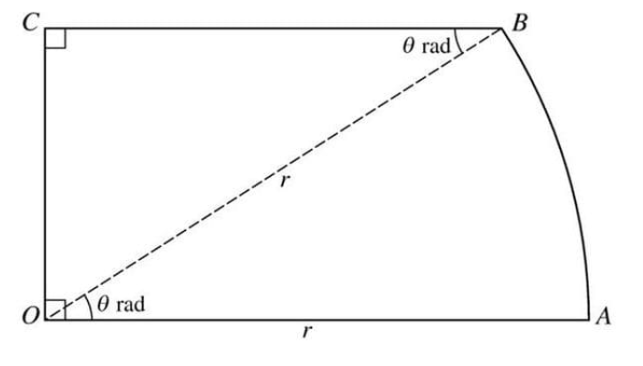
The diagram represents a metal plate OABC, consisting of a sector OAB of a circle with centre O and radius r, together with a triangle OCB which is right-angled at C. Angle AOB = \(\theta\) radians and OC is perpendicular to OA.
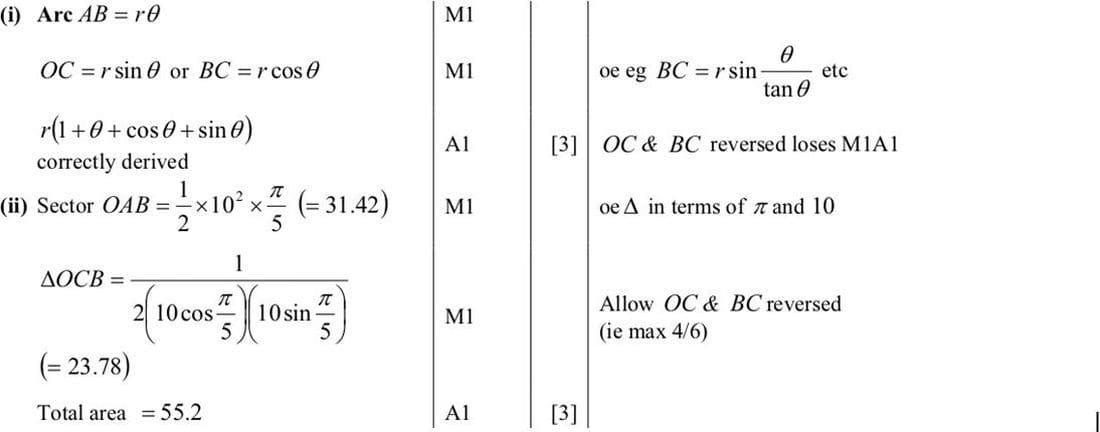
(i) Find an expression in terms of r and \(\theta\) for the perimeter of the plate.
(ii) For the case where r = 10 and \(\theta = \frac{1}{5}\pi\), find the area of the plate.
9709 P13 - Jun 2011 - Q7
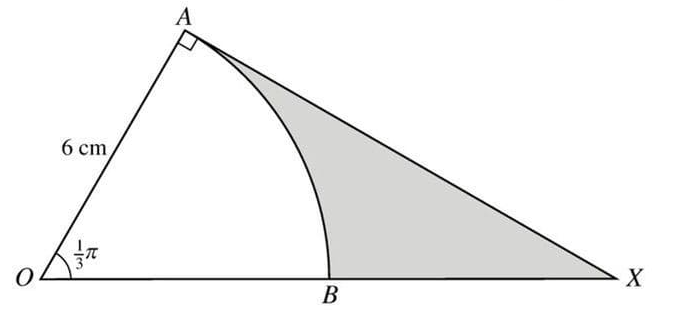
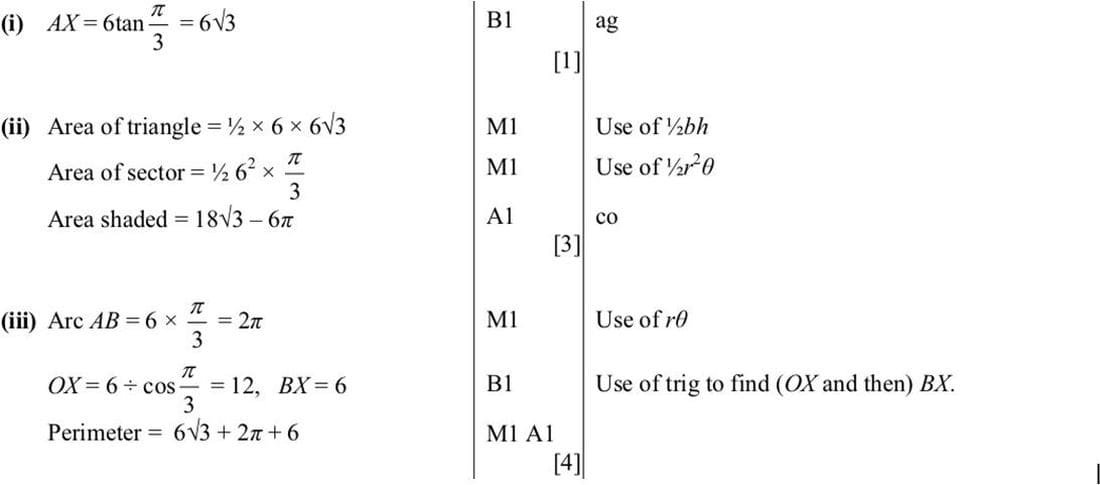
In the diagram, AB is an arc of a circle, centre O and radius 6 cm, and angle AOB = \(\frac{1}{3} \pi\) radians. The line AX is a tangent to the circle at A, and OBX is a straight line.
- Show that the exact length of AX is \(6 \sqrt{3}\) cm.
- Find, in terms of \(\pi\) and \(\sqrt{3}\),
- the area of the shaded region,
- the perimeter of the shaded region.
9709 P11 - Jun 2011 - Q9
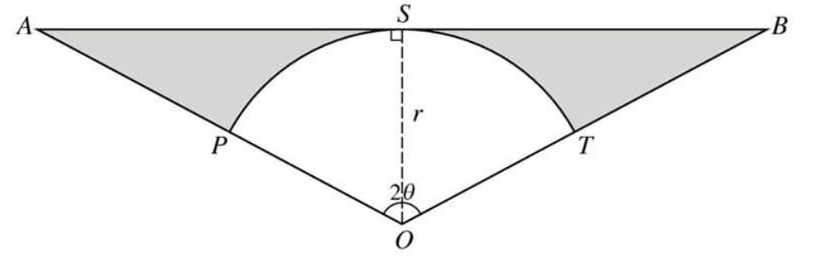
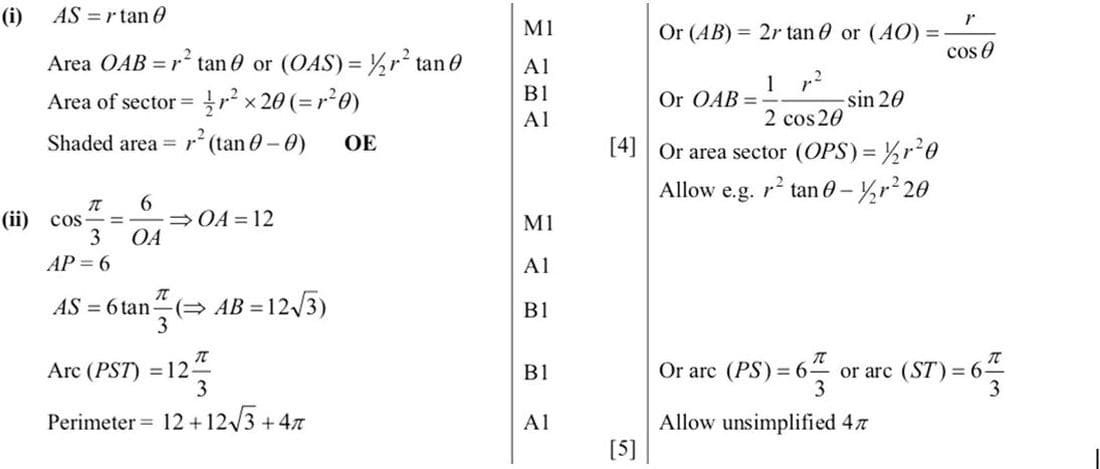
In the diagram, OAB is an isosceles triangle with OA = OB and angle AOB = 2\theta radians. Arc PST has centre O and radius r, and the line ASB is a tangent to the arc PST at S.
(i) Find the total area of the shaded regions in terms of r and \(\theta\).
(ii) In the case where \(\theta = \frac{1}{3}\pi\) and \(r = 6\), find the total perimeter of the shaded regions, leaving your answer in terms of \(\sqrt{3}\) and \(\pi\).
9709 P13 - Nov 2010 - Q8 - 8 marks
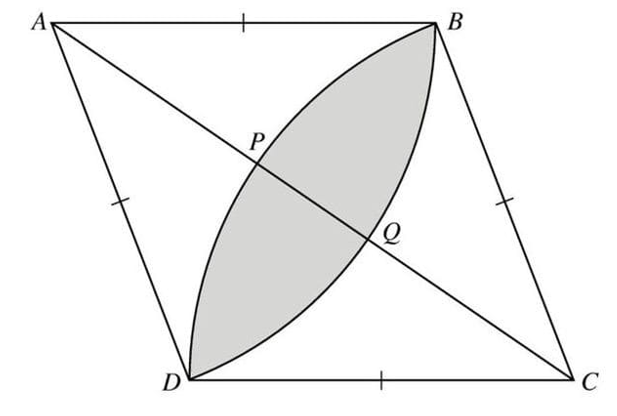
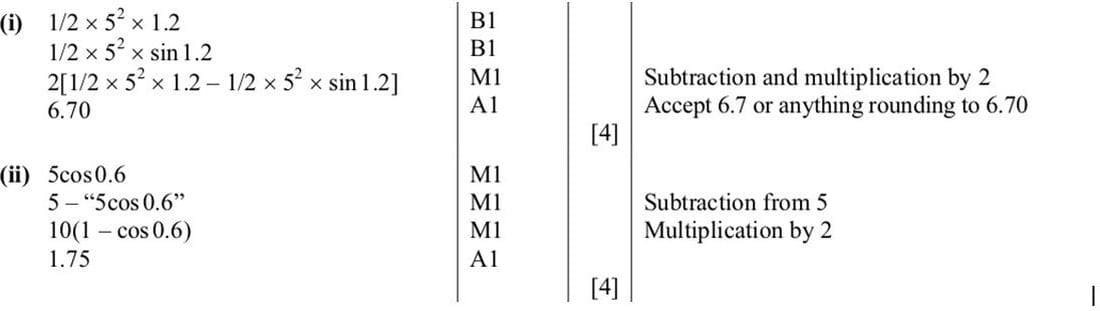
The diagram shows a rhombus ABCD. Points P and Q lie on the diagonal AC such that BPD is an arc of a circle with centre C and BQD is an arc of a circle with centre A. Each side of the rhombus has length 5 cm and angle BAD = 1.2 radians.
(i) Find the area of the shaded region BPDQ.
(ii) Find the length of PQ.
Question #272
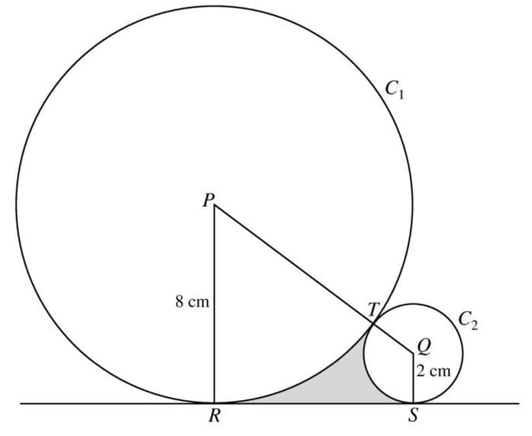
The diagram shows two circles, \(C_1\) and \(C_2\), touching at the point \(T\). Circle \(C_1\) has centre \(P\) and radius 8 cm; circle \(C_2\) has centre \(Q\) and radius 2 cm. Points \(R\) and \(S\) lie on \(C_1\) and \(C_2\) respectively, and \(RS\) is a tangent to both circles.
(i) Show that \(RS = 8\) cm.
(ii) Find angle \(RPQ\) in radians correct to 4 significant figures.
(iii) Find the area of the shaded region.
Question #273
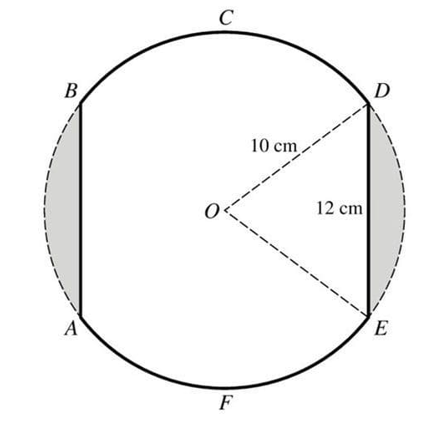
The diagram shows a metal plate ABCDEF which has been made by removing the two shaded regions from a circle of radius 10 cm and centre O. The parallel edges AB and ED are both of length 12 cm.
- Show that angle DOE is 1.287 radians, correct to 4 significant figures.
- Find the perimeter of the metal plate.
- Find the area of the metal plate.
Question #274
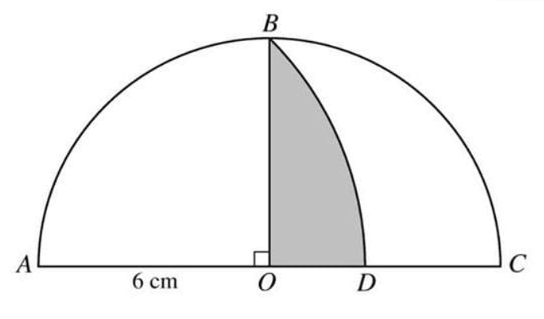
The diagram shows a semicircle ABC with centre O and radius 6 cm. The point B is such that angle BOA is 90° and BD is an arc of a circle with centre A. Find
- the length of the arc BD,
- the area of the shaded region.
Question #275
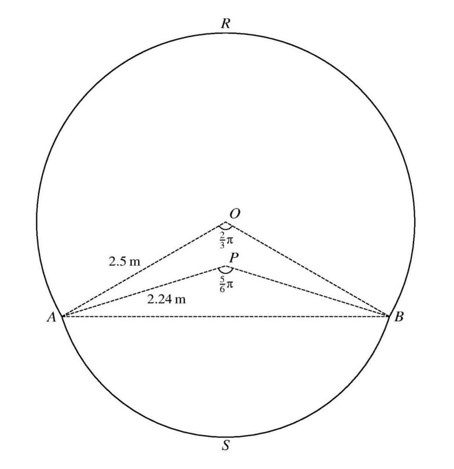
The diagram shows a cross-section RASB of the body of an aircraft. The cross-section consists of a sector OARB of a circle of radius 2.5 m, with centre O, a sector PASB of another circle of radius 2.24 m with centre P and a quadrilateral OAPB. Angle AOB = \(\frac{2\pi}{3}\) and angle APB = \(\frac{5\pi}{6}\).
(a) Find the perimeter of the cross-section RASB, giving your answer correct to 2 decimal places.
(b) Find the difference in area of the two triangles AOB and APB, giving your answer correct to 2 decimal places.
(c) Find the area of the cross-section RASB, giving your answer correct to 1 decimal place.
Question #276
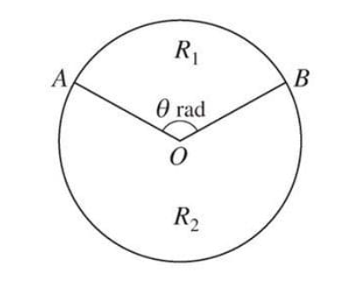
The diagram shows a circle with centre O. The circle is divided into two regions, R1 and R2, by the radii OA and OB, where angle AOB = \theta radians. The perimeter of the region R1 is equal to the length of the major arc AB.
(i) Show that \(\theta = \pi - 1\).
(ii) Given that the area of region R1 is 30 cm2, find the area of region R2, correct to 3 significant figures.
Question #277
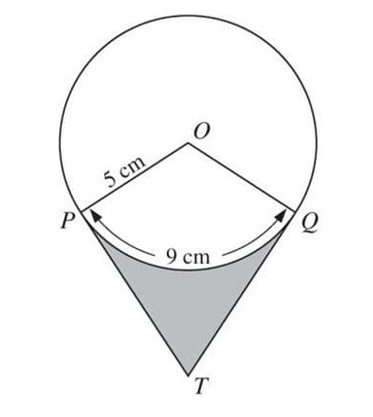
In the diagram, the circle has centre O and radius 5 cm. The points P and Q lie on the circle, and the arc length PQ is 9 cm. The tangents to the circle at P and Q meet at the point T. Calculate
(i) angle POQ in radians,
(ii) the length of PT,
(iii) the area of the shaded region.
Question #278
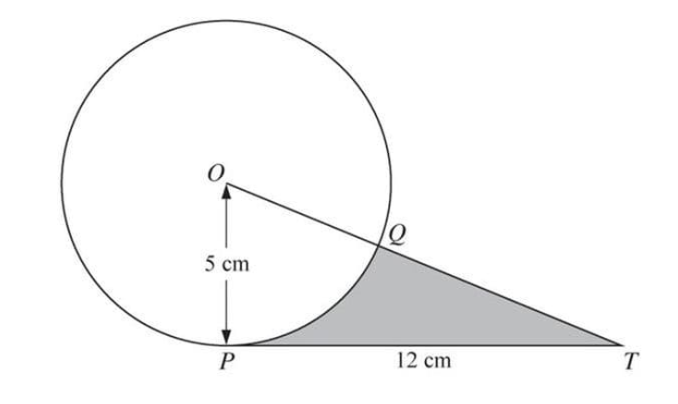
The diagram shows a circle with centre O and radius 5 cm. The point P lies on the circle, PT is a tangent to the circle and PT = 12 cm. The line OT cuts the circle at the point Q.
(i) Find the perimeter of the shaded region.
(ii) Find the area of the shaded region.
Question #279
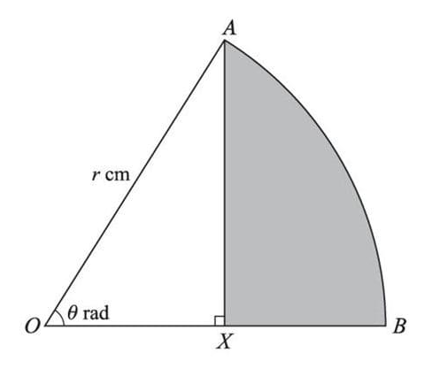
In the diagram, AB is an arc of a circle, centre O and radius r cm, and angle AOB = θ radians. The point X lies on OB and AX is perpendicular to OB.
(i) Show that the area, A cm², of the shaded region AXB is given by
\(A = \frac{1}{2}r^2(\theta - \sin \theta \cos \theta)\).
(ii) In the case where r = 12 and θ = \(\frac{1}{6}\pi\), find the perimeter of the shaded region AXB, leaving your answer in terms of \(\sqrt{3}\) and \(\pi\).
Question #280
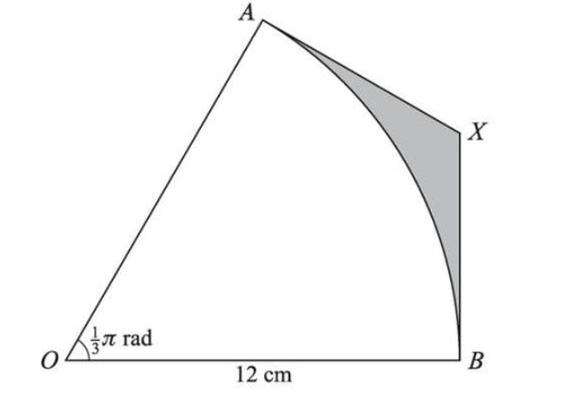
In the diagram, OAB is a sector of a circle with centre O and radius 12 cm. The lines AX and BX are tangents to the circle at A and B respectively. Angle AOB = \(\frac{1}{3} \pi\) radians.
(i) Find the exact length of AX, giving your answer in terms of \(\sqrt{3}\).
Question #281
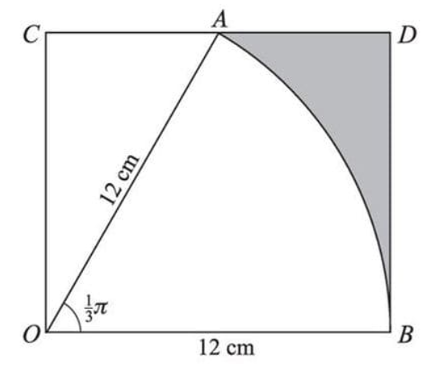
In the diagram, AOB is a sector of a circle with centre O and radius 12 cm. The point A lies on the side CD of the rectangle OCDB. Angle AOB = \(\frac{1}{3} \pi\) radians. Express the area of the shaded region in the form \(a(\sqrt{3}) - b\pi\), stating the values of the integers a and b.
9709 P1 - Jun 2006 - Q7 - 8 marks
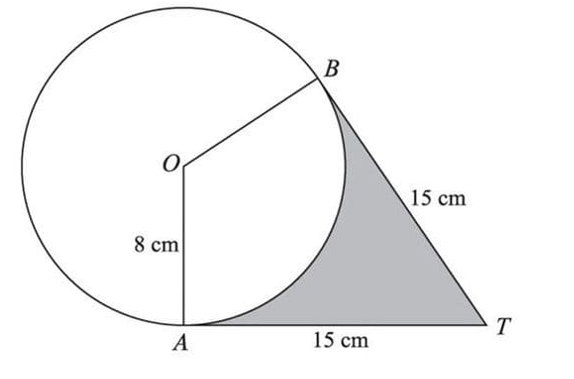
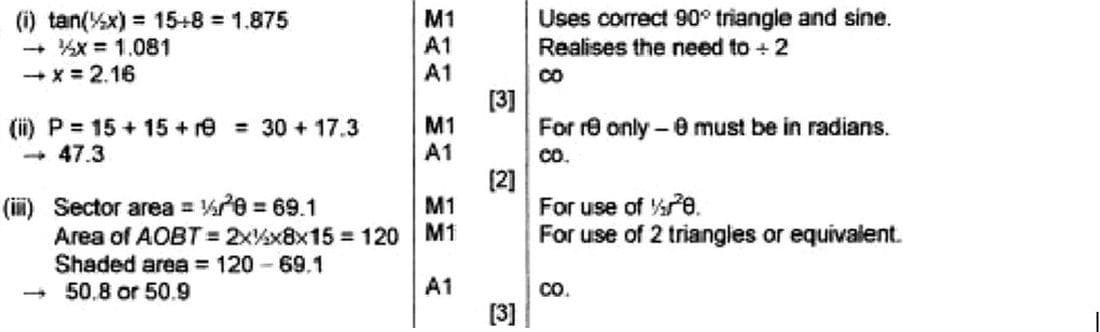
The diagram shows a circle with centre O and radius 8 cm. Points A and B lie on the circle. The tangents at A and B meet at the point T, and AT = BT = 15 cm.
(i) Show that angle AOB is 2.16 radians, correct to 3 significant figures.
(ii) Find the perimeter of the shaded region.
(iii) Find the area of the shaded region.
9709 P1 - Nov 2005 - Q9III - 4 marks
The equation of a curve is \(xy = 12\) and the equation of a line \(l\) is \(2x + y = k\), where \(k\) is a constant.
In the case where \(k = 10\), one of the points of intersection is \(P(2, 6)\). Find the angle, in degrees correct to 1 decimal place, between \(l\) and the tangent to the curve at \(P\).

9709 P1 - Jun 2005 - Q8 - 8 marks
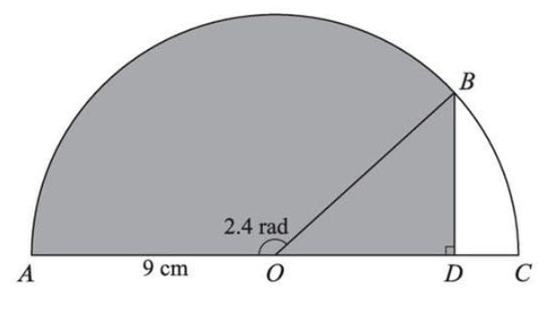
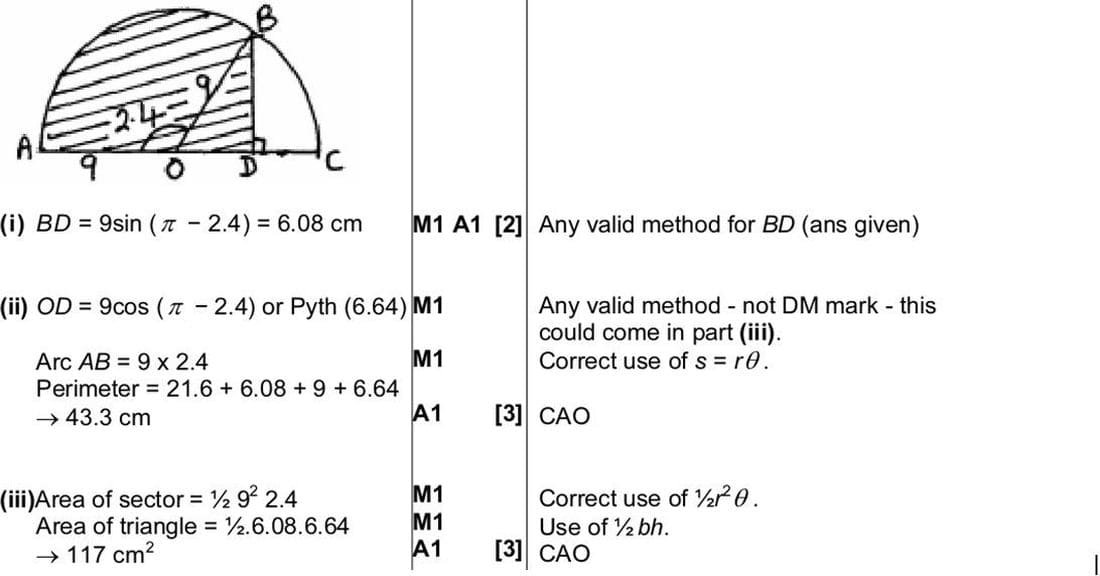
In the diagram, ABC is a semicircle, centre O and radius 9 cm. The line BD is perpendicular to the diameter AC and angle AOB = 2.4 radians.
- Show that BD = 6.08 cm, correct to 3 significant figures.
- Find the perimeter of the shaded region.
- Find the area of the shaded region.
9709 P33 - Nov 2023 - Q7
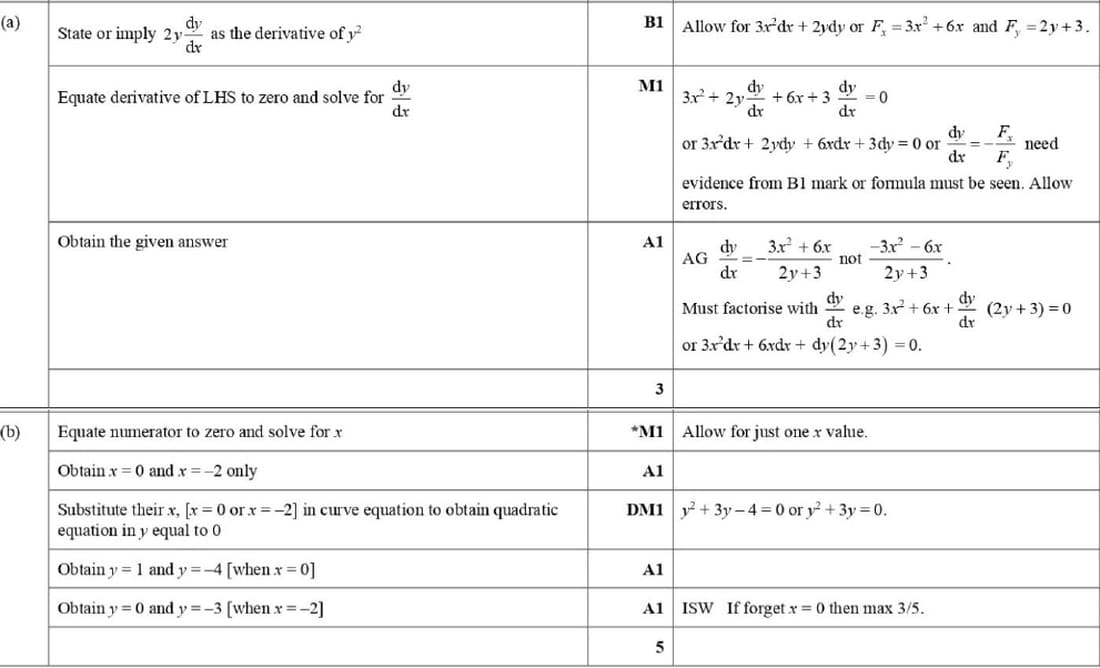
The equation of a curve is \(x^3 + y^2 + 3x^2 + 3y = 4\).
(a) Show that \(\frac{dy}{dx} = -\frac{3x^2 + 6x}{2y + 3}\).
(b) Hence find the coordinates of the points on the curve at which the tangent is parallel to the x-axis.
9709 P31 - Jun 2019 - Q3
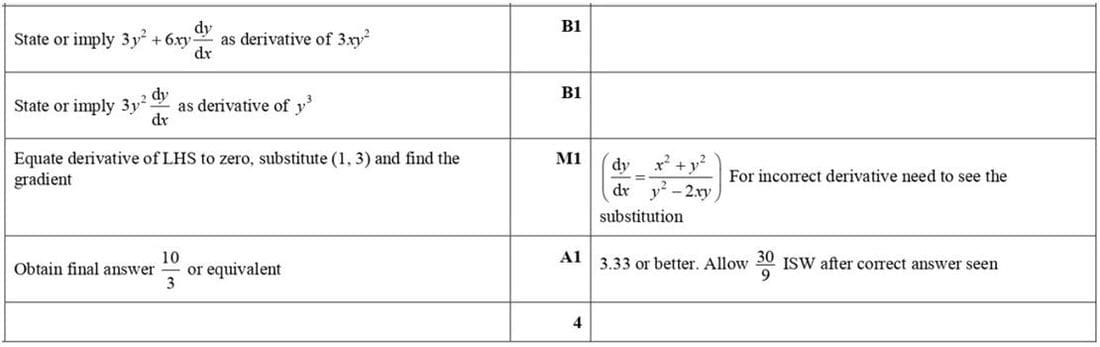
Find the gradient of the curve \(x^3 + 3xy^2 - y^3 = 1\) at the point with coordinates (1, 3).
9709 P32 - Mar 2019 - Q5
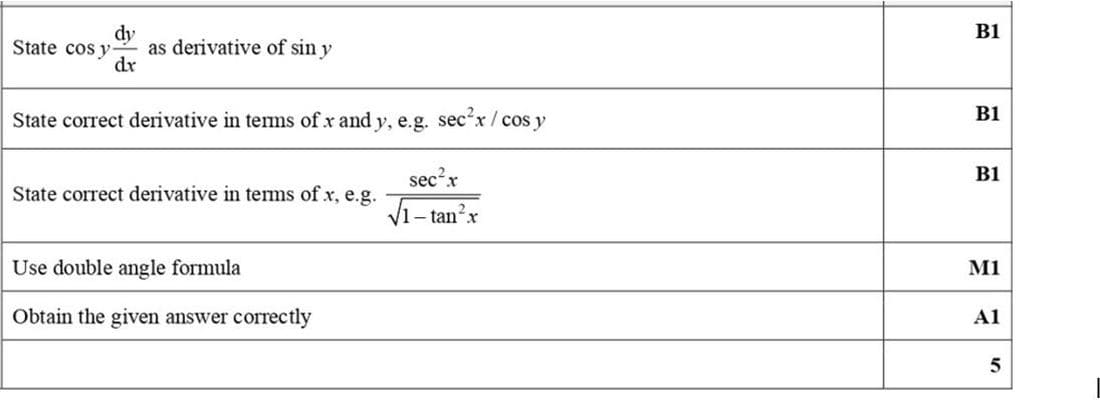
The variables x and y satisfy the relation \(\sin y = \tan x\), where \(-\frac{1}{2}\pi < y < \frac{1}{2}\pi\). Show that \(\frac{dy}{dx} = \frac{1}{\cos x \sqrt{\cos 2x}}\).