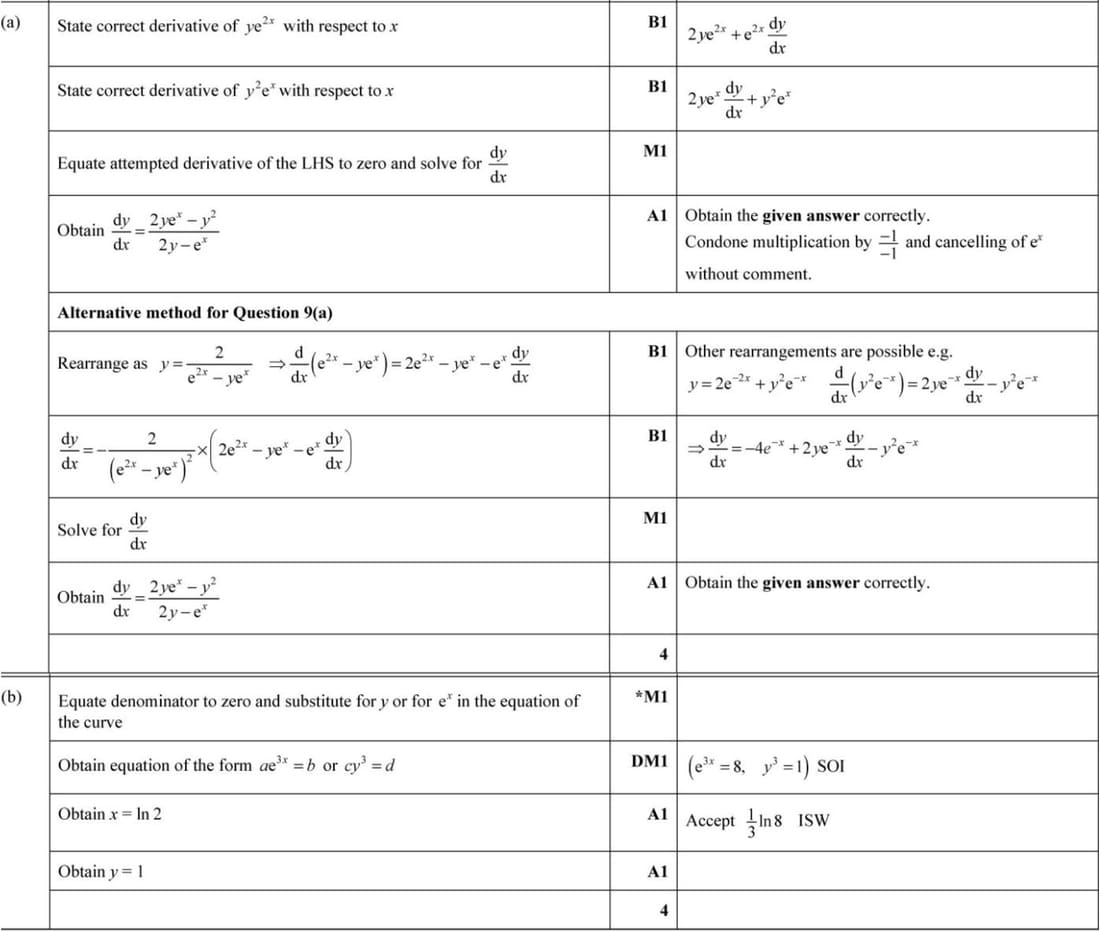
(a) Differentiate \(ye^{2x}\) with respect to \(x\):
\(\frac{d}{dx}(ye^{2x}) = 2ye^{2x} + e^{2x} \frac{dy}{dx}\).
Differentiate \(y^2 e^x\) with respect to \(x\):
\(\frac{d}{dx}(y^2 e^x) = 2y e^x \frac{dy}{dx} + y^2 e^x\).
Set the derivative of the left-hand side to zero and solve for \(\frac{dy}{dx}\):
\(2ye^{2x} + e^{2x} \frac{dy}{dx} - (2y e^x \frac{dy}{dx} + y^2 e^x) = 0\).
Rearrange to find \(\frac{dy}{dx}\):
\(\frac{dy}{dx} = \frac{2ye^x - y^2}{2y - e^x}\).
(b) For the tangent to be parallel to the y-axis, \(\frac{dy}{dx}\) is undefined, which occurs when the denominator is zero:
\(2y - e^x = 0 \Rightarrow y = \frac{e^x}{2}\).
Substitute \(y = \frac{e^x}{2}\) into the original equation:
\(\left(\frac{e^x}{2}\right)e^{2x} - \left(\frac{e^x}{2}\right)^2 e^x = 2\).
Simplify to find \(x\):
\(\frac{e^{3x}}{2} - \frac{e^{3x}}{4} = 2 \Rightarrow \frac{e^{3x}}{4} = 2 \Rightarrow e^{3x} = 8\).
\(3x = \ln 8 \Rightarrow x = \frac{1}{3} \ln 8 = \ln 2\).
Substitute back to find \(y\):
\(y = \frac{e^{\ln 2}}{2} = 1\).
The coordinates are \((\ln 2, 1)\).