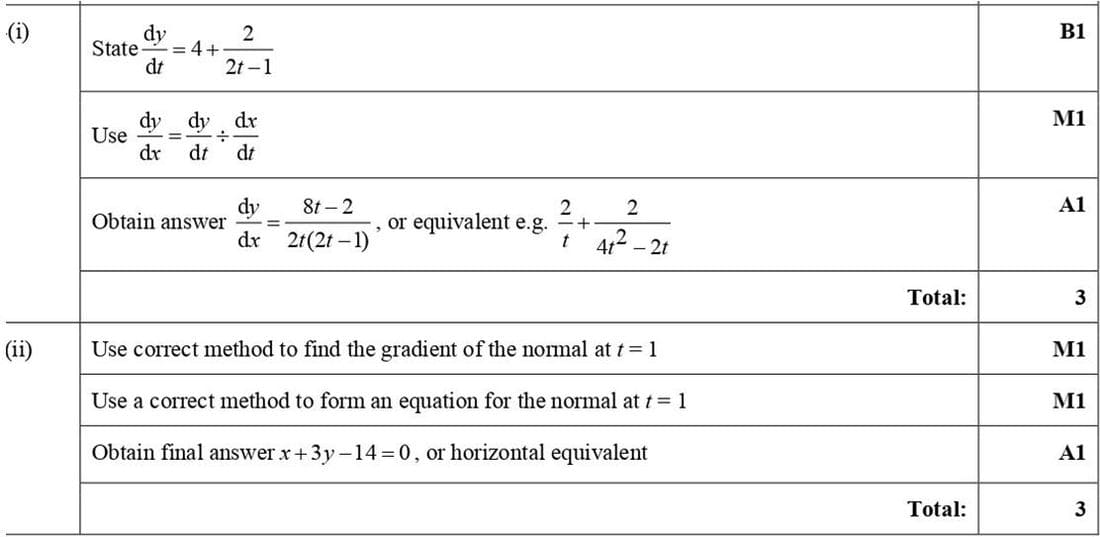
(i) First, find \(\frac{dy}{dt}\) and \(\frac{dx}{dt}\):
\(\frac{dy}{dt} = 4 + \frac{2}{2t - 1}\)
\(\frac{dx}{dt} = 2t\)
Now, use the chain rule to find \(\frac{dy}{dx}\):
\(\frac{dy}{dx} = \frac{\frac{dy}{dt}}{\frac{dx}{dt}} = \frac{4 + \frac{2}{2t - 1}}{2t}\)
Simplify to obtain:
\(\frac{dy}{dx} = \frac{8t - 2}{2t(2t - 1)}\)
(ii) To find the equation of the normal, first find the gradient of the tangent at \(t = 1\):
Substitute \(t = 1\) into \(\frac{dy}{dx}\):
\(\frac{dy}{dx} = \frac{8(1) - 2}{2(1)(2(1) - 1)} = \frac{6}{2} = 3\)
The gradient of the normal is the negative reciprocal of the tangent's gradient:
\(m_{\text{normal}} = -\frac{1}{3}\)
Find the point on the curve at \(t = 1\):
\(x = 1^2 + 1 = 2\)
\(y = 4(1) + \ln(2(1) - 1) = 4 + \ln(1) = 4\)
Using the point-slope form of the line equation:
\(y - 4 = -\frac{1}{3}(x - 2)\)
Rearrange to the form \(ax + by + c = 0\):
\(3(y - 4) = -(x - 2)\)
\(3y - 12 = -x + 2\)
\(x + 3y - 14 = 0\)