9709 P31 - Nov 2020 - Q3
1616
The parametric equations of a curve are
\(x = 3 - \\cos 2\theta\), \(y = 2\theta + \\sin 2\theta\),
for \(0 < \theta < \frac{1}{2}\pi\).
Show that \(\frac{dy}{dx} = \cot \theta\).
Solution
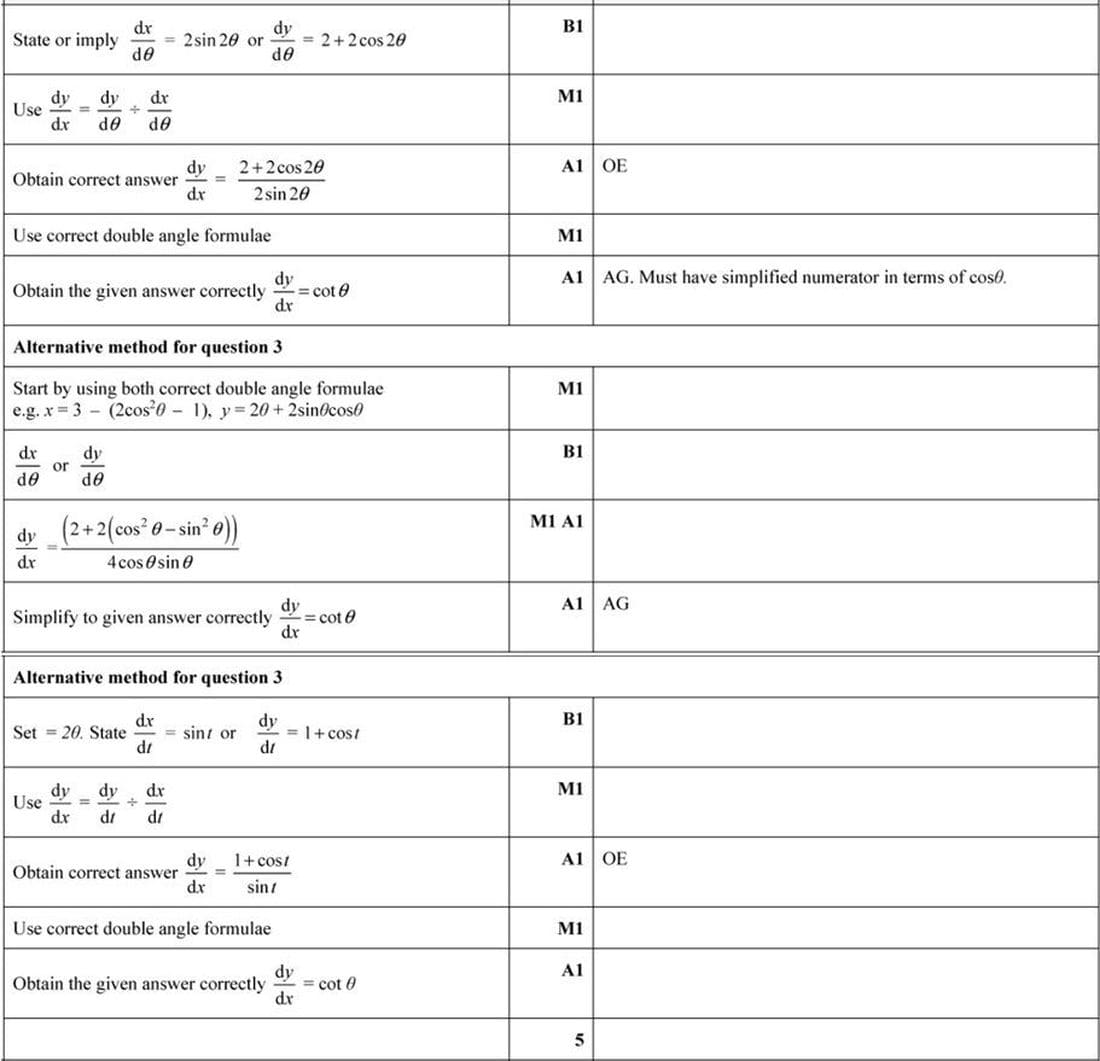
First, find \(\frac{dx}{d\theta}\) and \(\frac{dy}{d\theta}\):
\(\frac{dx}{d\theta} = 2\sin 2\theta\)
\(\frac{dy}{d\theta} = 2 + 2\cos 2\theta\)
Now, use the chain rule to find \(\frac{dy}{dx}\):
\(\frac{dy}{dx} = \frac{\frac{dy}{d\theta}}{\frac{dx}{d\theta}} = \frac{2 + 2\cos 2\theta}{2\sin 2\theta}\)
Simplify the expression:
\(\frac{dy}{dx} = \frac{1 + \cos 2\theta}{\sin 2\theta}\)
Using the double angle identities, \(\cos 2\theta = 1 - 2\sin^2 \theta\) and \(\sin 2\theta = 2\sin \theta \cos \theta\), we have:
\(\frac{dy}{dx} = \frac{1 + (1 - 2\sin^2 \theta)}{2\sin \theta \cos \theta} = \frac{2\cos^2 \theta}{2\sin \theta \cos \theta}\)
\(\frac{dy}{dx} = \frac{\cos \theta}{\sin \theta} = \cot \theta\)