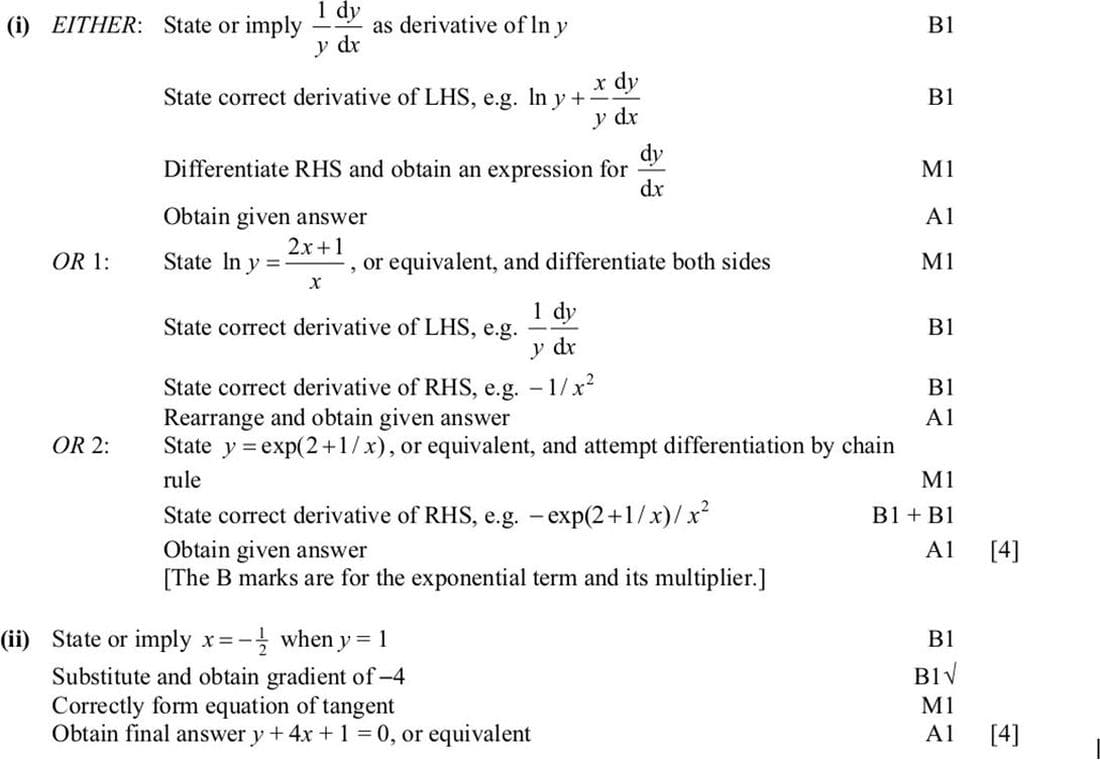
(i) Start with the equation \(x \ln y = 2x + 1\).
Differentiate both sides with respect to \(x\):
\(\frac{d}{dx}(x \ln y) = \frac{d}{dx}(2x + 1)\).
Using the product rule on the left side: \(\ln y + x \cdot \frac{1}{y} \cdot \frac{dy}{dx} = 2\).
Rearrange to solve for \(\frac{dy}{dx}\):
\(x \cdot \frac{1}{y} \cdot \frac{dy}{dx} = 2 - \ln y\).
\(\frac{dy}{dx} = \frac{y(2 - \ln y)}{x}\).
Substitute \(\ln y = \frac{2x + 1}{x}\) from the original equation:
\(\frac{dy}{dx} = \frac{y(2 - \frac{2x + 1}{x})}{x} = -\frac{y}{x^2}\).
(ii) Given \(y = 1\), substitute into the original equation:
\(x \ln 1 = 2x + 1 \Rightarrow 0 = 2x + 1 \Rightarrow x = -\frac{1}{2}\).
Find the gradient at this point using \(\frac{dy}{dx} = -\frac{y}{x^2}\):
\(\frac{dy}{dx} = -\frac{1}{(-\frac{1}{2})^2} = -4\).
The equation of the tangent line is \(y - 1 = -4(x + \frac{1}{2})\).
Simplify to the form \(ax + by + c = 0\):
\(y - 1 = -4x - 2 \Rightarrow y + 4x + 1 = 0\).