Past Exam Questions
← Back9231 P11 - Jun 2024 - Q06 - 15 marks
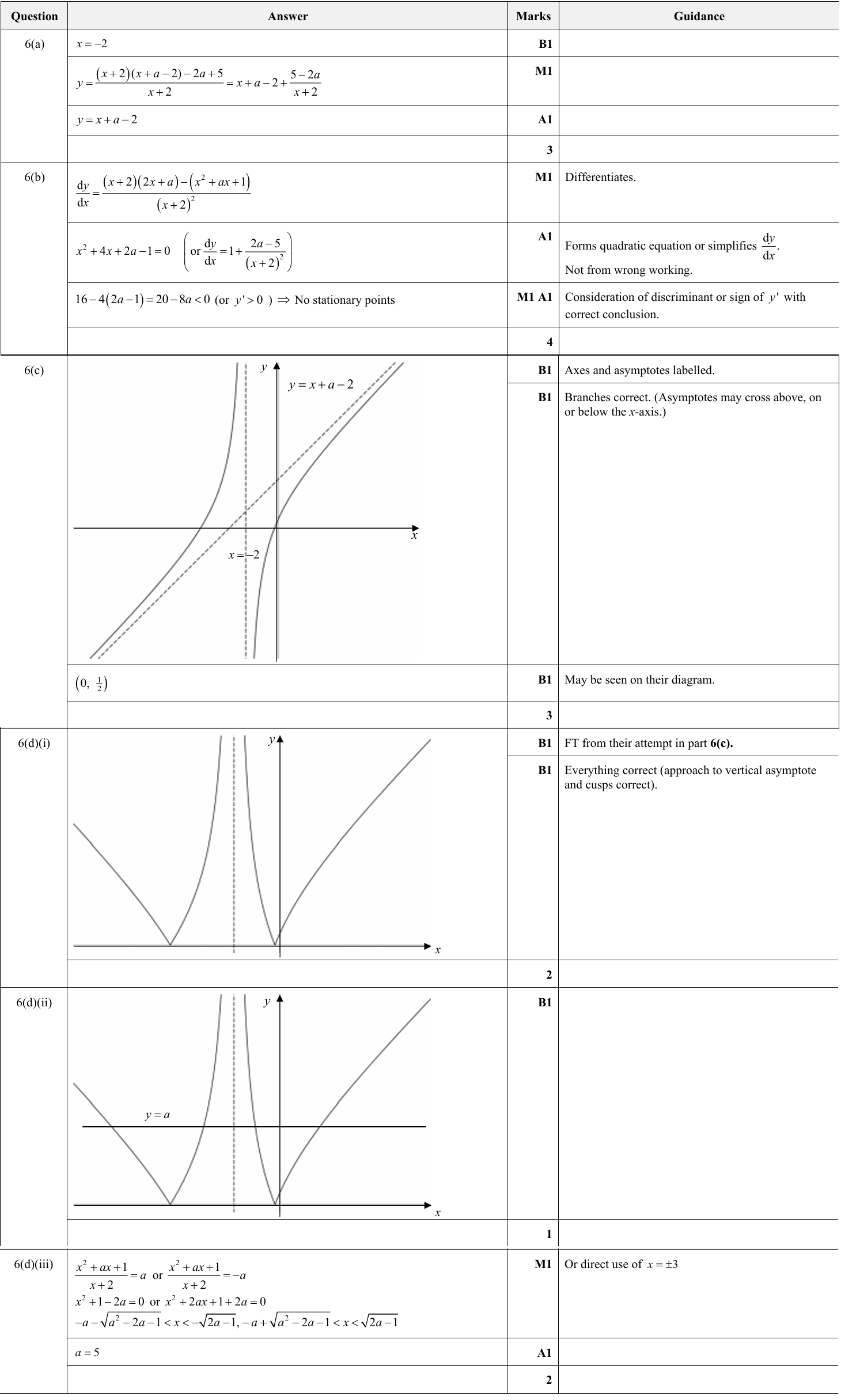
The curve C has equation \(y = \frac{x^2 + ax + 1}{x + 2}\), where \(a > \frac{5}{2}\).
- Find the equations of the asymptotes of C.
- Show that C has no stationary points.
- Sketch C, stating the coordinates of the point of intersection with the y-axis and labelling the asymptotes.
-
- Sketch the curve with equation \(y = \left| \frac{x^2 + ax + 1}{x + 2} \right|\).
- On your sketch in part (i), draw the line \(y = a\).
- It is given that \(\left| \frac{x^2 + ax + 1}{x + 2} \right| < a\) for \(-5 - \sqrt{14} < x < -3\) and \(-5 + \sqrt{14} < x < 3\). Find the value of \(a\).
9231 P12 - Jun 2024 - Q06 - 15 marks
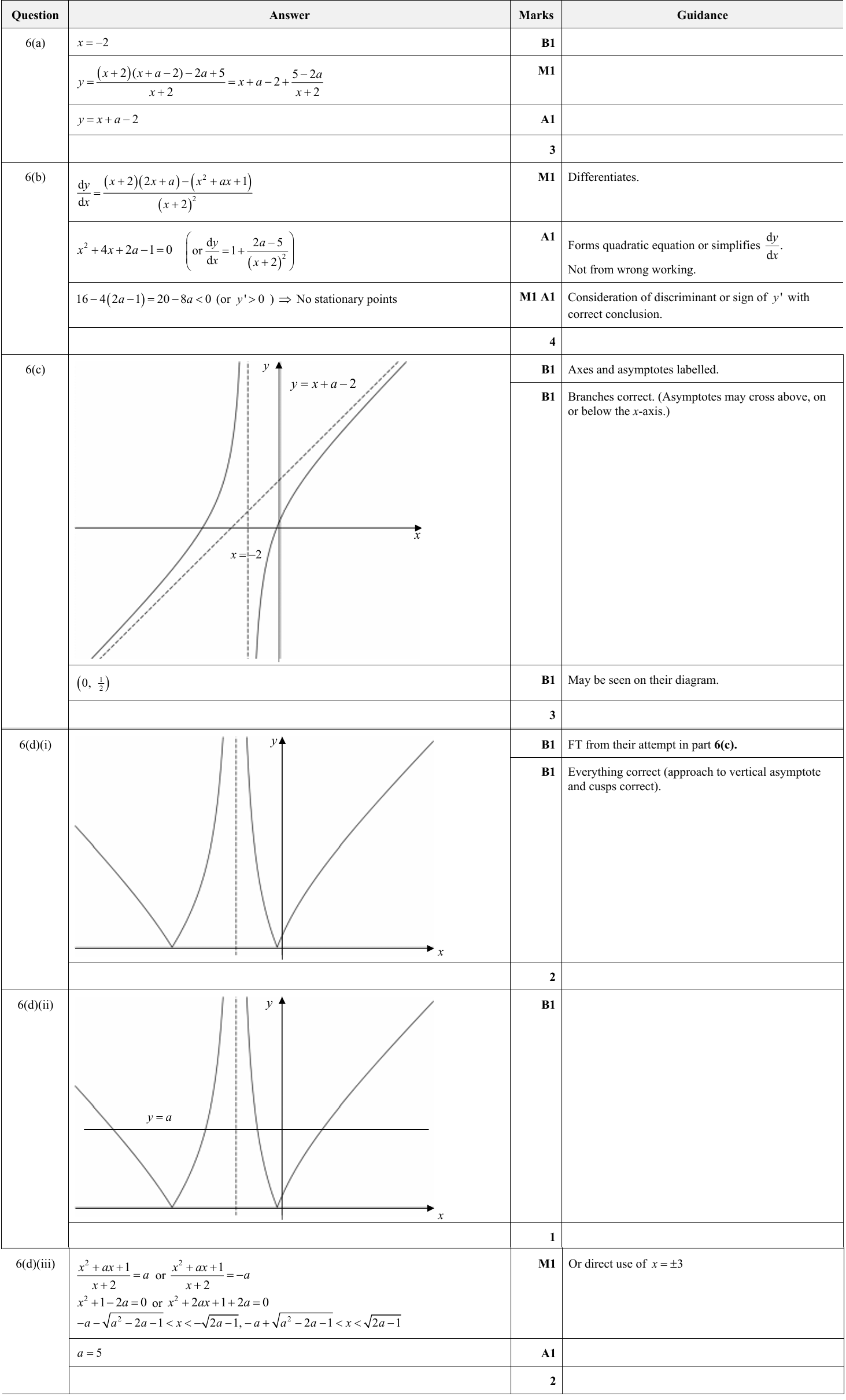
The curve \(C\) has equation \(y = \frac{x^2 + ax + 1}{x + 2}\), where \(a > \frac{5}{2}\).
- (a) Find the equations of the asymptotes of \(C\).
- (b) Show that \(C\) has no stationary points.
- (c) Sketch \(C\), stating the coordinates of the point of intersection with the \(y\)-axis and labelling the asymptotes.
- (d)
- Sketch the curve with equation \(y = \left| \frac{x^2 + ax + 1}{x + 2} \right|\).
- On your sketch in part (i), draw the line \(y = a\).
- It is given that \(\left| \frac{x^2 + ax + 1}{x + 2} \right| < a\) for \(-5 - \sqrt{14} < x < -3\) and \(-5 + \sqrt{14} < x < 3\). Find the value of \(a\).
9231 P12 - Jun 2021 - Q07 - 15 marks
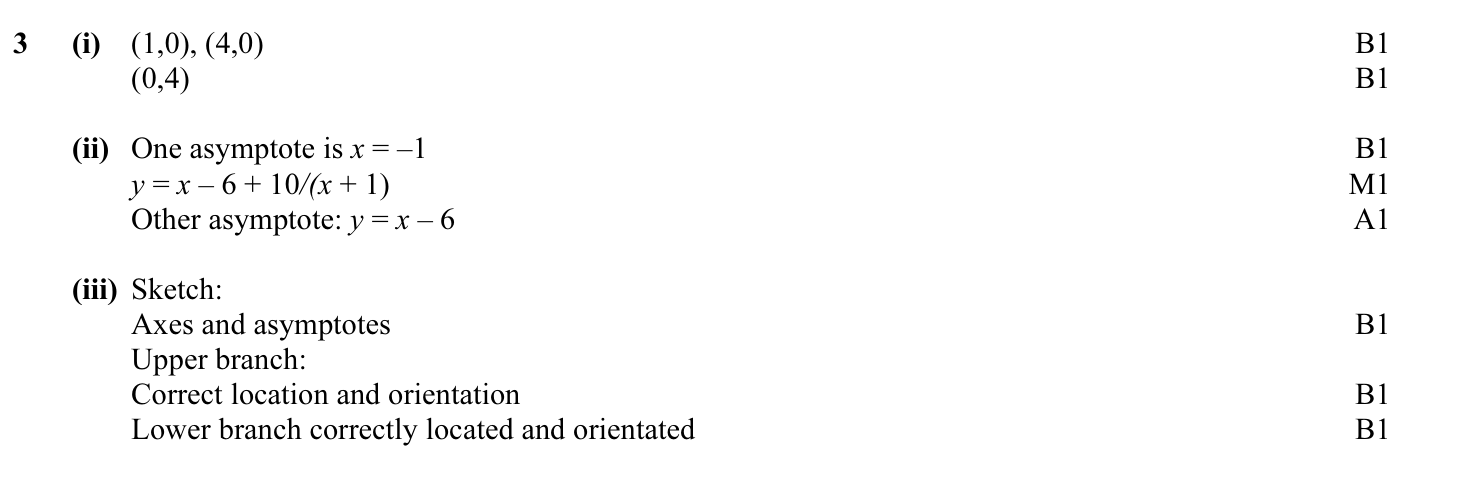
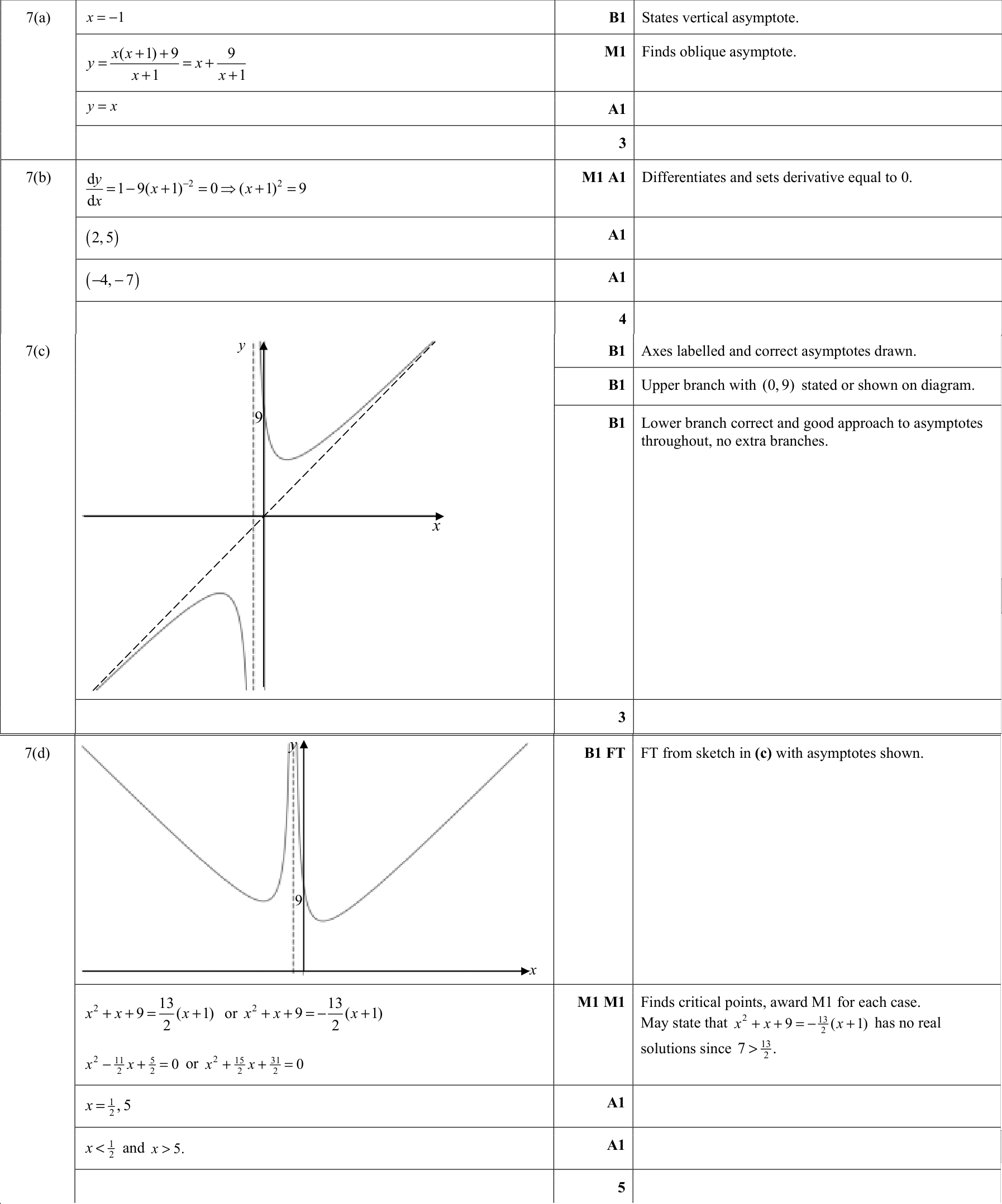
The curve C has equation \(y = \frac{x^2 + x + 9}{x + 1}\).
(a) Find the equations of the asymptotes of C.
(b) Find the coordinates of the stationary points on C.
9231 P11 - Nov 2020 - Q6 - 12 marks
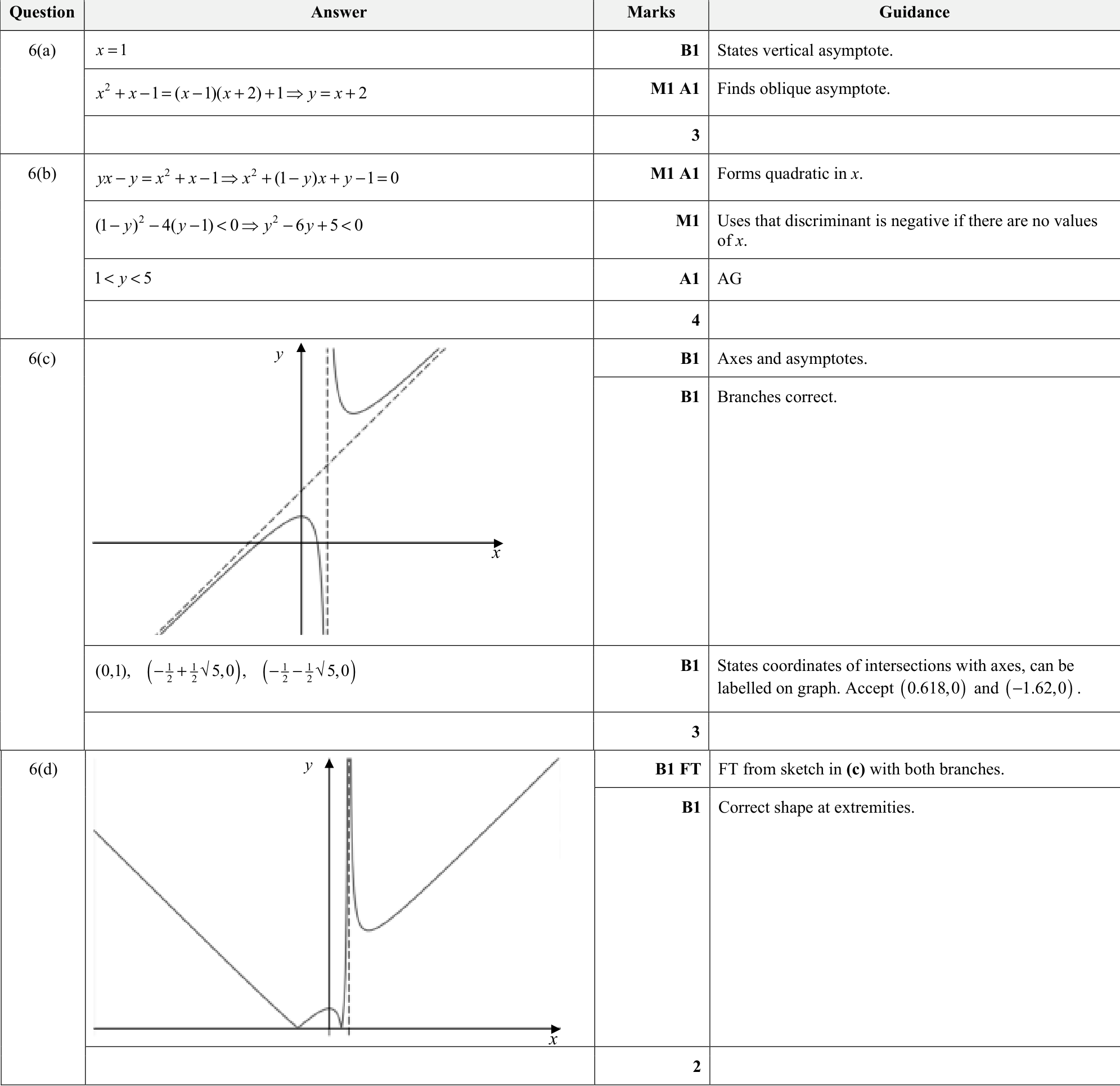
6 The curve \(C\) has equation \(y=\frac{x^{2}+x-1}{x-1}\).
(a) Find the equations of the asymptotes of \(C\).
(b) Show that there is no point on \(C\) for which \(1<y<5\).
(c) Find the coordinates of the intersections of \(C\) with the axes, and sketch \(C\).
(d) Sketch the curve with equation \(y=\left|\frac{x^{2}+x-1}{x-1}\right|\).
9231 P11 - Jun 2020 - Q3 - 9 marks
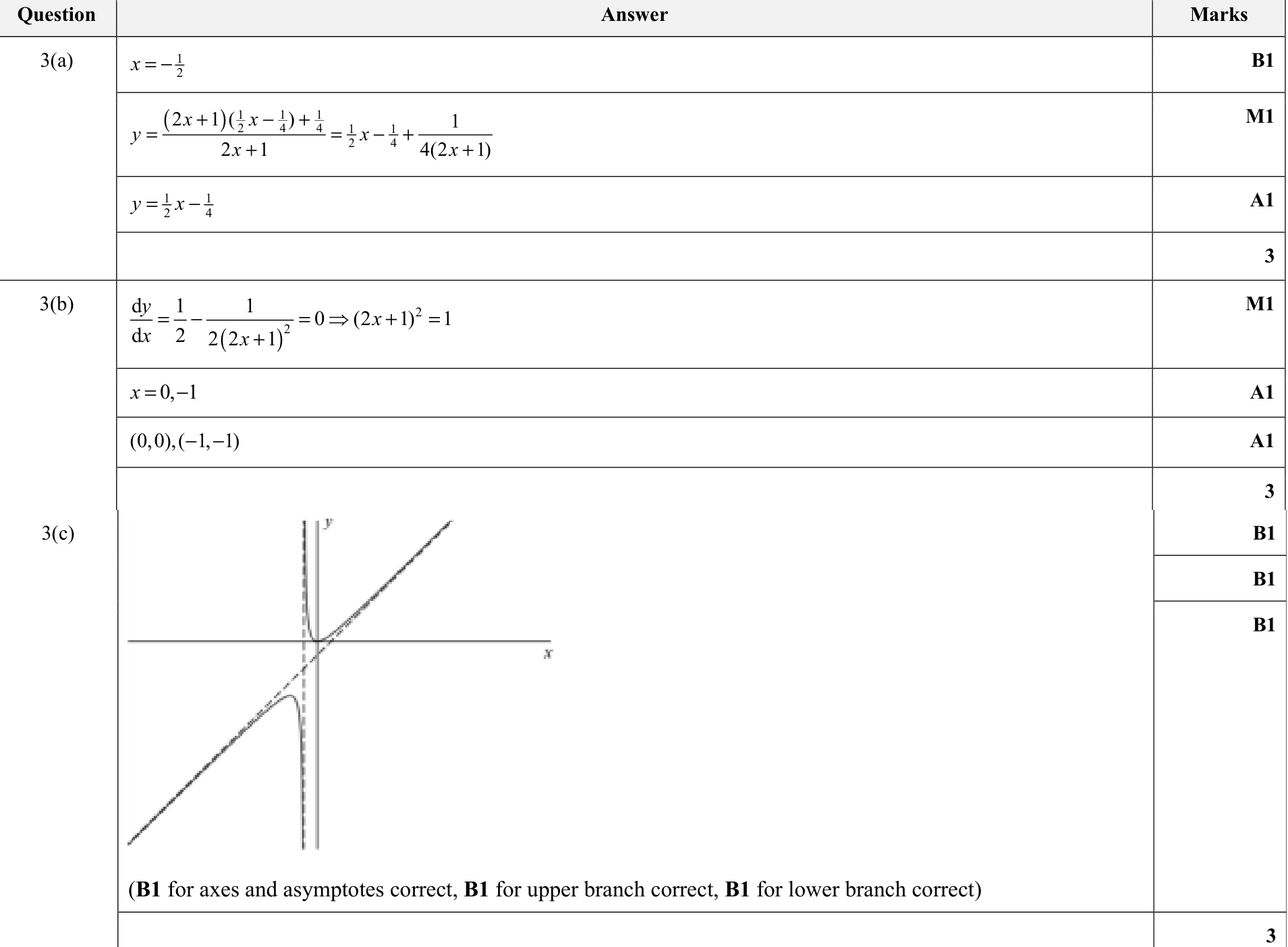
3 The curve \(C\) has equation \(y=\frac{x^{2}}{2 x+1}\).
(a) Find the equations of the asymptotes of \(C\).
(b) Find the coordinates of the stationary points on \(C\).
(c) Sketch \(C\).
9231 P13 - Jun 2019 - Q6 - 9 marks
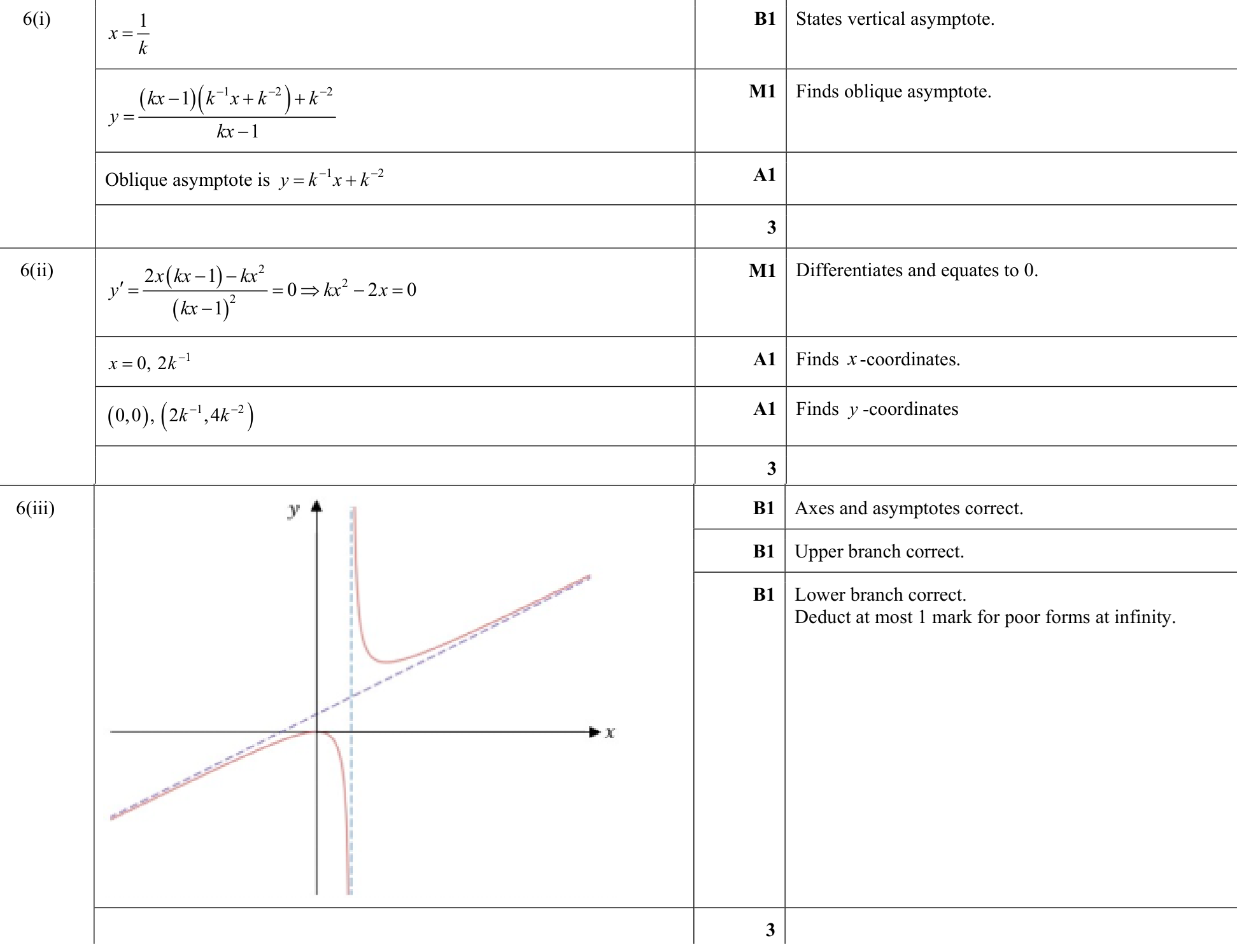
6 The curve \(C\) has equation
\(y=\frac{x^{2}}{k x-1}\)
where \(k\) is a positive constant.
(i) Obtain the equations of the asymptotes of \(C\).
(ii) Find the coordinates of the stationary points of \(C\).
(iii) Sketch \(C\).
9231 P11 - Nov 2019 - Q4 - 7 marks
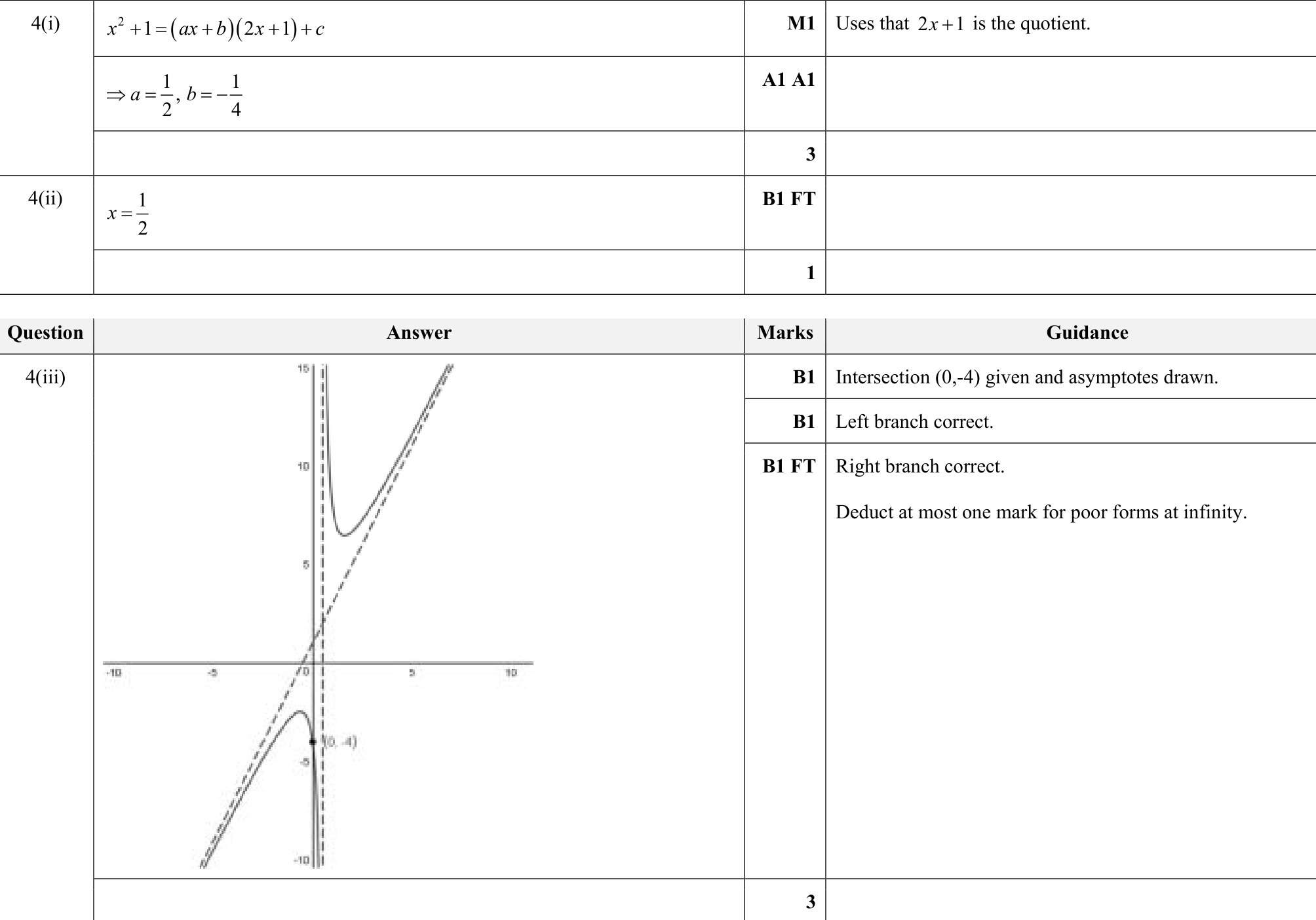
The line \(y=2 x+1\) is an asymptote of the curve \(C\) with equation
\(y=\frac{x^{2}+1}{a x+b}\)
(i) Find the values of the constants \(a\) and \(b\).
(ii) State the equation of the other asymptote of \(C\).
(iii) Sketch C. [Your sketch should indicate the coordinates of any points of intersection with the \(y\)-axis. You do not need to find the coordinates of any stationary points.]
9231 P11 - Jun 2018 - Q6 - 9 marks
The curve \(C\) has equation
\(y=\frac{x^{2}+b}{x+b},\)
where \(b\) is a positive constant.
(i) Find the equations of the asymptotes of \(C\).
(ii) Show that \(C\) does not intersect the \(x\)-axis.
(iii) Justifying your answer, find the number of stationary points on \(C\).
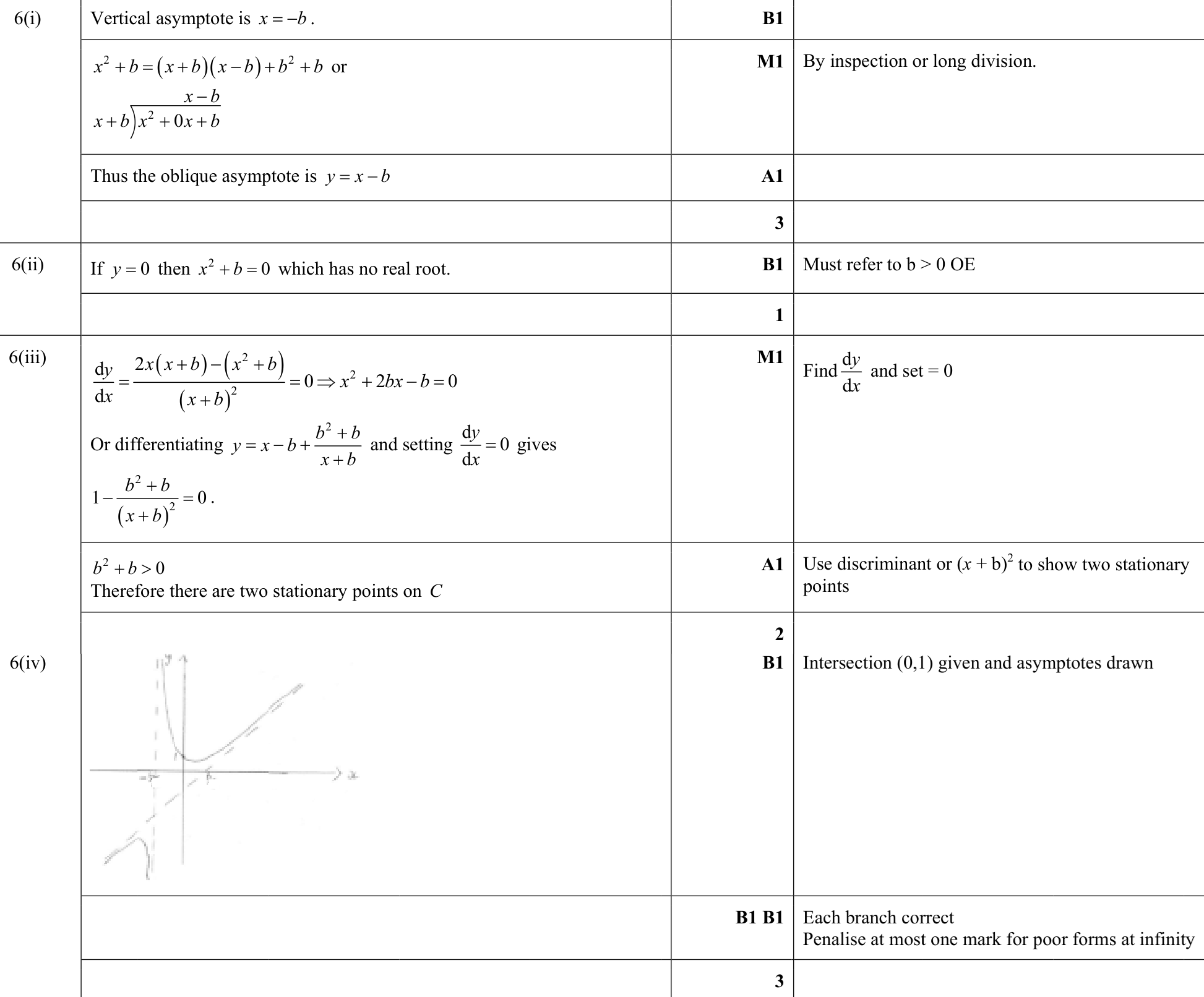
(iv) Sketch \(C\). Your sketch should indicate the coordinates of any points of intersection with the \(y\)-axis. You do not need to find the coordinates of any stationary points.
9231 P13 - Jun 2018 - Q4 - 8 marks
The curve \(C\) has equation
\(y=\frac{x^{2}+7 x+6}{x-2} .\)
(i) Find the coordinates of the points of intersection of \(C\) with the axes.
(ii) Find the equation of each of the asymptotes of \(C\).
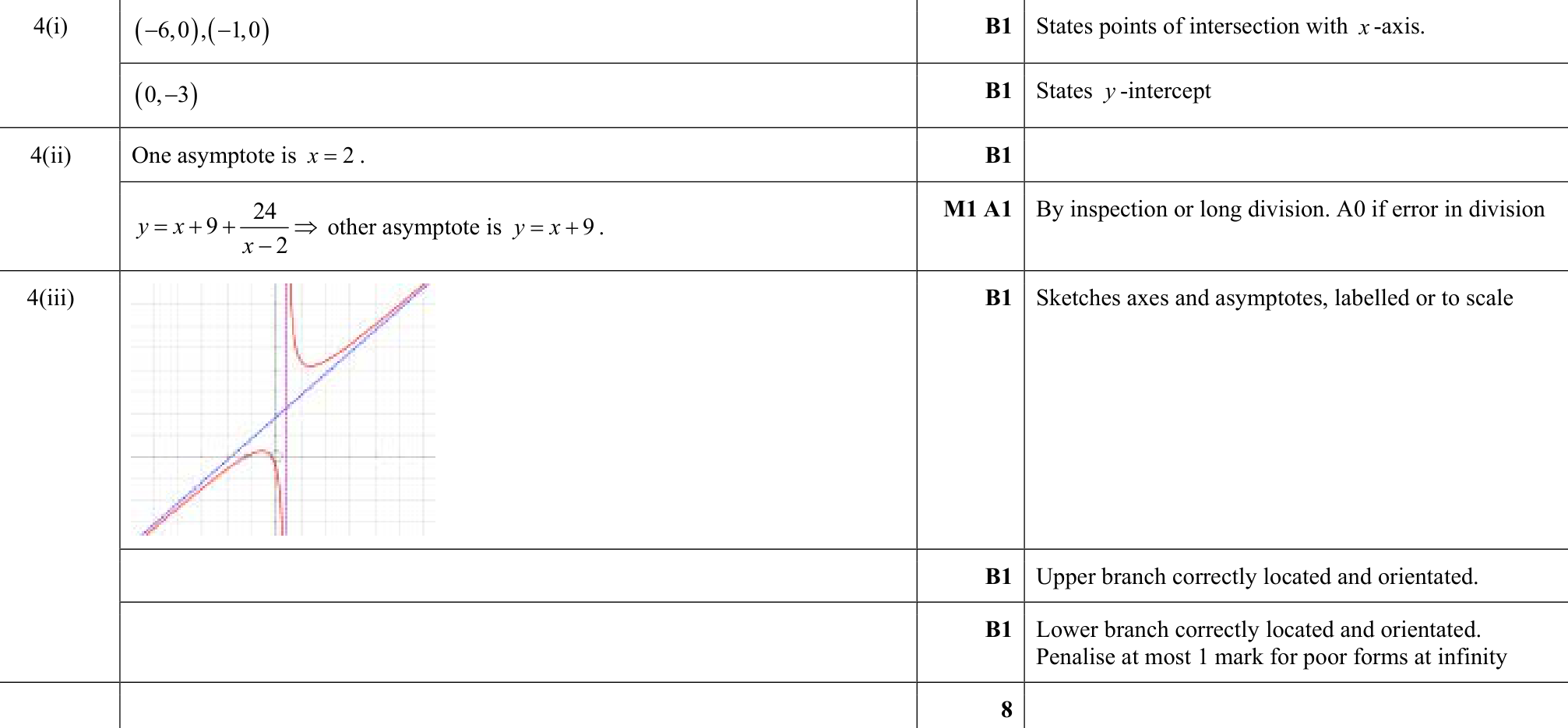
(iii) Sketch \(C\).
9231 P11 - Nov 2018 - Q6 - 9 marks
The curve \(C\) has equation
\(y=\frac{x^{2}+a x-1}{x+1},\)
where \(a\) is constant and \(a\gt 1\).
(i) Find the equations of the asymptotes of \(C\).
(ii) Show that \(C\) intersects the \(x\)-axis twice.
(iii) Justifying your answer, find the number of stationary points on \(C\).
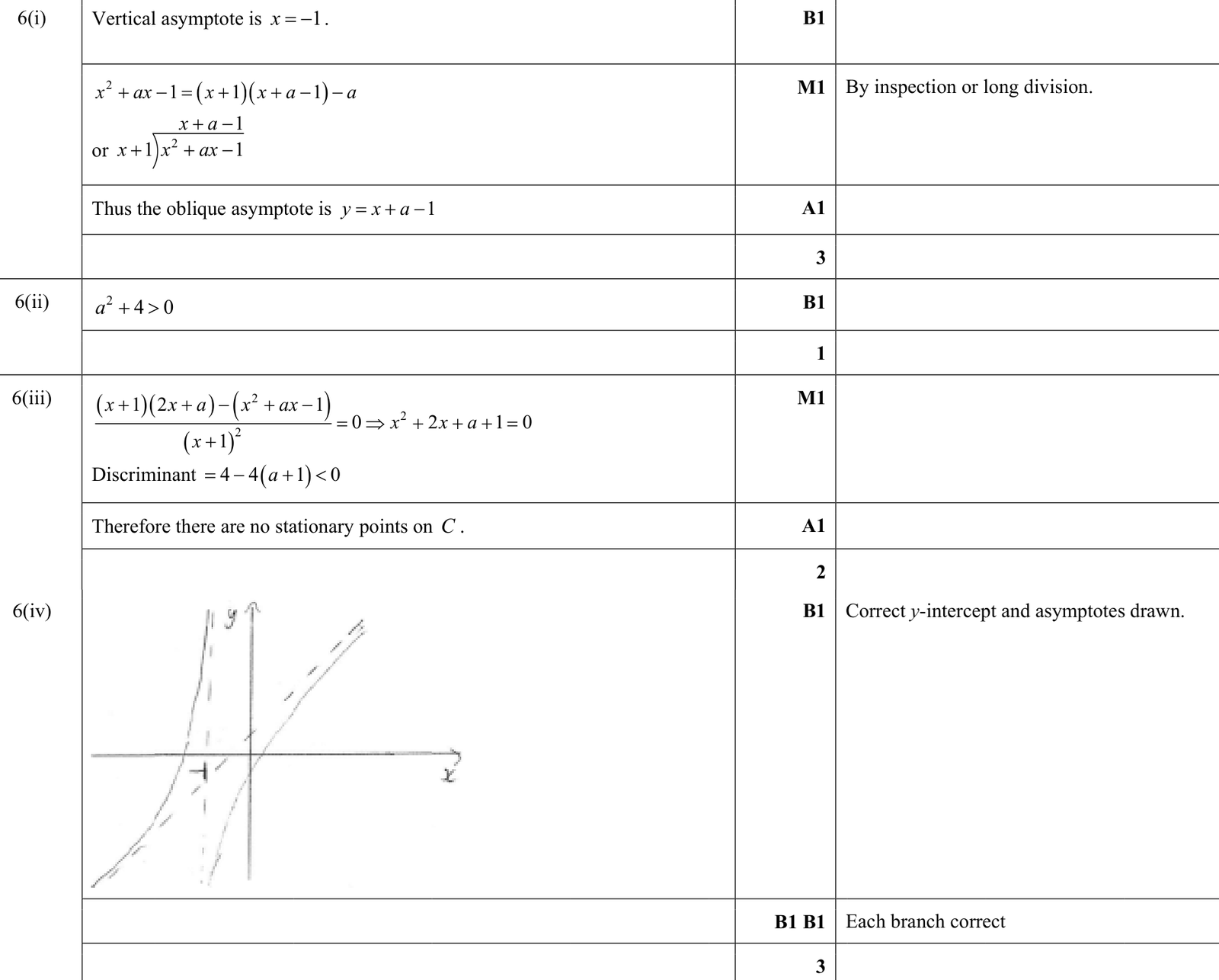
(iv) Sketch \(C\), stating the coordinates of its point of intersection with the \(y\)-axis.
9231 P12 - Nov 2018 - Q9 - 10 marks
The curve \(C\) has equation
\(y=\frac{5 x^{2}+5 x+1}{x^{2}+x+1} .\)
(i) Find the equation of the asymptote of \(C\).
(ii) Show that, for all real values of \(x,-\frac{1}{3} \leqslant y\lt 5\).
(iii) Find the coordinates of any stationary points of \(C\).
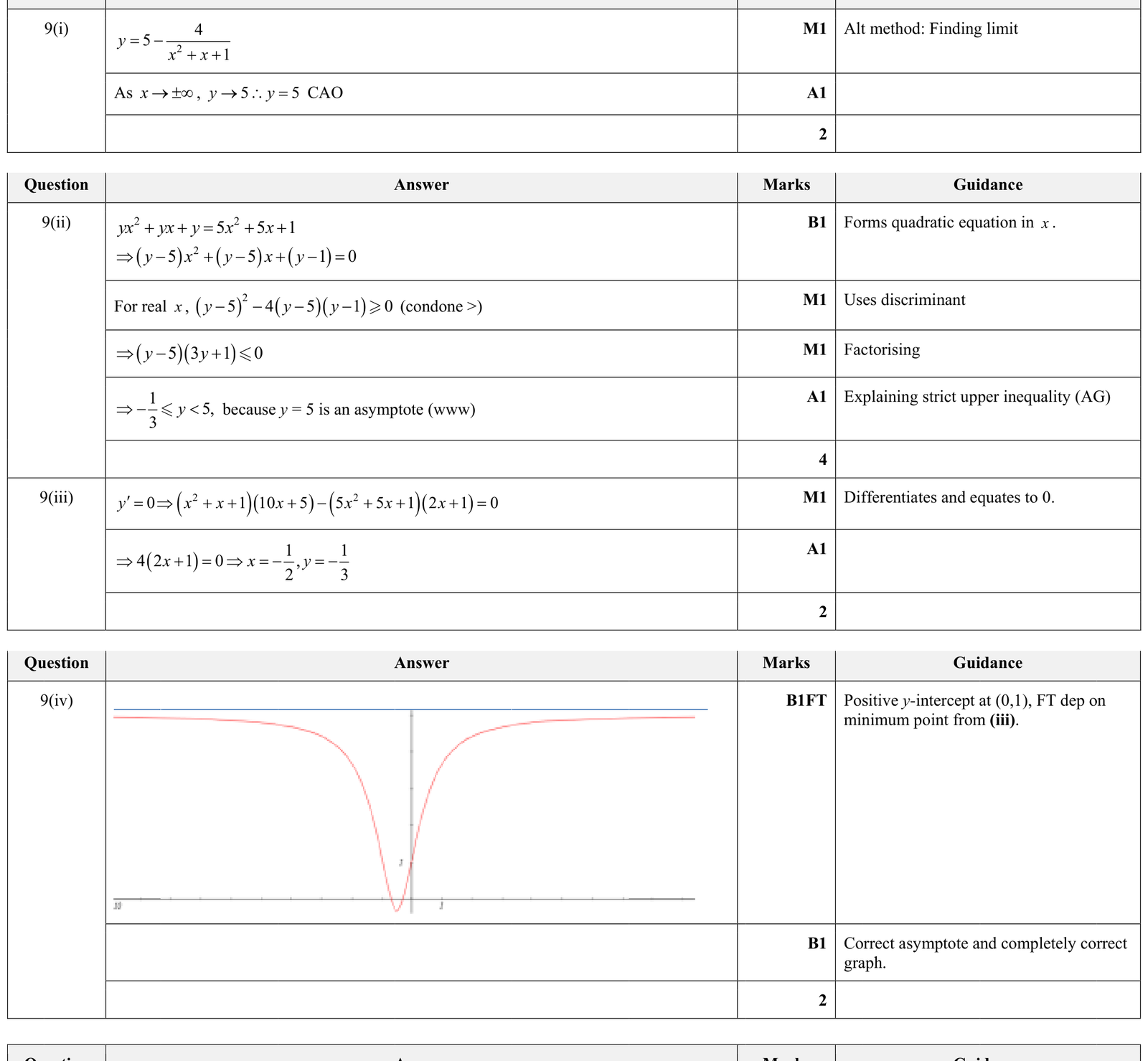
(iv) Sketch \(C\), stating the coordinates of any intersections with the \(y\)-axis.
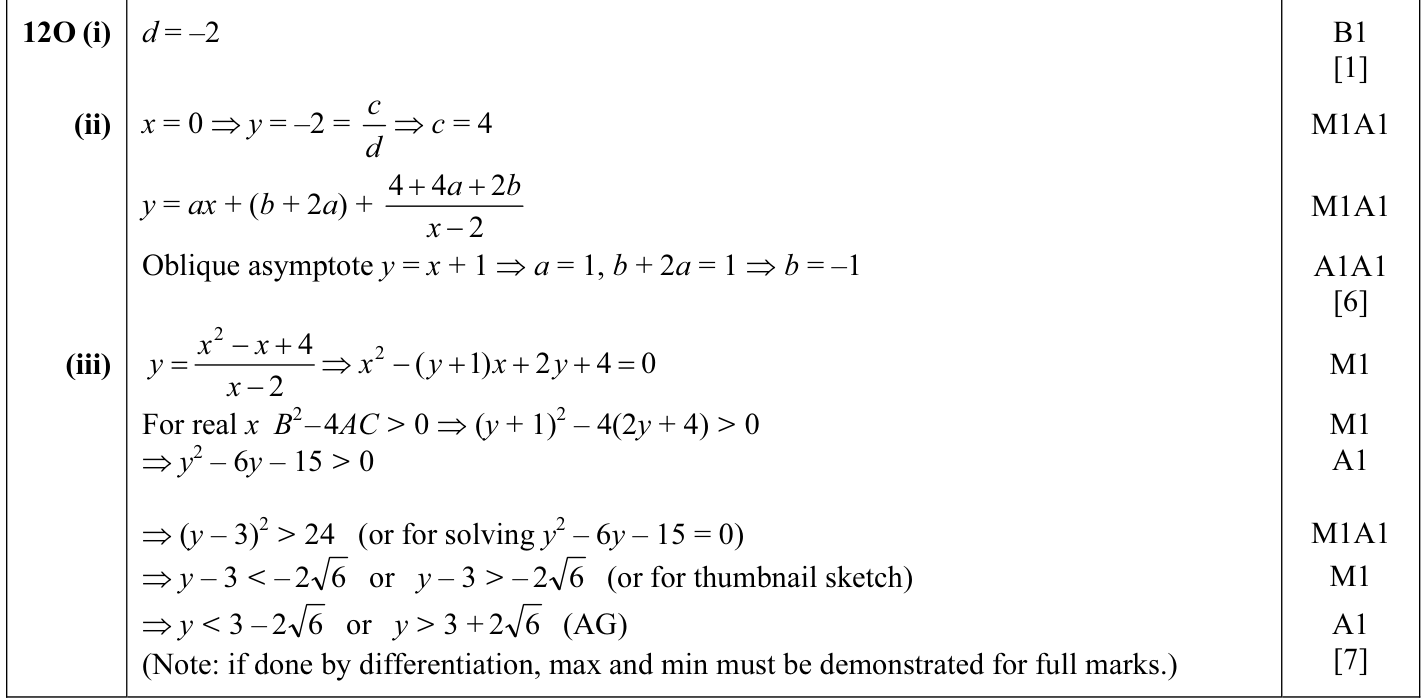
9231 P11 - Jun 2014 - Q12O - 14 marks
The curve \(C\) has equation
\(y=\frac{ax^2+bx+c}{x+d},\)
where \(a\), \(b\), \(c\), and \(d\) are constants. The curve cuts the \(y\)-axis at \((0,-2)\) and has asymptotes \(x=2\) and \(y=x+1\).
(i) Write down the value of \(d\).
(ii) Determine the values of \(a\), \(b\), and \(c\).
(iii) Show that, at all points on \(C\), either \(y\leq3-2\sqrt6\) or \(y\geq3+2\sqrt6\).
9231 P12 - Nov 2014 - Q4 - 7 marks
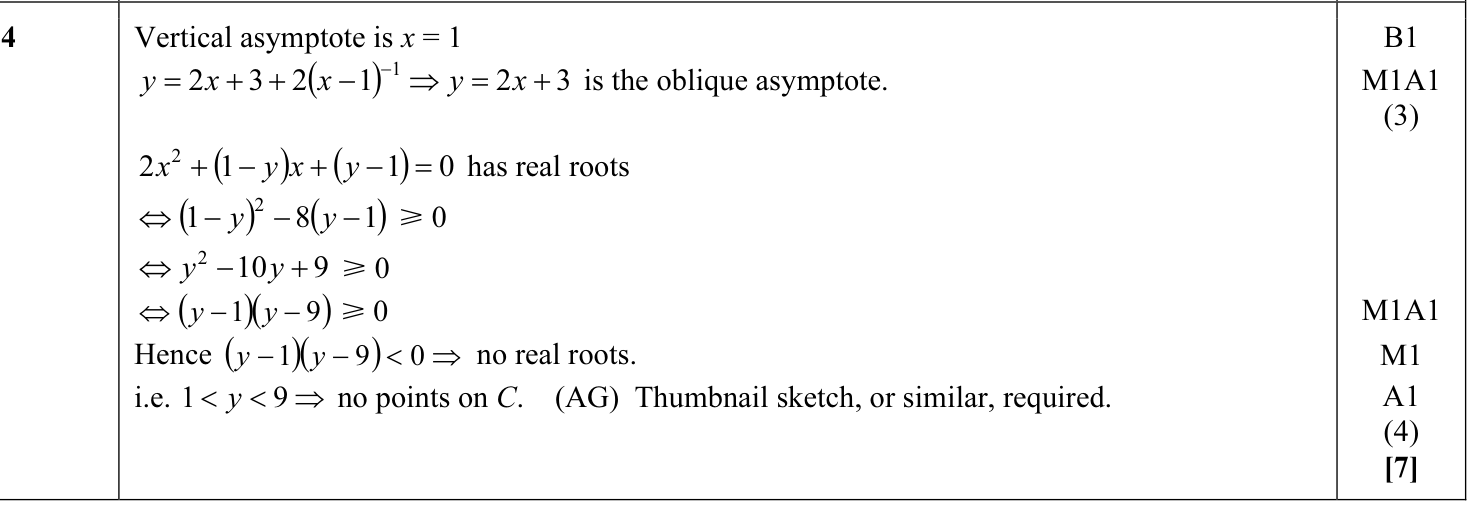
A curve \(C\) has equation \(y=\frac{2 x^{2}+x-1}{x-1}\). Find the equations of the asymptotes of \(C\).
Show that there is no point on \(C\) for which \(1\lt y\lt 9\).
9231 P11 - Nov 2014 - Q4 - 7 marks
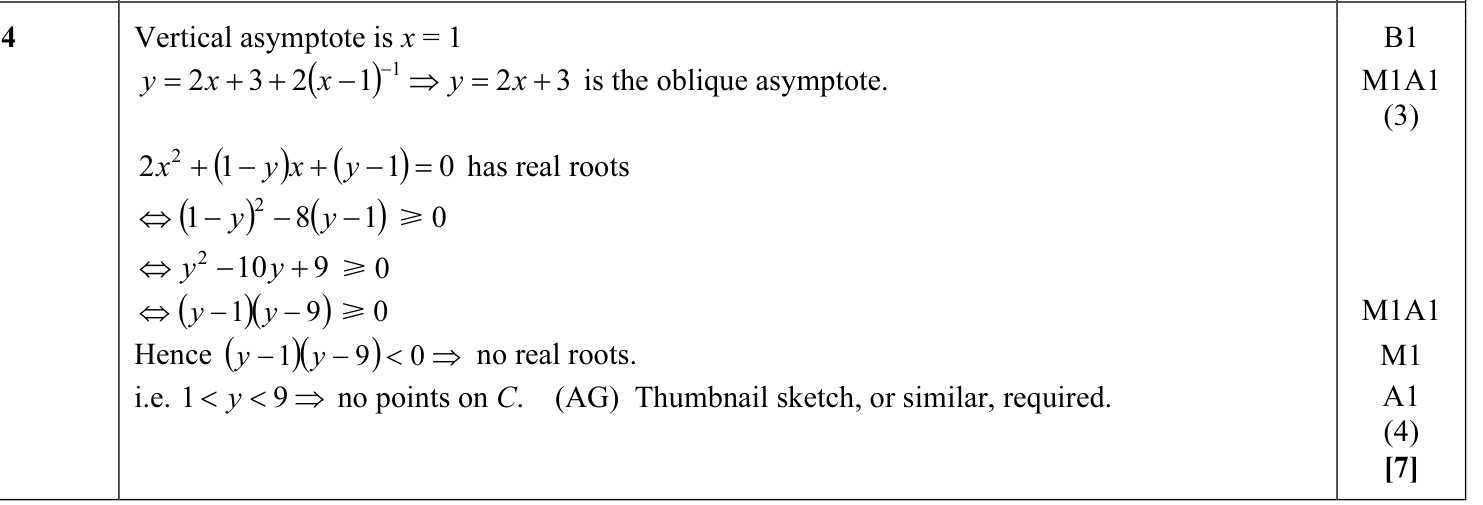
A curve \(C\) has equation \(y=\frac{2 x^{2}+x-1}{x-1}\). Find the equations of the asymptotes of \(C\).
Show that there is no point on \(C\) for which \(1\lt y\lt 9\).
9231 P11 - Jun 2013 - Q10 - 13 marks
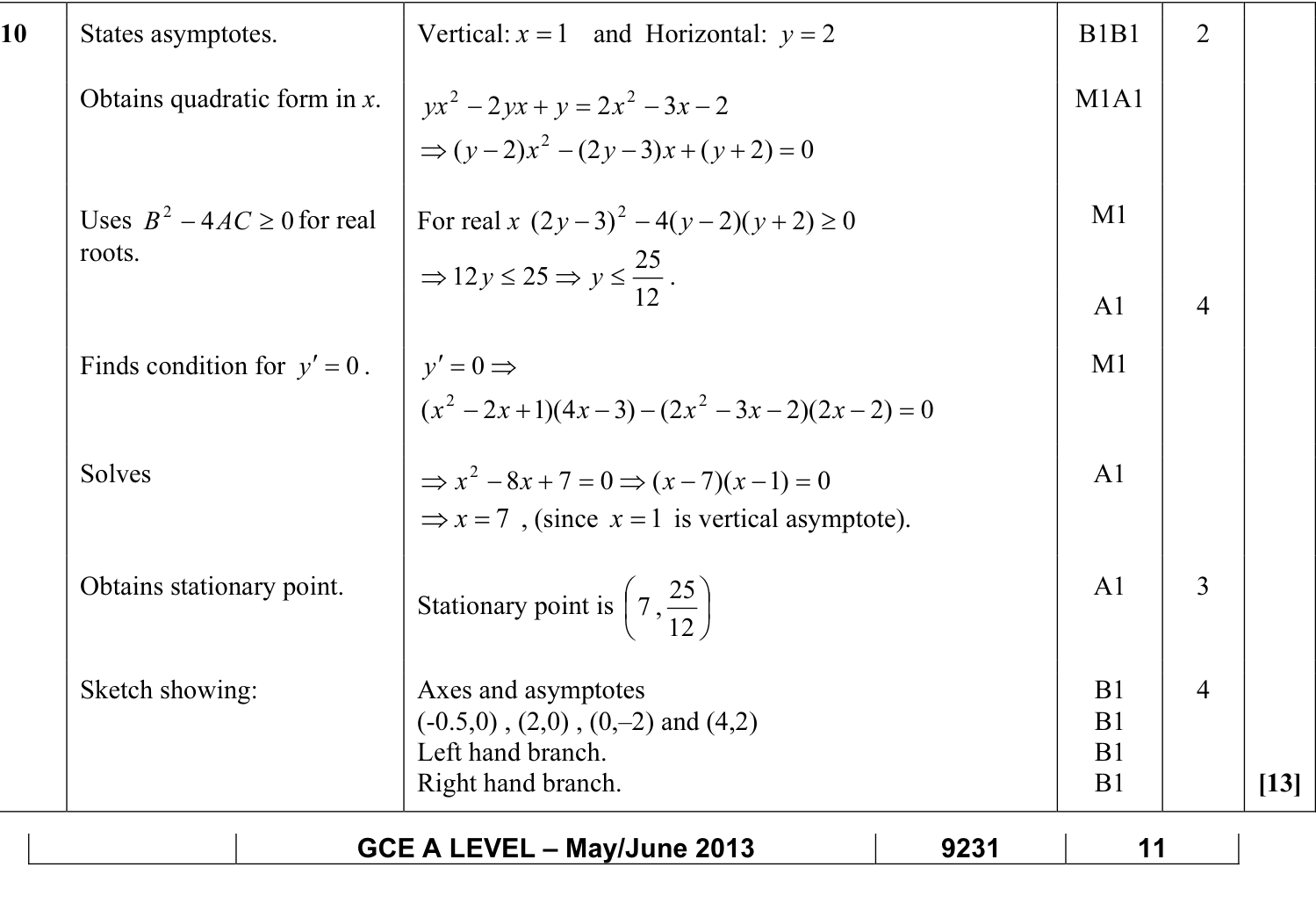
The curve \(C\) has equation \(y=\frac{2 x^{2}-3 x-2}{x^{2}-2 x+1}\). State the equations of the asymptotes of \(C\).
Show that \(y \leqslant \frac{25}{12}\) at all points of \(C\).
Find the coordinates of any stationary points of \(C\).
Sketch \(C\), stating the coordinates of any intersections of \(C\) with the coordinate axes and the asymptotes.
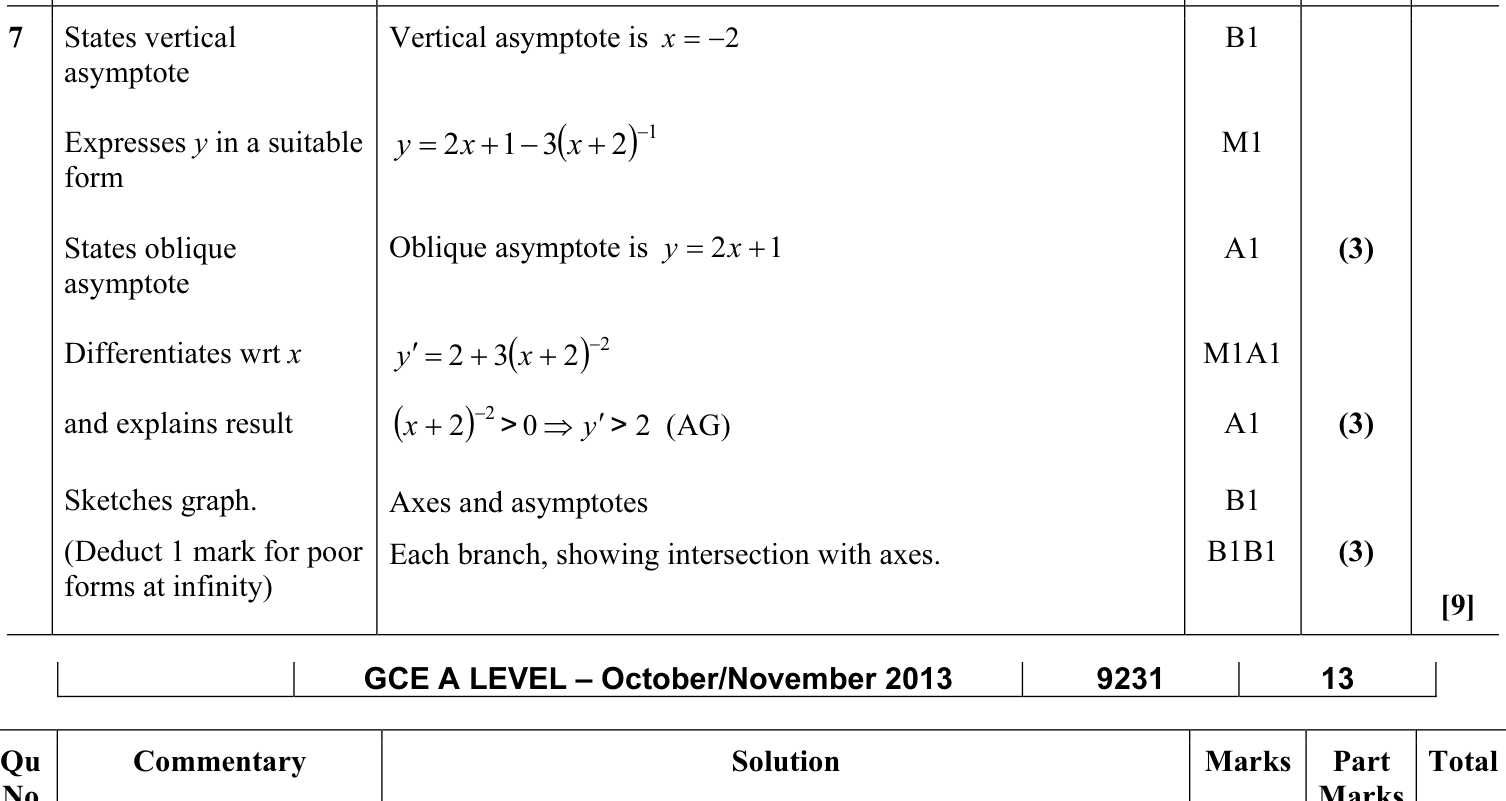
9231 P13 - Nov 2013 - Q7 - 9 marks
The curve \(C\) has equation
\(y=\frac{2 x^{2}+5 x-1}{x+2}\)
Find the equations of the asymptotes of \(C\).
Show that \(\frac{\mathrm{d} y}{\mathrm{~d} x}\gt 2\) at all points on \(C\).
Sketch \(C\).
9231 P1 - Jun 2008 - Q9 - 10 marks
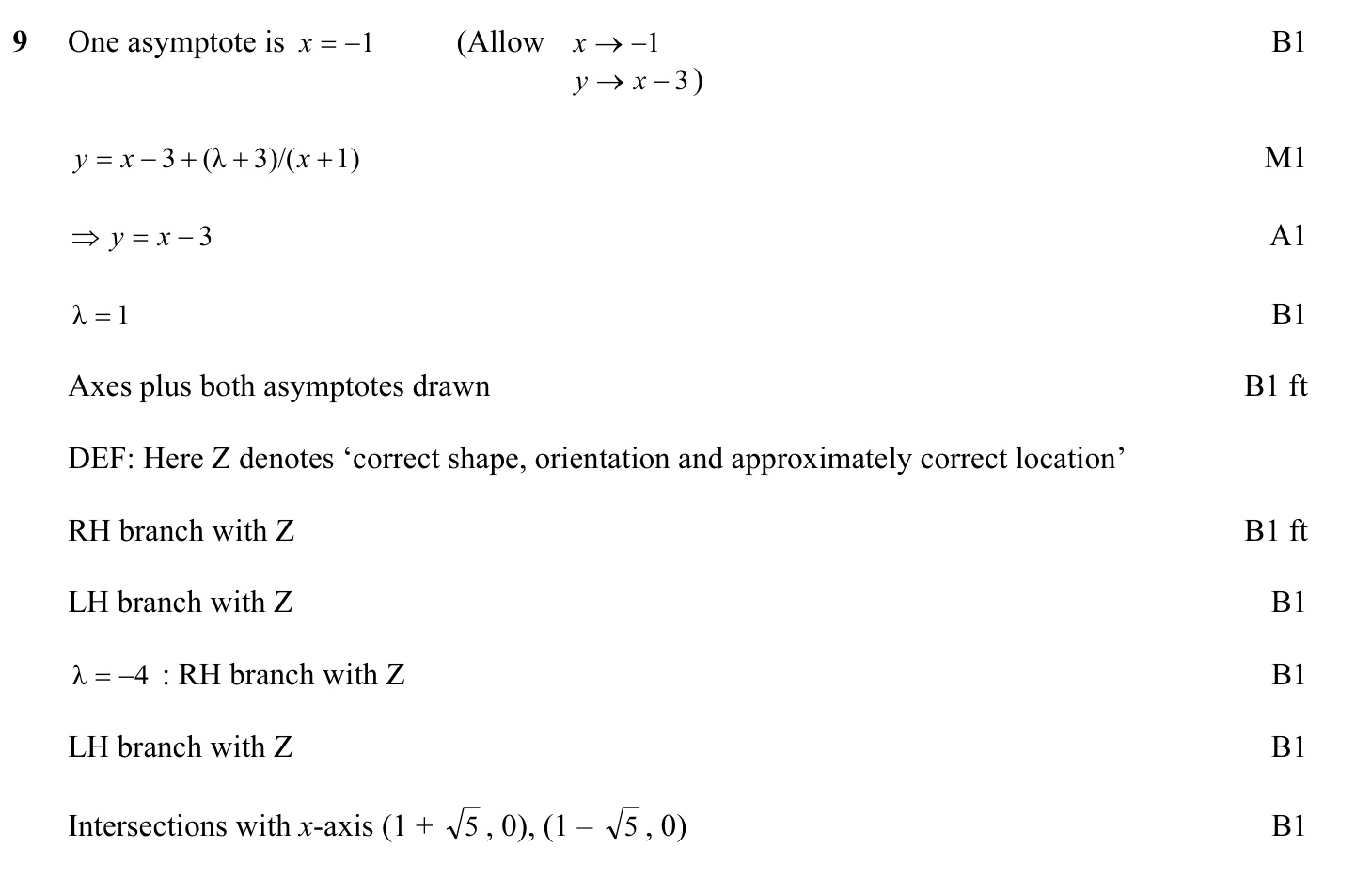
The curve \(C\) has equation
\(y=\frac{x^{2}-2 x+\lambda}{x+1},\)
where \(\lambda\) is a constant. Show that the equations of the asymptotes of \(C\) are independent of \(\lambda\).
Find the value of \(\lambda\) for which the \(x\)-axis is a tangent to \(C\), and sketch \(C\) in this case.
Sketch \(C\) in the case \(\lambda=-4\), giving the exact coordinates of the points of intersection of \(C\) with the \(x\)-axis.
9231 P12 - Jun 2014 - Q12 - 28 marks
Answer only one of the following two alternatives.
EITHER
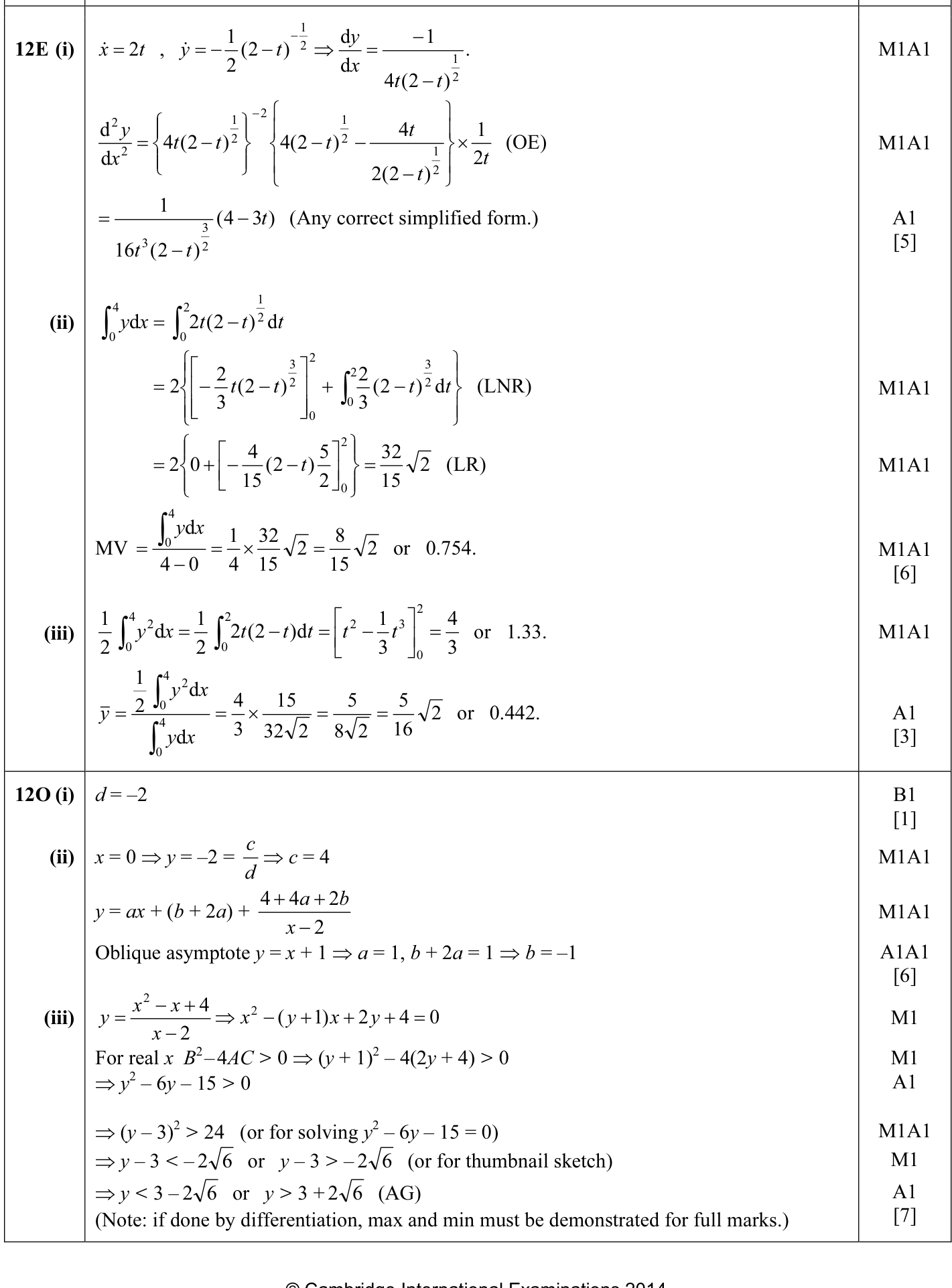
The curve \(C\) has parametric equations
\(x=t^{2}, \quad y=(2-t)^{\frac{1}{2}}, \quad \text { for } 0 \leqslant t \leqslant 2 .\)
Find
(i) \(\frac{\mathrm{d}^{2} y}{\mathrm{~d} x^{2}}\) in terms of \(t\),
(ii) the mean value of \(y\) with respect to \(x\) over the interval \(0 \leqslant x \leqslant 4\),
(iii) the \(y\)-coordinate of the centroid of the region enclosed by \(C\), the \(x\)-axis and the \(y\)-axis.
OR
The curve \(C\) has equation
\(y=\frac{a x^{2}+b x+c}{x+d},\)
where \(a, b, c\) and \(d\) are constants. The curve cuts the \(y\)-axis at \((0,-2)\) and has asymptotes \(x=2\) and \(y=x+1\).
(i) Write down the value of \(d\).
(ii) Determine the values of \(a, b\) and \(c\).
(iii) Show that, at all points on \(C\), either \(y \leqslant 3-2 \sqrt{ } 6\) or \(y \geqslant 3+2 \sqrt{ } 6\).
9231 P13 - Jun 2010 - Q6 - 8 marks
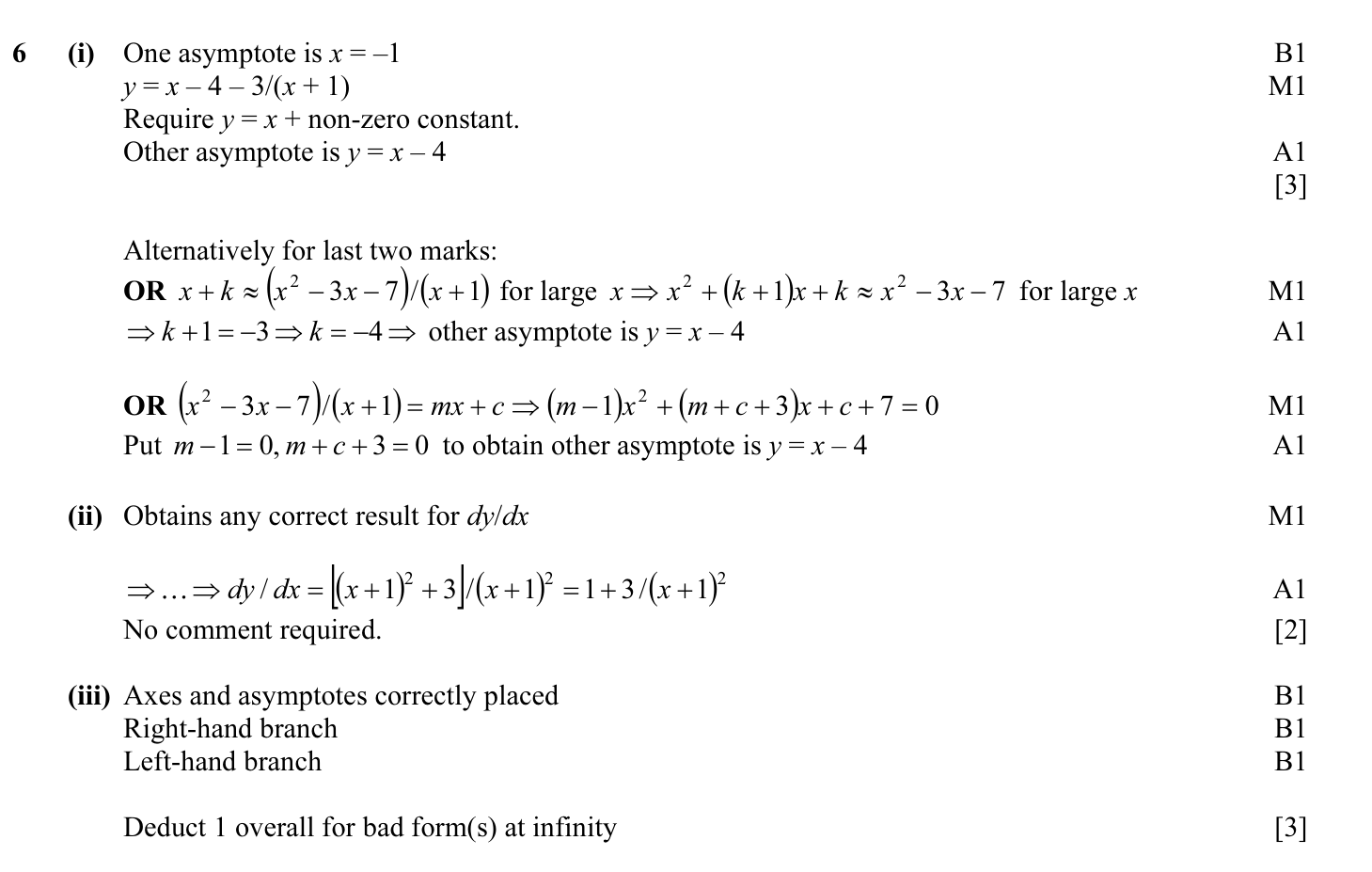
The curve \(C\) has equation
\(y=\frac{x^{2}-3 x-7}{x+1} .\)
(i) Obtain the equations of the asymptotes of \(C\).
(ii) Show that \(\frac{\mathrm{d} y}{\mathrm{~d} x}\gt 1\) at all points of \(C\).
(iii) Draw a sketch of \(C\).
9231 P1 - Nov 2009 - Q3 - 8 marks
The curve \(C\) has equation
\(y=\frac{x^{2}-5 x+4}{x+1}\)
(i) Obtain the coordinates of the points of intersection of \(C\) with the axes.
(ii) Obtain the equation of each of the asymptotes of \(C\).
(iii) Draw a sketch of \(C\).