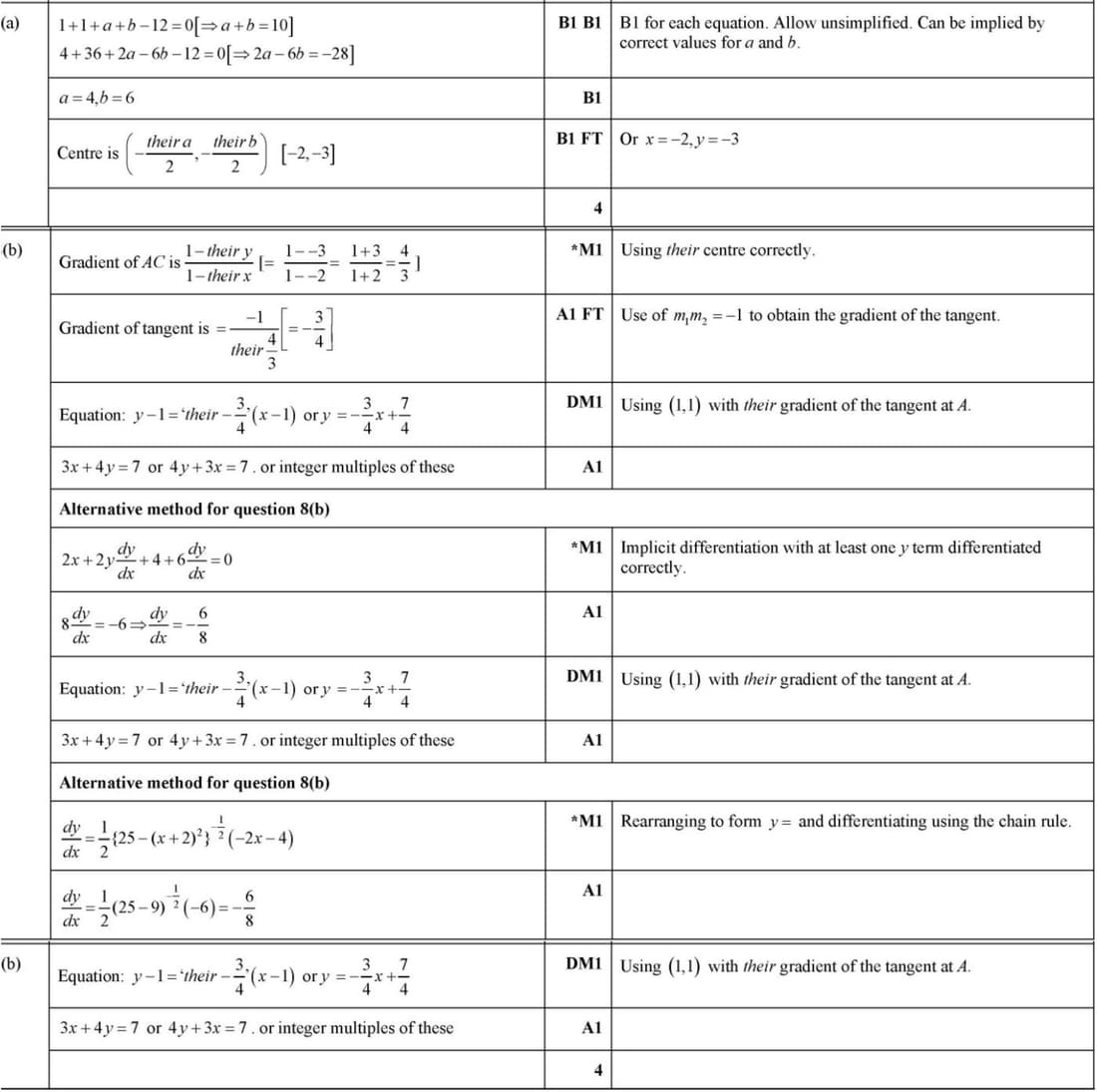
(a) Substitute the points \(A(1, 1)\) and \(B(2, -6)\) into the circle equation:
For \(A(1, 1)\):
\(1 + 1 + a + b - 12 = 0 \Rightarrow a + b = 10\)
For \(B(2, -6)\):
\(4 + 36 + 2a - 6b - 12 = 0 \Rightarrow 2a - 6b = -28\)
Solving these equations:
\(a + b = 10\)
\(2a - 6b = -28 \Rightarrow a - 3b = -14\)
Subtract the first from the second:
\((a - 3b) - (a + b) = -14 - 10\)
\(-4b = -24 \Rightarrow b = 6\)
Substitute \(b = 6\) into \(a + b = 10\):
\(a + 6 = 10 \Rightarrow a = 4\)
The centre of the circle is \(\left(-\frac{a}{2}, -\frac{b}{2}\right) = (-2, -3)\).
(b) The gradient of the radius at \(A(1, 1)\) is:
\(\frac{1 - (-3)}{1 - (-2)} = \frac{4}{3}\)
The gradient of the tangent is the negative reciprocal:
\(-\frac{3}{4}\)
Using the point-slope form of the line equation:
\(y - 1 = -\frac{3}{4}(x - 1)\)
Rearrange to the form \(px + qy = k\):
\(3x + 4y = 7\)