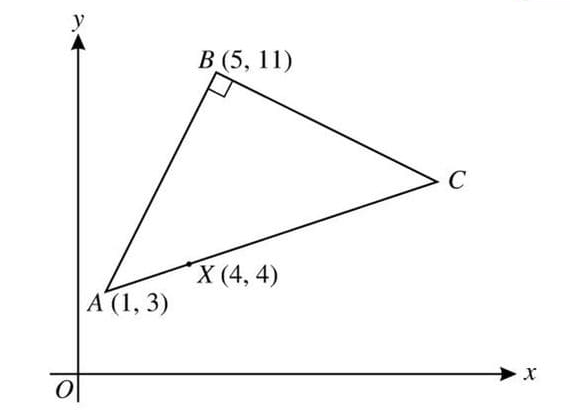
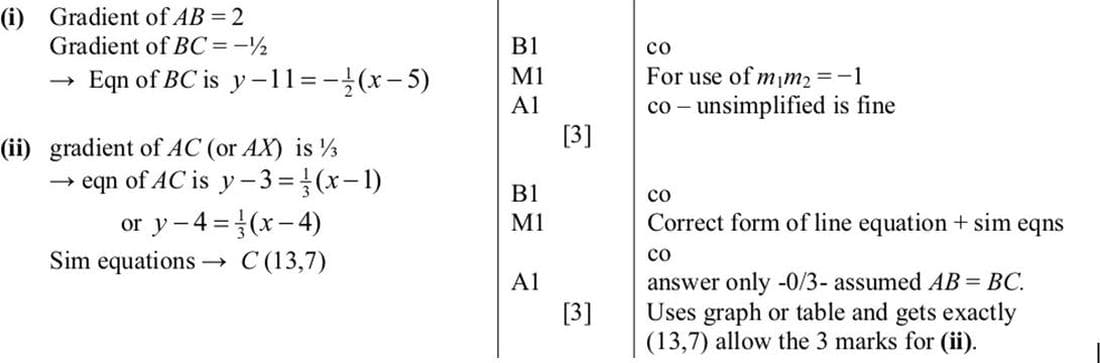
(i) To find the equation of BC, we first calculate the gradient of AB. The gradient \(m\) is given by \(m = \frac{y_2 - y_1}{x_2 - x_1}\). For AB, \(m = \frac{11 - 3}{5 - 1} = 2\).
Since ABC is a right angle, the gradient of BC is the negative reciprocal of the gradient of AB, so \(m_{BC} = -\frac{1}{2}\).
The equation of a line is \(y - y_1 = m(x - x_1)\). Using point B (5, 11), the equation of BC is \(y - 11 = -\frac{1}{2}(x - 5)\).
(ii) To find the coordinates of C, we first find the equation of AC. The gradient of AC (or AX) is \(\frac{1}{3}\) since X (4, 4) lies on AC.
The equation of AC using point A (1, 3) is \(y - 3 = \frac{1}{3}(x - 1)\).
Alternatively, using point X (4, 4), the equation is \(y - 4 = \frac{1}{3}(x - 4)\).
Solving the simultaneous equations of BC and AC gives the coordinates of C as (13, 7).