Past Exam Questions
← Back9231 P13 - Jun 2023 - Q07 - 13 marks
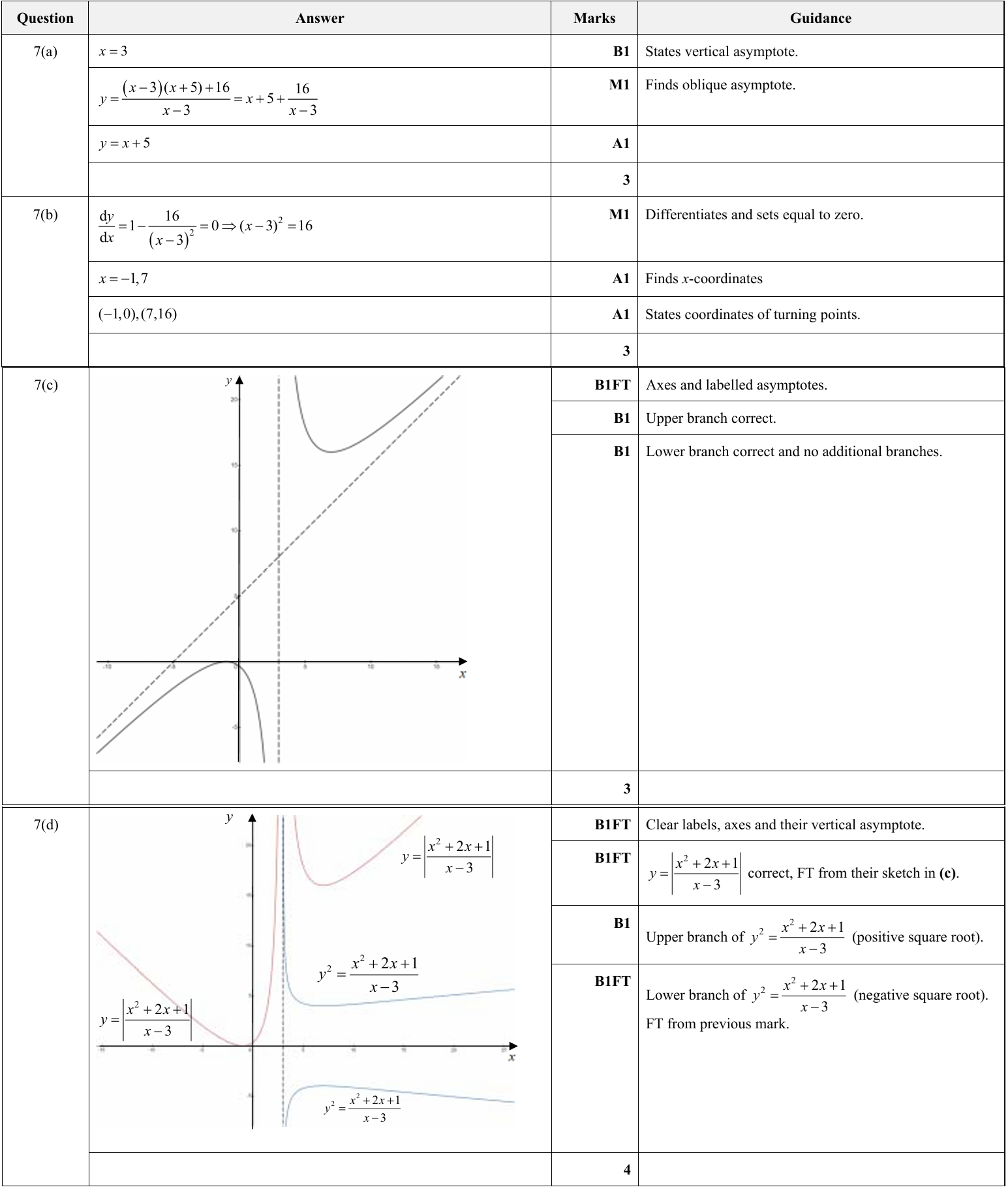
The curve C has equation \(y = \frac{x^2 + 2x + 1}{x - 3}\).
- Find the equations of the asymptotes of C.
- Find the coordinates of the turning points on C.
- Sketch C.
- Sketch the curves with equations \(y = \left| \frac{x^2 + 2x + 1}{x - 3} \right|\) and \(y^2 = \frac{x^2 + 2x + 1}{x - 3}\) on a single diagram, clearly identifying each curve.
9231 P12 - Jun 2022 - Q05 - 12 marks
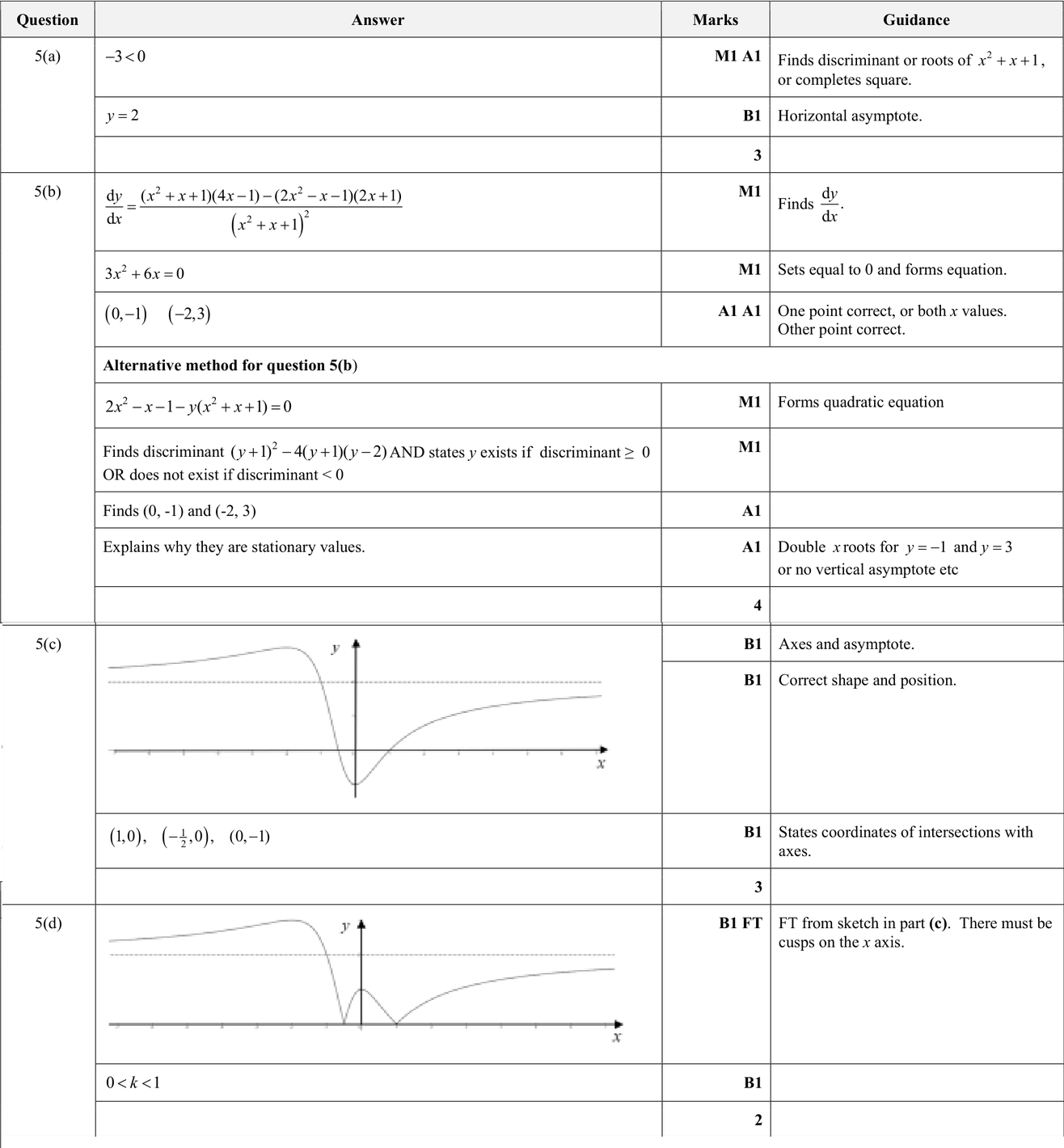
The curve C has equation \(y = \frac{2x^2 - x - 1}{x^2 + x + 1}\).
- Show that C has no vertical asymptotes and state the equation of the horizontal asymptote of C.
- Find the coordinates of the stationary points on C.
- Sketch C, stating the coordinates of the intersections with the axes.
- Sketch the curve with equation \(y = \left| \frac{2x^2 - x - 1}{x^2 + x + 1} \right|\) and state the set of values of \(k\) for which \(\left| \frac{2x^2 - x - 1}{x^2 + x + 1} \right| = k\) has 4 distinct real solutions.
9231 P13 - Jun 2022 - Q01 - 6 marks
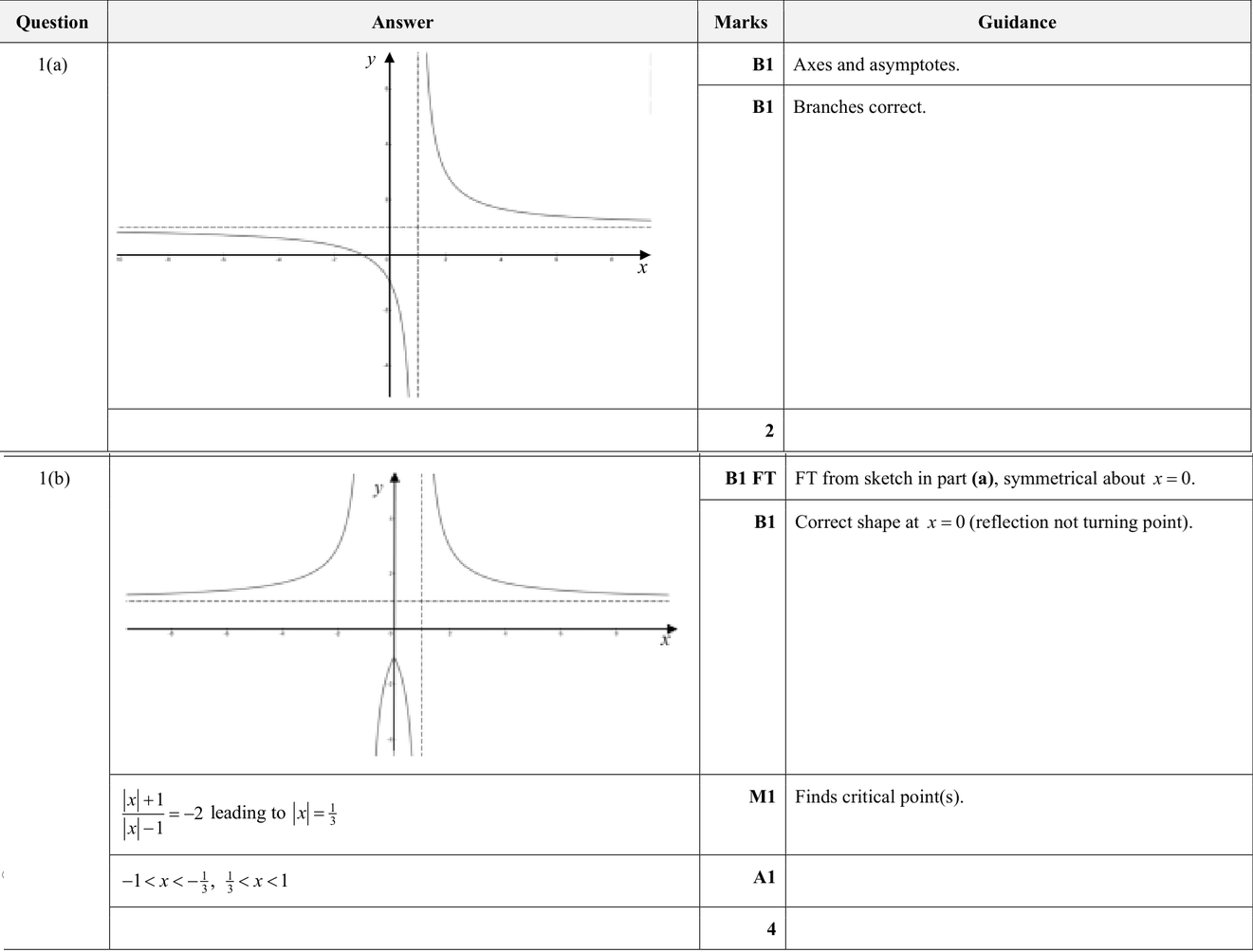
(a) Sketch the curve with equation \(y = \frac{x+1}{x-1}\).
(b) Sketch the curve with equation \(y = \frac{|x|+1}{|x|-1}\) and find the set of values of \(x\) for which \(\frac{|x|+1}{|x|-1} < -2\).
9231 P13 - Jun 2022 - Q03 - 10 marks
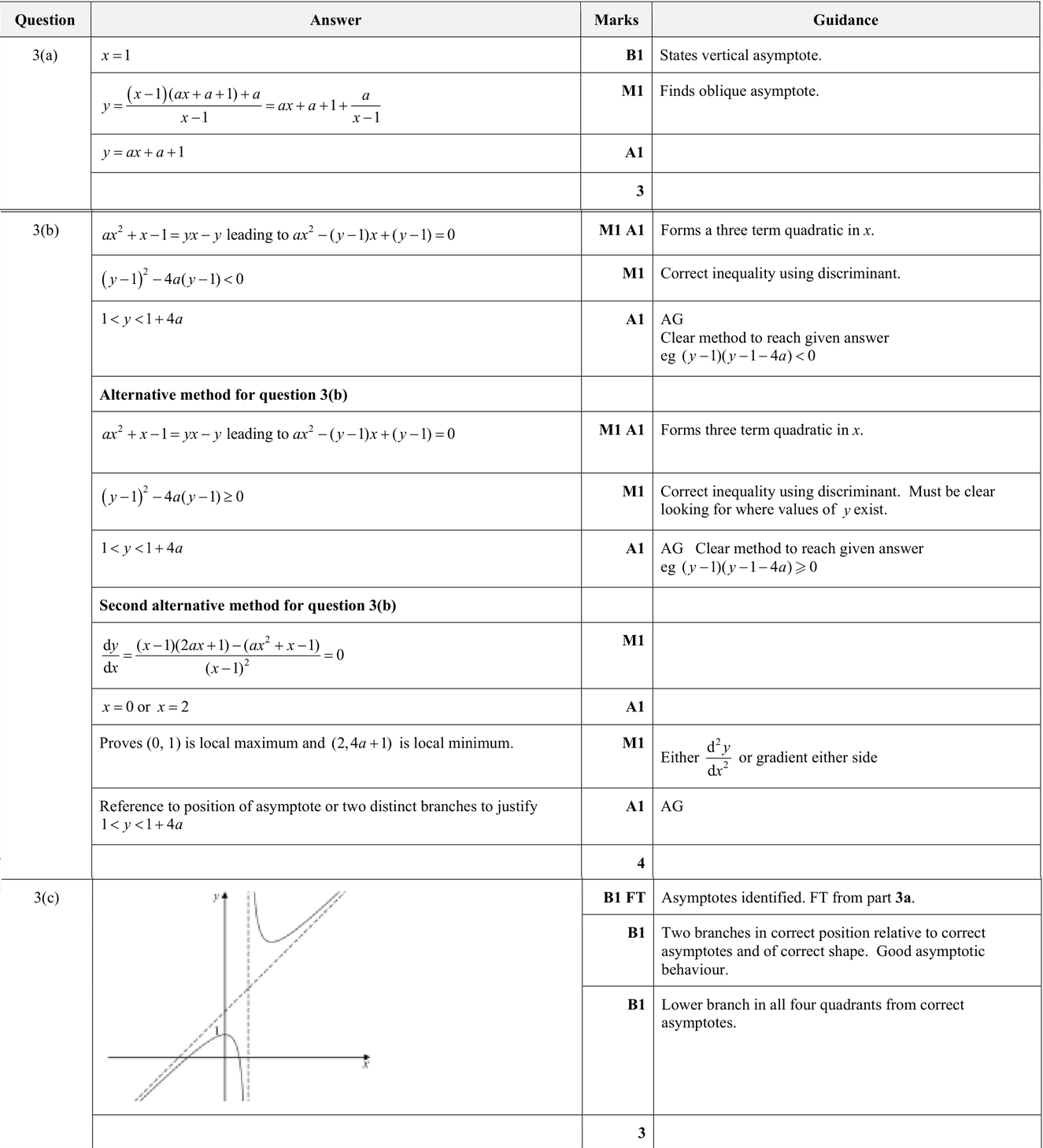
A curve \(C\) has equation \(y = \frac{ax^2 + x - 1}{x - 1}\), where \(a\) is a positive constant.
- Find the equations of the asymptotes of \(C\).
- Show that there is no point on \(C\) for which \(1 < y < 1 + 4a\).
- Sketch \(C\). You do not need to find the coordinates of the intersections with the axes.
9231 P12 - Nov 2022 - Q07 - 15 marks
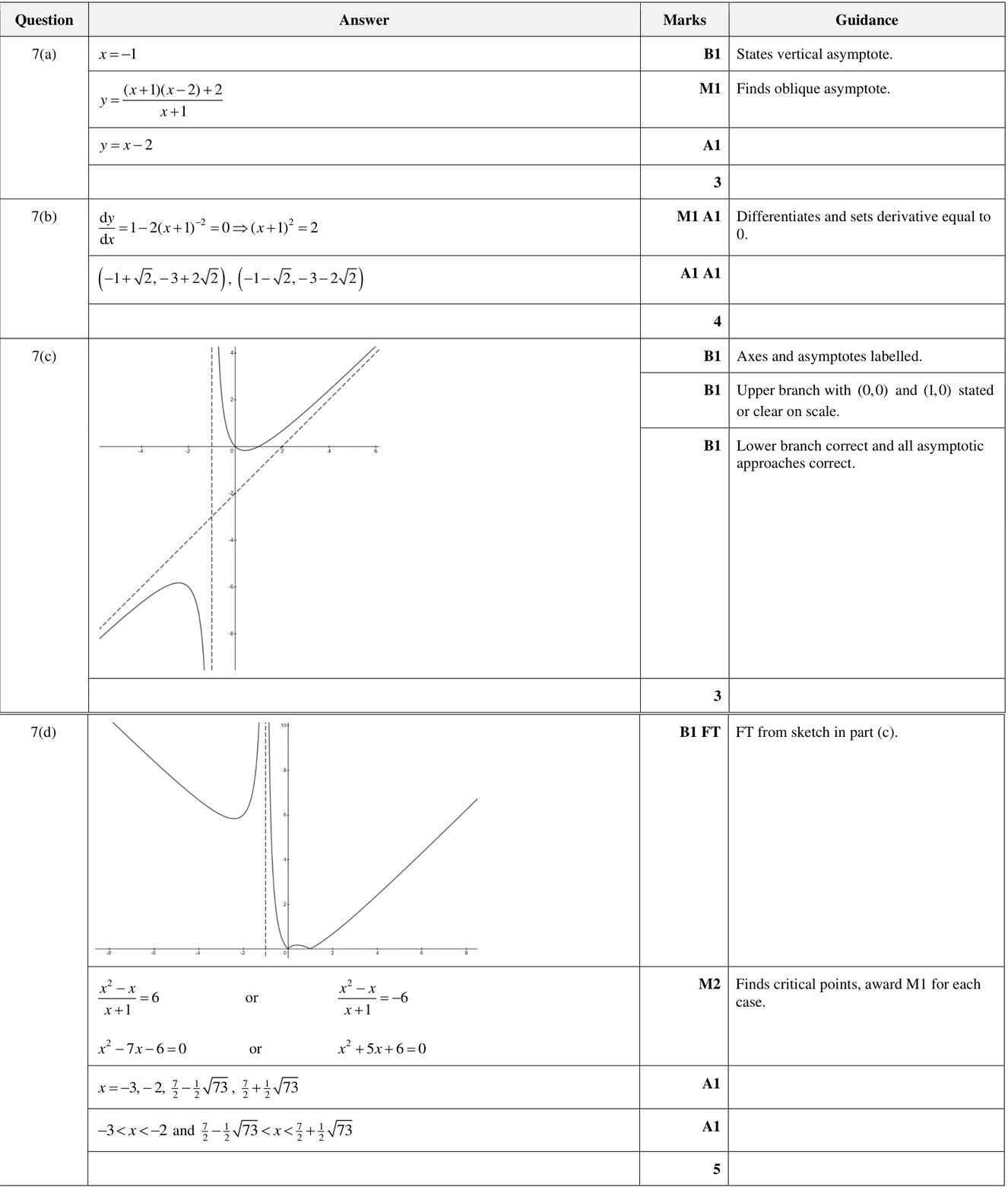
The curve C has equation \(y = \frac{x^2 - x}{x + 1}\).
- Find the equations of the asymptotes of C.
- Find the exact coordinates of the stationary points on C.
- Sketch C, stating the coordinates of any intersections with the axes.
- Sketch the curve with equation \(y = \left| \frac{x^2 - x}{x + 1} \right|\) and find in exact form the set of values of \(x\) for which \(\left| \frac{x^2 - x}{x + 1} \right| < 6\).
9231 P13 - Jun 2021 - Q07 - 14 marks
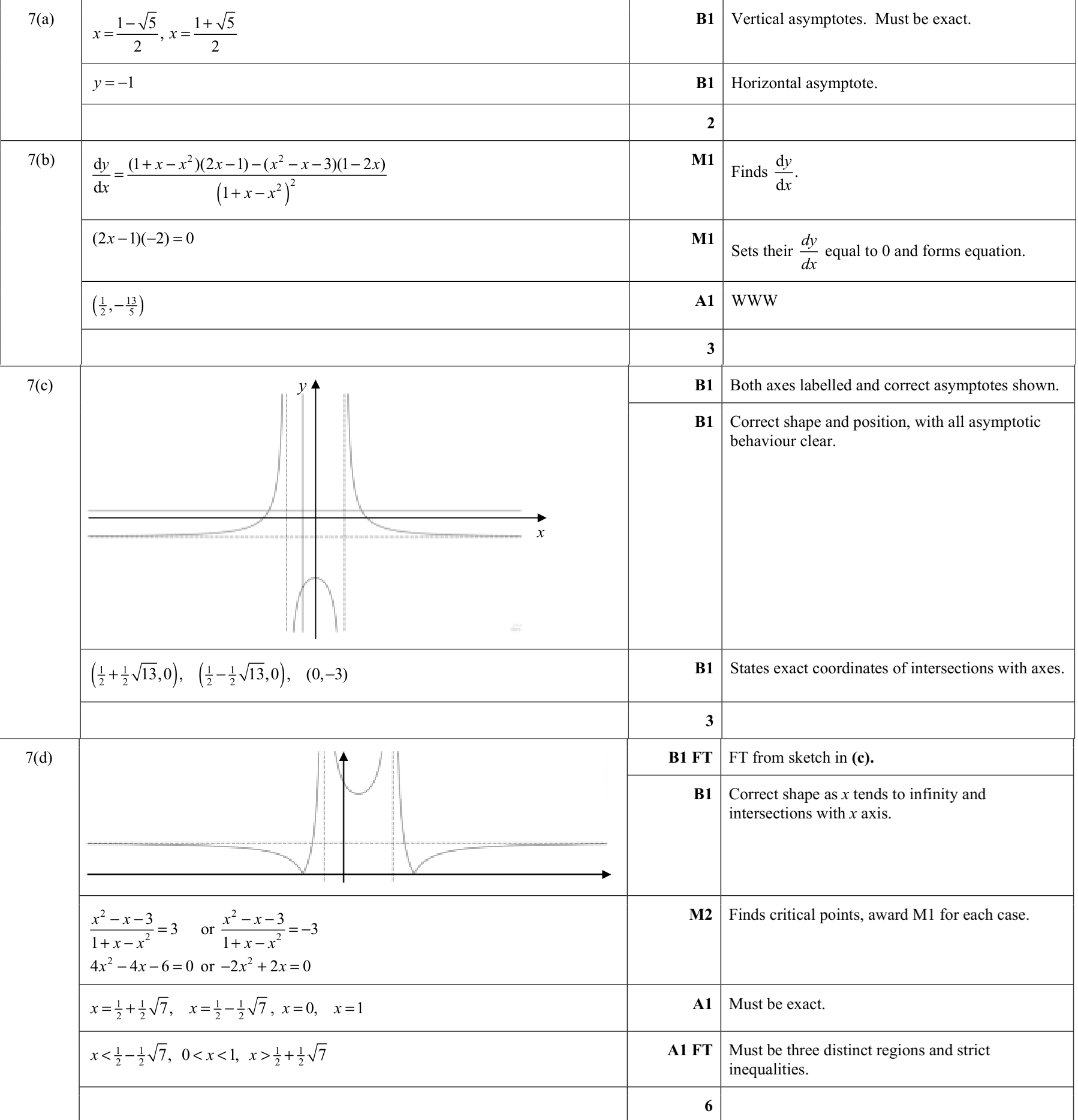
The curve \(C\) has equation \(y = \frac{x^2 - x - 3}{1 + x - x^2}\).
- (a) Find the equations of the asymptotes of \(C\).
- (b) Find the coordinates of any stationary points on \(C\).
- (c) Sketch \(C\), stating the coordinates of the intersections with the axes.
- (d) Sketch the curve with equation \(y = \left| \frac{x^2 - x - 3}{1 + x - x^2} \right|\) and find in exact form the set of values of \(x\) for which \(\left| \frac{x^2 - x - 3}{1 + x - x^2} \right| < 3\).
9231 P11 - Nov 2021 - Q07 - 15 marks
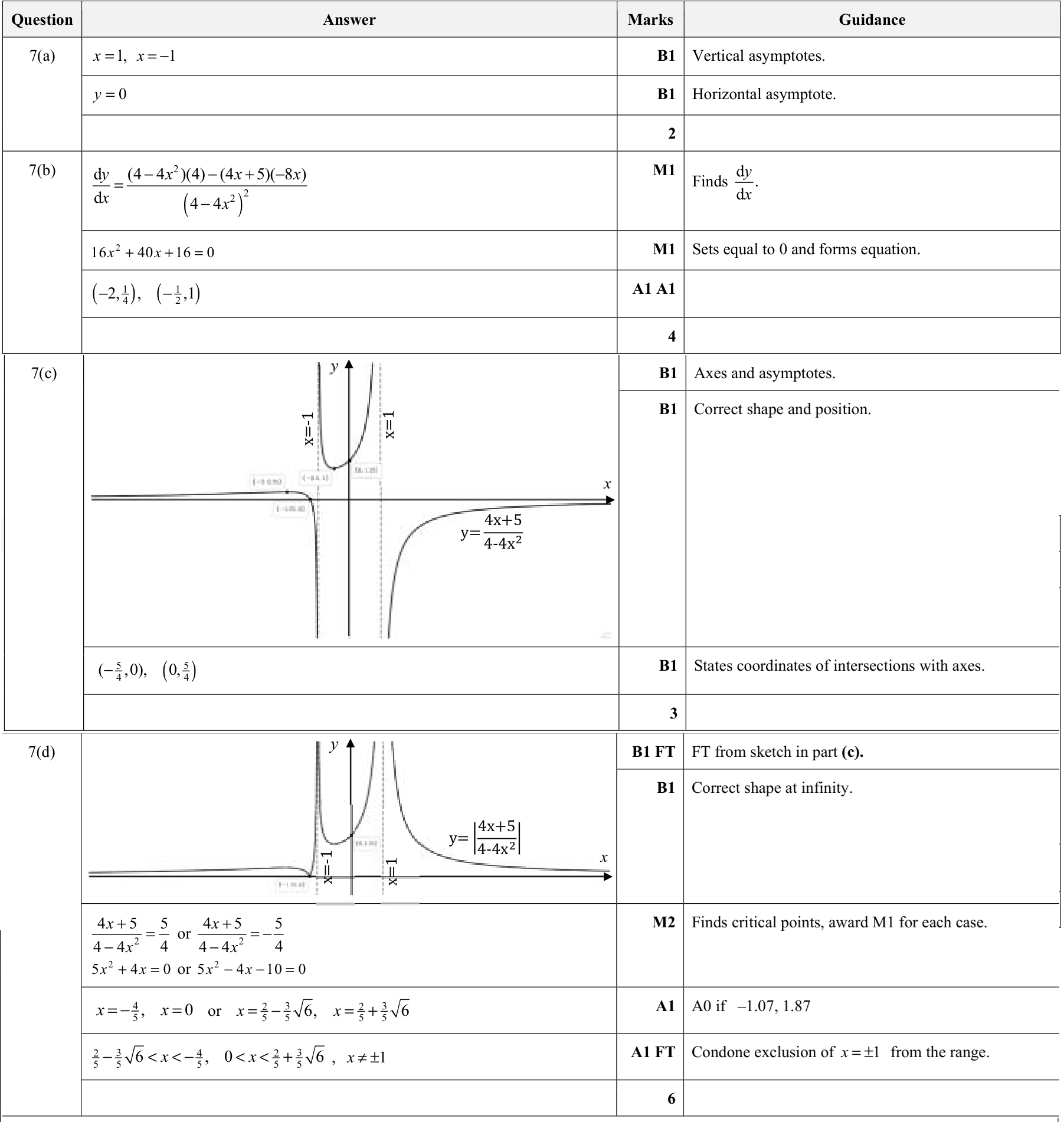
The curve \(C\) has equation \(y = \frac{4x+5}{4-4x^2}\).
- Find the equations of the asymptotes of \(C\).
- Find the coordinates of any stationary points on \(C\).
- Sketch \(C\), stating the coordinates of the intersections with the axes.
- Sketch the curve with equation \(y = \left| \frac{4x+5}{4-4x^2} \right|\) and find in exact form the set of values of \(x\) for which \(4|4x+5| > 5|4-4x^2|\).
9231 P12 - Nov 2021 - Q06 - 14 marks
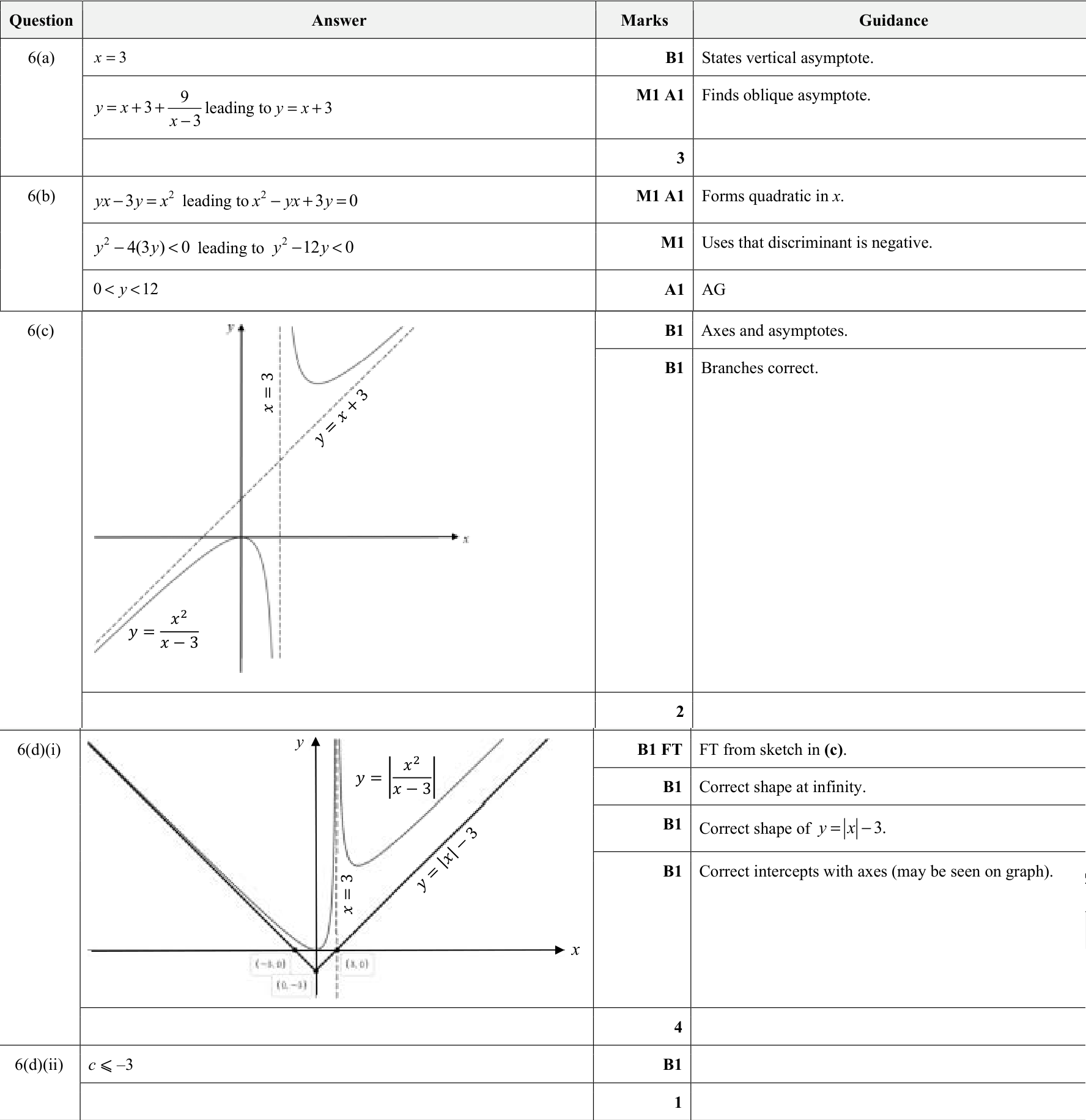
The curve C has equation \(y = \frac{x^2}{x-3}\).
- (a) Find the equations of the asymptotes of C.
- (b) Show that there is no point on C for which \(0 < y < 12\).
- (c) Sketch C.
- (d)
- Sketch the graphs of \(y = \left| \frac{x^2}{x-3} \right|\) and \(y = |x| - 3\) on a single diagram, stating the coordinates of the intersections with the axes.
- Use your sketch to find the set of values of \(c\) for which \(\left| \frac{x^2}{x-3} \right| \leq |x| + c\) has no solution.
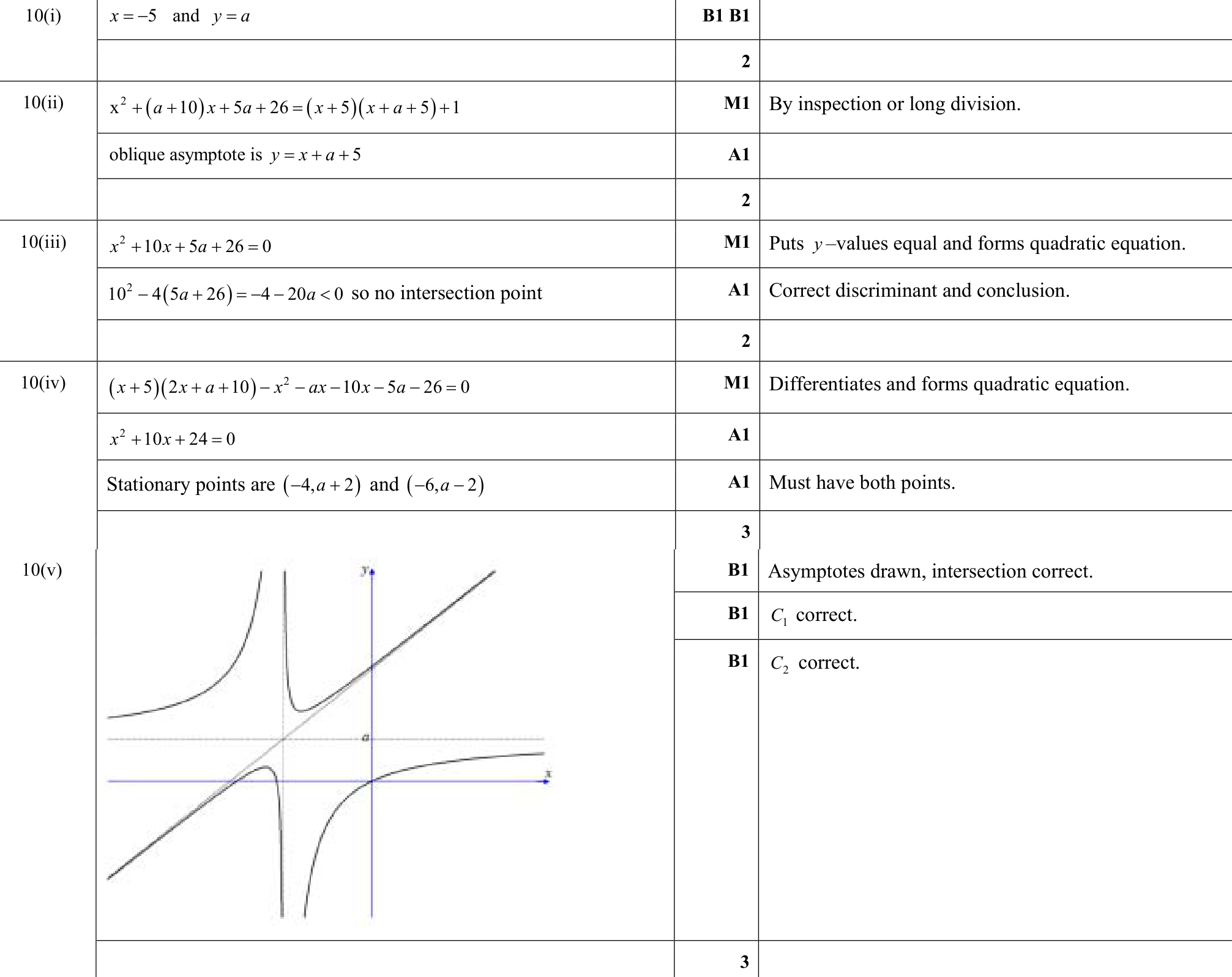
9231 P11 - Jun 2019 - Q10 - 12 marks
10 The curves \(C_{1}\) and \(C_{2}\) have equations
\(y=\frac{a x}{x+5} \quad \text { and } \quad y=\frac{x^{2}+(a+10) x+5 a+26}{x+5}\)
respectively, where \(a\) is a constant and \(a>2\).
(i) Find the equations of the asymptotes of \(C_{1}\).
(ii) Find the equation of the oblique asymptote of \(C_{2}\).
(iii) Show that \(C_{1}\) and \(C_{2}\) do not intersect.
(iv) Find the coordinates of the stationary points of \(C_{2}\).
(v) Sketch \(C_{1}\) and \(C_{2}\) on a single diagram. [You do not need to calculate the coordinates of any points where \(C_{2}\) crosses the axes.]
0606 P11 - Nov 2025 - Q8 - 5 marks
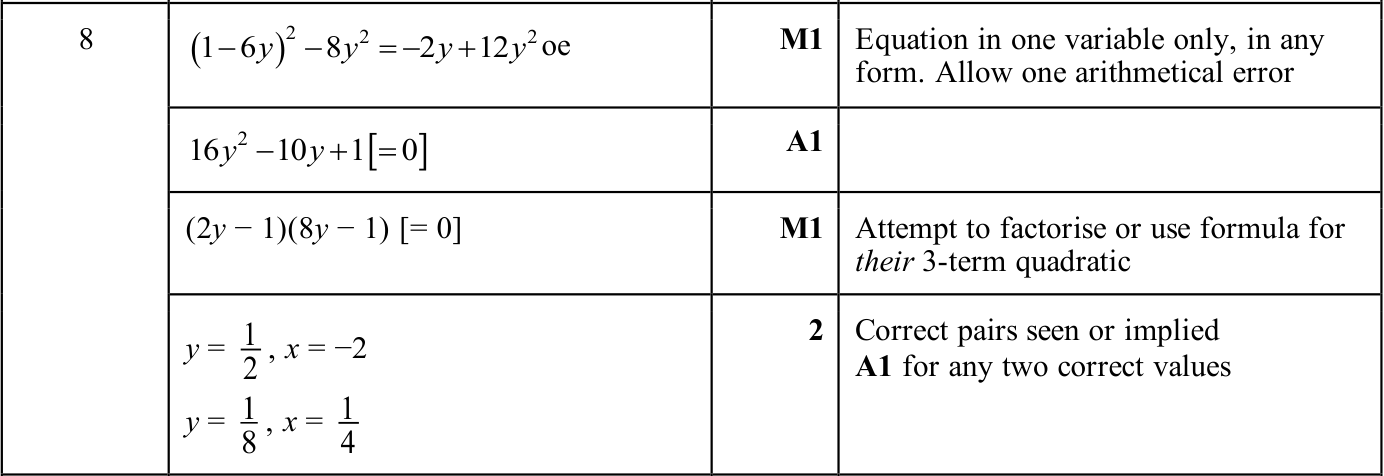
Solve the simultaneous equations
\(\frac{x}{2y}-\frac{4y}{x}=-1,\qquad x=1-6y.\)
0606 P11 - Jun 2025 - Q4 - 9 marks
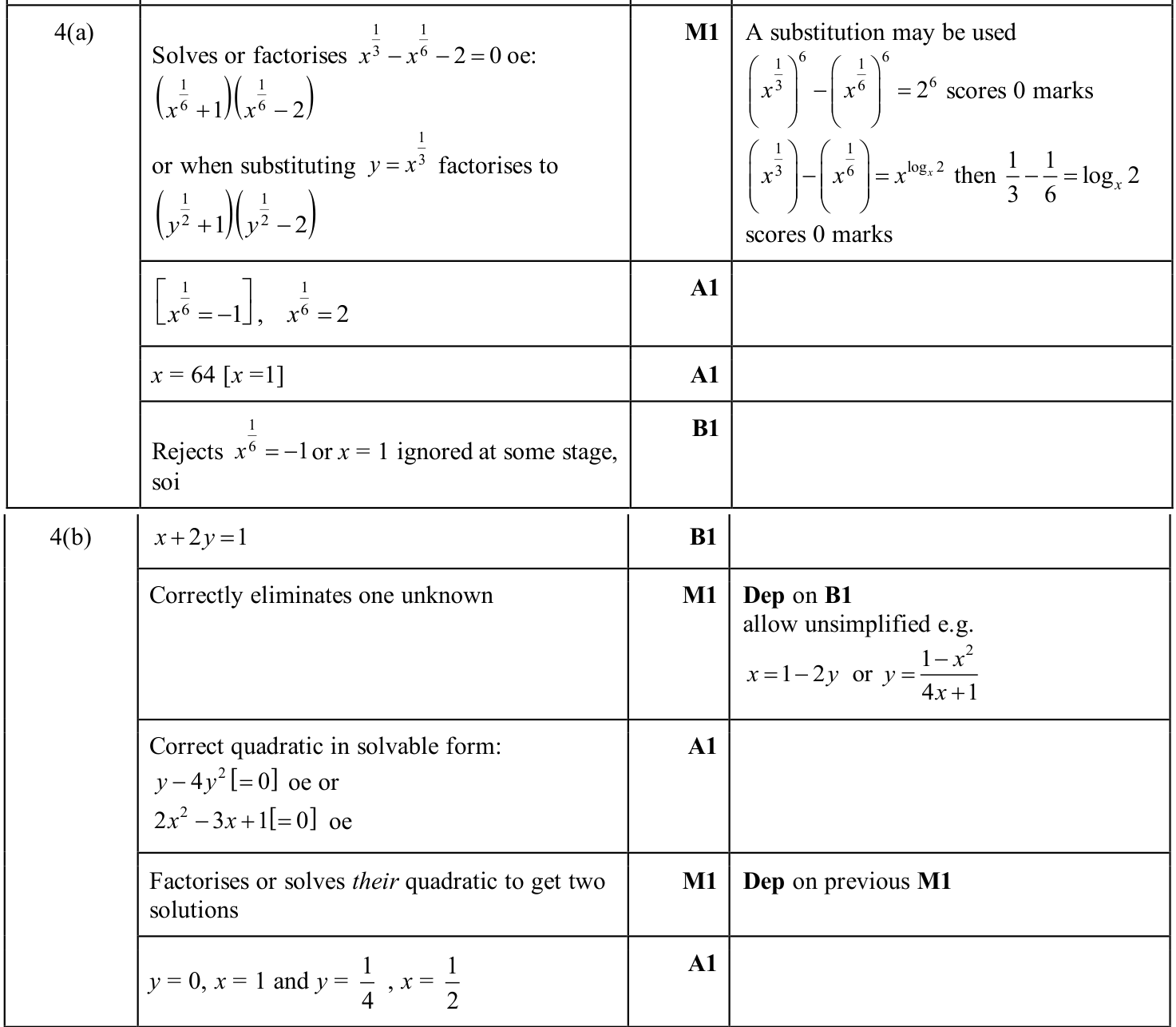
(a) Solve the equation \(x^{\frac13}-x^{\frac16}=2\).
(b) Solve the simultaneous equations \(\lg(x+2y)=0\) and \(x^2+4xy+y=1\).
0606 P11 - Nov 2024 - Q2 - 5 marks
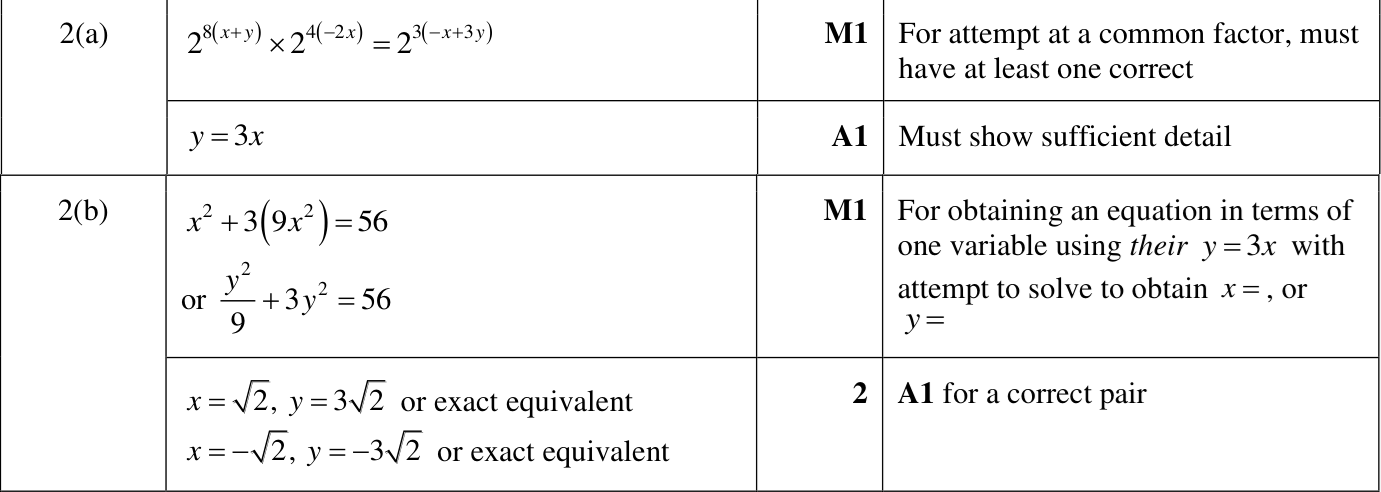
(a) Given that \(256^{x+y} \times 16^{-2x}=8^{-x+3y}\), show that \(y=3x\).
(b) Hence find the exact solutions of the following simultaneous equations.
\(256^{x+y} \times 16^{-2x}=8^{-x+3y}\)
\(x^2+3y^2=56\)
0606 P22 - Nov 2024 - Q1 - 3 marks
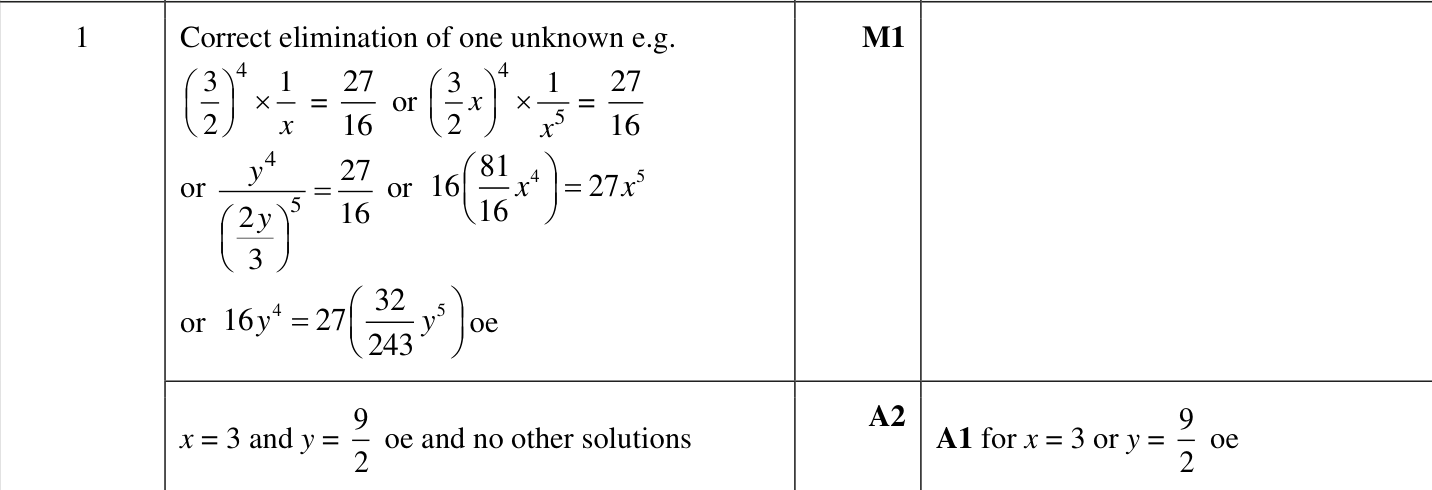
Solve the following simultaneous equations. \(\begin{aligned} \frac{y}{x} & =\frac{3}{2} \\ \frac{y^{4}}{x^{5}} & =\frac{27}{16} \end{aligned}\)
0606 P21 - Nov 2022 - Q1 - 5 marks
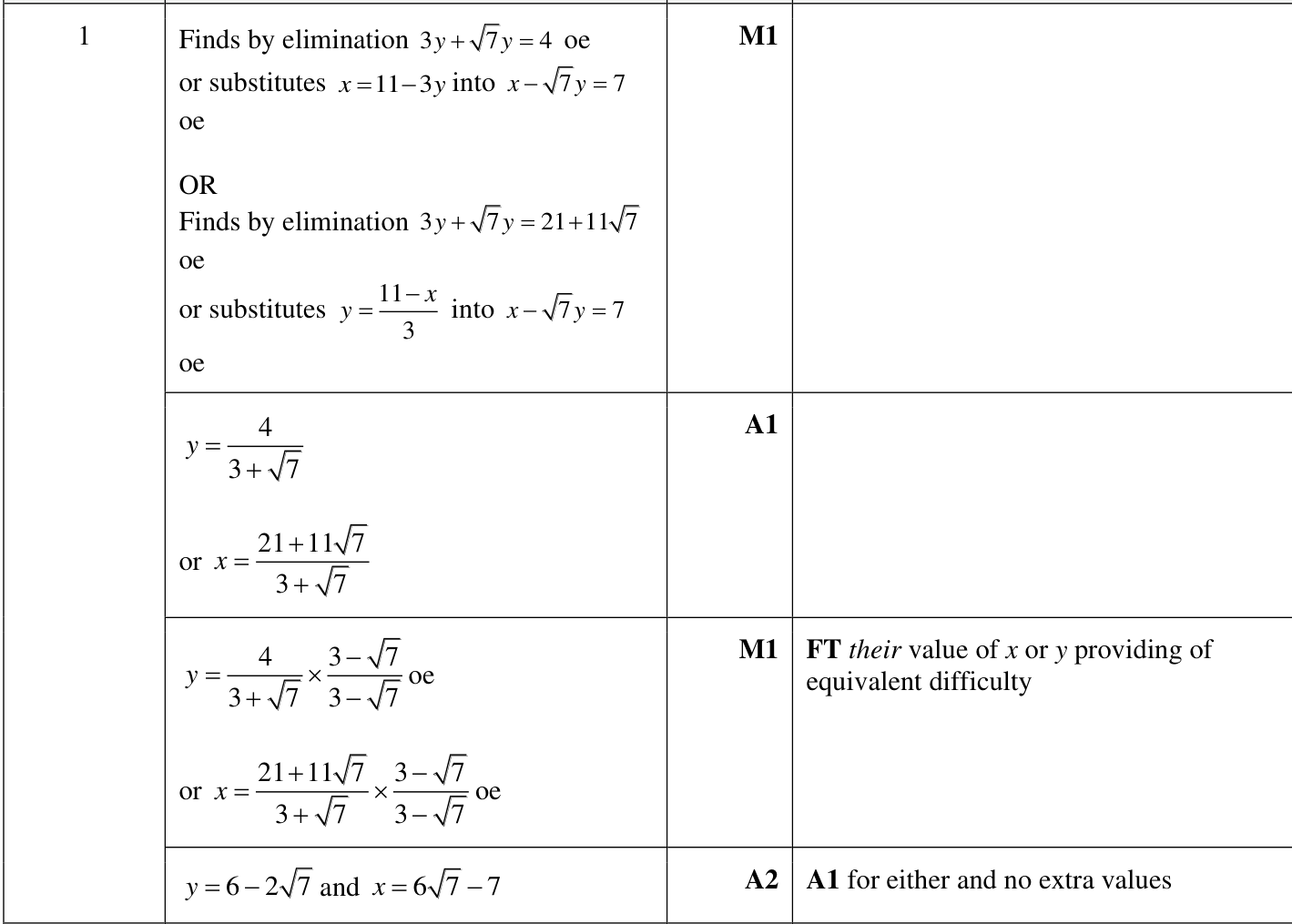
Solve the following simultaneous equations, giving your answers in the form \(a+b\sqrt7\), where \(a\) and \(b\) are integers.
\(x+3y=11\)
\(x-\sqrt7y=7\)
0606 P22 - Nov 2022 - Q1 - 5 marks
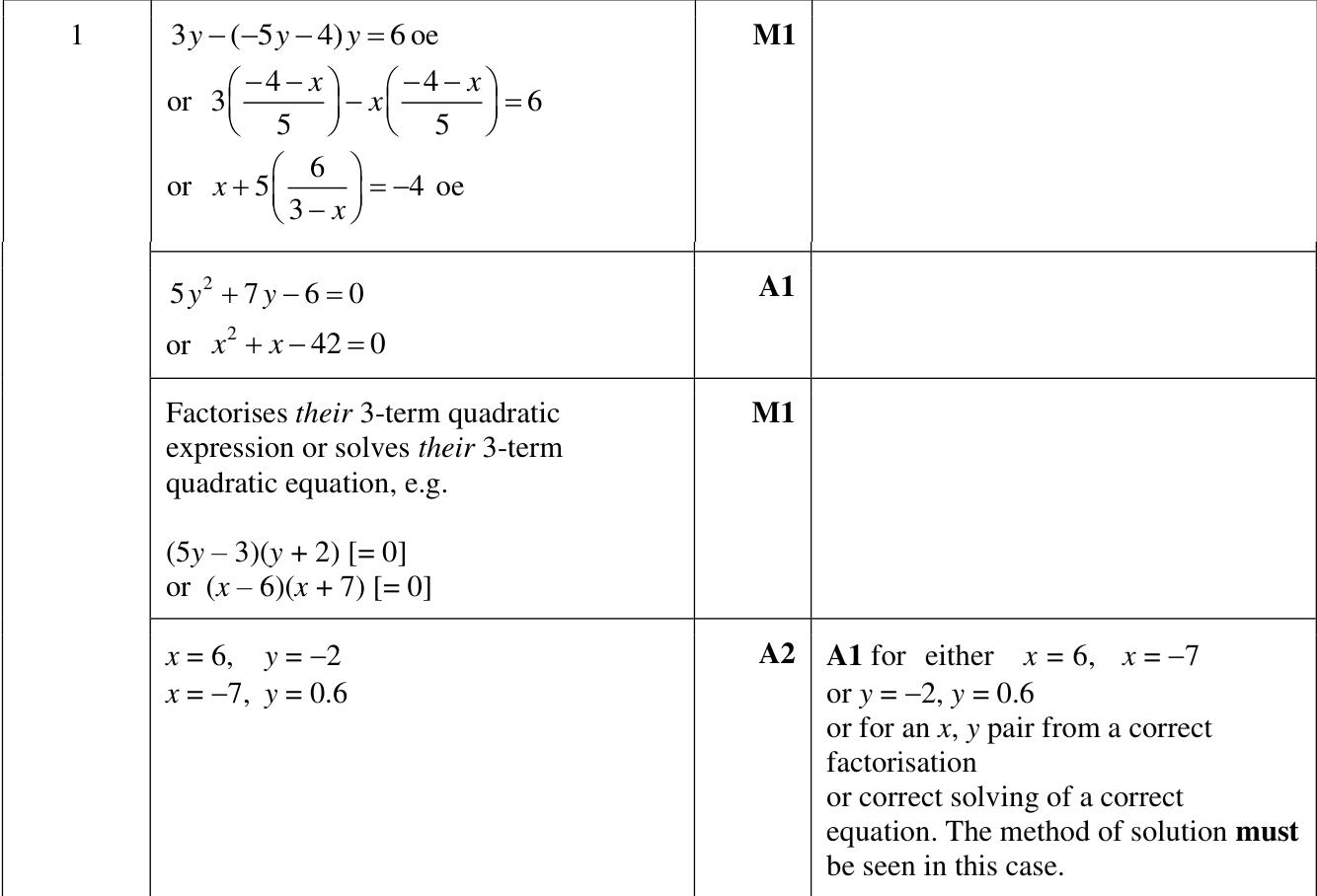
Solve the following simultaneous equations.
\(x+5y=-4\)
\(3y-xy=6\)
0606 P22 - Mar 2021 - Q4 - 6 marks
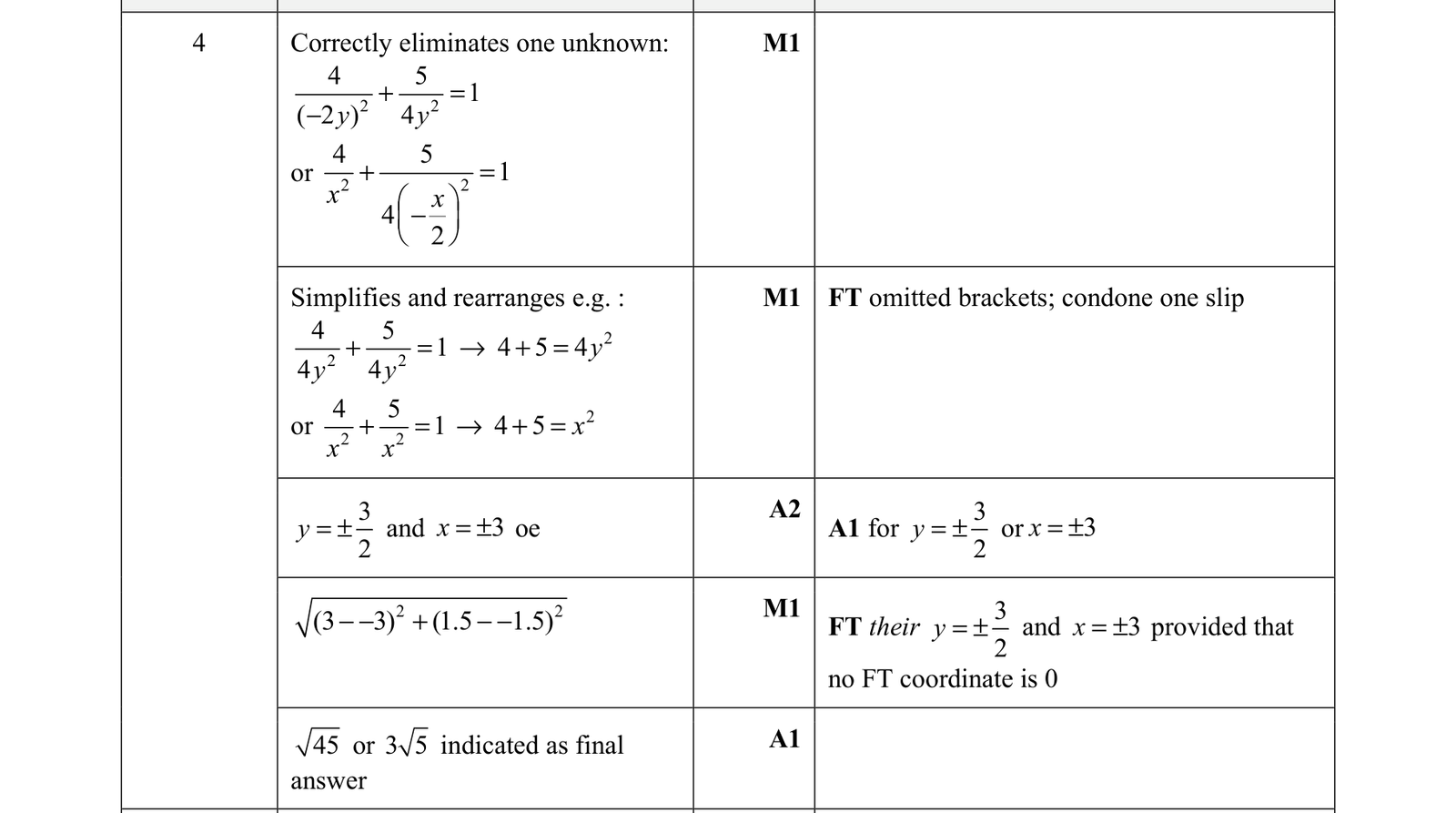
The curve
\(\frac4{x^2}+\frac5{4y^2}=1\)
and the line \(x+2y=0\) intersect at two points. Find the exact distance between these points.
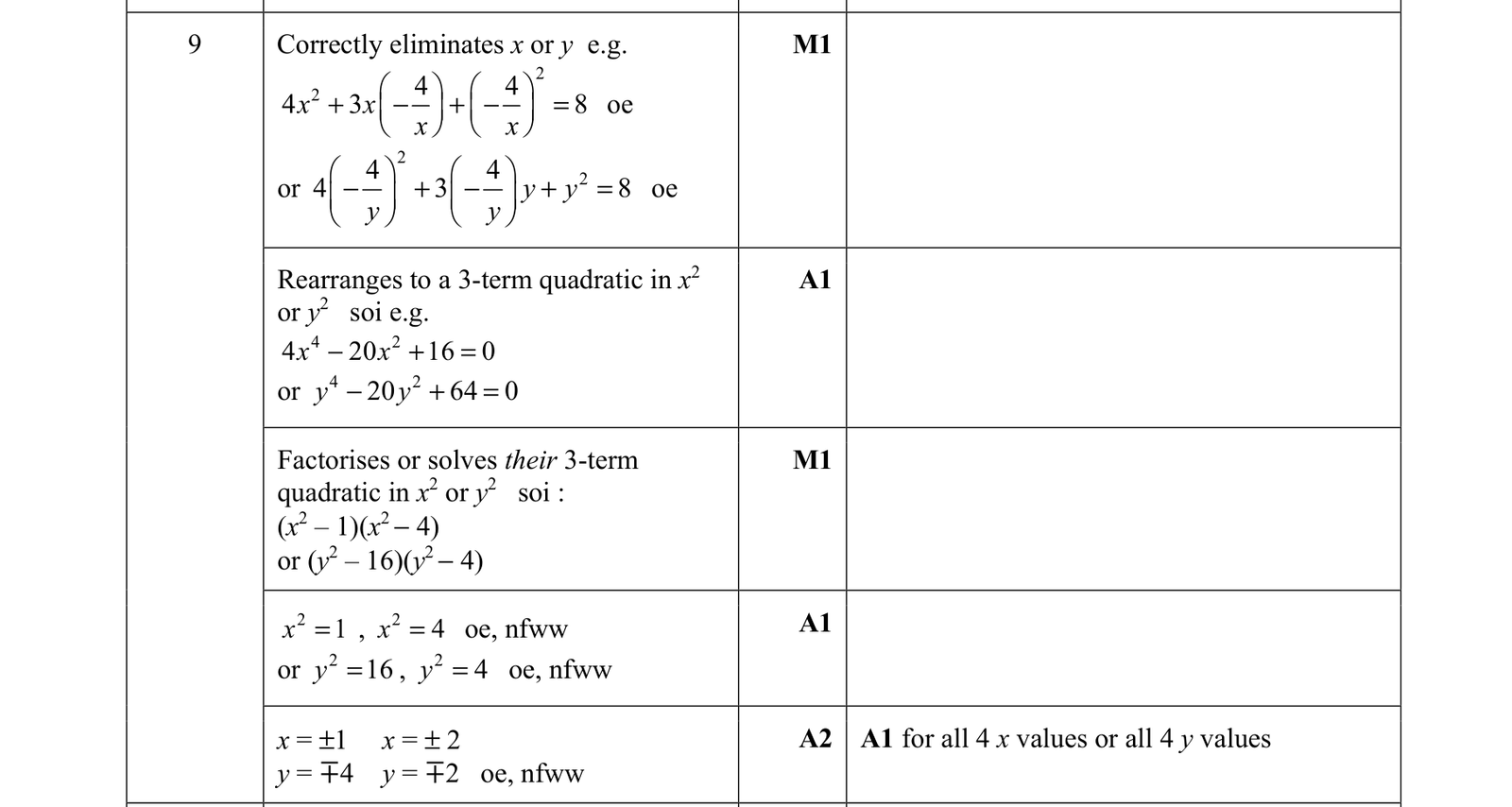
0606 P22 - Jun 2021 - Q9 - 6 marks
Solve the following simultaneous equations.
\(4x^2+3xy+y^2=8\)
\(xy+4=0\)
0606 P21 - Nov 2021 - Q2 - 5 marks
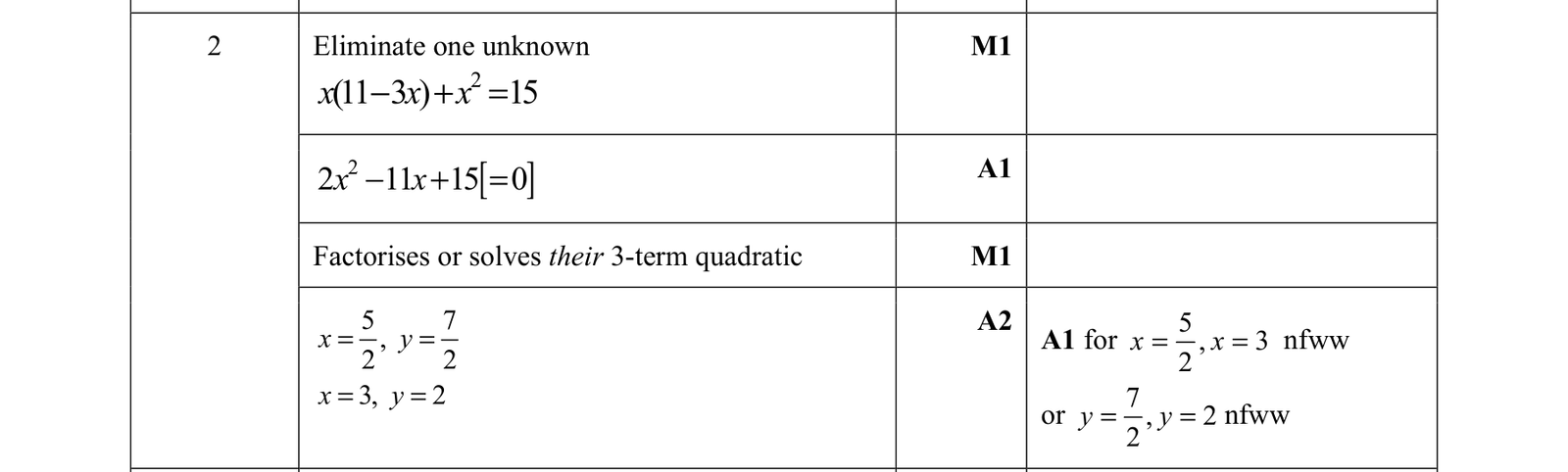
Solve the simultaneous equations
\(xy+x^2=15,\qquad y+3x=11.\)
0606 P23 - Nov 2021 - Q2 - 5 marks
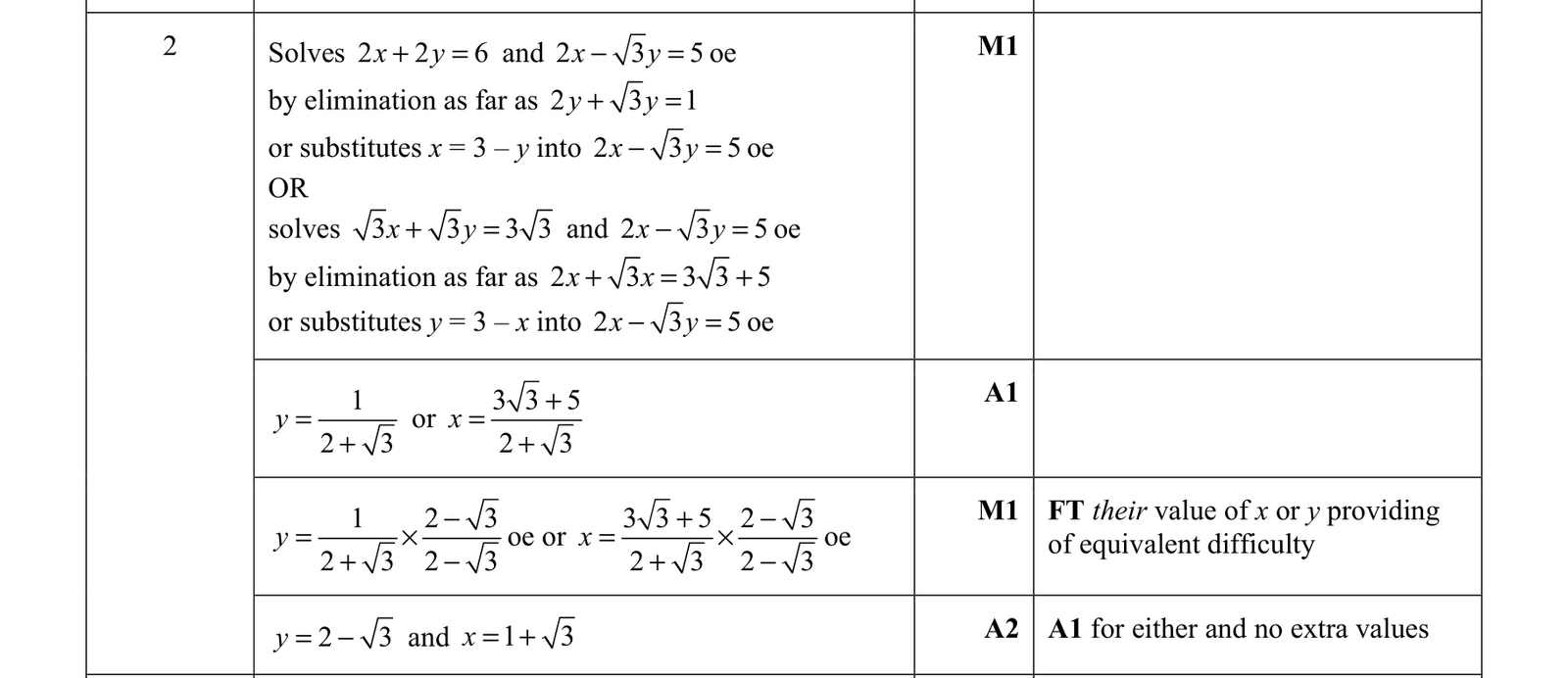
Solve the simultaneous equations. Give your answers in the form \(a+b\sqrt3\), where \(a\) and \(b\) are rational.
\(x+y=3,\qquad 2x-\sqrt3\,y=5.\)
0606 P23 - Nov 2020 - Q2 - 5 marks
Solve the simultaneous equations
\(x^2+3xy=4,\qquad 2x+5y=4.\)
